
Recommended Game Story · Warcraft Part 36
Chapters in this story
- The Dust of Kalimdor and the Axe of Liberation · The First Price Paid by the New Horde
- Table of Contents for this Part
- Chapter 1 · Broken Ships and Strange Shores
- Chapter 2 · Cairne and the Bloodhoof Tribe
- Chapter 3 · The Long March Protecting the Kodo
- Chapter 4 · The Old War Crossed the Sea
- Chapter 5 · The Axe Descends on Ashenvale
- Chapter 6 · The Trap Left by the Legion in the Forest
- Chapter 7 · Cenarius's Resistance and the Second Draught
- Chapter 8 · The Wings of Stonetalon and the Promise
- Chapter 9 · The Heart of Aszune and the Prophet's Cave
- Chapter 10 · The Soul Gem Offered by Jaina
- Chapter 11 · Grom's Confession and Purification
- Chapter 12 · Rejecting the Master in the Canyon
- Chapter 13 · The Final Flame and the Remaining Responsibility
- Chapter 14 · The Story Continuing on the Map
- Name and Setting Guide
- Related Parts and Continued Reading
- Official Game Guide
- Official Materials and Verification Scope
The Dust of Kalimdor and the Axe of Liberation · The First Price Paid by the New Horde
Spoiler Notice — This covers the eight chapters of the Orc campaign in Warcraft III: Reign of Chaos, from the landing on Kalimdor to the final showdown between Grommash Hellscream and Mannoroth. The fall of Lordaeron and the destruction of Dalaran are connected events occurring in the East, while the Night Elf campaign and the final battle at Hyjal will follow in the next part. This text is a narrative commentary written by TroubleMaker, interpreting events from the official game and manual in my own words. It is not a translation of an official novel, and I do not add new dialogue or unverified inner thoughts as official facts.
The question of this part begins with who a race defeated, and leads to what kind of race they chose to become to protect their future. Thrall crossed the sea, but he could not bury the Orcs' past in the water. Cairne reached out to his new neighbors, but that hand alone could not save his people from hunger and raids. Grom regained his strength, but he had to pay the price for ignoring whose power it truly was. The escort through the wilderness, the meeting in the mountains, the death in the forest, and the showdown in the canyon are not separate adventures, but a path preparing for a single choice.
Table of Contents for this Part
Chapter 1: Broken Ships and Strange Shores / Chapter 2: Cairne and the Bloodhoof Tribe / Chapter 3: The Long March Protecting the Kodo / Chapter 4: The Old War Crossed the Sea / Chapter 5: The Axe Descends on Ashenvale / Chapter 6: The Trap Left by the Legion in the Forest / Chapter 7: Cenarius's Resistance and the Second Draught / Chapter 8: The Wings of Stonetalon and the Promise / Chapter 9: The Heart of Aszune and the Prophet's Cave / Chapter 10: The Soul Gem Offered by Jaina / Chapter 11: Grom's Confession and Purification / Chapter 12: Rejecting the Master in the Canyon / Chapter 13: The Final Flame and the Remaining Responsibility / Chapter 14: The Story Continuing on the Map / Name and Setting Guide / Related Parts / Official Game Guide.
Chapter 1 · Broken Ships and Strange Shores
The fleet that crossed the sea did not enter the harbor in an orderly fashion. Ships were scattered while passing through the violent maelstrom, and Thrall's ship, which reached the shores of Kalimdor, was no longer seaworthy. He did not even know where Grom and the other ships were. The fact remained that they had come west trusting the Prophet's instructions, but that belief did not immediately provide food or a path. The Orcs had to search the shipwrecks and the beach to find their scattered comrades. The first landscape of their new life was not thrones and banners, but broken timber and the traces of the shore.
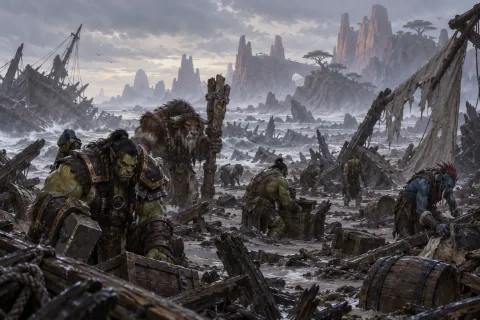
For Thrall, this voyage was not about moving the battlefield to another location. It was about finding a land where Orcs, freed from human internment camps, could live by their own names. However, as they moved from the coast to the interior, what appeared before them were also traces of conflict. There were strange quilboars and dangerous wild creatures, scattered survivors, and horse-bodied raiders attacking those with the appearance of cattle. Even in a place that avoided the hatred from across the sea, there was someone else's ancient war. Kalimdor was not an empty land.
The Darkspear Trolls who came with the Orcs also gathered again amidst the chaos of the shore. They were not decorations attached to the background of the story, but comrades who had to survive together. The new Horde was not composed solely of a procession of Orcs from the beginning. Its form emerged little by little depending on who they walked the path with and how they acted when strangers were attacked. What Thrall was first tested on in Kalimdor was not how quickly he could occupy territory, but how far he would accept the people before him as his own concern.
Chapter 2 · Cairne and the Bloodhoof Tribe
The person Thrall met there was Cairne Bloodhoof, chieftain of the Bloodhoof Tauren. The elderly chieftain possessed a massive frame and combat experience, but what threatened his tribe was not an enemy that could be ended with a single duel. The mobility of the Centaur continued to drive the Tauren of the plains. Cairne saw the fierce combat and valor of the Orcs, and Thrall saw that Cairne was a leader carrying the fate of his tribe. Before knowing each other's races in detail, what they recognized first was the purpose of their fight.
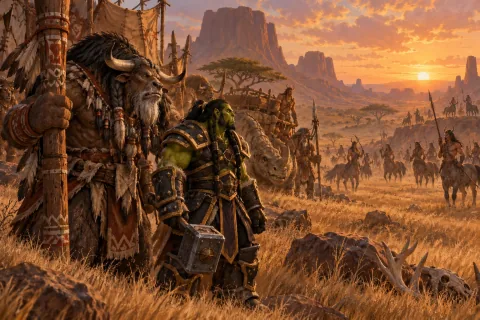
News that a large group of Centaurs was moving north interrupted their conversation. In that direction lay Cairne's village. Thrall's warriors headed to the village with Cairne, and the Tauren blocked the incoming attacks. The new neighbors who had barely survived the sea were now guarding the front of another race's home. They did not yet have ancient alliances or treaties of great nations. However, the fact that they moved their bodies before someone's village disappeared created a relationship before any document could.
The problem did not end just because they blocked the raid. The Centaurs drove away the surrounding game. Cairne could not keep his tribe trapped there to starve; he had to move them to the distant, lush plains of Mulgore. It was more dangerous during the move. Unlike the fast Centaurs, a procession carrying people and supplies could not move at will. Thrall agreed to escort the march in exchange for learning the path to the Prophet in the north from Cairne. Thus, the future of the Horde opened not only to races sharing blood but also to those sharing the path.
Chapter 3 · The Long March Protecting the Kodo
The Kodo procession passing through the Barrens carried the slowest things in the war. Supplies and the burdens of daily life were necessary to survive even after arriving at a new place. They might have survived faster if they had abandoned their baggage and only the warriors had run, but that would not have moved the life of the tribe. The object to be protected on this road was not the dueling opponent of the strongest warrior, but the procession that slowed its pace behind. The game's 'Long March' places such protection at the center of the journey.
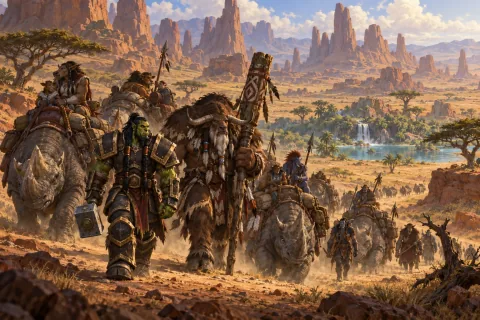
Thrall found oases where they could rest while opening the path, and Cairne held out with the procession. Cairne was not a chieftain who only received protection because he was old. When threats swarmed, he stood with the Tauren. During the move, they also reunited with the warriors Grom had sent who had been scattered. The enemies of the wilderness aimed for the moment the battle line collapsed, and the convoy had to find water, rest, and the next path together. The reason the mission connects several oases is that it shows the journey as a work of repeated protection rather than a single, massive victory. There is no need to translate the game's respawn intervals or number of battles into actual historical figures.
The life of the Tauren is rooted in respect for the Earthmother and the life of the plains. The relationship formed with spirits in the Orcs' shamanic tradition becomes the basis for a language that works even between races unfamiliar to them. However, the two beliefs cannot be merged into the same religion. Cairne was a leader with his own people and traditions, not someone who gained meaning only by becoming Thrall's subordinate. The Orcs, who did not know the paths of Kalimdor, gained a guide and a companion for protection, and the hunted Tauren gained the strength to block enemies together. The alliance did not begin with a scene where one side provided all the answers.
After overcoming the final danger leading to Mulgore, Cairne pointed toward the Prophet of Stonetalon Peak. He also added the help of the Kodo to the young Warchief who was going to find a deeper fate. One cannot pre-build the future Thunder Bluff or Orgrimmar on this journey. What is important here is not the city, but the relationships that will make those cities possible. The supplies and people protected together in the desert showed first what the name of the new Horde could actually mean.
Chapter 4 · The Old War Crossed the Sea
On the way to the Stonetalon Mountains, Thrall finally found the Warsong clan and Grom again. However, there was a battle with humans at the scene of the reunion. Grom informed him that Jaina Proudmoore had led humans to this continent. The path leading north was blocked by the human camp. After the time spent struggling to find comrades after the ships were scattered, the war they had tried to end across the sea was occupying the path again.
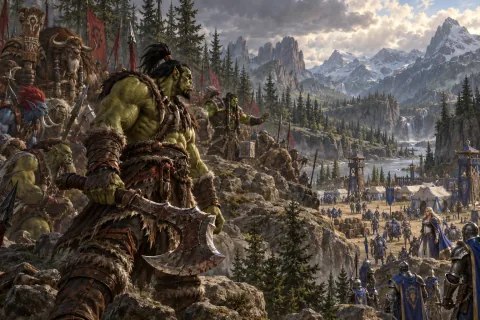
Thrall ordered them not to attack the humans recklessly. He surveyed the situation first and found a way to cross the blocked path by securing goblin zeppelins. However, Grom did not wait. The Warsong's attack moved in a different direction from the Warchief's orders, and Thrall had to prepare for defense amidst the erupting battle. To Grom, humans were an old enemy, but to Thrall, a life of killing old enemies everywhere again eroded the purpose of the new voyage. What splits here is not simply the personalities of an aggressive warrior and a cautious warrior, but a choice about how the new Horde will ultimately live.
Even after securing the airship, Grom's rage did not easily subside. He spoke of feeling the old bloodlust as if demons were nearby. Thrall could not keep the unstable Warsong in the same path. He ordered Grom to head to the northern forest to prepare a settlement, while he himself went to find the Prophet. It was an order that tasked a mighty warrior with labor instead of battle. In the game, destroying all human bases is an optional mission. If one confirms that Thrall annihilated all human forces at this point, the tension of this chapter, which seeks to escape the cycle of violence, itself disappears.
Chapter 5 · The Axe Descends on Ashenvale
To Grom, the forest of Ashenvale was dense and ancient trees. The settlement needed timber. However, to the Night Elves who lived in this land, the forest was a place of life and an order of life and ancient protection. The light floating between the trees and the magic imbued in the trees were not mere obstacles. The Orcs' purpose of obtaining resources for settlement could become an act of destroying the life already existing there. The moment people looking for a new home regarded someone else's home as an empty warehouse, the goal of survival that crossed the sea touched the appearance of a new invasion.
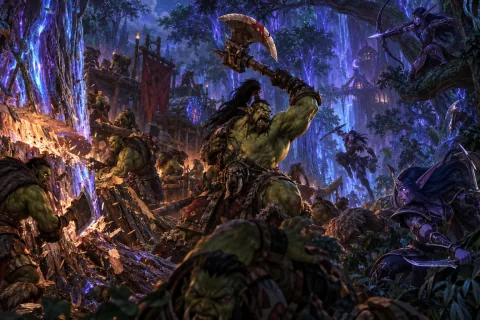
The Warsong began logging, and the Sentinels came out to stop them. The Night Elf huntresses, their beasts, and the mounts passing through the sky attacked the strange Orcs. Grom did not fully understand them from the beginning. To the Orcs, hidden enemies were raiding, and to the forest's inhabitants, outsiders were damaging life. This incomplete understanding on both sides created a battle where axes and arrows flew before explanations. Winning against the opponent in front of you in battle does not justify the reason for entering the forest.
The forest also had ancient spirits with life and Wisps. It was a world where the act of cutting down a tree led to harming someone's life. Grom believed that even trees imbued with magic could be cut down to obtain timber. However, this does not turn the game's timber count, optional missions, and the list of trees the player actually cuts into a fixed damage specification of history. The center of the event is the fact that the Warsong's logging and the Night Elves' resistance escalated into a larger confrontation. Behind the piled timber remained unhealed hostility and wounds.
Chapter 6 · The Trap Left by the Legion in the Forest
Where Grom could not see, the Burning Legion was watching this conflict. The resistance in the East had been weakened by the Scourge, and Archimonde was now preparing for the invasion of Kalimdor. To Mannoroth, the Orcs were a race that had drunk his blood long ago. He did not consider that they had escaped his ownership just because they had crossed the sea. However, Archimonde and Tichondrius saw the remaining utility instead of wiping out the Orcs immediately. It was a way to eliminate the forest's guardians, who could face the Legion with force, by the hands of the warriors the Legion had once tamed.
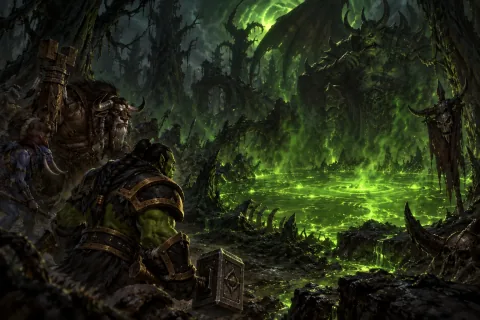
Cenarius was a demigod who had stood against the Legion since the War of the Ancients. The forest was connected to his power, and his resistance was a burden for the Legion to return to Kalimdor. Tichondrius made Mannoroth pour his blood into a pool. It was a trap to make the Orcs, who were looking for the strength they urgently needed, be drawn to it. A much crueler calculation than the method of beating the enemy directly was placed in the forest. It was a calculation that reversed the cause and effect of the battlefield so that the victory the Warsong gained by becoming stronger would become a victory that helped the Legion's invasion.
This event shows that the old blood pact had not completely disappeared. Even if the Orcs had left the internment camps and reclaimed the name of freedom, the influence of demons and the temptation for that power remained. The memory of having been deceived before did not automatically block the next temptation. What Mannoroth prepared was not just an order forcing Grom to commit evil without any purpose. It was a trap that attached power to the urgent purpose of surviving and defeating the enemy, and after drinking that power, even changed the master of the purpose.
Chapter 7 · Cenarius's Resistance and the Second Draught
When Cenarius stepped forward, the forest became a battlefield that the Warsong could not handle. The Orcs' bases that were attacked collapsed, and the power of nature raised the damaged forest again. Grom looked for another path in front of the incoming Night Elves and the power of the guardian. A witch doctor with shamanic senses sensed the power of darkness, and the warriors headed toward its source. At the end, there was a pool of blood guarded by Satyrs. Deep in the Night Elves' forest, the enemy of the one who guards the forest was waiting.
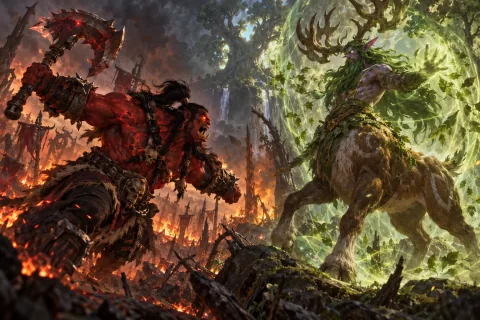
The warning that the pool contained a demonic curse was delivered to Grom. Among the Warsong warriors, some said that they should not be swallowed by rage again, as it went against the Warchief's teachings. Therefore, this scene cannot be changed into a story of water drunk by mistake without knowing anything. Grom chose the power to strike down Cenarius while knowing the fact that he had already suffered the curse. He made his warriors accept the same power. The fact that he was a victim in the past does not absolve him of the responsibility for the choice he made at this moment.
The Warsong, having accepted the demon's blood again, faced Cenarius with a power different from before and finally killed him. The guardian of the forest that the Legion desired had fallen by the hands of the Orcs. It was a victory for Grom, but the death of a demigod remained in the forest. And Mannoroth appeared. In front of Grom, who shouted that he was free, the master of the blood declared that the Orcs would serve the Legion again. Here, his victory did not become proof of freedom. The power that made that victory possible was the chain that held him again.
Describing Cenarius as dead at this point is different from concluding that the demigod of nature does not exist forever afterward. This part deals with the death during the Third War and the wounds it left. Events regarding the return of nature, dreams, and the demigod continue in the stories of that era. Also, just because Grom's final sacrifice appears later does not mean one can erase what he did in the forest first. The scene of salvation carries weight because there are things the person trying to return has truly lost and destroyed.
Chapter 8 · The Wings of Stonetalon and the Promise
Meanwhile, Thrall headed for the high path of Stonetalon. Human forces blocked the path up the mountain, and Cairne appeared again, responding to the help the Orcs had given with the strength of his own race. Cairne, who believed that the Prophet's wisdom did not belong to only one side, focused on the Wyverns around the mountain. Freeing these creatures captured by Harpies was a possibility to open the high path. The alliance that began with the escort in the wilderness did not remain just a transaction that ended after the promise was fulfilled. Cairne added his body to the next journey of the one who saved his tribe.
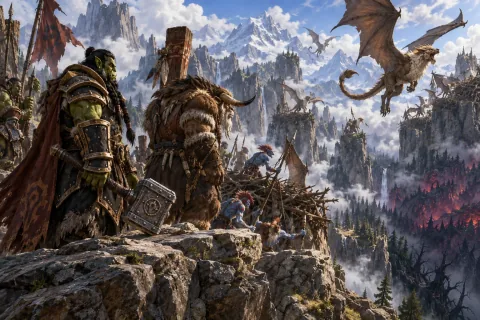
The Wyverns were freed, and the Orcs and Tauren were able to head to the mountain. The cavalry called Wind Riders in the game shows one aspect of the relationship the Horde forms with such Kalimdor creatures. Quilboars and Centaurs, Harpies and Tauren, Wyverns and Orcs are on the same map. The mountain path is not just an entrance to the next mission, but a passage where the newly arrived race settles into the existing ecology and relationships. There is an optional mission dealing with the polluted spring where the spirits have left, but one does not inflate it into a single history that must have happened in all versions.
Thrall, who saw Jaina entering the mountain cave, knew that she was also looking for the Prophet. However, the same purpose did not immediately become trust. Cairne warned of the possibility of an ambush, and Thrall also knew the humans' tactics. His past of being raised by humans made him understand the enemy, but understanding did not immediately erase the accumulated resentment. Even though they had fled the same disaster and reached the same mountain, they were still ready to take up weapons against each other.
Chapter 9 · The Heart of Aszune and the Prophet's Cave
Inside the mountain, the path split. Thrall and Cairne searched different passages to find a way to reunite. Inside the mountain were ancient statues, magical barriers, and disconnected passages. The statue of the ancient daughter of the moon, who revealed her name as Aszune, said she would open the path only when her heart was returned. Thrall found the object corresponding to that request and returned it, and Cairne found the gem that would move the Spirit Stone bridge. It was a journey where not all doors could be opened by a single leader's blade. Only by obtaining what was found on the two separate paths could the final passage be connected.
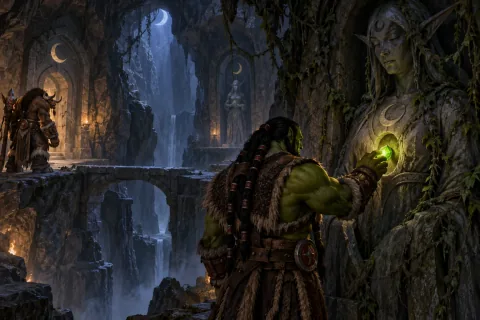
Aszune's words should be read as lore presented within this mission. One cannot create the lineage of an entire ancient kingdom or the intentions of the Moon Goddess based on the short lines of a statue. However, one can feel how long a memory Kalimdor holds even with that small scene. History did not begin only when Thrall docked his ship on this continent. Even in the mountains where the new settlers were finding their way, there were traces of those who had left their names long ago, and one had to meet those traces to pass the next door.
Thrall and Jaina, who reached the Prophet, were still trying to fight. What stopped the two was a familiar voice. Thrall recognized that it was the Prophet who had led him across the sea. The Prophet introduced Jaina as the leader of the survivors of Lordaeron, and those words revealed to Thrall the weight of what had happened in the East. The human kingdom had already fallen, and the Burning Legion was heading toward Kalimdor. A much larger battlefield was opening than the mountain path they were arguing over.
What the Prophet demanded was cooperation between humans and the Horde. It was not a request that Jaina could comfortably accept from the beginning, nor was it a decision that could be easily reached by Thrall. However, the warning that Grom was already captured by demons left no time to delay the choice. Thrall's power alone was not enough to save his friend. To protect the world, the survivors brought by Jaina also had to treat their old enemies as new allies. The path of the Prophet, who would later be understood by the name Medivh, approached the two leaders at this moment as a task to act together first.
Chapter 10 · The Soul Gem Offered by Jaina
On the way to the Warsong camp, Thrall had to fight his own race. The leader who had freed the Orcs from human internment camps and crossed the sea now had to cross the defensive line of Orcs captured by demons. Grom was a comrade like a brother to Thrall. A conclusion of simply defining him as an enemy and killing him was not enough to stop the destruction the master of blood desired. Jaina prepared a gem that could capture the soul without killing Grom. If one brought that gem to her ritual circle, one could try to break the demon's control.
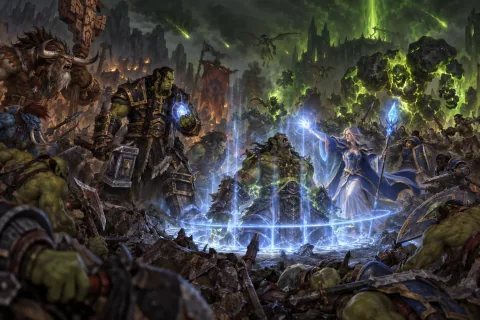
Cairne examined the location of the Warsong that the Prophet had told them about, and Jaina's human forces supported them from a separate base. It was a case of Orcs trying to save Orcs with the help of humans. The cooperation of the two leaders who crossed the sea did not remain just good words. They had to actually trust each other's magic and forces, and they had to enter the friend's camp occupied by the enemy. The fact that they were of the same race and the fact of what they were serving now collided. What Thrall was trying to protect in between was Grom's life and the freedom the Horde could lose again.
In the sky, Infernals poured down. Amidst the shaking ground and spreading fire, both the attackers and defenders were placed under the influence of demons. There is no need to change the game's repeated attack cycle or the health conditions for using the gem into an exact timetable in the novel. The event lies in the fact that they had to break through the demon's warriors to reach Grom, and that killing Grom and saving him were different missions. The victory Thrall needed was not a victory that increased the enemy's body count, but a victory that reclaimed his comrade.
Chapter 11 · Grom's Confession and Purification
On the journey toward Grom, the truth about the orcs' past is revealed once again. Regarding the matter that Thrall knew as the story of ancestors deceived by demons, Grom confessed that there was a choice where he and other chieftains willingly accepted the power. This does not mean there was no demonic deception or manipulation. However, it could not be explained that all the choices the leaders made themselves were non-existent. Grom was a warrior who had suffered the curse long ago, and he was a person who chose that power again. If there was a way for him to return, it had to be a path of facing the choices he made in his own name again.
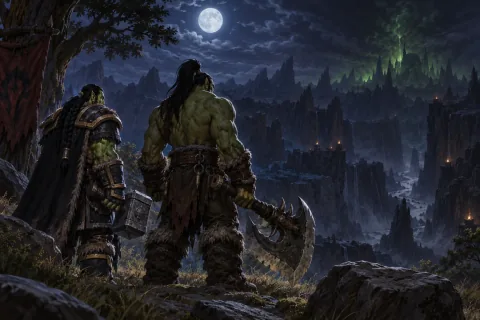
Thrall captured Grom with the Soul Gem and brought him to Jaina's ritual circle. The magic of the human priest and the orc shaman purified him together. It was not a scene where one race unilaterally fixes another, but a scene where different traditions join forces for a single purpose. Grom was able to see the situation clearly again and regretted what he had done. However, the mission did not end with an apology. What Thrall needed to do now was to save his people.
Just because the ritual freed Grom from immediate control did not mean that the entire orc blood curse had already disappeared on the spot. Mannoroth was still alive. They had to face the one who was the source of the power and who had declared the orcs as his own. Grom said he had to confront him in the canyon, and Thrall went with him. Thus, the regained spirit becomes not a spirit for running away, but a spirit for turning back toward the master who held his race. He was now ready to raise his axe toward the master of that power instead of drinking more of it.
Chapter 12 · Rejecting the Master in the Canyon
In the canyon, Mannoroth waited for the two orcs. His size, weapon, and the demonic flames around him were a threat far beyond the battlefields of humans or orcs. He considered Grom's blood and the orc race to still be his own. Thrall attacked with the Doomhammer, but that blow did not end the demon. Mannoroth's counterattack pushed the Warchief against the rock wall, and the moment of the final confrontation was left to Grom. This war could not end by itself with just good intentions and strong shamanism.
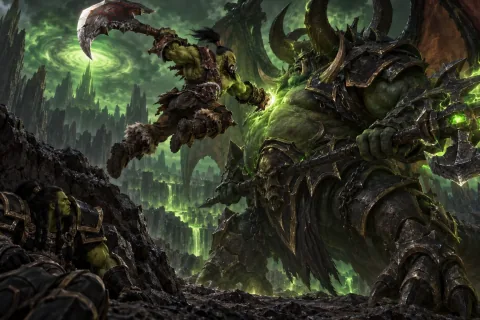
Mannoroth shook Grom by suggesting that the rage within him was the same as his own. The cruelty of that claim lay in the fact that Grom had actually accepted that power twice. However, what power one chose in the past and whom one raises a weapon against now could not always be the same answer. Grom lunged at Mannoroth. His axe, Gorehowl, pierced the giant demon's breastplate and body. This account explains that attack as an event of the official cinematic and does not make up oaths or internal monologues that do not appear in the scene as official dialogue.
A massive flame erupted from the demon's body. Grom could not avoid that explosion. While the power he chose again remained within him, he could not prove his freedom, but there was no guarantee he would return alive even at the moment he dealt a fatal blow to the master of that power. Victory and death touched in one scene. In the canyon, there was a warrior who had struck down the enemy, and the price of not being able to make that warrior continue to live remained as well.
Chapter 13 · The Final Flame and the Remaining Responsibility
The awakened Thrall returned to the fallen Grom. Grom felt that the influence of the demon that had clouded his blood had lifted, and he left behind the meaning that he had become free. Thrall did not accept that sacrifice only as the liberation of one person. This is because the blood curse that held the orcs ended with the death of Mannoroth. What Grom regained was freedom for the last moment, but what he left behind was the next time for his kin to live without a demonic master. In the victory Thrall achieved, there was a place for a friend who could not return with him.
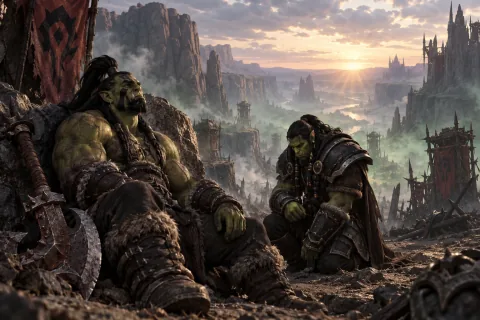
That does not mean this scene ended all the wars and wounds of the Orcs. Cenarius was dead, and the Night Elves' forest was damaged. The cooperation between humans and the Horde had also only passed its first trial. The Burning Legion was heading toward Kalimdor. There is no need to expand the event of one demon falling into the extinction of the entire Legion, or to make the liberation at this time a meaningless event by mixing it with the principles of demonic return of later eras. The victory of this moment broke a specific control and returned the responsibility of the next choice to those who survived.
Grom is the protagonist of the sacrifice who liberated his race while being the person who destroyed the forest. If you take away only one scene, you cannot understand the other side. Thrall also saved his friend, but he could not prevent all his choices in advance. Jaina helped the Orcs, but she did not become a person who forgot all the wars between humans and Orcs of the past. Cairne recognized the Orcs and fought with them, but he remained a chieftain who had to protect the life of his tribe. Their moving quality does not come from becoming perfect people through one action. It comes from being able to take on the next task within a world that has not ended.
Chapter 14 · The Story Continuing on the Map
Now the Horde was not just a group of shipwrecks that had arrived in Kalimdor. There was a path walked with the Tauren, a purification carried out with humans, and an axe that had turned toward the demonic master. The home Thrall first hoped for still had to be built, but the direction of the community to be established there began to be revealed through actions. The strong accepting the speed of the weak procession, borrowing the hand of an old enemy to save one's comrade, and not turning away from the price of the power received for victory created that direction.
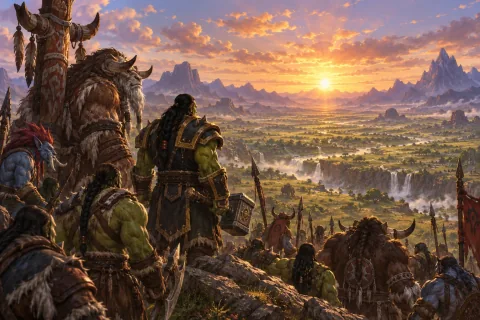
At the same time, there were guardians in Kalimdor they did not yet know well enough. After Cenarius's death, the Night Elves had to face those who had invaded their land and the demons who had returned. The choices of Tyrande and Malfurion, Illidan trapped in an ancient prison, and the World Tree targeted by the Legion become the stage for the next part. Here, I do not fold those events into a single concluding sentence first. Only by following how the forest's inhabitants faced this war with their own eyes can one see what the different forces are trying to protect together at Hyjal.
The Grom in this account is the green-skinned Grom who killed Mannoroth and lost his life in the Third War of Azeroth. The brown-skinned Grom and the Iron Horde that appear in a different Draenor later are treated as separate events and continuity. Jaina's Theramore, Thrall and the Horde's new city, and Rexxar's journey are also placed in their own subsequent times. The path of the story is long, but when distinguishing between the path protected now and the path to walk in the future, the choices of the characters remain clearer.
Name and Setting Guide
Thrall — The young Warchief of the Orcs. In this part, he finds a new home, meets the Prophet, and after saving Grom with Jaina and Cairne, faces Mannoroth. His future role and attire are distinguished from his appearance at the time.
Grom / Grommash Hellscream — Leader of the Warsong clan. The name spelling appears differently in games and versions. This part deals with the same individual in Azeroth's original timeline and does not mix him with the Iron Horde leader of a parallel world.
Cairne Bloodhoof — Chieftain of the Bloodhoof Tauren. He leads his tribe threatened by Centaurs and performs the journey toward the escort and the Prophet with Thrall. Cairne and his son Baine are different people.
Jaina Proudmoore — A mage who led the survivors of Lordaeron to Kalimdor. She participates in the cooperation to save Grom with human forces and magic. Her future white hair and attire after Theramore are not applied to her appearance in the Third War.
Mannoroth — A pit lord of the Burning Legion who provided blood to the Orcs. Distinguish between the canyon showdown in this part and the confrontations occurring in other eras and other Draenors.
Cenarius — A demigod connected to the forest. He fought against the Warsong's logging and was killed by Grom and the Orcs who had received demonic power at this time. Subsequent events regarding the demigod of nature are dealt with separately in the next era.
Wisps / Ancients — Beings related to the Night Elves and the life and magic of the forest. If one understands them as inanimate resources just by looking at the appearance of light and trees, one will miss why the battle of the forest occurred.
Kodo / Wyvern / Wind Rider — Kodo is a large creature used for escort and combat, and Wyvern is a creature of Kalimdor with wings. Wind Rider is a name related to the Horde's cavalry. Do not combine different creatures into the same mount.
Aszune / Spirit Stone of Stonetalon Chasm — These are names connected to the statues and the magic of the passages that appear in the cave leading to the Prophet. The heart of Aszune, the gem that operates the bridge, and the Soul Gem that contains Grom have different roles.
Gorehowl / Doomhammer — Grom's axe and Thrall's hammer. These are the names of different weapons. The axe that dealt the final blow to Mannoroth is not replaced with Thrall's hammer.
Related Parts and Continued Reading
The Orcs' blood pact and the birth of the old Horde: You can continue reading about the deception and choices of Draenor in Part 24.
/en/community/tm-warcraft-saga-part024-20261008
Until Thrall becomes Warchief and sets sail for Kalimdor: You can continue reading about the background of the internment camps and the new Horde in Part 31.
/en/community/tm-warcraft-saga-part031-20261008
The Eastern Front of the same war: You can continue reading about the destruction of Dalaran and the invasion of Archimonde in Part 35.
/en/community/tm-warcraft-saga-part035-20261008
The next main part continues with the Night Elves' response, Illidan, and the showdown at Hyjal. You can read the released parts in order from the series table of contents below.
Official Game Guide
This part is the story of the Warcraft III: Reign of Chaos Orc main campaign. I link the official game guide and purchase page for Warcraft III: Reforged, which includes that campaign, at the end of the text. Check the official page for supported languages, product composition, and terms of use.
Warcraft III: Reign of Chaos — Orc campaign in Kalimdor and Grom's end
https://us.shop.battle.net/en-us/product/warcraft-iii-reforged
Official Materials and Verification Scope
Verification Date: October 8, 2026 (UTC). This was written based on settings and events confirmed in the official public materials below. Public samples and setting introductions were verified only for their respective public scope, and I do not indicate that I have read the entire books. The illustrations are AI reconstructions, not official images.
Warcraft III: Reign of Chaos — Orc campaign in Kalimdor and Grom's end
Warcraft III: Reign of Chaos — official 2002 manual
World of Warcraft — Arthas/Lich King history in early official manuals
Tales from the Smithy: Reforging the Orcs — official Cairne/Orc models
Jaina Hero Week — Kalimdor alliance and Grom purification in official history introductions
Warcraft III — current official product and campaign inclusion
comments 1
그롬의 마지막 선택은 언제 봐도 마음이 먹먹해지네요. 단순히 힘을 휘두르는 전사가 아니라, 자신의 실수를 끝내 책임지려 했던 모습이 지금의 호드를 만든 것 같아요. 다음 나이트 엘프 이야기도 기대되네요! 🌳