
Recommended Game Story · Warcraft Part 3
Chapters in this story
- Origins and Antiquity: The Elemental Lords and the Black Empire
- Chapter 1: The Deficiency Held Within the World
- Chapter 2: The Wind Fights with a Different Hand
- Chapter 3: The Earth Waits, and the Water Turns
- Chapter 4: Roots Fallen from the Sky
- Chapter 5: The Moment Monsters Become Cities
- Chapter 6: The Lords Become Allies for the First Time
- Chapter 7: What the Next Era Must Resolve
- Official Materials and Scope of Verification
Origins and Antiquity: The Elemental Lords and the Black Empire
Spoiler Notice: This installment covers the elemental era of ancient Azeroth, the arrival of the Old Gods, and the formation of the Black Empire. This is a novel-style commentary written based on official lore. It reconstructs the atmosphere of the scenes but does not attribute unconfirmed dialogue or inner thoughts to the characters.
There were no mountains or harbors that bore human names yet. Before the seas could remember the shape of the continents, flames consumed the coasts, and the newly hardened rock split apart once more. Storms flowed from the heavens. The world sleeping beneath was Azeroth, which would one day become the home of countless lives. However, for the beings who ruled the land at this time, there was no reason to make way for forests or cities.
Four lords desired the world: wind, fire, earth, and water. Whenever one side succeeded in reshaping the continent in its own image, another would shatter it. It was not a promise of peace that halted this endless strife, but rather strange beings who fell from between the stars. From that day on, the war familiar to the elementals transformed into a struggle of an entirely different nature.
Chapter 1: The Deficiency Held Within the World
To understand the frenzy of the elementals, one must first return to the world-soul seen in Part 1. Deep within Azeroth, a soul with immense potential was growing. The public descriptions in the Chronicle state that the soul drew in a great deal of the fifth element, Spirit. As the power that connected and balanced the elements diminished, the elementals on the surface became increasingly unstable.
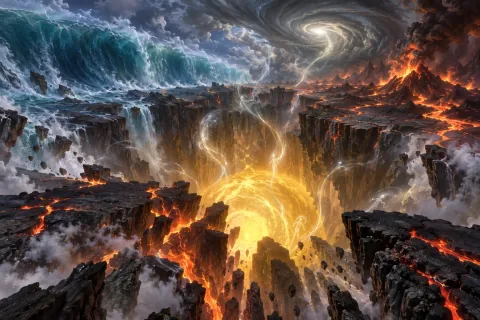
Let us not read the world-soul and the Spirit of the elements as the same thing simply because the translation for 'spirit' is the same. One refers to the entity growing within the world, while the other refers to the force that explains the harmony between elements and the connection of life. The fact that the world's vast potential existed alongside the vast imbalance on the surface is the starting point of this era.
At this time, the elementals were not merely the backdrop for natural disasters. They were actors, each with their own lords and followers. Depending on which side the wind fanned the flames or which mountain the water covered, the master changed. However, depicting a world with fixed borders like later kingdoms would only narrow the story. To them, the very shape of the land was the result of war.
Chapter 2: The Wind Fights with a Different Hand
Al'Akir, the Windlord, did not seek victory solely by clashing with force. He sent minions of the storm to discover the enemy's movements and sow distrust. He would pour his power into his foes only after they had been weakened by turning against one another. His wind changed the relationships on the battlefield before any procession of spears and shields could.
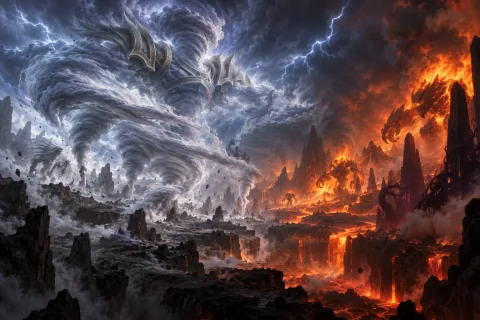
Therefore, the dark sky that signaled his arrival is not merely a background. The fighting has already occurred elsewhere, and the storm rolls in only after the fatigue of that battle has accumulated. Lightning and cyclones are the final blow. In that his schemes move before the most visible forces, Al'Akir's war serves as the first threshold for understanding the many conspiracies Azeroth would later endure.
Ragnaros, the Firelord, despised such methods. His power collided, burned, and melted. The rising volcanoes and flowing lava altered not only the enemy's strongholds but the very earth that served as the battlefield. In a world where the seas boiled and mountains crumbled, the victory of flame also meant reducing the space available for other elementals. Thus, the reason other lords hated him was not just a clash of personalities, but the reality that their own worlds were being destroyed.
Chapter 3: The Earth Waits, and the Water Turns
Therazane was the Stone Mother who protected her children. She built mountain ranges to create barriers and forced her enemies to exhaust their strength against them. After the attackers grew weary, she would open fissures in the earth to swallow their armies. For those who barely survived, massive minions made of stone and crystal awaited. Her defense was not another name for retreat, but a way to prepare for a counterattack.
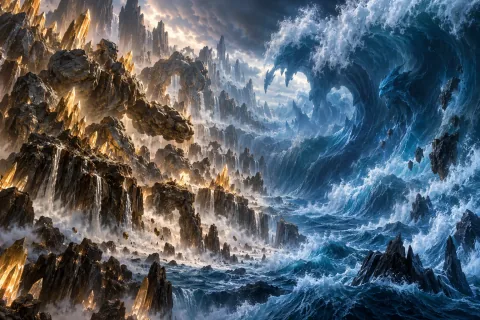
Neptulon possessed the power of water. He sought not to be caught in Al'Akir's schemes or waste his strength uselessly against Therazane's sturdy fortresses. While the other elementals drove one another, he dealt with his divided opponents individually and covered fleeing enemies with massive waves. Water moving in dispersion was not a formless weakling, but a force waiting for the moment when the opponent was most unstable.
The methods of the four lords were different: the wind that exhausted enemies with deception, the fire that melted the earth, the earth that swallowed after holding firm, and the water that read the flow and engulfed. Viewed this way, the elemental war is not a story of repeating attacks that differ only in color. What they sought to change the world into and which weaknesses of the opponent they targeted were different. Yet, for long ages, those differences converged into one result: no one left behind a stable world.
Chapter 4: Roots Fallen from the Sky
The Old Gods did not wait for this strife to end. The beings that fell from the dark cosmos onto the surface of Azeroth embedded themselves in different locations. What they brought was not merely another army seeking to claim a seat among the Elemental Lords. The bodies that took root in the land began to change their surroundings.
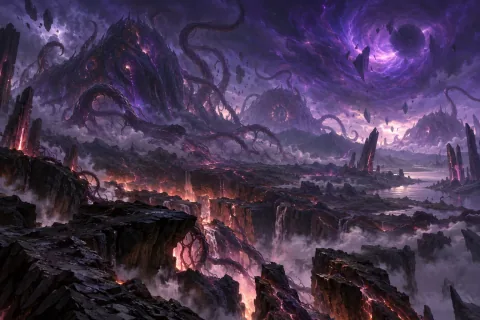
Masses of flesh rose like mountains, and eyes and mouths covered the world. Forms like tentacles and roots burrowed from the surface into the crust. The moment one reads the purpose of the war solely as territorial, one misses a deeper threat. At the center of Azeroth lay the sleeping world-soul. The corruption on the surface was an invasion leading to its heart.
The names that define the Black Empire thereafter are C'Thun, N'Zoth, Yogg-Saron, and Y'Shaarj. Blizzard's public introductions explain the era ruled by these four Old Gods. Let us not assume that we know every battle and sphere of influence of each based solely on these four names. What must be grasped here first is the fact that their different strongholds created a single era that covered the entire world.
Chapter 5: The Moment Monsters Become Cities
Organic matter flowing from the bodies of the Old Gods birthed servants. There were the clever and cruel N'raqi, or Faceless Ones, and the hardy insectoid Aqir. These did not appear merely as two types of monsters. As the N'raqi directed operations and the Aqir built citadels and temple cities, spaces of power were created around the massive bodies.
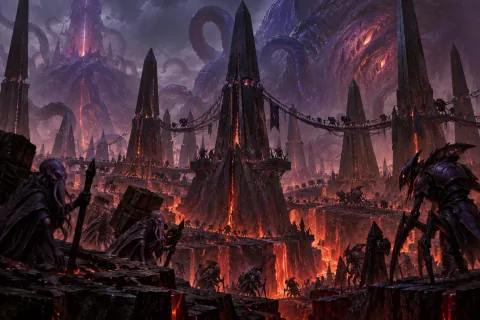
If one removes 'Empire' from the name 'Black Empire,' half of this era is lost. The rulers were the Old Gods embedded in the earth, but there were servants and architecture that carried out their will far and wide. The labor of building cities expanded their dominion, and as dominion expanded, more land was corrupted. A story of slaying a single terrifying entity and a story of dismantling an order rooted in the world are different in scale from the start.
The published Chronicle explains that the largest stronghold was built around Y'Shaarj, the most powerful of the Old Gods. As that city, located in the center of Azeroth's great continent, and the territories of the other Old Gods spread, the Black Empire was formed. This does not mean to fill it with flags and government offices modeled after later human kingdoms. It means to look at the strange dominion formed together by the god's massive body, the labor of servants, and the corruption burrowing into the crust.
Chapter 6: The Lords Become Allies for the First Time
As the Old Gods claimed their world, the Elemental Lords responded. Beings who had endlessly destroyed one another moved toward a common enemy for the first time. Ragnaros's fire and Al'Akir's wind formed a massive firestorm together. Therazane raised the earth to trap the enemy and destroyed their temple cities. The power once used against each other was now directed at the invaders from outside.
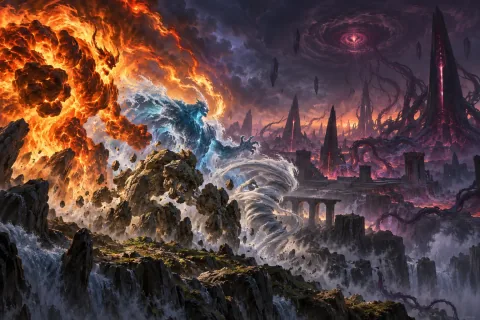
This transition has a simple but significant meaning. There is no basis to say that because they fought together, they forgot all their previous hatred. What can be confirmed is joint action. Even for lords who continued their endless strife, there was a world they did not want to lose. Familiar competition and alien invasion were not the same thing.
Let us imagine the scene of the Black Citadel facing fire and storm. Until now, the power that melted the world was a disaster to other elementals. Now, that power targets alien corruption. Rather than deciding who is always good and who is always evil, one must examine what that power was directed toward in which era to see the history of Azeroth more broadly. This does not erase the massacres and hostilities of later ages. One must read the relationships and results for each event.
Chapter 7: What the Next Era Must Resolve
The power of the elements alone could not explain the threat burrowing into the heart of the world. The era of the Black Empire leads to the subsequent response of the Pantheon and the Titan-forged. The danger that attacking the Old Gods could itself harm Azeroth, and the conflict between the methods of driving out the invaders and saving the world, become the focus of the next installment.
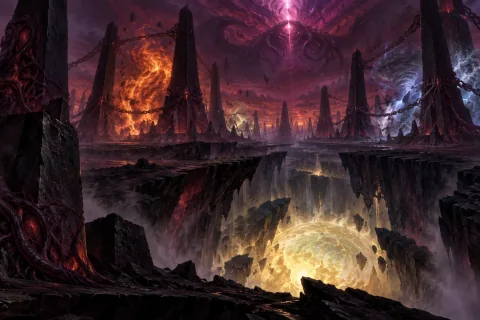
Let us carry over the terminology of this installment. Elemental Lords refers to the four rulers of the primeval world, while Faceless Ones (n'raqi) and Aqir refer to the servants of the Old Gods. The Black Empire is the era of corrupted dominion, and the Well of Eternity or later races belong to the history that follows. The descendants of the Aqir and the empires that follow are not enemies that merely repeat the same name, but beings that will diverge into different societies after long changes.
If you have read the story of the Pantheon searching between the stars, it is good to read Part 2, and if you are curious about the relationship between the sleeping world-soul and the six forces, it is good to read Part 1 together. You can continue reading from the table of contents below. Right now, black temples still stand above the surface. However, the world growing beneath them held a future far longer than any ruler of this era.
Official Materials and Scope of Verification
Verification Date: October 8, 2026 (UTC). This was written based on lore and events confirmed in the official public materials below. Public samples and lore introductions were verified only for their respective scope of disclosure, and it is not indicated that the entire books were read. Illustrations are AI reconstructions, not official images.
World of Warcraft: Chronicle Volume I
Take Wing Through Time with the Dragon Aspects
Reign of the Black Empire — canonical setting introduction only
comments 0