
Recommended Game Story · Warcraft Part 19
Chapters in this story
- Arathor and the Troll Wars: When the People First Stood Under the Same Light
- Chapter 1: People Who Were Enemies While Passing Through the Same Forest
- Chapter 2: A Place Left Even for the Defeated Leader
- Chapter 3: Two Generals Returning from the North
- Chapter 4: The Ambition of an Old Kingdom Revived in Zul'Aman
- Chapter 5: Elven Envoys Enter Strom
- Chapter 6: Power Gathered Under the Alterac Sky
- Chapter 7: The King's Sword and the Long-Lasting Promise
- Chapter 8: From Walls to a City of Knowledge
- Terminology and Character Guide
- Related Eras and Further Reading
- Official Materials and Scope of Verification
Arathor and the Troll Wars: When the People First Stood Under the Same Light
Spoiler Notice: This article covers the period approximately 2,800 years before the opening of the Dark Portal, detailing the formation of Arathor by human tribes, the alliance with Quel'Thalas, the conclusion of the Troll Wars, and the early growth of Dalaran. It spans thousands of years from the founding of the High Elves in the previous installment. The events are based on official chronicles and game documentation, presented as an independent narrative commentary. No new dialogue for characters is invented or presented as official, and the Arathi Empire, Alliance, and Horde of the present are not treated as the same organizations as these ancient kingdoms.
Chapter 1: People Who Were Enemies While Passing Through the Same Forest
Human history did not begin within the confines of high stone walls. Hunting grounds stretched along forests and hills, and small communities took root between them. The descendants of the Vrykul who settled in Tirisfal had become smaller than their ancestors, but their will to survive had not diminished. Enduring long winters and strange beasts, the people formed their own respective tribes.
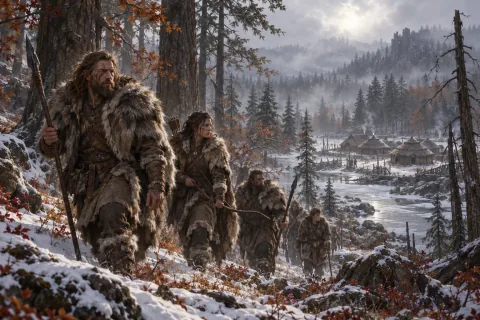
They held a deep reverence for the powers inherent in nature. Official chronicles describe the faith of early human tribes as a simple belief in spirits and nature. Before the rise of sophisticated orders and magic schools, people grasped at fear and hope as a way to understand the land they inhabited. The symbol of the Silver Hand, passed down in Tirisfal, was one such ancient memory. While the Paladin order would later use the same symbol, this does not imply that the order existed in this era.
However, having the strength to survive did not mean they knew how to live together. Tribes fought incessantly over land and power. The mere fact that a nearby village had slightly different customs or speech could turn yesterday's hunting ground into today's battlefield. The Amani were in the north and the Elven kingdom was far away, but the enemies that divided humans the longest were other humans.
Thoradin, leader of the Arathi tribe, saw what this division would eventually bring. The Troll incursions were becoming more brutal and frequent. Even if one tribe built walls and increased its warriors, if a neighboring tribe fell, their land would be next. Thinking of a kingdom not yet born meant looking beyond the victory of one's own tribe.
Chapter 2: A Place Left Even for the Defeated Leader
Thoradin was a warrior who had fought the Trolls for a long time on the northern frontier. That experience did not make him a man who relied solely on force. It made him a commander who could judge where the enemy would emerge, which path they would take, who could become an ally, and which rivalries could be exploited.
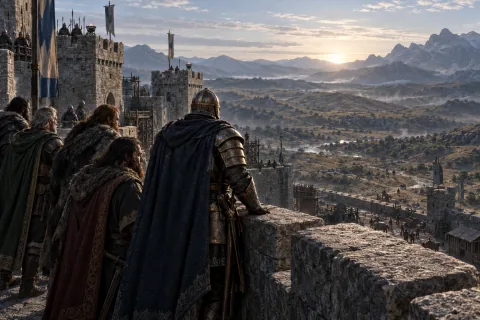
It took six years for him to unite the other human tribes. Not every tribe joined in the same way. There were unions through marriage and diplomacy, and politics that kept rival factions in check. With tribes that would not yield, there was war. The path to unification was not a conflict erased by a single declaration, but a long process of bringing different communities into one order.
The decisive difference in that process was revealed after victory. Thoradin did not drive out all the defeated leaders and keep only his own people. Within the new nation, he granted them positions as respected generals. He entrusted the community that needed to be protected to his former enemies.
This choice created a different kind of power than the fear of war. Obedience can be maintained as long as the blade is held against the throat, but when there is a shared place to protect, people begin to think of a future after the blade is lowered. The name Arathor was thus placed above the names of the tribes. Thoradin became king, and warriors who had fought each other began to guard the borders of the same kingdom.
The city built at the center was Strom. The large fortress, situated in semi-arid terrain, made the ambushes the Amani launched using the forest difficult. Walls were also built near the capital. News that a safe place existed spread to other tribes, and more people gathered at those walls. The city built of stone protected the people, but the diverse folk gathered within it were the true measure of the newly born nation.
Chapter 3: Two Generals Returning from the North
The establishment of the kingdom did not mean the borders became quiet. Thoradin had two generals watch the movements of the Amani. Ignaeus led warriors from the rugged mountains of Alterac. Though some looked down on the rough mountain folk, their courage and strength were proven on the frontier. The name Trollbane he earned carried the blood-scent of those battles.
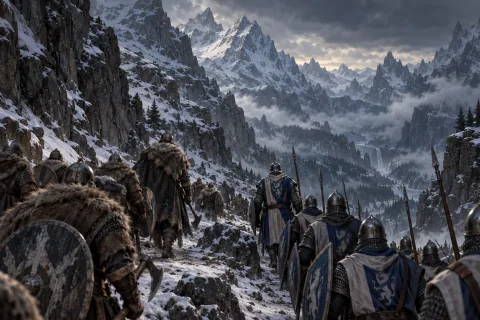
Lordain was a general from Tirisfal. He led disciplined warriors in a different manner than Ignaeus to patrol the borders. The scene of armies from different origins defending the same country reveals what the unification of Arathor had changed. The warriors of the mountains and the warriors of Tirisfal no longer needed to be wary of each other.
However, the news brought by the two generals pointed to another war outside the borders. The conflict between Quel'Thalas and the Amani was intensifying. Stories of strange rituals and supernatural entities circulated in the forest. A power unknown to humans was changing the war in the north.
Thoradin initially stood on the side of not putting his people in danger. The Elves had lived within their own kingdom for a long time, and Strom had sturdy walls. No matter how terrible a distant war might be, sending an army there was a different judgment. The caution to protect his people was an understandable choice, but it could not block the fact that the world outside the walls was changing.
Chapter 4: The Ambition of an Old Kingdom Revived in Zul'Aman
To the Amani, Quel'Thalas was not just a beautiful neighboring country. There was a memory that it was the land they had lived in before the Elves arrived. The defeat from thousands of years ago did not remain quietly buried as a finished past. In the temples of Zul'Aman and the forest communities, the idea remained that it was land to be reclaimed.
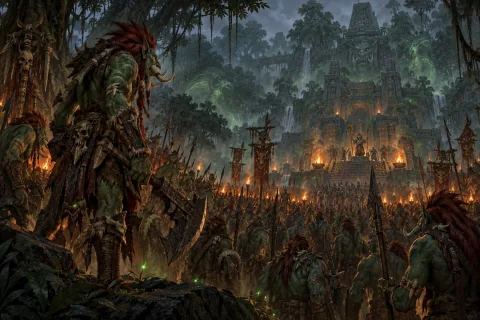
Even such Amani were shaken by internal strife and the absence of a powerful leader. The turning point came from the help of the Zandalari. The Zandalari considered themselves the spiritual center and protectors of Troll society. They saw the Amani as an important foothold to revive the Troll civilizations that had lost power after the Great Sundering and to regain influence on the Eastern Kingdoms.
They sent envoys to Zul'Aman. They helped prepare for war and ensured the power of the Loa was with the Amani. As the warrior Jintha came to lead the Amani, the scattered movements turned into preparations for a great war. Small raids were used to test Elven defenses and hide actual troop numbers and capabilities.
Finally, countless Trolls emerged from the forest. The army, backed by the power of the Loa, crushed the outer regions of Quel'Thalas. Elven magic was strong, but the soldiers to wield that magic and the paths to protect were not infinite. While guarding one border, the forest elsewhere could burn. The eternal spring the kingdom had enjoyed was not a promise that would prevent war forever.
If one looks at this fight only from the human perspective, the Amani remain enemies coming toward the walls. From the Amani perspective, it was a war to reclaim land lost long ago. That does not mean the invasion and destruction they wrought disappear. When different memories overlap on the same land, an era that one side calls victory can be the origin of the next revenge for the other.
Chapter 5: Elven Envoys Enter Strom
Envoys sent by Anasterian Sunstrider arrived in Strom. What they brought was not merely a request to borrow an army. It was a warning about where the Amani's power would be directed after Quel'Thalas fell. The belief that the northern war had nothing to do with Strom could no longer be a safe answer.
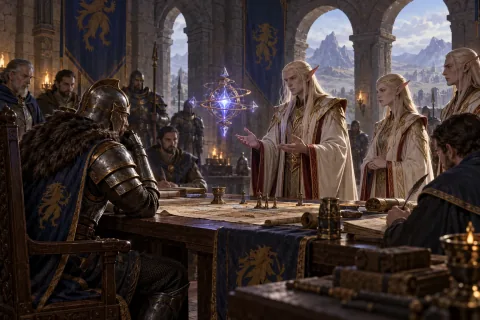
Thoradin and his advisors debated until the night grew deep. The reason humans needed to form an alliance became clear, but the means to fight were still lacking. Arathor's strength alone was insufficient to face the massive Troll army head-on. Simply gathering more of the swords and walls they currently possessed would not change the conditions of the war.
At that moment, Elven magic became a new path. If humans could learn that power, they would possess a new weapon that could influence the war. Thoradin was a man deeply suspicious of magic, but he did not make his own distrust the fate of the kingdom. To protect his people, he had to face even the knowledge he had been reluctant to embrace.
The Elves taught magic to the humans, and the humans contributed their strength to the war the Elves were enduring. The one hundred human mages who joined this battle were the people who would test whether new knowledge could actually change the conditions of war. The core of the alliance conveyed by official manuals is this exchange. The long-lived kingdom needed numbers, and the kingdom that had just become one needed knowledge. When they acknowledged each other's deficiencies, the two civilizations created the power to fight together.
The meaning of this moment does not end with a few mages gaining new spells. A secret that one race had guarded for a long time entered the history of another race. Even after the war ended, that knowledge remained. The promise made to overcome today's crisis was opening the next era of human civilization that no one fully understood yet.
Chapter 6: Power Gathered Under the Alterac Sky
The war shifted to a phase where the armies of the two kingdoms fought together. Human attacks and Elven counterattacks made it difficult for the Amani to concentrate their power on only one front. As the army of Arathor moved south, the Amani pursued them to the mountains, and the Elves descended from the north. Thoradin hid the humans who had learned the new magic within the Alterac fortress. The power to turn the tide of war after a long fight had not yet revealed itself. The conclusion of the battle confirmed in official previews leads to the moment in the Alterac mountains where human and Elven mages combined their strength.
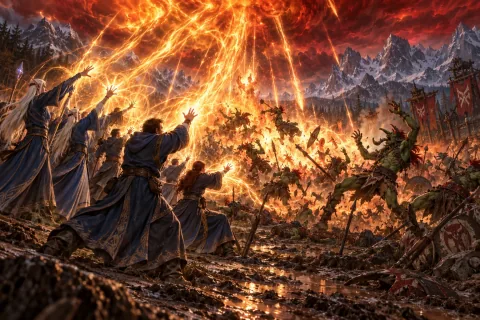
Thoradin was not a ruler who remained only on the throne of Strom. Official weapon introductions explain that his tactics and Strom'kar played a significant role in the conclusion of the Troll Wars. The judgment that had united the country now had to become a judgment to find a way for the country's soldiers to return alive.
Instead of repeating small attacks, the Elven and human mages pooled their strength. The mana possessed by many became a single spell, and a cataclysm of fire descended from the sky of Alterac. The Amani advance, which had been sustained by overwhelming numbers and the prestige of the Loa, collapsed before magic of a scale they had never experienced before.
Jintha also fell within those flames. The army, having lost its commander, could not maintain its formation, and the surviving warriors retreated to the north. The Elves and humans pursued them. The conclusion was not merely a scene where a single charge failed. It was the moment when the Troll hegemony of the Eastern Kingdoms that the Zandalari had tried to rebuild, and the future of the land the Amani had tried to reclaim, were broken together.
Celebrations of victory continued in Strom and Silvermoon. Quel'Thalas survived, and Arathor proved the power of its kingdom even outside its own walls. But for those who had seen the sky of war, the lights would not remain the same meaning for all. The torches of the victorious city and the ashes of the defeated forest were placed in the same era. The history of civilization sometimes reveals very different faces depending on which street one reads it from.
Chapter 7: The King's Sword and the Long-Lasting Promise
The grateful Elves swore loyalty and friendship to Arathor and the descendants of Thoradin. This relationship lasted longer than the lives of the soldiers gathered on the battlefield that day. When humans and Elves would fight together in war again in the future, the old promise would not be a decoration of the distant past, but a reason that moved current choices.
This does not mean that all subsequent human kingdoms and Elven communities always made the same decisions. Nations change, kings die, and new wars bring old debts along with other conflicts. This is why the alliance of the Troll Wars should be read as a starting point placed in the relationship of the following thousands of years. If one reads it as an endpoint that solved all conflicts in advance, the choices of later generations disappear.
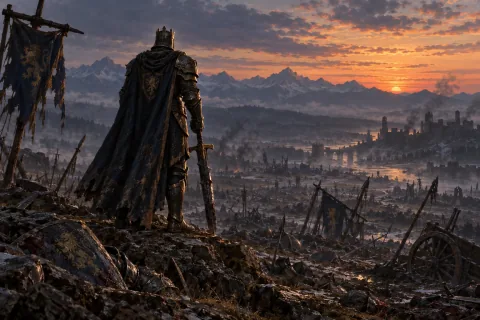
A long time remained for the sword Thoradin held. According to the official Strom'kar introduction, the sword was later used to subdue a K'thir monster in the forgotten tomb of Tirisfal before disappearing. The sword, having absorbed the darkness of that place for a long time, appears as an artifact of a much later era. One should not overlap the state of the sword held by the king in the Troll Wars with the state of the artifact revealed in the Legion era.
The person who built a kingdom eventually becomes a figure in history. However, the promises, weapons, and the name of the community they first brought together gain different lives. Thoradin's story is not just the story of a warrior who struck down the most enemies in a war. It is also the story of a person who changed the boundaries of his era by accepting other tribes as his people and a strange race as his allies.
Chapter 8: From Walls to a City of Knowledge
In Arathor after the victory, changes outside the battlefield grew. As more people gathered and strongholds grew larger, new cities gained power even within the order that had been intended to be maintained only around Strom. Among them, Dalaran started as a trade hub and became a place where people and opportunities gathered.
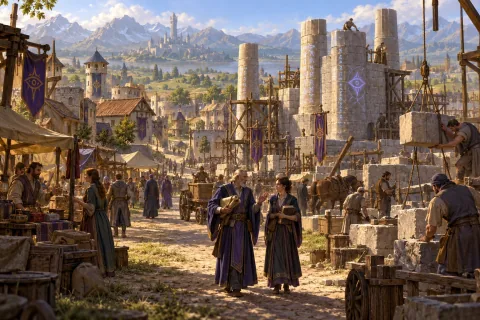
The brilliant mage Ardogan led the city with the support of the citizens. Dalaran grew into a city-state with increasing autonomy and became an important refuge for mages. Magic, which had helped save the community in the war, was not comfortably accepted by everyone in daily life. Distrust toward mages still existed, and those who used strange powers had to find their own place.
Ardogan invited such people to Dalaran. The gathered mages expanded the city, creating shining towers, libraries, and places where arcane knowledge was collected. A system governed by powerful mages was established, and under their protection, trade and industry also grew. Within the kingdom that had started with swords and walls, another civilization moving around knowledge was growing.
However, just as the power that brought victory in war brought prosperity, its unrestrained use also brought other dangers. The magic of Dalaran began to shake the boundaries of reality, and demons of the Legion seeped into that place. These are not the same entities as the Loa that fought in the north during the Troll Wars. One must distinguish between different enemies and systems of power to understand the role of the Tirisfal Guardians who appear later.
The towers of the new city grew higher, but the eyes watching that light were not only those of the citizens. The story of Azeroth leads again to the question of what door the power obtained to protect the world had opened. Humans had now built a nation to survive, and they stood before an era where they had to bear the consequences of what that nation had accepted.
Terminology and Character Guide
Arathi, Arathor, Strom: Names distinguishing the human tribe that led the unification, the kingdom they built, and the capital of that kingdom. They are not merged into the same state as much later organizations or Arathi communities of other eras.
Thoradin, Strom'kar: The king who founded Arathor and the greatsword he used. The state of the sword tainted by darkness in the future, as described in official artifact introductions, is not applied to the ancient war scene.
Ignaeus, Lordain: Thoradin's generals from the Alterac mountains and Tirisfal. The stories of later places, families, or characters using the same names are read in separate eras.
Anasterian, Quel'Thalas: The High Elf king and the northern Elven kingdom. Anasterian and the later Prince Kael'thas are not seen as the same person.
Amani, Zandalar, Jintha: The Troll faction of the Eastern Kingdoms, the Troll society that aided them, and the leader who led the Amani in this war. Jintha and the Zul'jin of thousands of years later are different people.
Loa, Demons of the Legion: Distinguishes between the entities the Trolls revere and the Burning Legion. Human arcane magic and the flames manifested by magic do not immediately mean the fel magic of the Legion.
Dalaran, Ardogan: The hub that grew from a trade city to a city of mages and its early ruler. The Dalaran described here is not in the state of a floating city of the future.
Related Eras and Further Reading
The ancient roots of Vrykul and humans: /ko/community/tm-warcraft-saga-part006-20261008
Early history of Troll civilization: /ko/community/tm-warcraft-saga-part008-20261008
The process of founding Quel'Thalas: /ko/community/tm-warcraft-saga-part018-20261008
The next installment will look back at the War of the Shifting Sands in Kalimdor, followed by the era of the Tirisfal Guardians and Medivh. The Tirisfal Guardians installment is a history that continues from Dalaran at the end of this article. The later differentiation of human kingdoms and the stories of each family, mage organization, and the Amani will continue to be unraveled in the connected character, faction, and setting tracks.
The currently published full table of contents and previous/next installments can be found in the series guide below. Articles in preparation are not marked like the posted links.
Official Materials and Scope of Verification
Verification Date: October 8, 2026 (UTC). Written based on settings and events confirmed in the official public materials below. Public samples and setting introductions were verified only within their respective public scope, and it is not indicated that the entire books were read. Illustrations are AI reconstructions, not official images.
World of Warcraft: Chronicle Volume I — publisher-authorized Google Books preview/search
World of Warcraft: The Burning Crusade — official manual, Legacy of the Blood Elves
comments 1
소라딘 왕이 패배한 부족의 지도자들에게 장군의 지위를 주어 공동체의 일원으로 포용했던 결단이, 이후 아라소르 왕국이 서로 다른 부족들을 하나의 질서 안에 결속시키는 데 가장 결정적인 역할을 했다고 보시는 건가요?