
Recommended Game Story · Warcraft Part 29
Chapters in this story
- Preface: Who Will Guard the Place of the Missing Commander?
- Chapter 1: The War That Saved the North Returned to the South
- Chapter 2: Blackrock, the Mountain Where Retreat Ends
- Chapter 3: The Shield Turalyon Lifted
- Chapter 4: The Final Path, the Dark Portal
- Chapter 5: Broken Stone, Remaining Paths
- Chapter 6: The People Left Behind After Victory
- Chapter 7: Could the Nations That Ended the War Together Remain Together?
- Chapter 8: What Lothar Left, What the Portal Left
- Criteria for Reading Events and Editions
- Index of Terms for People and Places
- Further Reading
- Continuing in official games
- Official materials and scope of verification
Preface: Who Will Guard the Place of the Missing Commander?
Spoiler Notice: This installment covers the conclusion of the Second War leading into Warcraft II: Tides of Darkness, the duel between Lothar and Orgrim at Blackrock, the succession of command to Turalyon, the destruction of the Dark Portal, and the post-war conflicts of the Alliance. It begins with the shift in the tide of war caused by Gul'dan's departure and connects to the reasons why the subsequent expedition to Draenor became necessary. This is not a transcription of game dialogue or novel excerpts, but a narrative commentary interpreting official events in our own prose.
The brightest moments in war sometimes arrive alongside the darkest losses. Lothar, who once led the survivors of Stormwind on ships to the north, was now leading an army forged by many nations back to the south. As they retraced the path they had once retreated, their purpose had shifted. This time, they were not fighting to survive a falling city, but to ensure the next city would not fall.
The Horde's advance, which had threatened the north, was broken by Gul'dan's departure and internal division. However, a retreating army is not necessarily a powerless one. Orgrim Doomhammer still had his warriors and commanders, and Blackrock had the fortress they could hold. When both commanders arrived beneath the same mountain, the war awaited a death and the choices that would transcend that death.
Chapter 1: The War That Saved the North Returned to the South
When the Horde marched toward Lordaeron, the Alliance had to manage multiple fronts simultaneously. The occupation of Khaz Modan, the burning forests of Quel'Thalas, and the threats to sea lanes and the capital were all connected. If each kingdom had looked only at its own land, the army would have inevitably scattered. Lothar's role was to make them understand these disparate crises as a single war.
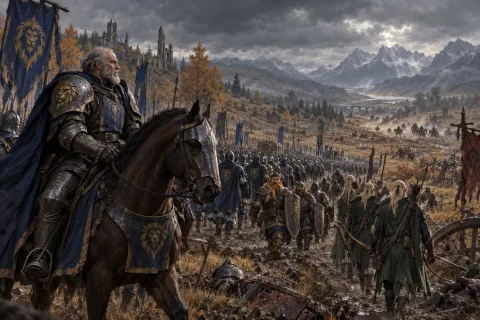
The balance shifted when Gul'dan took his followers and departed for the sea. The forces the commanders had calculated were no longer the forces that would actually receive orders. Orgrim, who had been gathering strength to strike at major cities, had to divide his power between continuing the war and dealing with betrayal. The moment an enemy weakens is usually the moment they are forced to handle unseen tasks simultaneously.
The Alliance used that gap to push the Horde south. In official history, the armies of Lothar, Uther the Lightbringer, and Daelin Proudmoore appear together as the axis that reversed the Orcish advance. The command of the land, the power of the Paladins, and the strength of the navy did not end in separate victories but created a unified pressure. The fight to defend the north turned into a fight to pursue them to the south.
This movement took place over old wounds. In the south, where the Horde had returned, lay the human kingdom that had already fallen in the First War. To Lothar, that land was not an unfamiliar enemy territory, but a path leading back to his lost homeland. For the soldiers of Lordaeron, it was a front line to protect an ally; for the survivors of Stormwind, it was a land where they faced their past once more. The same march carried different weights for each.
One could not stop the war just by saving a single capital. If the retreating Horde gathered new forces, the threat could turn north again. The Alliance had to pressure the fortresses and supply networks the enemy could still use. At the end of that path stood Blackrock Spire. Nestled within the black terrain of the volcano, the Horde's stronghold was the place where the retreating army would make its final stand.
The shift in the tide here is not explained solely by Gul'dan's betrayal. While that departure opened a decisive gap, it required the Alliance's counterattack and persistent pursuit to turn that gap into the outcome of the war. The Alliance did not win simply because it was formed. Because the forces of different nations moved together until the end, they were able to turn the possibility of survival into an actual conclusion.
Chapter 2: Blackrock, the Mountain Where Retreat Ends
The siege surrounding Blackrock Spire narrowed the Horde's options. The army that had once crossed a vast continent now had to find an exit from a restricted stronghold. The fortress was a place to protect troops, but it was also a place where those troops were gathered, unable to move further. Holding out inside the walls for a long time did not automatically improve the situation outside.
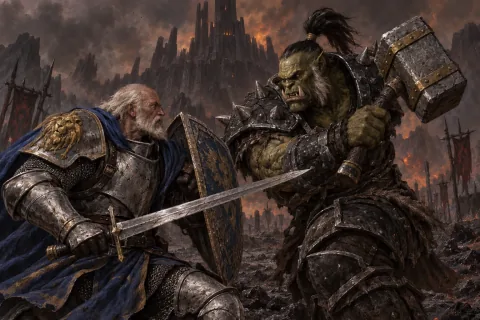
Lothar's army pressured Orgrim's clans. The official history of Warcraft III describes this phase as a clash between the Alliance, which had besieged the defense of Blackrock, and the Horde, which charged out from the fortress. Orgrim and his commanders launched a final counterattack, clashing with Lothar's army in the heart of the Burning Steppes. The retreating war turned back into a direct collision.
Orgrim was not a commander with the same goals as Gul'dan. Gul'dan left the front to seek his own power, while Orgrim continued the war with the remaining Horde. That does not, however, erase the consequences of the invasion. For the lands and people destroyed under his command, Blackrock remained the center of that threat. It is a battlefield where one must look at both individual resolve and the damage that resolve left upon the world.
Lothar was not a commander who stood on symbolism alone. After Stormwind fell, he led the survivors, persuaded the northern kings, and bound the armies into a single alliance—that time had accumulated within him. His name bridged the gap between the lost kingdom and the newly formed Alliance. If the army he commanded collapsed, it would not just be one front that failed, but the connection itself that would falter.
The fight between the two took place within this broad conflict. The Warcraft III manual states that Orgrim and Lothar fought fiercely until both were exhausted, and that Orgrim barely managed to strike Lothar down. We do not add dozens of precise attack motions or final words here. What is confirmed is the duel, Lothar's death, and the fact that this death led to a path different from what was expected.
The mountain remained as it was. The army was still fighting. However, the man who had led the Alliance could no longer issue the next order. At this moment, the weight of the war shifted to those who survived. If defeating the enemy commander was victory, that victory already belonged to Orgrim. But whether the will of the entire army would end with that death was yet to be decided.
Chapter 3: The Shield Turalyon Lifted
Lothar's death was not the end of the Alliance. Turalyon was there. As a lieutenant trusted by Lothar and a Paladin who followed the Light, he had to ensure that the soldiers who had lost their commander would move as a single army again. Grief came to many at once, but someone had to be the first to start the next action.
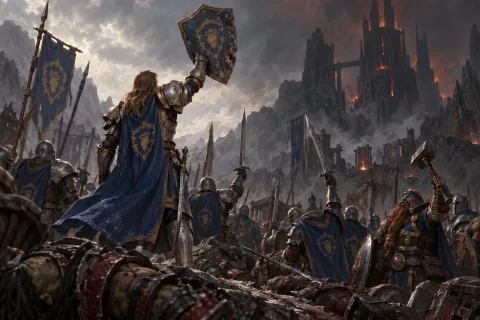
An important object left by the official manual is Lothar's shield. Turalyon gathered his comrades again, holding the blood-stained shield. We do not call this a specific magical shield or attach an unconfirmed relic name to it. The power the object held at that moment lay in connecting what Lothar had protected with what the surviving army had to carry on. It was a sign that the place of the departed was not left entirely empty.
The troops gathered under the banners of Stormwind and Lordaeron counterattacked. Even when one kingdom fell, another accepted its people; even when one commander fell, another took up the responsibility. The reason the Alliance was first formed was revealed again at Blackrock. The alliance, bound together to share the burden of what each had lost, did not scatter even when facing the greatest loss.
The Horde's counterattack sought to break the Alliance's command, but the battle continued even after Lothar's death. Turalyon's army crushed the remaining forces of Orgrim. The surviving Orcs fled, and the last stronghold they could rely on was the Dark Portal. The flow that had been reversed at Blackrock now headed toward the final connection further south.
If one reads this succession simply as a scene where a stronger warrior appeared, an important part is lost. Turalyon inherited the alliance and the army that Lothar had built. The reason he could issue the next order was because of the soldiers who had fought together, the nations that understood the same threat, and the solidarity the Paladins had upheld. Individual courage became the power of war only when it actually connected and moved others.
Lothar failed to protect his capital in the First War. He did not survive until the end of the Second War. Nevertheless, his story does not end as a list of defeats. The choice to lead survivors from a fallen city birthed the northern alliance, and that alliance fought on even after his death. Because there were results that continued beyond his final moment, Lothar remains the commander of a lost kingdom and the memory of the Alliance.
Chapter 4: The Final Path, the Dark Portal
The path pursuing the retreating Horde passed through the Swamp of Sorrows and led to the Blasted Lands. The place that had been the Black Morass before the Dark Portal opened had already changed into something else. The Warcraft II manual describes the transformation of the land, where life vanished and the earth became desolate, alongside the portal. The passage connecting the worlds was a space for troops to cross, but also a wound that had changed the life around it.
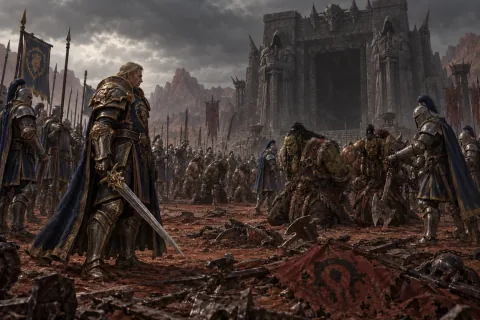
Through this portal, the first Orcs entered Azeroth. More warriors and clans followed, and the connection between the two worlds continued to bolster the Horde's strength. If the Alliance only destroyed the fortresses and left the portal, the possibility of new armies arriving would not vanish even after the war at hand ended. The goal of the final battle included both defeating the enemy and severing that connection.
Turalyon's army caught up with the surviving Horde beneath the portal. Official history records this clash as the final battle of the Second War. The warriors scattered after the defeat at Blackrock and the Alliance that had continued the pursuit fought again before the massive gate. The path to victory continued even after defeating one commander. They had to finish the conflict regarding the remaining troops and the passage.
The Alliance won. Orgrim was taken prisoner and moved to Lordaeron, and the survivors of the broken clans were also transported north. The Warchief who had once threatened many kingdoms was now under the watch of the victorious nations. The road moving north took on the opposite meaning of the march just moments before. The path that had led troops was now a path for prisoners being led away.
That does not mean the actions of every Orc present can be bundled into one. The clans and groups that made up the Horde at the time did not all meet the same fate in the same place. The stories of those who hid, those who were at separate outposts in the sea and mountains, and those who were in other worlds continue. The victory of the Second War is the result of breaking the Horde's invasion; it does not mean the history of all Orcs ended that day.
To the victorious soldiers, the portal may have been a symbol of the enemy they were finally viewing up close. However, knowing what remained beyond it was another matter. Clearing the battlefields of Azeroth did not mean the clans and leaders of Draenor vanished. The problem that had connected the two worlds now began to lead deeper than the stone structure visible before them.
Chapter 5: Broken Stone, Remaining Paths
The Alliance destroyed the physical structure of the Dark Portal. They sought to actually collapse the connection they had failed to sever during the first invasion. The massive stone gate lost the form that had symbolized the Horde's victory. The monument that had opened the path between worlds became a ruin of war. It was the moment the surviving Azeroth finally reached out to the entrance of the invasion.
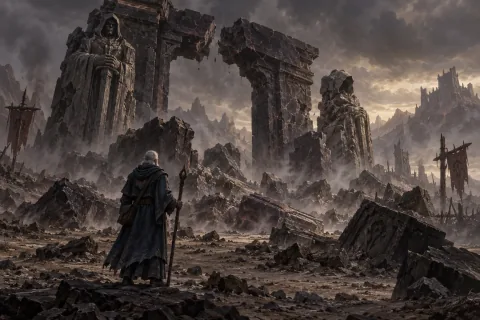
But just because the structure was broken did not mean the rift between the worlds disappeared. The history of Warcraft III continues with Khadgar's concern regarding the magic that remained even after the portal was destroyed. The mage, who had experienced the threat surrounding Medivh and the portal in the First War, did not accept the disappearance of the enemy's symbol as the disappearance of the danger.
As a result, Nethergarde was established to watch over the ruins of the Dark Portal. Khadgar persuaded the Alliance to guard the site. Instead of sending all the victorious troops home and forgetting, they kept a watch near the place where the portal had been. Even after surviving the war, someone had to remain in the ruins to protect the lives others would return to.
This watch was not just about finding Orcs still in hiding. The connection on the Draenor side had not completely vanished. The official timeline distinguishes that even after the portal on Azeroth was destroyed, the portal on Draenor remained. The collapse of the stone we saw and the severance of the two worlds entirely are not the same event. If someone on the other side opened the path again, the ruins could once again become a starting point.
Calling Draenor 'Outland' here would cause the next event to vanish. At this time, the planet had not yet been destroyed by Ner'zhul's multiple portals. The devastated Draenor and the shattered Outland are connected, but they are not the same landscape at the same point in time. The illustration for this installment also shows the devastated land of Azeroth and does not mix in the alien sky of Draenor or the floating continents of later eras.
Khadgar's watch soon became reality. After Nethergarde was completed, the energy around the portal gathered again to open a path, and the Orcs under Ner'zhul on Draenor crossed over to Azeroth. This reopening and the story of the expedition connect to the events of the next era. The Second War ended, but the wounds of the finished war remained as a threshold for a new war to enter.
Chapter 6: The People Left Behind After Victory
The nations that won the war now had villages and cities to restore and survivors to return to. The reconstruction of Stormwind was the way the Alliance's victory translated into life in the south. Rebuilding a fallen kingdom was not just about raising walls. The people who would live within them and the kingdom itself had to return. The stories of the survivors Lothar had brought north led back there.
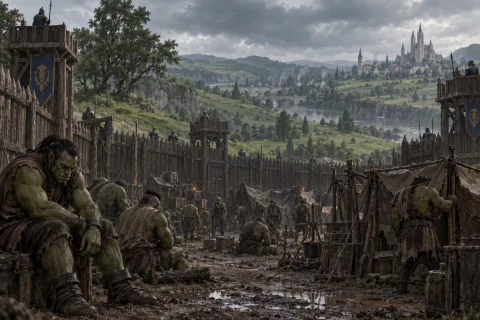
Another problem was the prisoners. Resources were constantly needed to house and guard the Orcs moved to Lordaeron. King Terenas maintained this, but the other nations that had to share the costs did not maintain the same thinking indefinitely. Whether the alliance that fought together against a common threat would show the same solidarity in the process of sharing common responsibilities had to be tested anew.
For the Orcs, the internment camps were the conclusion of the war. Those who had once moved with their clans and the war were now gathered to live under surveillance. We do not compress the subsequent lethargy and liberation movements into a single day's change. The remaining outposts of the Dragonmaw, the liberation of Alexstrasza, and the stories of the clans Thrall would meet are events that must be addressed in the unfolding time.
In particular, the liberation of the red dragons at Grim Batol should not be mixed into the same battle immediately following this victory. Official history places that event in the flow following the next expedition surrounding the Dark Portal. Even if the Horde's main force on the continent was defeated, not all control and oppression were lifted immediately. The imprisonment of Alexstrasza, seen in previous installments, awaited a separate resolution.
The Alliance's victory gave some the possibility of returning home, while it left others with a life of surveillance and imprisonment. One must look at both results together to understand the conflicts of the next era. The new Horde is not a faction that suddenly appears. It is a story of finding a different direction atop the invasion of the old Horde, its defeat, and the lives of the clans left behind.
Chapter 7: Could the Nations That Ended the War Together Remain Together?
During the war, what bound the nations of the Alliance was a common threat. As that threat receded, the wounds and interests of each nation became clearer. The costs of the restoration and camp maintenance pushed by Terenas were not just Lordaeron's problem. Other kingdoms felt the burden, and thoughts on what responsibilities should be shared after the war ended diverged.
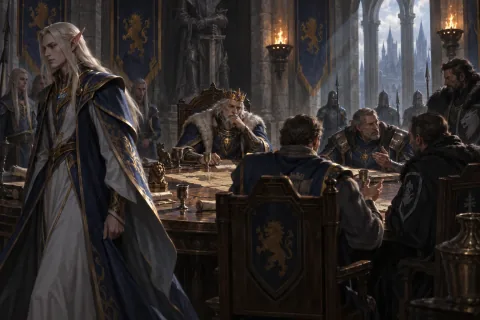
Quel'Thalas had burnt forests remaining. The High Elves connected the damage their land had suffered in the war to their dissatisfaction with human command and eventually withdrew from the Alliance. That choice is not the same event as the relationship between the Blood Elves and the Horde that appears later. One must follow what wounds and grievances moved the Quel'Thalas and High Elves of this period.
Gilneas and Stromgarde also withdrew from the Alliance. The official Warcraft III manual introduces the post-war division of the Alliance alongside the choices of such nations. However, it does not write as if these choices happened simultaneously on the very day the final battle ended. In the politics and time that followed the end of the joint war, the scope of the alliance that had been one gradually changed.
There were nations that remained. Daelin Proudmoore's Kul Tiras, Varian Wrynn's Stormwind, Antonidas's Dalaran, and Magni Bronzebeard's Ironforge are grouped in official history as the axis that remained loyal. The Alliance did not disappear just because the war ended. Which nations stayed and which left changed the subsequent relationships.
In this process, Lothar's absence is felt again. The commander who had bound different nations to a single front is gone. Terenas and the leaders of each nation had to deal with the post-war reality without the hero of the war. The Alliance maintained its name, but its composition changed. The burden and anger of each were not resolved automatically just by the memory of having been under the same banner.
The victory of the war was not the completion of peace. It was an opportunity to face the next problems while alive. They had to rebuild fallen cities, decide how to treat prisoners, and choose future relationships with wounded neighbors. The place where a new era begins is not just in a grand victory ceremony, but in the difficult and time-consuming decisions left behind.
Chapter 8: What Lothar Left, What the Portal Left
If one looks back at Lothar's story from the beginning, the direction of the war becomes visible. He saved people from a fallen kingdom, knocked on the doors of other kingdoms for them, and created an alliance to survive together. His life ended at Blackrock, but the army Turalyon led carried on that connection. The power that transcended one person's death came from the relationships built beforehand.
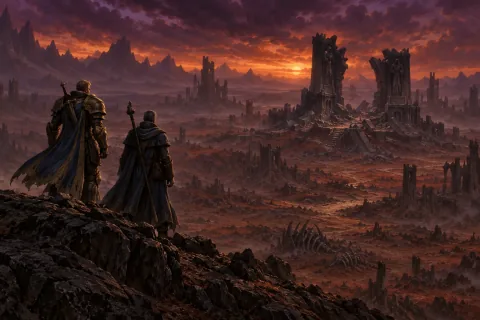
Orgrim's path does not end there either. The Warchief became a prisoner, but his story connects again through his later escape, his meeting with Thrall, and the emergence of the new Horde. That is not the same event as the fight being waged at Blackrock now. One must see the path the figure who led the war returns on after defeat and imprisonment to understand his entire life.
Turalyon took over Lothar's place. Khadgar looked at the threat remaining at the broken portal. These two continued to do different things even after the same victory. When the experience of the person leading the army and the mage who understands the connection between worlds meet, the Alliance becomes able to track threats outside of Azeroth. The next expedition is a story where those experiences are tested in a new world.
The finished war was not an erased war. The memory of the fallen commander remained at Blackrock, prisoners and burdens remained in Lordaeron, and a kingdom to rebuild and a fortress to guard the portal remained in the south. The surviving nations inherited both victory and wounds. Amidst them, the ruins of the Dark Portal pointed toward another world that had not yet been fully confirmed.
Next time, that portal opens again. Ner'zhul's plans, the new invasion, and the expedition of Khadgar, Turalyon, Alleria, Danath, and Kurdran bring two worlds with different purposes to clash once more. Because the path did not end just with the fact that the portal was broken at the end, this narrative also continues from the ruins of victory toward another world.
Criteria for Reading Events and Editions
The conclusion of Blackrock in this installment follows the duel, death, and Turalyon's counterattack as presented by the official Warcraft III manual and Blizzard's later historical introductions. The old hero introductions of Warcraft II contain phrasing that describes Lothar's ambush and death differently. We have not combined different explanations into a scene where everything happens simultaneously. Furthermore, we do not merge the branch endings of the Human and Orc campaigns into a single canon.
The destruction of the Dark Portal structure on the Azeroth side, the persistence of magic and rifts, the construction of Nethergarde, the reopening of the portal, and the destruction of Draenor are not a single explosion occurring at the same moment. This installment covers the conclusion of the preceding war and the guard, while the Draenor expedition and the planet's collapse are distinguished as the next events. The 'Kingdom of Azeroth' expression in old manuals refers to the southern human kingdom in context and is not to be confused with the entire planet.
Index of Terms for People and Places
Anduin Lothar: The figure who led the survivors of Stormwind and commanded the Alliance army. He falls to Orgrim in the battle of Blackrock.
Orgrim Doomhammer: Warchief of the old Horde. He struck down Lothar but became a prisoner after the Alliance's counterattack and the final battle. Distinguished from the Draenor figure of the alternate timeline.
Turalyon: Lothar's lieutenant and a Paladin. After the commander's death, he regathered the army and commanded the pursuit that led to the Horde's defeat.
Blackrock Spire: The stronghold in the volcanic region where the Horde retreated and held out. Do not read the battle of this period as the same event as later dungeon raids.
Burning Steppes: The volcanic terrain in the south where the Horde emerging from Blackrock and the Alliance clashed. We have not created precise duel motions or troop deployments beyond confirmed records.
Dark Portal: The connection between Azeroth and Draenor. The destruction of the physical stone gate is different from the complete disappearance of the connection between dimensions.
Khadgar: The mage who experienced the threat of Medivh and the first invasion. He guards against the danger remaining at the portal and persuades the construction of Nethergarde.
Nethergarde: The Alliance stronghold built to watch over the place where the portal had been. It is not depicted as a fortress completed before the final battle.
Further Reading
The process of the war's reversal: Warcraft Part 28 — Khaz Modan and Quel'Thalas, the imprisonment of Alexstrasza, and Gul'dan's departure. /en/community/tm-warcraft-saga-part028-20261008
The beginning of the alliance: Warcraft Part 27 — Lothar's evacuation and the Alliance of Lordaeron, the Order of the Silver Hand. /en/community/tm-warcraft-saga-part027-20261008
The path first opened: Warcraft Part 25 — Medivh and the Dark Portal, the process of the connection between two worlds becoming an invasion. /en/community/tm-warcraft-saga-part025-20261008
The Orcs' previous life: Warcraft Part 18 — The clans of Draenor and the background of Orc society. /en/community/tm-warcraft-saga-part018-20261008
Continuing in official games
Warcraft II: Remastered is the official product including the Tides of Darkness and Beyond the Dark Portal campaigns. Read the faction-specific progression and branch endings of the game separately from the world-building conclusions organized later. Supported languages, regional availability, pricing, and terms of use can be checked on the official page. Warcraft II: Remastered — official Battle.net product page
Official materials and scope of verification
Verification date: October 8, 2026 (UTC). This was written based on settings and events confirmed in the official public materials below. Public samples and setting introductions were verified only for their respective scope, and it is not indicated that the entire books were read. Illustrations are AI reconstructions, not official images.
Warcraft III: Reign of Chaos — official 2002 manual
Warcraft III: The Story So Far
Warcraft II: Battle.net Edition — Official Manual
Warcraft II: Tides of Darkness
comments 1
로서의 방패를 든 투랄리온의 모습은 언제 봐도 참 뭉클하네요. 전쟁이 끝난 뒤의 복잡한 정치 문제까지 짚어주시니 당시 상황이 더 입체적으로 느껴져요. 다음 원정 이야기에서 카드가는 또 어떤 활약을 보여줄지 벌써 궁금해집니다! 🛡️