
Recommended Game Story · Warcraft Part 20
Chapters in this story
- The War of the Shifting Sands · Names Left Outside the Walls
- Chapter 1 · Why Those Who Guarded the Forest Went to the Desert
- Chapter 2 · Enemies Where Numbers Become the Horizon
- Chapter 3 · Between One Front and One Village
- Chapter 4 · The Dragons Who Guard Time Had to Fight Too
- Chapter 5 · The Hand of the Person Holding the Tool of Victory
- Chapter 6 · The Seal Was Buying Time
- Chapter 7 · A Thousand Years Later, Different People Gathered at the Same Gate
- Chapter 8 · Names That Appear When Read Again
- Further Reading
- Official Materials and Scope of Verification
The War of the Shifting Sands · Names Left Outside the Walls
Spoiler Notice: This covers the ancient War of the Shifting Sands, the death of Valstann Staghelm, and the sealing of Ahn'Qiraj. The final chapter explains the time difference between this event and the opening of the gates and the raid in World of Warcraft. The atmosphere and interpretation of the scenes are the operator's commentary; I have not created or included official dialogue for the characters.
Chapter 1 · Why Those Who Guarded the Forest Went to the Desert
In the earlier parts of this series, Azeroth has survived many times. Under the order of the Titans, under the chains of the Old Gods, and amidst the cataclysm that shattered the world. However, a surviving world does not mean a safe one. Dangers buried underground endured time at a different pace than the calendars of the surface. Even as generations passed and city names changed, the problems surrounding sealed entities remained.
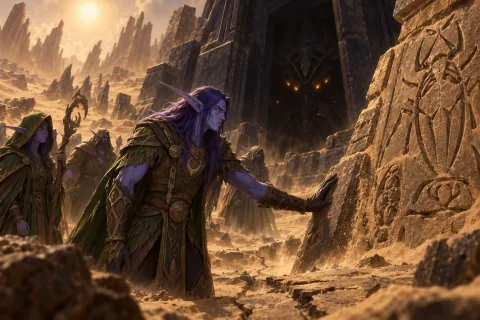
Silithus in southern Kalimdor is the land that revealed that long history once again. The public portions of the official chronicles explain that C'Thun's subterranean prison was in this barren region, and that the Qiraji and their allies expanded it to create the massive fortress of Ahn'Qiraj. Therefore, Ahn'Qiraj cannot be understood merely as a new nest built by insects one day. One must view the architecture of imprisonment and the forces that grew within it together.
The history of the Aqir branching out connects to Part 8. The Nerubians of the north, the Mantid of Pandaria, and the Qiraji of the south are beings whose names and ways of life have diverged. If one reads them all as the same military force simply because they look like insects, the paths each chose and the power dynamics behind them are erased. The battlefield in this installment is the threat created by the Qiraji and Silithid of the south.
The chronicle's explanation that Fandral Staghelm sought to revitalize the lands of Silithus changes the entrance to this war. The starting point was not the glory of conquering new territory, but an attempt to bring life back to a parched land. His son Valstann and trusted druids took on the task, and the hidden fortress was rediscovered. A touch meant to nurture life encountered a danger that had been hidden for a long time.
Chapter 2 · Enemies Where Numbers Become the Horizon
The chronicle recounts the process of the Qiraji's numbers increasing before the eyes of those surveying the fortress, and a great army pouring out from underground tunnels. Fandral gathered not only druids but also Sentinels, priestesses, and Keepers of the Grove. These names are not a decorative list. It means that bows and weapons, healing and shapeshifting, the faith of the moon, and the power of the forest formed a single defensive line with distinct roles.
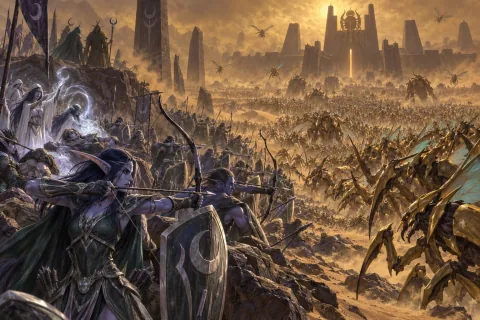
Does the method of guarding a forest work the same way in a desert war? What matters on the battlefield is not just the strength of one powerful individual, but the place for the wounded to return to and the time for those using spells to hold out. If the rear collapses, the valor of the front is difficult to maintain for long. This is why, when reading about this war, one must place the healers and the nameless Sentinels alongside the Archdruid's name.
The insectoid appearance also clouds judgment. Knowing that the Qiraji have a command structure and a massive army, this event moves far away from simple pest control. The act of destroying a nest is different from stopping the operations of a faction. Without knowing the scale at which the enemy is moving, it is difficult to judge whether a victory before one's eyes is a victory for the entire war.
Chapter 3 · Between One Front and One Village
Micky Neilson's official short story looks back on the ancient war through the memories of the priestess Shiromar. Valstann led troops to help the besieged Southwind Village. However, he was captured by a Qiraji general and killed before Fandral's eyes. The night elves retreated.
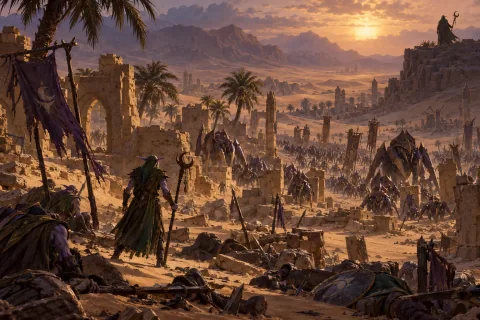
Those who read the records of war see the troops splitting on a map. While the remaining forces hold back the enemy, other troops go to save the residents. However, the map does not record what the father and son were to each other. Fandral's tragedy overlaps these two layers within a single event. A commander has a front that cannot be abandoned, and a parent has a person who cannot be replaced.
It is easy for us to judge that decision as simply foolish or brave. But judgments made in hindsight, knowing the scale of the enemy that was unknown at the time, are too smooth. The weight this story leaves behind lies not in the conclusion that one person chose the wrong answer, but in the situation where choosing to protect one thing puts another precious thing at risk. Tragedy does not make the decision light, even for readers who know the outcome.
Chapter 4 · The Dragons Who Guard Time Had to Fight Too
The public portions of the chronicle state that the Qiraji pushed into Tanaris and attacked the Caverns of Time. The Bronze Dragonflight took action, and with Anachronos at the center, the aid of the Red, Green, and Blue Dragonflights was added. The night elves and dragons drove the enemy back into Ahn'Qiraj, but the number of enemies and the continuous sacrifices made it difficult to end the war.
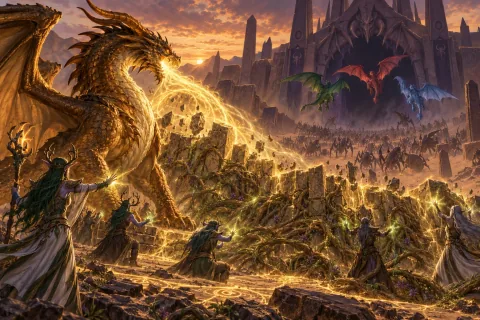
In the official short story, Merithra, Caelestrasz, and Arygos entered the city to hold the enemy inside. Outside, Anachronos, Fandral, the druids, and the priestesses created the seal. The wall built of stone and roots had a magical barrier that even prevented enemies from flying over it.
It seems as if everything would be solved if dragon wings covered the sky. However, the conclusion of this war directly shakes that expectation. Even after the appearance of powerful beings, what is needed is to divide roles, buy time, and have someone pass that time on to others. The valor at this moment can be read not as the number of enemies killed, but as the time allowed for others to complete the final task.
If one places the three dragons heading into the city and those left outside the wall on one screen, the outline of the seal becomes visible. The moment a boundary is created that divides inside and outside, that boundary also separates comrades. The wall built to survive can be a wall that closes the path home for someone. That is precisely why the news of completing the wall alone cannot end this war as a bright victory celebration.
Chapter 5 · The Hand of the Person Holding the Tool of Victory
Anachronos created the Scarab Gong and the Scepter of the Shifting Sands. The scepter was a tool that could open the seal when needed, and it was entrusted to Fandral. However, Fandral, having lost his son, shattered the scepter. The result of stopping the threat of C'Thun and the Qiraji could not return his loss to him.
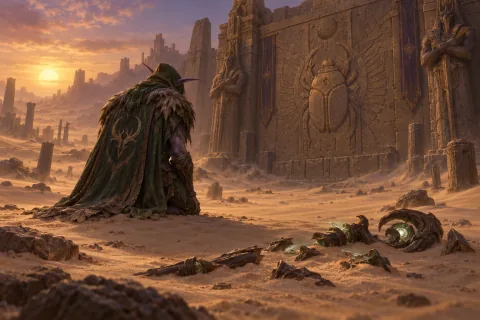
A single war here has different endings. From the world's perspective, a catastrophe was contained; from the commander's perspective, many lives were saved. From the parent's perspective, someone who would not return remained. The fact that the same event can end in three sentences is an important clue to understanding Fandral. Saying that a nation and the world were saved does not explain everything the surviving individual went through.
There is no need to say the destruction of the scepter was right, nor to dismiss his grief as something incomprehensible. This scene shows that what one felt and what one did are subjects of different evaluations. Understanding the loss does not make the result of the choice disappear. Conversely, pointing out the result does not make the weight of the lost person disappear. Only by reading these two together does Fandral move beyond a simple caricature of arrogance.
Readers who know the later Fandral might want to use this tragedy as a single explanation for all subsequent events. However, behind it are separate eras, relationships, interventions, and choices. When reading the subsequent actions of the character we will meet in the future, I will remember the wounds of this war, but I will not insert events yet to come into this point as if they were already fated.
Chapter 6 · The Seal Was Buying Time
Blizzard's introduction to the Temple of Ahn'Qiraj explains that the Twin Emperors and the Qiraji Empire were bound behind a magical barrier. This is different from a conclusion where the enemy was completely eradicated. The world gained some distance from them, but the world inside the barrier did not disappear.
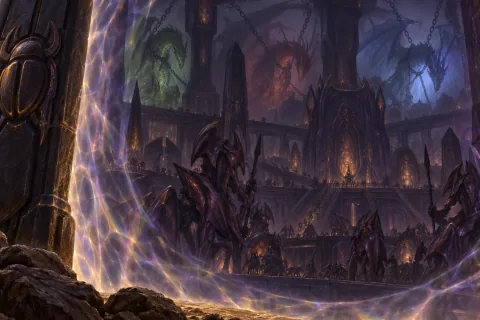
The 2020 official raid introduction states more clearly that the dragons who sacrificed themselves in ancient times are weakened or enslaved within the temple. Therefore, one should not conclude that all three dragons who entered the city died forever based on this chapter. The status of characters who became invisible on the battlefield and their subsequent survival or captivity are different pieces of information. We must verify this again when dealing with later periods.
Such differences may seem like small footnotes in the lore. But if someone is alive, the way one remembers past sacrifices changes. The name left on a tombstone and the name held onto while waiting for someone to return carry different weights even if they are the same name. The charm of a long-running worldview also lies in the fact that a conclusion that seemed certain when reading one scene takes on deeper meaning when it meets information from the next era.
If I write that C'Thun was defeated here, the connection of the worldview is severed. Only when a time gap remains between the sealing and the final battle of the raid can one understand why the task given to future heroes is necessary. Did the old heroes fail, leaving work to be done? Rather, it can be read that they created the time for the world to endure until the next generation. The victory of those who came later rests upon the fight of those who endured first.
Chapter 7 · A Thousand Years Later, Different People Gathered at the Same Gate
The ancient war in this chapter and the opening of the gates that actually took place in World of Warcraft in 2006 must be distinguished. Blizzard's retrospective talks about the sound of the gong on January 23, 2006, and the ten-hour battle that followed. The real-world date refers to the event in the game service. It does not mean the ancient war where Fandral and Valstann fought happened in that year.
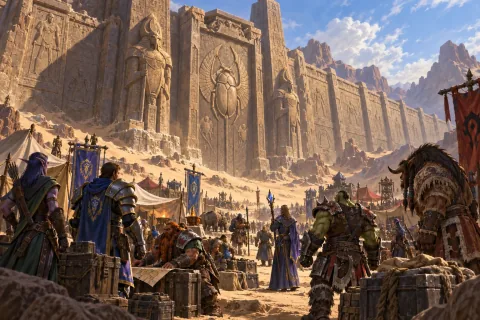
The retrospective also includes the process of opposing factions gathering resources to prepare for battle, and the appearances of those who opposed cooperation or profited from the supplies. It is the point where the war of the worldview meets the collective work of the users. Bandages, food, and equipment are placed next to the hero's narrative. The community of the game experienced the fact that dealing with a massive enemy requires not only those who hold swords but also those who send what is needed to those who hold them.
The actual raid bosses, quests, and the process of opening the gates are covered separately in the main story of the later World of Warcraft era. For now, it is enough to keep one connection in mind. The same wall was a boundary that the first generation had to protect to the end, and for the next generation, it became a boundary that had to be crossed after preparations were complete. It is not that the wall changed, but that the world, the danger, and the people standing before it have changed.
Chapter 8 · Names That Appear When Read Again
Fandral Staghelm: The night elf leader of this war and Valstann's father. One must remember his position and family relationship together.
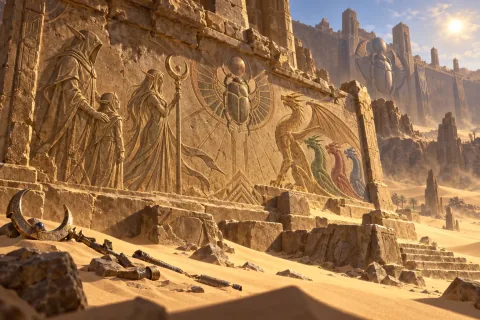
Valstann Staghelm: Fandral's son who participated in the Silithus revitalization attempt and the war. His death connects Fandral's personal loss to the retreat of the war.
Shiromar: A priestess who remembers the ancient war in the official short story. I do not turn her experience and hearsay into an omniscient historical narrative.
Anachronos: A figure of the Bronze Dragonflight. A name that connects the seal, the gong, and the scepter; he is not the same person as Nozdormu.
Merithra, Caelestrasz, Arygos: Three dragons connected to the Green, Red, and Blue Dragonflights, respectively. Distinguish their roles in this sealing from their later actions.
Qiraji, Silithid: Do not erase the two names into one just because they move together. Distinguishing the names makes it easier to read the power dynamics and combat composition.
Ahn’Qiraj, Scarab Wall, Scepter of the Shifting Sands: The place, the boundary, and the tool to open the boundary. The relationship between these three terms connects the ancient war to the later opening of the gates.
Further Reading
Reading the sealing of the Old Gods in Part 4, the Aqir and Troll Wars in Part 8, and the Sundering of the World in Part 14 makes it easier to follow the background of this war. The links below lead to already published parts.
/en/community/tm-warcraft-saga-part004-20261008
/en/community/tm-warcraft-saga-part008-20261008
/en/community/tm-warcraft-saga-part014-20261008
The desert wall ended this war, but it could not bury the names of those who disappeared. Reading the history of Azeroth is not just about following the flags of the victorious faction. It is about looking back at the people who left time so that those flags could continue to wave, even to the places of the nameless.
Official Materials and Scope of Verification
Verification Date: October 8, 2026 (UTC). This was written based on the settings and events confirmed in the official public materials below. Public samples and setting introductions were only verified for their respective public scope, and I do not indicate that I have read the entire books. The illustrations are AI reconstructions, not official images.
World of Warcraft: Chronicle Volume I — publisher-authorized Google Books preview/search
Summer Challenge: The Temple of Ahn’Qiraj
comments 0