
Recommended Game Story · Warcraft Part 32
Chapters in this story
- The Plague and Stratholme · The People the Prince Tried to Protect
- Chapter 1 · The Heir with the Hammer
- Chapter 2 · An Army Growing in the North
- Chapter 3 · An Investigation Started with an Old Friend
- Chapter 4 · The Promises Received by the Damned
- Chapter 5 · The Enemy That Remains After Defeating the Necromancer
- Chapter 6 · How to View the People Beyond the Gate
- Chapter 7 · The Prince Moving Away from His Mentor
- Chapter 8 · A Massacre Started in the Name of Salvation
- Chapter 9 · The Anger Toward the North and the Ship Toward the West
- Chapter 10 · What Did Lordaeron Lose?
- Terms and Character Paths
- Reading Along with Already Published Series
- Related Game Official Purchase Locations
- Official Materials and Confirmation Scope
The Plague and Stratholme · The People the Prince Tried to Protect
Spoiler Notice: This article covers the plague investigation and the Stratholme massacre in the Warcraft III Human campaign, as well as the parting of ways between Arthas, Jaina, and Uther. This is a narrative commentary based on events confirmed in official manuals and developer-released character histories. It does not invent dialogue to present as official quotes, and the story of Frostmourne in Northrend and the prince's return is left for the next era.
The gates guarding Lordaeron stood with the expectation of enemies coming from the outside. Soldiers watched the roads, and carts passed through them into the city. Even after the war, people had to eat, and the grain harvested from the fields connected the villages to the markets. That ordinary flow, which kept the kingdom alive, became the path that would bring the kingdom down at a certain moment.
The plague did not appear before the gates carrying the banners of an invading army. While carts filled with food passed through the gates, the people did not know the name of the danger contained within. Faced with this threat, the heavy hammers of the paladins and the high, sturdy walls had to ask again what it was they were meant to defend. The enemy did not end the fight even after people died. They made the dead rise and turn against the living.
The prince following that path was Arthas Menethil. Before the crown of the future, what was given to him was the responsibility to protect his people. Between the people he sought to protect and the order to kill those same people, a line that no one wanted to cross was waiting. The tragedy of Stratholme begins right before that line.
Chapter 1 · The Heir with the Hammer
Arthas was the son of King Terenas and the heir to the throne of Lordaeron. He was connected to the future of the nation from birth, but the power to protect the kingdom's people was not granted by birth alone. He had to learn how to handle weapons and the path of serving the Light. Muradin Bronzebeard taught him combat, and Uther the Lightbringer led him as a paladin of the Order of the Silver Hand.
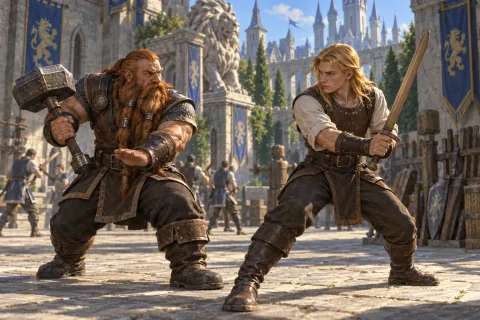
The official early manual introduces his courage and persistence, along with his strong self-confidence and impulsive side. If one reads these traits as evidence of a villain from the start, looking only at the final outcome, the reason he was trusted disappears. The prince was not a man who sought to avoid danger. He could step forward and fight where his people were threatened. However, the courage to step toward danger and the strength to pause and judge within that danger are not the same thing.
Uther, who was by his side, was a man who had shared long-standing trust with the royal family. To Arthas, he was not just a superior connected by title. He was the mentor from whom the prince had learned what he must do in the name of the Light. For the two of them to stand on the battlefield together meant not only combining their strength but also sharing the same standards for what purpose that strength should protect.
At the time Arthas took up the paladin's hammer, neither Frostmourne nor the Lich King's crown was his. Distinguishing that appearance is not merely a matter of memorizing equipment differences. Within the name Arthas, one must not move events he had not yet chosen as if they were already finished facts. At this moment, he was a living paladin who had set out to protect the kingdom.
Chapter 2 · An Army Growing in the North
The enemy he had to face was not born at the kingdom's borders. The shadow of the Scourge spread southward from Ner'zhul, the Lich King bound to the Frozen Throne of Northrend. It was a tool prepared by the Burning Legion to weaken Azeroth's defenses, but within that tool, a will to escape the Legion's control was also growing. As Arthas followed the plague before his eyes, a longer purpose moved behind it.
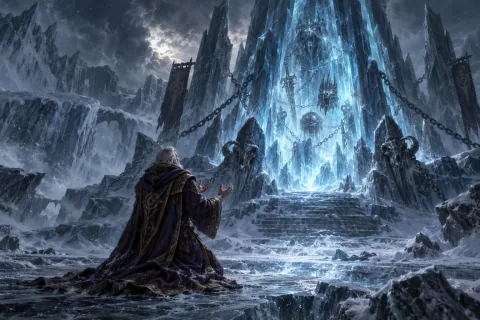
The Scourge overturned the calculations of war fought against living enemy armies. Instead of the ranks of dead soldiers remaining empty, the dead could stand in the enemy's lines again. The failure to protect the people did not end as a mere loss of population. Those people could return as a force attacking their own kingdom. It was a terror that could not be explained by numbers alone.
The origin of the Scourge in the official manual features a living collaborator who enters human society. Kel'Thuzad was a powerful mage belonging to the Kirin Tor of Dalaran, but he followed the call of the Lich King out of a desire for forbidden necromancy. After pledging loyalty to his new master in Northrend, he was given the mission to return to the lands of the humans.
It is important that he still maintained his human appearance at this time. The preparations to bring down the kingdom were not all revealed with the face of a skeleton. A living person spoke to other living people and gathered them with new promises. If one only thinks of the giant Lich of the future, the human choice that opened the door for the plague to enter at the beginning remains unseen.
Chapter 3 · An Investigation Started with an Old Friend
Jaina Proudmoore was a brilliant mage who had learned from Antonidas in Dalaran. She and Arthas had known each other since childhood and had once loved each other, but their respective studies and royal duties did not keep the two in the same place. When the plague reconnected them, what was needed was not to rekindle a past love, but to find out what was happening to the people living now.
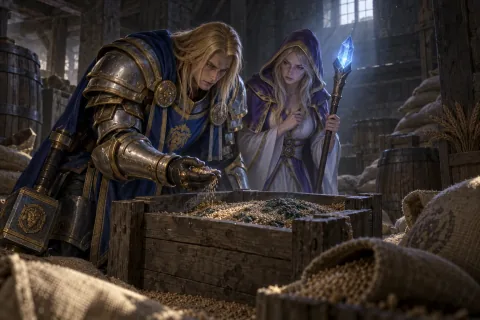
Antonidas saw that this disease might not be an ordinary sickness. Jaina was sent to investigate the cause with Arthas. In the sight of a paladin and a mage walking the same path, the different powers of the kingdom gathered. If soldiers with swords and hammers blocked the front lines, magical knowledge asked how the visible carnage was being created.
What they confirmed was contaminated grain and the changes that occurred after death. Official character histories record Brill and Andorhal as the connecting points of the regions devastated by the plague. The path along which food traveled could spread threats faster than the path of news. To the hungry, grain meant salvation, but death was beginning from that same grain.
The method of attacking the daily life that should be safe does not end with one person for a soldier's blade to point at. Even if one finds out who sent the grain, the supplies already scattered to many villages do not return to a single box. Investigating the plague involved the difficulty of having to chase down the consequences that had already spread, in addition to defeating the enemy.
Chapter 4 · The Promises Received by the Damned
The Cult of the Damned, gathered by Kel'Thuzad, was not just an army from outside the kingdom. The official manual explains that the cult grew by promising equality and eternal life to weary laborers and those alienated from society. The narrator does not acknowledge these promises as true. It is merely a record showing why people opened that dark door and what gaps the cult exploited.
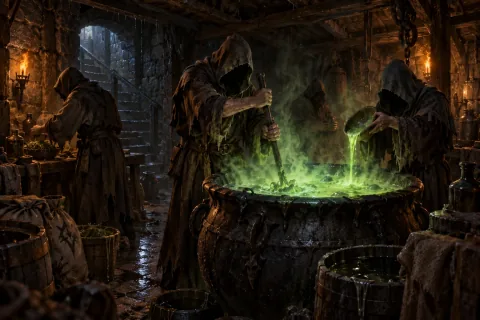
Those who served the Lich King also prepared the foundation to spread the plague. The early manual describes the process by which portable devices called plague cauldrons were hidden in villages controlled by the cult. When read alongside the grain contamination in the campaign, the threat was not a single sick beast that appeared by chance, but a plan eroding the lands of humans through multiple channels. There is no need to define the magic of the devices and the contamination of food with real-world bacteriological formulas.
The humans following the cult and the undead rising after the plague did not move in the same way. Some submitted to their new master of their own accord, while others were controlled after a death they did not choose. If one calls everyone a single faceless evil, the difference between the deceived promises and the stolen freedom disappears. The tragedy the kingdom suffered included both voluntary betrayal and forced enslavement.
In that process, the meaning of the name Scourge is also revealed. They did not stop at fighting to gain territory. They incorporated the very life and community that human society relied upon into the enemy's army. It is understandable why Arthas became increasingly hard-line as he looked at this threat. However, that terror does not automatically justify every subsequent order.
Chapter 5 · The Enemy That Remains After Defeating the Necromancer
In the process of chasing the plague, Arthas found and killed Kel'Thuzad. Discovering and defeating the mastermind threatening the kingdom was clearly an important action. However, that victory did not erase the plague. Kel'Thuzad was the person who had planted the plan received from the Lich King into the lands of humans, and that plan was now moving beyond the body of one person.
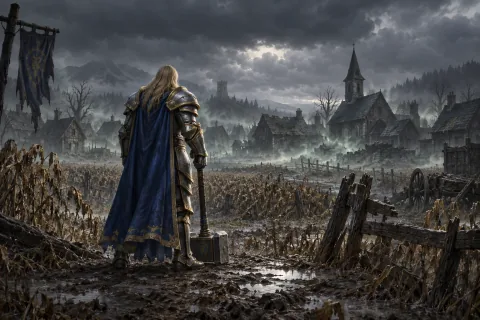
Here, the prince's fight loses the familiar shape of a victory. Even though the enemy commander is killed, the people being threatened are not saved. Even if the enemy army is repelled, the same grain can arrive in other villages. Even if more soldiers are called to guard one place, it is impossible to know immediately which places are already contaminated. The distance between the act of finding the cause and the act of stopping the consequences pressured him.
Official Jaina history conveys the flow of her returning with the support of Uther and the Order of the Silver Hand. The reinforcements showed that they could still trust each other's strength and move together. Jaina's act of seeking help was not an act of a helpless person giving up on everything. It was a choice to gather more paladins and soldiers and not to bear the crisis alone.
However, that help could not reverse the grain that had already arrived at the tables of Stratholme. Between the number of soldiers arriving later and the food already eaten, there was a time that was difficult to recover. The situation where Arthas felt he had to hurry and the question of how far to accept that haste are now placed before the same gate.
Chapter 6 · How to View the People Beyond the Gate
Stratholme was not the capital of an enemy nation. It was a city where the people of Lordaeron lived. The statement of protecting this city did not only include protecting the walls and the banners. It had to include the meaning of protecting the people who worked, ate, and slept within it. However, the fact that the contaminated grain had already been consumed made Arthas see the city in a different light.
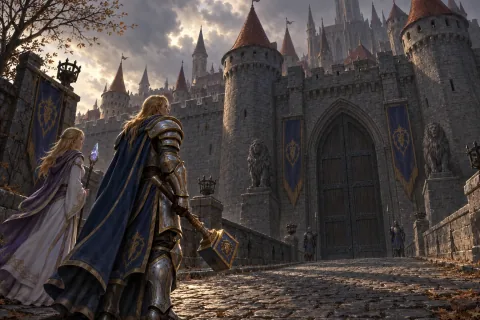
He judged that he had to kill the residents before they turned into the undead. It was to eliminate that possibility before the Scourge could make these people their own army. In that judgment, the present of the people and the future of the enemy overlap in one place. It was an order to treat the residents, who were still people inside the gate, like the undead army that would soon come out of the gate.
Uther refused to participate in that massacre. He had fought for the kingdom and was the mentor who taught Arthas the path of the Light, but he could not accept killing the people as the same mission. Jaina also parted ways with Arthas before that order. One must distinguish between saying they did not know the threat and saying they did not agree with the method even if they knew the threat.
The expressions in official materials must also be read carefully. The 2014 Jaina introduction emphasizes the danger of the residents who ate the grain, and separate character histories state that even people who might not yet have been infected were placed under the prince's order. This account does not add a record that all residents were tested to confirm infection, nor a figure that everyone would definitely turn immediately. What Arthas was convinced of and the facts confirmed about all residents are not the same sentence.
Chapter 7 · The Prince Moving Away from His Mentor
The moment Arthas, who was not yet king, and his mentor did not agree on the same order, the standard that supported the relationship between the two collapsed. The prince asserted his authority by removing Uther from command and suspending the service of the paladins. The mentor who had returned to help was now treated as an opposition he had to remove.

The weight of this scene does not lie merely in the fact that two strong people argued. To Arthas, Uther was a man who held both the teachings of the Light and the trust of the royal family. The fact that he opposed him could have been a reason to rethink the prince's decision. However, Arthas did not take that opposition as a signal to stop. He moved in a direction that cleared away the restraint of others to execute his own decision.
Jaina's departure also cannot be read only as the betrayal of an old love. The person who had investigated the danger together could not agree with the order to respond to that danger. The starting point of having set out to save the same people did not guarantee the same action in the end. The question of what they sought to protect and the question of what they deemed permissible to do diverged.
The image of the three people on the same stone bridge moving away from each other is a reconstruction of this parting. At the time, the armor and appearance, the stone structure of the gate, and the banners were referenced from the game scene, but the distance and expressions are a composition for commentary. It does not mean that I have discovered what sentences actually crossed the characters' minds. It is a scene that makes the distance created by confirmed choices visible.
Chapter 8 · A Massacre Started in the Name of Salvation
Arthas eventually killed the city's residents with his soldiers. Even those who had not yet risen as undead became targets of attack for the reason that they could fall to the enemy in the future. An act of harming the kingdom's people was carried out under the purpose of protecting the kingdom. In this tragedy, understanding the desperation of the purpose must not become an act of erasing the existence of the dead people.
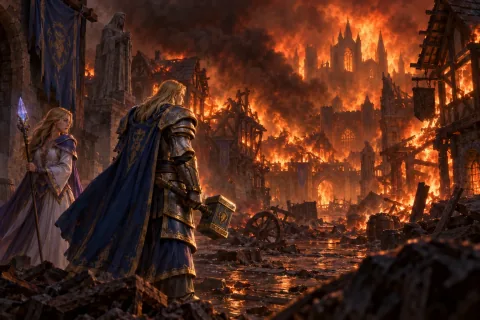
The demon Mal'Ganis he faced was not simply an enemy commander waiting behind the gate. The official introduction conveys that he manipulated the prince to draw Arthas in as a servant of the Lich King, and that the massacre of Stratholme was part of that path. Arthas discarded more and more to stop the enemy, but that very process led to the direction the enemy wanted.
If one understands this event only as a numbers game, the essence of the story disappears. The mission objectives and victory conditions of a strategy game are devices that drive the play. One cannot transfer those figures into a historical record that replaces the actual total population of the city or the names of all victims. What is important in the scene is not who eliminated more residents first, but the fact that the person who should have protected the residents drove himself to the method of eliminating them.
What Jaina encountered upon her return was the burning city and its streets of dead people. The danger of the village they were investigating together now left behind the results of the massacre carried out by the prince. Stratholme became a city that showed how terrifying the plague was, and at the same time, a place that made it impossible to forget what the person fighting against that terror had committed.
Chapter 9 · The Anger Toward the North and the Ship Toward the West
Arthas's pursuit continues to Northrend in the north. It was with the purpose of ending Mal'Ganis and eliminating the cause that threatened the kingdom. However, the statement that he was going toward the mastermind of the plague cannot guarantee that the path would save the prince. The Lich King's plan made him chase the enemy, and another choice waited at the end of that pursuit.
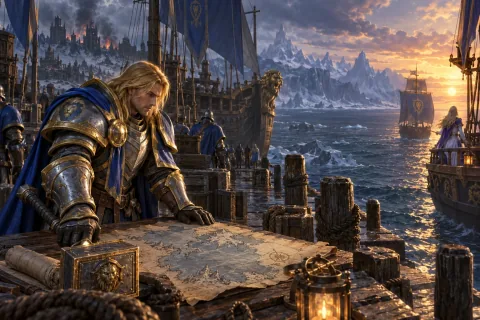
At this moment, he does not yet have Frostmourne in his hand. If one combines the decision at Stratholme and the act of picking up the cursed sword in the future into a single scene, the change in responsibility and judgment that occurs between them is erased. The prince went to the next battlefield carrying the line he had already crossed. That battlefield could not make the previous actions as if they had never happened.
For Jaina, a path in a different direction opened. The prophet Medivh, met in the ruins of Stratholme, advised her to lead the survivors and go to Kalimdor in the west. She followed those words. Faced with the fact that the city could not be completely restored, she chose the responsibility of gathering the people who could still be saved.
The people going west had to rebuild their lives from the beginning. However, they crossed the sea as living people. When Arthas headed north to end the source of the threat, Jaina headed west to find a space to survive from the threat. The two paths headed toward different purposes, but they were the future of humans divided by the same plague.
Chapter 10 · What Did Lordaeron Lose?
Even after the massacre of Stratholme, not all the gates of Lordaeron collapsed at once that day. The prince is not yet in the state of having returned to the kingdom and killed his father. If one keeps the position of this event, it is revealed that the downfall was not a change suddenly completed by a single magic. The decisions to investigate the threat, seek support, refuse that support, and take up weapons against the people were accumulated beforehand.
The standard Uther tried to protect, the order Jaina did not accept, and the enemy Arthas saw as something that must be ended turned in different directions before the same gate. If one reduces everyone to a single simple personality, that conflict shrinks. The mentor was not just an obstacle who hesitated, and Jaina was not just a lover who left. They were the people who could have allowed the prince to make a different choice.
What the Scourge took was not just life. They made the bodies and wills of the dead their own, and they tested the faith of those who stood against that terror. If the grain that entered the gate threatened human bodies, the conviction and fear of looking at the results shook even the relationships of the people protecting the kingdom. The plague entered the city, and the response to it divided those who served the Light.
At the end of the next path, the ice of Northrend and Frostmourne wait. However, before knowing the name of that sword, there is something to remember. The people Arthas tried to protect were not just a background decorating the prince's fate. Their deaths and the voyage of those who survived change the history of Azeroth thereafter. The two paths leaving Stratholme leave behind how different a future people who started in the same kingdom can have.
Terms and Character Paths
Arthas Menethil: A paladin who is the heir to the throne of Lordaeron and a student of Uther. This part covers his time as a living paladin. It does not advance the equipment and roles of the Death Knight wielding Frostmourne and the Lich King era.
Jaina Proudmoore: A mage from Kul Tiras who learned from Antonidas. After investigating the plague and refusing the order at Stratholme, she leads the survivors to Kalimdor. Her appearance, which changed after the tragedy of Theramore in the future, is distinguished from her appearance at the time.
Uther the Lightbringer: The leader of the Order of the Silver Hand and Arthas's mentor. He returned as reinforcements but refused to participate in the massacre of the residents. He is a character who clashes with the mission of fighting for the Light and the problem of obeying a monarch's order.
Kel'Thuzad: A mage from the Kirin Tor who served the Lich King and organized the human cult. His death at this time is not the same as his later resurrection, and his previous role is not explained solely by the appearance of the future Lich.
Cult of the Damned: An organization of living followers who serve the Lich King. Read by distinguishing between the promise of equality and eternal life, and their covert activities and the spread of the plague. Do not treat all victims forced into control by the Scourge as voluntary cult members.
Scourge and Lich King: The undead army and its ruler that weaken Azeroth ahead of the Burning Legion's invasion. At the time, the Lich King Ner'zhul and Arthas, who is still a paladin, are not yet merged into one body.
Mal'Ganis: A dreadlord tasked with drawing Arthas to the Lich King. Distinguish between his manipulation at Stratholme and the subsequent confrontation in Northrend. Do not transfer the figures seen in game combat to the actual combat time of the canon or permanent death judgments.
Stratholme: A human city of Lordaeron where the plague arrived. It is the place where Arthas's massacre and Jaina and Uther's refusal diverged. Read the event re-experienced in the Caverns of Time in the future, the history of the people at the time, and the current state of the city in their respective contexts.
Reading Along with Already Published Series
The path where Thrall liberated his kin and headed west in the same era can be read as a continuation from Part 31. /en/community/tm-warcraft-saga-part031-20261008
The connection after the collapse of Draenor and Ner'zhul's departure can be read in Part 30. /en/community/tm-warcraft-saga-part030-20261008
The background of the establishment of the Lordaeron Alliance and the Order of the Silver Hand is connected from Part 27. /en/community/tm-warcraft-saga-part027-20261008
Related Game Official Purchase Locations
The human campaign of this era is included in Warcraft III: Reign of Chaos. Distinguish between the base game and additional campaign configurations provided on the current official sales page. Follow the actual guidance on the purchase page for the scope of provision by language, price, and region.
Warcraft III — current official product and campaign inclusion
Official Materials and Confirmation Scope
Confirmation Date: October 8, 2026 (UTC). This was written based on settings and events confirmed in the official released materials below. Public samples and setting introductions were only confirmed for their respective public scope, and it is not indicated that the entire book was read. Illustrations are AI reconstructions, not official images.
Warcraft III: Reign of Chaos — official 2002 manual
Jaina Proudmoore, the Mage — official history (27 March 2014)
Jaina Hero Week — official Warcraft history and period artwork
Kel’Thuzad Enters the Nexus! — official history
Tales from the Smithy: Reforging the Humans — official model reference
Heroes of the Storm PTR Patch Notes — Mal’Ganis history (8 October 2018)
Warcraft III: Reign of Chaos — Stratholme in-game scene from the human campaign
Warcraft III — current official product and campaign inclusion
comments 1
아서스가 스트라솔름에서 내린 선택은 지금 봐도 정말 마음이 무겁네요. 빛을 섬기던 성기사가 어떻게 서리한보다 먼저 자기 신념을 먼저 잃게 되었는지 다시금 생각해보게 됩니다. 🛡️