
Recommended Game Story · Warcraft Part 27
Chapters in this story
- Chapter 1: A Name from the South Reaches Southshore
- Chapter 2: Joining Hands Without Laying Down the Crown
- Chapter 3: Red Lands and Green Seas
- Chapter 4: Violet Knowledge, Black Borders, and Orange Anxiety
- Chapter 5: The Hammer in the Mountains and the Ancient Oath in the Forest
- Chapter 6: When the Healing Hand Wears Armor
- Chapter 7: The Horde Heading North Was Also Changing
- Chapter 8: The Scale of War Seen When Spreading the Map
- Note on Distinguishing Eras and Versions
- Reading the Terms
- Already Published Related Stories
- To Play This Era Directly
- Official Materials and Verification Scope
Flags of the Seven Kingdoms: The Birth of the Knights of the Silver Hand
After the fall of Stormwind, war became an unavoidable reality for the northern kingdoms. This installment covers the formation of the Lordaeron Alliance in the original timeline, the choices made by each nation and allied race, the birth of the Knights of the Silver Hand, and the two factions preparing for the Second War. This narrative contains spoilers for the war and subsequent events. It is a reconstruction based on the official manuals of Warcraft II and Warcraft III, contrasted with later retrospectives from Blizzard. The issue of Gilneas's participation, where early manuals and current lore differ, is clarified at the end. The meeting layout and relief scenes in the illustrations are interpretations for the narrative and are not official dialogue or records of actual events.
Chapter 1: A Name from the South Reaches Southshore
Those who crossed over from the southern kingdoms could not immediately reclaim their homes upon arriving at the northern shores. While the sea had provided distance from the pursuing forces, it did not rebuild their burned houses. The people of a land whose king was alive now had to begin their days in the lands of another king. The act of unpacking their burdens and accepting the loss of their nation arrived simultaneously.
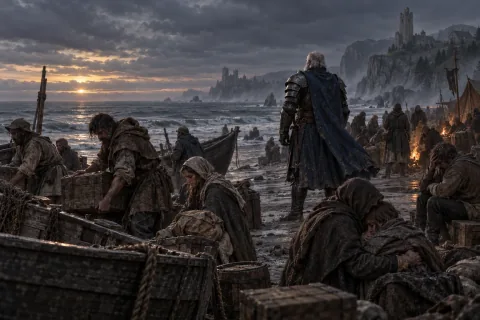
The official old manuals state that the survivors of Stormwind settled near Southshore. It was not just soldiers who moved from the south to the north. Evidence of a war that one kingdom could not withstand arrived in the form of the people themselves. They still possessed the name of their nation and a leader. Anduin Lothar, as the regent leader representing the survivors, took on the responsibility of the lost kingdom.
What Lothar needed to seek from other nations was not merely a safe settlement. The people who followed him wanted a land to return to someday. To return, they had to drive out the Horde, and to drive out the Horde, they needed a force greater than the remaining Stormwind troops. This is why the end of their flight became the beginning of diplomacy.
Terenas Menethil II, King of Lordaeron, heard the plea. The southern city had already fallen, and its king, Llane, was dead. The room to dismiss the distant war as a rumor unrelated to his own country had shrunk. If the Horde had toppled one kingdom, there was no guarantee that the next kingdom would be safe.
The problem was now clear. Would each nation fight in turn beneath its own walls, or would they join hands while they could still fight together? Only after one kingdom had collapsed did the remaining kingdoms begin to view each other's existence with a new weight.
Chapter 2: Joining Hands Without Laying Down the Crown
Terenas summoned the leaders of the human kingdoms to discuss a joint response. However, gathering in one place was different from sharing the same intent. Every king had borders and subjects to protect, and there were already established interests and distrust. While they acknowledged the tragedy that had occurred in the south, deciding how much of their own nation's military to commit was a separate choice.
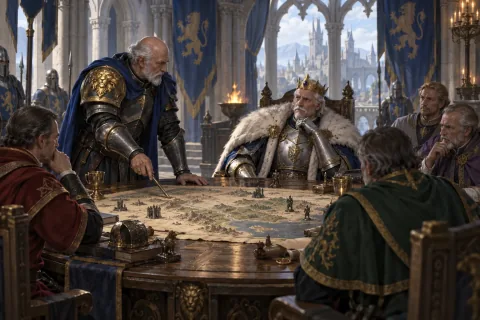
Lordaeron, Stormwind, Stromgarde, Kul Tiras, Dalaran, Gilneas, and Alterac. Later official history explains that these seven nations formed the Lordaeron Alliance. These names were not provinces of a single empire. They were an alliance formed by nations with different rulers and traditions in the face of war. Just because Terenas led the meeting did not mean all the crowns became his.
The responsibility of leading the coalition army was entrusted to Lothar. A commander who had lost his own capital now had to command the forces of several nations. While his knowledge of the war's nature was a strength, the alliance could not be maintained if he consumed other people's lives solely for the vengeance of his own country. Lothar's next battle was the struggle to bind the intent of many flags into a single front.
The debates recorded in the old manuals show that this formation did not happen automatically. Seeing a single enemy does not mean everyone accepts the costs and risks equally. Some had to provide troops, some ships, and others magic and supplies. For promises to become an actual army, each nation had to send the power in its hands into the war.
Thus, the defeat of Stormwind did not become the end of humanity as a whole. In a war that failed to protect one nation, a way for nations to endure together was born. Nothing had been won yet. However, in the next battle, the people standing behind Lothar were no longer just the people of one kingdom.
Chapter 3: Red Lands and Green Seas
Thoras Trollbane of Stromgarde ruled a nation with a long tradition of war. To the warriors standing under the red flag, the crisis in the north could not sound like a story from the distant south. If enemy movements continued from the direction of Khaz Modan, the borders and roads of the land could soon become their own battlefield.
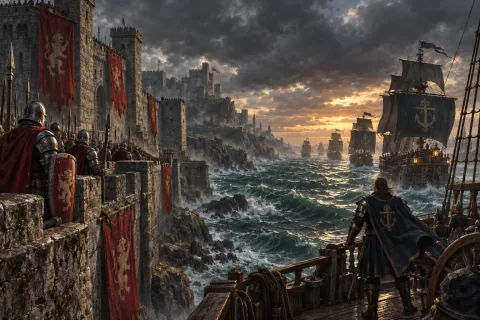
Their name carried the long history of Arathi and Strom. However, history alone cannot stop a new enemy. Their experience fighting trolls, their strict military spirit, and their border-guarding troops became power used within the new coalition. The support Thoras offered was a decision to translate the pride of an ancient kingdom into the actual battlefield.
At sea, Kul Tiras occupied a vital position. Leader Daelin Proudmoore had a long-standing relationship with Lothar, and his nation possessed merchant ships and sailors who traversed the distant seas. A nation that had built its strength through maritime trade since before the First War now had to commit its routes and shipbuilding capabilities to the war.
The sea that had saved the people of Stormwind could not remain merely a safe escape route forever. The enemy could also build ships and transport armies. The task of stopping troops arriving on the coast on land and the task of guarding the sea to prevent those troops from arriving were connected. Ports, shipyards, sailors, and transport ships became as important to the war as walls and knights.
The fact that the battlefields of Warcraft II unfold across both land and sea is in line with these changes. There were more roads to protect than in the first war, which was fought over the capital of a single kingdom. The alliance had to consider the army moving on land and the fleet moving at sea together. When each nation's strengths began to cover the weaknesses of others, the meaning of binding multiple flags was revealed as actual power.
Chapter 4: Violet Knowledge, Black Borders, and Orange Anxiety
Dalaran was a city that gained its name through knowledge and magic before the sword. The Kirin Tor there was an organization that had studied the threats between demons and dimensions more closely than anyone else. Considering how Medivh and the Dark Portal opened the first war, the coming fight could not be judged by troop numbers alone. The enemy's power contained elements that had crossed over from beyond the ordinary borders of Azeroth.
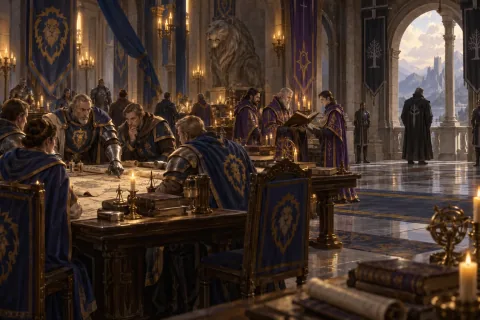
The failure of the first war remained with the mages as well. The old manuals explain that previous magic users could not sufficiently handle the dangers of combat, and that the next generation of mages prepared more rigorous training and powerful combat magic. Knowledge could not remain only within the city's archives. It was necessary to block attacks, support troops, and understand the means of an invisible enemy.
Genn Greymane of Gilneas was a king who valued his nation's strength and independence. He was not a figure who would accept external demands simply because they were fellow human nations. The issue of questioning whether the alliance protected his country or constantly demanded his country's strength would continue into his future choices.
If one were to conclude here that Gilneas remained outside the alliance throughout the war, it would contradict later official lore. While early Warcraft II manuals wrote such things, Blizzard's later introductions clearly explain that Gilneas supported the Alliance during the Second War and severed ties afterward. This story follows that revised flow. The kingdom of the black flag also entered the common crisis, but the alliance did not erase the suspicions of each nation.
Aiden Perenolde of Alterac had a different kind of anxiety. In official manuals, his nation is introduced as having relatively smaller military power compared to others. If the enemy keeps winning, is it safer to trust in the alliance's victory and hold out, or is it the way to survive to surrender? There is no need to rush the results of choices that have not yet happened, but it is revealed here that the alliance did not have the same conviction from the start.
Even though several kingdoms joined hands, different fears remained. Enduring that while fighting the war together was a new test in itself. While defeating the enemy on the front lines, the relationships between the kings also had to endure.
Chapter 5: The Hammer in the Mountains and the Ancient Oath in the Forest
To the dwarves of Ironforge, the Horde was not a monster from rumors. The mountain kingdom of Khaz Modan was already under attack. Their contribution to the alliance was not merely a favor to humans, but a defense of their own homeland. The fact that they faced the same enemy connected the survival of different races.
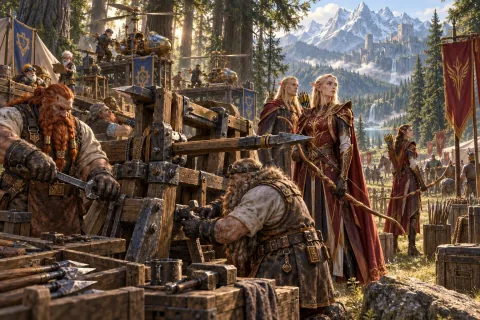
The dwarves brought their ability to handle metal, gunpowder, and sturdy equipment to the war. The gnomes, in place of their small bodies, observed the vast battlefield through invention and piloting. The original game's official manual introduces reconnaissance flying machines as a means to detect enemy movements from the sky. With cannons, explosives, reconnaissance, and transport added, the war became broader than just infantry running toward each other.
In the description of the ballista, which humans designed, elves helped produce, and dwarves improved the projectiles for, the image of this coalition is contained even within a single small weapon. Writing down more race names does not make a strong alliance. When different technologies actually accomplish one task, a reason to fight together is born.
The high elves of Quel'Thalas had a much older promise. After humans and elves fought together in the Troll Wars, an oath made with the bloodline of Arathi remained. Lothar, as the last descendant of that bloodline, asked for help. It was a moment where the history of humans and elves, passed through in parts 18 and 19, returned to the current war after many generations.
Anasterian Sunstrider did not offer all of his kingdom's power from the start. Later official retrospectives explain that he sent a small support force, placing Ranger-General Alleria Windrunner at its head. The existence of an ancient pact and how actively one intervenes are different matters. The forest kingdom also had its own borders and its own judgment.
Nevertheless, the support force set out. Elves with bows, dwarves with hammers, gnome machines, and human cavalry and mages entered the same war. They did not all share the same past. However, it was not predetermined whose house the enemy would burn next. That common danger brought long history and ancient promises back to life.
Chapter 6: When the Healing Hand Wears Armor
The first war left deep scars on the clerics of Northshire as well. The ability to care for people alone could not protect the caregivers themselves and the people before them to the end. If a cleric fell, the help that would have reached wounded soldiers and villagers was cut off. What Alonsus Faol faced was the question of how to protect the teachings of faith in the face of the violence of the battlefield.
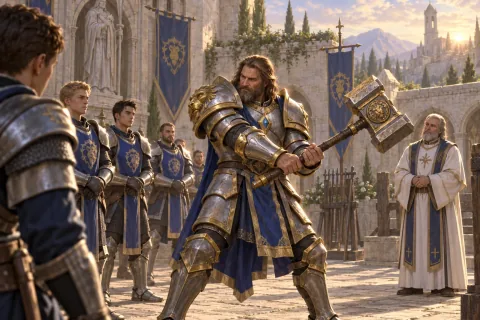
Together with the surviving clerics, he sought out those among the knights of Lordaeron who possessed high virtue. It was a path to teach healing power to warriors and to equip those with faith with the ability to fight and defend. If armor and magic, discipline and faith remained as separate roles, the same failure could be repeated.
From this preparation, the Knights of the Silver Hand were born. Uther, as Faol's disciple, became the figure leading that new order. A paladin was a warrior who struck down the enemy and, at the same time, a person who raised fallen comrades. The meaning of that hammer did not end with a single heavy blow. It included protecting refugees, treating soldiers' wounds, and helping collapsed communities find the strength to endure again.
Possessing the power of the Light does not mean the pain of war disappears. A person who is healed and survives can return to the battlefield, and a knight in strong armor can meet an even stronger enemy. The birth of the paladin order is not a scene that promises an easy victory. It was a choice to remember the weaknesses revealed in the first war and to change roles to save more people in the next war.
Turalyon also enters the next war as one of the early paladins. His name gains weight later at the moment he takes over Lothar's command and in the expedition beyond the Dark Portal. He is a new knight whose end is not yet known. It would take more time on the battlefield for one person's training and choices to reach the fate of the alliance.
In a separate installment covering the individual stories of the paladin order and the founding paladins, we will reconnect their respective post-war paths. The core followed in this main volume is the cause that made them necessary. While the person with the sword and the person who heals waited for each other, they had lost lives; now, a single order of knights sought to protect them together.
Chapter 7: The Horde Heading North Was Also Changing
While the Alliance gathered its army, Orgrim Doomhammer also moved. He did not end the war after toppling Stormwind. He sought to pursue the surviving humans to the north and gain the strength to deal with the remaining kingdoms. The Warchief also encountered the problem on his side that he could not fight a war expanded by swords and axes alone.
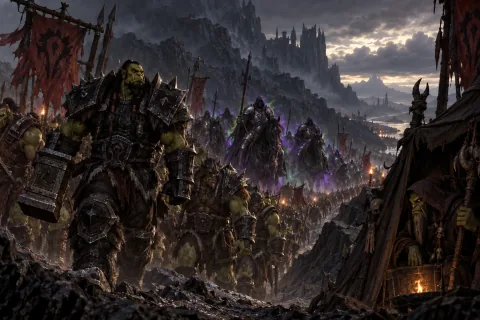
Gul'dan did not die and remained in the Horde. Having awakened from a coma after Medivh's death, he preserved his life by making a deal with the new Warchief and rebuilt his base. Orgrim did not trust him completely, but he could use the power his magic would create. The interests of a warlock who wanted to survive and a commander who wanted to continue the war overlapped dangerously.
The first generation of death knights also appeared within that relationship. Those described by old official manuals were beings created by binding the souls of orc warlocks to the corpses of human knights. Although they share the same name as the death knights who would later appear under the Lich King, their era and birth process should not be merged into one. The Horde used the death left by the war in Stormwind as a weapon for the next war.
The forest trolls of Amani had an old hostility toward humans and elves. The force led by Zul'jin was not a race that had lived the same history on the same land as the orcs. However, the goal of fighting the elves became a reason to join hands with the Horde. On the path of Orgrim's army heading north, conflicts that had long continued in Azeroth joined in.
This alliance, too, was not a peaceful union achieved because one side completely understood the other's intent. Zul'jin's goals, Orgrim's war, and Gul'dan's pursuit of power were not the same. For the moment, they could use each other's strength, but the question of what to protect first and what they were moving for remained. That difference would be revealed again in the forests of Quel'Thalas and the more distant seas.
With transport ships, combat vessels, and warriors from various clans and factions added, the Horde did not remain the same army as in the first war. The invasion that began through the portal between worlds now embraced the old hostilities, technologies, and maritime routes within Azeroth. Just as the human alliance connected various nations and races, their enemy also bound more power and moved north.
Chapter 8: The Scale of War Seen When Spreading the Map
When the power gathered by the two factions is placed on a map, what changed from the first war becomes clear. The northern coast where Stormwind survivors stayed, the heart of Lordaeron, the land borders of Stromgarde, the sea routes of Kul Tiras, the mountain regions of Khaz Modan, and the forests of Quel'Thalas all entered the scope of the same war. The victory or defeat of one place was connected to the safety of others.
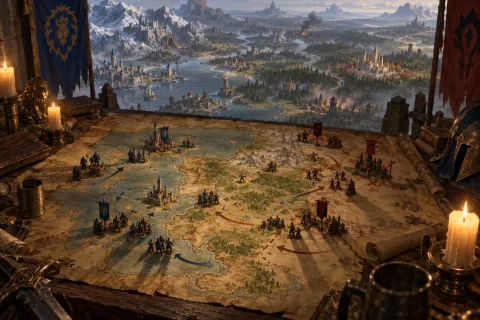
The dwarves in the mountains waited for the human alliance while their own land was under attack, and the humans had to protect the time and roads for the alliance's troops to move. The elven support force came following an ancient oath, but if the forest itself began to be threatened, the meaning of the fight could change. The fleet had to transport the army while simultaneously preventing the enemy from opening new fronts on other coasts.
Orgrim continued the destruction as he advanced north. Lothar tried not to repeat the end of Stormwind before him. However, this time he was not just commanding the soldiers of his own country. He had to consider the circumstances of allied nations, the goals of other races, the healing of paladins and the firepower of mages, and naval engagements and land supply lines together. A larger army was more possibilities, but also more responsibility.
Even after the name Alliance was completed, the actual alliance had to be continuously forged on the battlefield. Does the promised support arrive? Do they accept the crisis of another nation as their own? Can they turn an opportunity gained in one battle into the flow of the entire war? The decisions of kings would reach the daily lives of nameless soldiers, sailors, and refugees, proving their meaning.
The new hope at this point did not come from the enemy being weakened. It came from the fact that nations that could have collapsed alone had created a way to endure together. Since the Horde's power heading north had also grown, no one could guarantee that the path would lead to the end.
In the next main volume, we will follow the war that burns the forest, the power that binds dragons, and the diverging purposes within the Horde. The old grudge of Quel'Thalas and the Tomb of Sargeras that Gul'dan seeks will meet in a single war. For now, it is the moment when all flags have begun to move. The people of the lost kingdom have gained, for the first time in the north, the possibility that they might be able to build a path back together.
Note on Distinguishing Eras and Versions
The Alliance here is the Lordaeron Alliance during the Second War. It is not depicted as a union possessing all the races and political structures of later eras from the beginning. The notation of the Kingdom of Azeroth in old manuals refers to Stormwind in the south in this context, not the government of the entire planet of Azeroth.
Early manuals wrote that Gilneas remained outside the alliance. Later official introductions and the 2020 retrospective explain its participation and subsequent withdrawal. The text follows the later flow and does not merge early sentences into established facts of different eras. The colors of each nation in the manuals are expressions of the game, and it is not assumed that all emblems and uniforms of all eras were the same based on one color.
This installment covers the formation of the alliance and the connection of the forces that supported the war. It does not merge the branch endings of each game mission into the same canonical event, and individual operations and detailed post-war stories of characters will be contrasted in the next phase of the main volume and separate character/faction installments. Official cinematics and later character models were used for appearance verification, and events from later in those scenes were not moved to this era.
Reading the Terms
Alliance of Lordaeron — A coalition organized by human kingdoms and allied forces for the Second War. It is not a single empire where Terenas became the king of all nations.
Southshore — A village on the northern coast where old official manuals explain that Stormwind survivors settled nearby.
Kirin Tor — The mage organization of Dalaran. In the war, magic and knowledge lead to the alliance's means of defense.
Khaz Modan — A mountain region where the history of dwarves and gnomes is connected. In the Second War, the Horde's attack and the alliance's defense are intertwined.
Knights of the Silver Hand — The early human paladin order founded by Faol and led by Uther. They sought to possess both combat ability as knights and the healing of the Light.
Alonsus Faol — The archbishop who prepared the new paladin order through his experience in the first war. Here, he is the human cleric of that era.
Turalyon — An early paladin who goes out to the next war with Lothar. His later expedition and role continue in the main volume of that era.
Zul'jin — A forest troll leader with a long-standing hostility toward elves. His joining of the Horde in this era is not equated with the later origin of the Darkspear tribe.
Already Published Related Stories
To continue reading about the fall of Stormwind and the sea voyage of the survivors, see Warcraft Part 26.
/en/community/tm-warcraft-saga-part026-20261008
To examine the birth of Gul'dan and the original Horde, see Warcraft Part 24.
/en/community/tm-warcraft-saga-part024-20261008
The background of Quel'Thalas, founded by the high elves, is in Warcraft Part 18.
/en/community/tm-warcraft-saga-part018-20261008
The origin of the ancient human-elf pact requested by Lothar is in Warcraft Part 19.
/en/community/tm-warcraft-saga-part019-20261008
To Play This Era Directly
Warcraft II: Remastered is the official game that provides both the Tides of Darkness and Beyond the Dark Portal campaigns. After reading the text, you can check the supported environments and purchase conditions on the official product page below to experience each faction's missions and battlefields yourself. It is good to read the playable results of the original campaigns and the later canonical chronology separately.
Warcraft II: Remastered — official Battle.net product page
Official Materials and Verification Scope
Verification Date: October 8, 2026 (UTC). This was written based on settings and events confirmed in the official public materials below. Public samples and setting introductions were only verified within their scope, and it is not indicated that the entire books were read. The illustrations are AI reconstructions, not official images.
Warcraft II: Battle.net Edition — Official Manual
Warcraft III: Reign of Chaos — official 2002 manual
Warcraft III: The Story So Far
comments 1
초기 설명서와 후대 설정의 충돌이 언급된 길니아스의 참전 문제처럼, 당시 동맹의 결속력을 시험했던 다른 왕국들의 내적 갈등이나 불신이 구체적으로 어떤 사건을 통해 표면화되었는지 궁금합니다.