
Recommended Game Story · Warcraft Part 17
Chapters in this story
- The Satyr War and the Fury of the Wolf · Losing Oneself in the Forest Meant to be Protected
- Chapter 1 · The War Left Behind by Demons Who Could Not Return
- Chapter 2 · The Reason to Call Upon the Sleeping
- Chapter 3 · An Army That Knows the Ways of the Forest
- Chapter 4 · The Power of Goldrinn, the Fury of the Pack
- Chapter 5 · A Scythe Created to Calm the Fury
- Chapter 6 · When Power Called for Victory Turns Against Allies
- Chapter 7 · An Old Sleep Was Not an Eternal Solution
- Chapter 8 · The Boundaries the Forest Learned
- Reading with Terminology
- Official Materials and Verification Scope
The Satyr War and the Fury of the Wolf · Losing Oneself in the Forest Meant to be Protected
Spoiler Notice: This entry covers the Satyr War approximately 9,300 years before the opening of the Dark Portal, the response of Shandris and the druids, Ralaar Fangfire and the Druids of the Pack, and the birth of the first worgen through the Scythe of Elune. A new war descends upon the society that the World Tree and the Sentinels began to protect in the previous chapter. The events described are based on the World of Warcraft: Chronicle and official Cataclysm manuals and artifact introductions; no fabricated dialogue has been attributed to the characters as if it were official.
Chapter 1 · The War Left Behind by Demons Who Could Not Return
The Great Sundering altered the map of Kalimdor, but it did not send every surviving demon back to another world. While the night elves rebuilt their lives in the forests, remnants of the Legion remained on Azeroth. In the peace following the massive invasion, there were still places for darkness to hide.
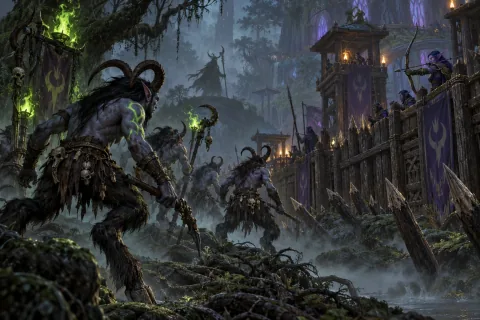
From that darkness, the satyr leader Xalan gathered his forces. Satyrs were not merely strange monsters disconnected from night elf history. Among them were former night elves who had been transformed into demonic forms through corruption. It was as if the past that had invited the Legion's invasion had returned as a new enemy of the forest.
Xalan's movements were echoed by doomguards and other demons trapped on Azeroth after the Sundering. The call of the satyrs provided a direction for the scattered remnants to gather. Even without the massive gates of the Legion reopening, it was possible for the remaining enemies to form a single army.
That army attacked the night elf stronghold of Night Run. The Chronicle explains that this raid plunged the still-vulnerable society back into war. The institution of the Sentinels, established to protect, was now tested in actual combat. For the survivors of the Sundering, the forest was a new home. The enemy did not wait for them to finish preparing to defend that home.
The satyrs' horns, hooves, and furred legs, as well as the Sentinels' long ears, violet skin, and bows, have been reconstructed according to official materials. The arrangement of the palisades and paths under the moonlight is a reconstruction intended to help visualize the Night Run raid. It is not an official illustration restoring a specific map or the exact face of Xalan.
Chapter 2 · The Reason to Call Upon the Sleeping
The initial losses were significant. Knowing the forest did not guarantee the ability to block every raid, and there were limits to facing a demonic army with only strong archers. At this time, Shandris Feathermoon proposed another path: to bring back the druids who were within the Emerald Dream.
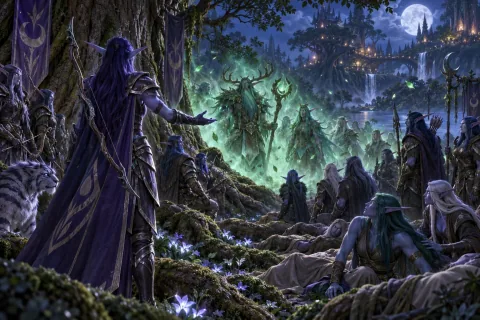
Shandris was Tyrande's adopted daughter and a commander of the Sentinels. A child who had lost her family in the War of the Ancients, she now stood in a position responsible for the survival of others. The solution she found was not a rejection of the Sentinels' role. It was to reconnect with those who could help protect the forest in a fight too difficult to handle alone.
Malfurion understood the danger of the corruption Xalan was spreading and agreed to this proposal. Powerful druids returned from the Dream. Those who had been connected to nature through the blessing of the World Tree were once again participating in the war of the waking world.
Here, the druids' sleep is not simply read as an irresponsible escape. As seen in the previous chapter, the connection to the Dream was also a part of life spent caring for the world. However, to stop the enemy currently burning the forest, different methods of protection had to be gathered on the same battlefield. Shandris's judgment allowed them to cross that boundary.
Chapter 3 · An Army That Knows the Ways of the Forest
The cooperation between the Sentinels and the druids changed the tide of the war. The Chronicle recounts that they counterattacked toward the heart of the satyr forces, and Shandris's guerrilla tactics struck down the enemies, including Xalan. This was not a victory achieved merely by stronger soldiers charging in lines. Command that read the terrain and movement was combined with the power of nature.
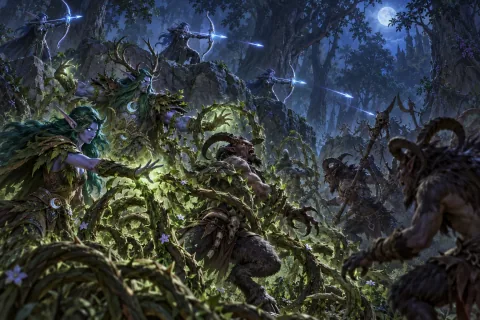
Protecting the forest did not mean treating everything in the forest as a single weapon. The range and cover of archers and the natural powers wielded by druids could take on different roles. The roots, palisades, and moonlight in the text and illustrations are expressions of scenes meant to evoke that cooperation; specific operational orders or one-on-one duels not found in public materials have not been fabricated.
This counterattack was a crucial turning point that ended Xalan's threat. However, not every power chosen during the war remained under control. On one side of the battlefield where the satyrs were collapsing, the night elves faced another danger brought forth by their own side.
Knowing the name of an enemy and defeating their army is different from fully understanding the nature of the power one uses. The Satyr War left both of those problems in the same forest.
Chapter 4 · The Power of Goldrinn, the Fury of the Pack
Druidic shapeshifting is not a magic trick that merely changes one's appearance. It is a discipline that approaches the nature and power of living beings, and it tests the spirit of those who wield that power. After the War of the Ancients, some druids used a form that drew upon the fury of the wolf Wild God, Goldrinn. These were known as the Druids of the Pack.
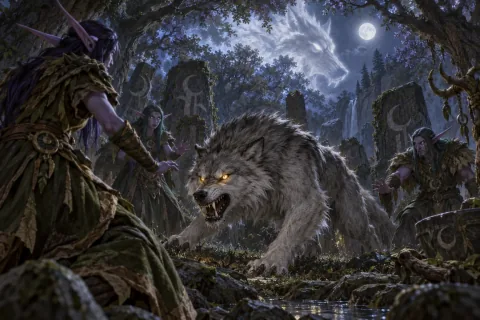
That power was immense. The problem was that the fact of its power could not replace the fact of its safety. The official Cataclysm manual explains that they became slaves to their own fury, drawn more to instinct than reason. While their combat capabilities increased, the boundaries of their judgment collapsed.
Malfurion forbade the use of this form. However, his disciple Ralaar Fangfire did not accept that decision. Ralaar was not someone who was unaware of the danger itself. He saw the fury of Goldrinn as the key to winning the war against the satyrs.
Thus, this conflict does not reduce to a simple opposition between those who believe in good power and those who want bad power. Faced with the goal of protecting the community, one side believed that uncontrollable power must be abandoned, while the other believed that a way to control that power must be found. That difference led to the next choice.
Chapter 5 · A Scythe Created to Calm the Fury
Ralaar, along with the priestess of Elune, Belysra, created an artifact. It was the Scythe of Elune. The purpose revealed by the official manual was to temper the raw fury of the pack form. Creating more cruel monsters was not the goal from the beginning.
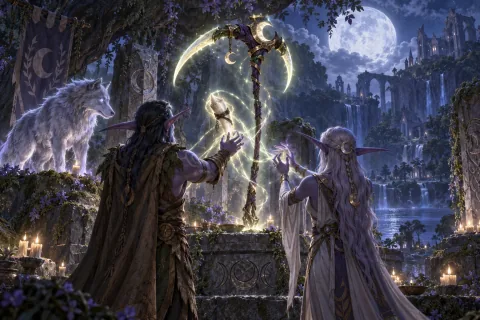
The official druid artifact introduction explains that this scythe was made from the Staff of Elune and the Fang of Goldrinn. The power of the moon and the power of the wolf were connected within a single weapon. That combination was an attempt at control, but the result was different from the intention.
The scythe did not calm Goldrinn's fury. Ralaar and his followers transformed into a new form, neither wolf nor night elf. They were the first worgen of Azeroth. The attempt to change the vessel of power ended up changing the people who used that power themselves.
This is why the official artifact introduction warns even after a long time has passed. A user who has lost balance can become not the one who wields the power of the scythe, but one who is dominated by it. This history cannot be explained solely by the appearance of a beautiful lunar artifact. The weapon inherited not only the intentions of those who made it but also the consequences of their failure.
The gray and black fur, long wolf snouts, golden eyes, and large claws were referenced from official worgen materials. The scythe in the foreground is a new representation reflecting the golden ornaments, purple wrappings, and curved blade of the official artifact. The composition placing the scythe and the worgen together is a symbolic scene showing the relationship between power and control, not a record that a specific individual used the artifact in this position.
Chapter 6 · When Power Called for Victory Turns Against Allies
The worgen attacked the satyrs. However, their attacks did not stop at the enemy. The official manual recounts that they tore through both allies and enemies in battle. The moment they lost sight of who they were meant to protect, even after gaining the power to defeat the enemy, that power could no longer remain a shield for the community.
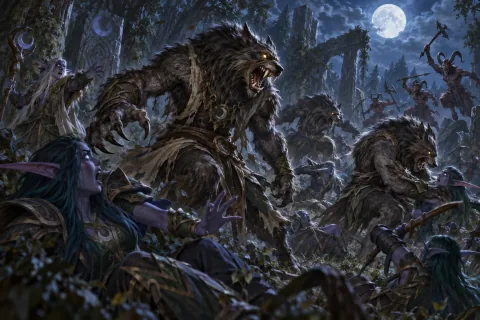
The danger did not end with the rampage of one group. Even night elves who were bitten were cursed and transformed into worgen. It was a case where the damage of war turned new victims into the same threat. This is the point where it differs from a transformation form simply chosen by several druids. The change spread even to those who had not chosen it.
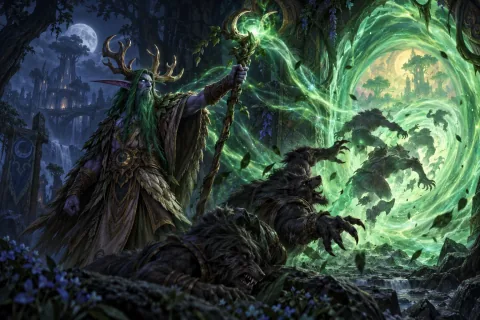
Malfurion no longer had only the problem of pursuing the enemy army. He had to stop the danger his own disciples had unleashed and halt the curse spreading to others. He eventually banished the worgen to the Emerald Dream. There, they entered a peaceful sleep.
No fabricated trial dialogue or final inner thoughts are attached to this conclusion. What the official manual conveys is Malfurion's reluctant banishment and the long sleep. Instead of a conclusion where they return to the forest they sought to protect and share in the victory, a conclusion remains where those who sought to protect the forest leave the waking world.
Chapter 7 · An Old Sleep Was Not an Eternal Solution
Sleep in the Dream does not mean the curse was undone as if it never happened. The worgen did not disappear; they were merely separated from the waking world. Those who remained quelled the threat, but they could not erase the history of how that threat came to be.
The story of Arugal summoning the worgen from the Dream to fight against the undead thousands of years later belongs to the era when this seal was reopened. The official Cataclysm manual reveals that connection, but in this entry, the ancient Satyr War and the later events in Gilneas are not mixed as if they were the same war. The choices and damages of Arugal, Silverpine Forest, and Gilneas continue in the main story and character entries of that era.
The public introduction of the official comic, Curse of the Worgen, also presents the friendship between Ralaar and Arvell as a story to understand the origin of the worgen. Having only confirmed the public introduction of that comic, I do not fabricate scenes and dialogue that I have not yet read. Deeper stories of the characters are left as research items for separate character entries to be connected after verifying the materials.
Once you know of this long sleep, the later worgen do not appear as monsters that suddenly came into existence. Behind that form lies the time of an attempt to protect the community long ago, power that failed to be controlled, and people who were cursed even though they did not choose it.
Chapter 8 · The Boundaries the Forest Learned
In the Satyr War, the night elves confirmed the power of cooperation. Shandris gathered the guardians of the Dream and reality once again, and the Sentinels and druids faced a common enemy. Their victory was not proof that one organization alone could protect the world. It was an experience that different roles must be connected.
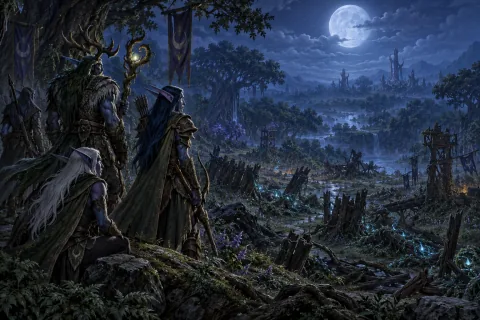
At the same time, the Druids of the Pack left behind another question. If you lose the people you are meant to protect while gaining the power to defeat an enemy, what does that victory protect? This question is not the hidden monologue of an official character, but a perspective of commentary read by following the events.
Society after the Great Sundering forbade magic and connected life to nature and the Dream, but the power of nature itself was not unconditionally safe. The new order that avoided danger also had to make choices again in the face of new power. Surviving does not end with repeating one correct decision forever.
Even after the war passed, the problems of arcane magic and the Highborne remained. Those who could not agree on the boundaries to be kept in the forests of Kalimdor would later cross the sea to find other lives. The path of the next era begins with yet another farewell.
Reading with Terminology
Satyr: A demonic force that includes corrupted former night elves. The ancient satyrs and the later Nightmare form of Xavius are not conflated as having the same appearance.
Xalan: The leader who gathered the satyrs and Legion remnants to lead the attack on Night Run.
Shandris Feathermoon: Tyrande's adopted daughter and Sentinel commander. She proposed calling the druids from the Dream.
Druids of the Pack: Druids who used a dangerous form that drew upon the fury of Goldrinn.
Ralaar Fangfire: The druid who opposed Malfurion's ban and created the Scythe of Elune with Belysra.
Scythe of Elune: An artifact made from the Staff of Elune and the Fang of Goldrinn. It is connected to the origin of the worgen.
Worgen: The first worgen in this entry belong to the ancient history of the night elves. The process of the curse spreading to later Gilnean humans is a separate era.
Reconstruction of the World Tree, Dream, and Sentinels: /en/community/tm-warcraft-saga-part016-20261008
Read from the beginning of the world view: /en/community/tm-warcraft-saga-part001-20261008
The entire series currently published can be read in order from the work index below the article. I have not linked unreleased parts as if they were posted.
Official Materials and Verification Scope
Verification Date: October 8, 2026 (UTC). This was written based on settings and events confirmed in the official public materials below. Public samples and setting introductions were only verified within their respective public scope, and it is not indicated that the entire books were read. Illustrations are AI reconstructions, not official images.
World of Warcraft: Chronicle Volume I — publisher-authorized Google Books preview/search
Warcraft III: Reign of Chaos — official 2002 manual
World of Warcraft: Cataclysm official manual — Worgen: The Fury of Goldrinn
comments 0