
Recommended Game Story · Warcraft Part 9
Chapters in this story
- The Origin of the Mogu and the Reign of Lei Shen
- Chapter 1: The Army of Stone Without a Keeper
- Chapter 2: The Warrior Who Became the Master of Lightning
- Chapter 3: Chains Forged in the Name of Unification
- Chapter 4: Faith That Remained Even After the White Tiger Fell
- Chapter 5: Calculations Made by Two Empires
- Chapter 6: The Day the Lightning Stopped in Uldum
- Chapter 7: The Place Where the Emperor Vanished, and the Door Not Yet Opened
- Names and Concepts of This Episode
- Official Data and Verification Scope
The Origin of the Mogu and the Reign of Lei Shen
Spoiler Notice: This article covers the Mogu Empire in ancient Azerothian history and the first fall of the Thunder King. The adventure involving the resurrected Thunder King in Mists of Pandaria continues in later chapters. The following story is a commentary based on officially released lore. No new dialogue for characters has been invented to pass as official text.
Stone endures for a long time. However, simply being made of stone does not mean one can serve the same purpose forever. Change eventually came to the Mogu, who guarded the fertile lands of the south. Once, the commands of the creators were indistinguishable from their reason for existence. What to protect and what to repel, the positions they held were defined within the order of things. As time passed, the Keeper who issued the commands grew distant, and the Curse of Flesh seeped into their stone bodies.
At last, the Mogu knew death. And they turned that fear against one another. Tribal competition turned into war, and war turned into vengeance. From the place where the ancient order collapsed, a warrior arose. His name was Lei Shen. In later days, the palaces of his empire would shine with his lightning, but for the people who had to live beneath that light, it was not a warm dawn.
Chapter 1: The Army of Stone Without a Keeper
The origin of the Mogu reaches back to the Titan-forged. In the history where Keeper Ra established and guarded Titan facilities in the south, the Mogu appeared alongside other creations like the Tol'vir and Anubisath. One must remember this starting point. If one describes the Mogu, who later became the slave-masters of an empire, as a race created solely for that purpose from the beginning, the long history between creation and corruption is lost.
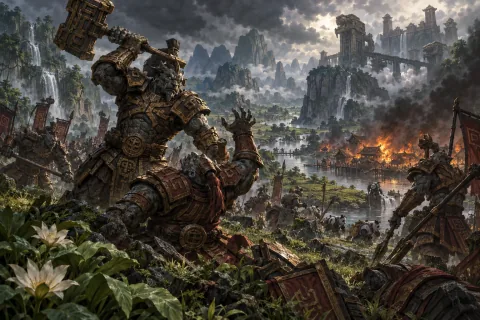
The Curse of Flesh did not only change their bodies. The possibility of death, which had been foreign until then, became a matter of individual survival. Official Chronicle materials explain that during this period, internal anxiety and division among the Mogu, as well as clashes between warlords and clans, intensified. When someone was defeated, that defeat did not end with a single battle. Competitors sought to end the bloodline of the defeated leader. It was a calculation to prevent the next generation from returning for revenge.
Thus, it became a society that sought to protect the present by eliminating the future. For other inhabitants of the same land, the wars of the Mogu were disasters caused by far greater powers. The power struggles of warlords passed over the lives of farms, villages, rivers, and forests. The abundance of the south became not a reason to stop the war, but a reason to fight over who should possess it.
Chapter 2: The Warrior Who Became the Master of Lightning
Lei Shen was a descendant of a minor warlord. He knew the cruelty of clan warfare up close, and while he was skilled in combat, he did not see the endlessly repeating divisions as the answer. What he sought was not merely an opportunity to strike down a stronger competitor. He sought the lost purpose of the Mogu and the whereabouts of the Keeper who could explain that purpose.
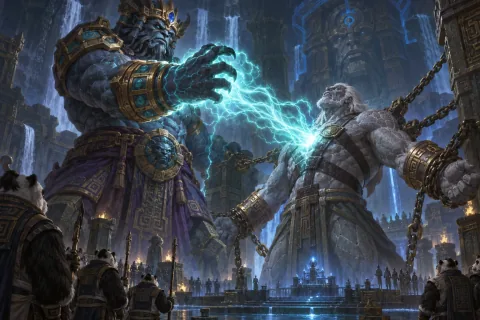
In the Mogu language, Ra came to be called Ra-den, the Master Ra. However, the silence of the creator was long. The Keeper Lei Shen encountered was not the proactive leader the Mogu had expected. The public sections of the Chronicle connect Ra-den's knowledge of the Pantheon's destruction to his preservation of the remaining power of Aman'Thul. Lei Shen saw in the answer he found not comfort, but another disconnection.
He judged that if Ra-den would not continue the purpose of the Titans, he would take that place himself. He attacked, subdued, and bound the Keeper, stealing Ra-den's power and the preserved power of Aman'Thul. Beyond the event of a powerful warrior becoming even stronger, it was the moment a being entrusted with power had that power forcibly stolen. Lei Shen's empire began upon this twisted succession.
The name Thunder King was not merely an ornament. Even in official raid introductions, Lei Shen is not described as a helpless vessel that must be charged by its surroundings. Rather, he becomes the source of power, even moving the mechanisms of the citadel. The Palace of Lightning that adventurers later faced shows what image the power of the ancient empire left behind. The lightning surging from the ruler's body connects architecture, military, and terror into one.
Chapter 3: Chains Forged in the Name of Unification
Lei Shen bound the divided Mogu into an empire. The fact that he had the power to end the division and the claim that this power guaranteed the freedom of his people are not at all the same thing. As the empire grew, the beings living within his domain were treated not as residents with their own lives, but as resources belonging to the Emperor.
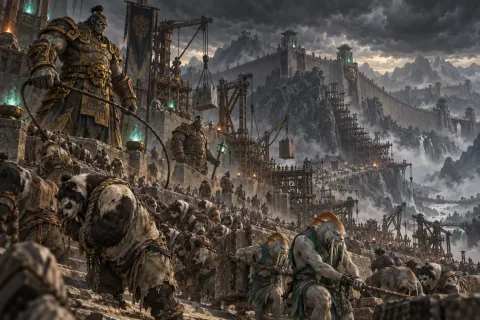
The public Chronicle conveys that enslaved residents were mobilized for war and expansion. It was not only the Pandaren who suffered. The Jinyu, accustomed to the life of rivers and waters, and the territories of other surrounding races also fell under the power of the Mogu. If one narrows this to the tragedy of a single race, one misses the scale at which the empire reorganized various societies. Someone's hometown was turned into a region for labor supply on the Emperor's map.
The periodic attacks of the Mantid were another pressure. The Thunder King erected the Serpent's Spine, a massive wall. The gaze directed at the wall must have differed from person to person. The function of a defensive line was clear, but the plight of those who had to stack those stones and hold the front line cannot be explained by the magnificent appearance of the empire alone. Defense and exploitation were layered upon the same structure.
The Mogu also connected the technology of flesh-shaping, using the Engine of Nalak'sha, to their power. If existing slaves died or were deemed not efficient enough, they sought to create and use new life. This legacy can be seen in the official descriptions regarding the Saurok and flesh-shaping in later raids. The ability to create life did not mean respecting the value of life. The empire treated living beings as if they were replenishing a shortage of labor.
Chapter 4: Faith That Remained Even After the White Tiger Fell
Stealing power alone could not break all resistance. As long as the people held hope for other beings, the Emperor could not become the entirety of the world. For the Pandaren, there were the Great Celestials, the great Wild Gods. Xuen was the White Tiger, Yu'lon the Jade Serpent, Chi-Ji the Red Crane, and Niuzao the Black Ox. These were beings of protection and teaching connected to the lives of the south.
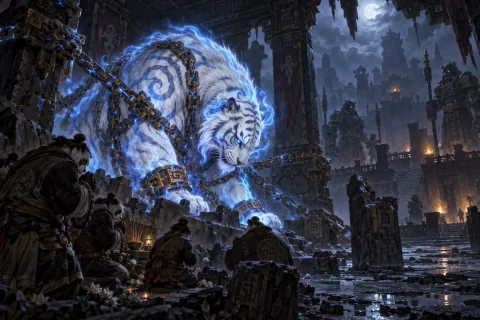
Lei Shen proposed a duel to Xuen, staking the fate of the Pandaren. Public lore conveys that after a long battle, the White Tiger was defeated and imprisoned. Other Celestials also stepped forward to help the Pandaren but could not subdue the Thunder King. Afterward, the empire banned the worship of the Celestials. After binding the gods, they sought to sever even the hearts that reached out to them.
However, the decree could not erase all faith. There remained those who risked danger to keep their connection to the Celestials. This small continuity becomes important in the next era. People who could not directly confront the power of the empire found other possibilities for their bodies and minds. The story of the Pandaren's liberation is not a door that opened automatically when the Emperor died. It is a history created by those who pondered what to learn and how to protect each other in a world controlled by violence.
Chapter 5: Calculations Made by Two Empires
The alliance between the Zandalari and the Mogu shows that the world surrounding Pandaria was wider. The trolls possessed an ancient civilization and faith that had experienced the war against the Aqir. The Mogu held Titan technology and the new power of lightning. They had what the other needed, and that need bound the two empires.
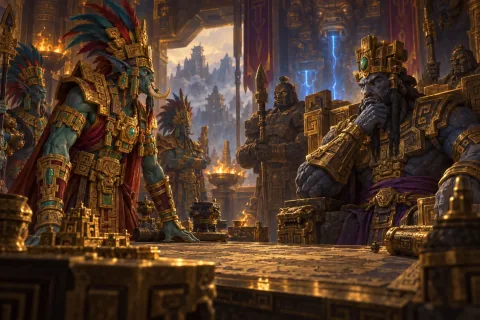
That does not mean they trusted each other completely. The public Chronicle explains that leaders on both sides harbored secret calculations toward the other. The thoughts of those trying to learn technology and power, and those trying to subjugate the other once the alliance became useless, existed together beneath the surface of friendship. The alliance was maintained for a long time not because there was no malice, but because immediate benefits delayed the moment when that malice would be turned into action.
This connection does not end even after the Thunder King disappears. The lore that the Zandalari held the secret to his resurrection also connects to the later invasion of Pandaria. While we are currently following the first ancient empire, it is good for the reader to remember this alliance. The Thunder King who returns in the future is not a new villain who appeared suddenly. It is the result of promises and ambitions made long ago moving once again across the ages.
Chapter 6: The Day the Lightning Stopped in Uldum
The power Lei Shen possessed led him toward an even greater goal. He sought to place the Titan facilities of Uldum under his empire. The demand for the Tol'vir there to accept the rule of one who betrayed Ra and stole his power was also a demand to abandon the creator and the mission they were entrusted with. Negotiations did not lead to submission.
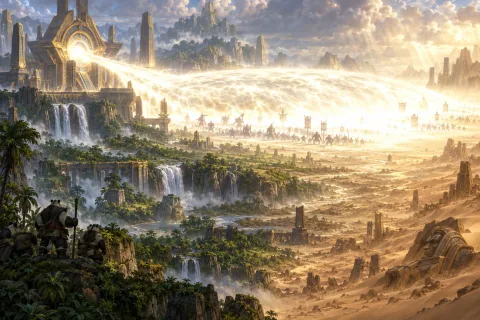
The Thunder King led his allies and army toward Uldum. If one thinks of Uldum today only as a desert landscape, it is difficult to fully feel the loss of the event. In public lore, the region the expeditionary force saw was a land with lakes, waterfalls, and lush life. To the Emperor who came to take it, it was a fertile conquest; to those who guarded it, it was a home where life continued.
The Tol'vir knew they could not break the Thunder King's power with ordinary combat. They chose a desperate defense using the power of the Forge of Origination. The energy that swept through Uldum eliminated Lei Shen and his allies, but it also took the defenders and countless lives with it. The abundance of the region vanished. This is why this cannot be called an easy victory. The result of stopping the Emperor and the irreversible sacrifice remained within a single event.
The surviving Tol'vir later magically concealed the passage into Uldum. It was a measure to ensure that no one seeking such power would ever find it again. Even after the empire outside collapsed, the place of lost life remained in that land. The day Lei Shen's lightning stopped halted the power of the empire, but it did not return the world to what it was before.
Chapter 7: The Place Where the Emperor Vanished, and the Door Not Yet Opened
Keeper Ra-den was not the Emperor of the empire, but he lies at the bottom of this history. The loss he suffered, the power stolen by Lei Shen, and his long imprisonment show that the order of the Titans is not complete with only the facilities left on the ground. No matter how massive the scale of the palace, a being that needed to be protected was imprisoned beneath it.
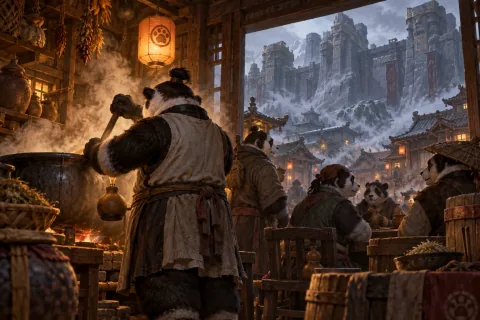
After the Thunder King died, the power of the Mogu split again. However, his death did not automatically loosen the chains of the slaves. Other rulers remained, and a society maintained through labor and violence remained. The fact that the strongest being of the empire disappeared could be a condition for liberation, but it was not liberation itself.
In the next story, we shift our gaze to a place lower than the throne of the warlords. There was Kang, a brewer who had his family taken away. Instead of setting out to find a Keeper to steal immense power, he learned the power within himself and the solidarity among people. It was the tragedy of Uldum that ended the era of the Thunder King, but the process by which the Pandaren began their own era required other choices, training, and courage.
Names and Concepts of This Episode
Mogu: A race originating from the Titan-forged of the south. Read by distinguishing between the Curse of Flesh, the era of warlords, and the transition of the empire.
Lei Shen: The Thunder King who unified the Mogu by stealing Ra-den's power. This episode covers the first empire and his first death.
Ra-den: The later name for Keeper Ra. Connects the loss of the Titan Pantheon to the history of the Mogu.
Engine of Nalak'sha: A Titan facility connected to Mogu'shan. Relates to the Mogu's flesh-shaping and the power of the empire.
Serpent's Spine: A massive wall that stands against the attacks of the Mantid. One must also read the history of the residents mobilized for its construction and defense.
Forge of Origination: A Titan facility in Uldum. The power used to stop the Thunder King left a fatal cost on the region.
Data Classification: The 2013 official raid preview introduces the meeting between Ra-den and the Thunder King as a mystery of the time. The ancient events in this episode were contrasted with the later released Chronicle sections. Detailed tactics and facility operation processes not confirmed in the cut preview were not invented.
Official Data and Verification Scope
Verification Date: October 8, 2026 (UTC). Written based on settings and events confirmed in the official public materials below. Public samples and setting introductions were checked only for their respective scope, and it is not indicated that the entire book was read. Illustrations are AI reconstructions, not official images.
World of Warcraft: Chronicle Volume I
World of Warcraft Chronicle Volume 1: public Lei Shen, mogu and Uldum previews
comments 0