
Recommended Game Story · Warcraft Part 30
Chapters in this story
- Preface · Those Who Had to Close the Path Behind Them
- Chapter 1 · Nethergarde Built Before the Ruins of Victory
- Chapter 2 · The Remaining Clans Gathered Under Ner'zhul
- Chapter 3 · What Was the Returning Army Seeking?
- Chapter 4 · Five Names Came from Different Paths
- Chapter 5 · The Alliance Entered the Enemy's World
- Chapter 6 · Countless Exits Tore the Homeland Apart
- Chapter 7 · To Save Home, One Had to Destroy the Path to Home
- Chapter 8 · Outland and Another Prison Awaiting Ner'zhul
- Paths of Terms and Characters
- Reading Along with Previous Public Serializations
- Meeting in the Game
- Official Materials and Scope of Verification
Preface · Those Who Had to Close the Path Behind Them
Spoiler Notice: This installment covers the central events of Warcraft II: Beyond the Dark Portal, including Ner'zhul's reinvasion and his portal plan, the Alliance Expedition's entry into Draenor, the planet's collapse, and the sealing of the Dark Portal. This is the original timeline immediately following the Second War, distinct from the alternate timeline of Warlords of Draenor. This narrative commentary is written by cross-referencing contemporary official manuals with later official chronologies and artifact lore. It is not a transcription of mission briefings or official novels.
The gate remained even after the war ended. Although the stone gate on Azeroth had been shattered, the power that connected the two worlds had not vanished entirely. On the Draenor side, there was still a gate that could lead to the other side. The victorious world watched the debris, while in the defeated world, the remaining clans sought a different path.
When the two worlds were last bound by the same crisis, neither side fully understood the crisis at first. The humans sought to prevent another invasion. Ner'zhul sought to create an exit to leave his defiled homeland. The power channeled into that exit eventually tore the homeland itself apart, and those who entered it to protect their home had to sever the path they would return by.
Chapter 1 · Nethergarde Built Before the Ruins of Victory
When the Second War ended, the Alliance faced captured orcs and the scars of war. The army that threatened the capital had collapsed, and Orgrim Doomhammer was captured. However, Khadgar saw the magic remaining in the ruins. As an apprentice of Medivh, he knew how the first invasion was opened, and he understood that breaking the visible stones was different from eliminating the connected power.
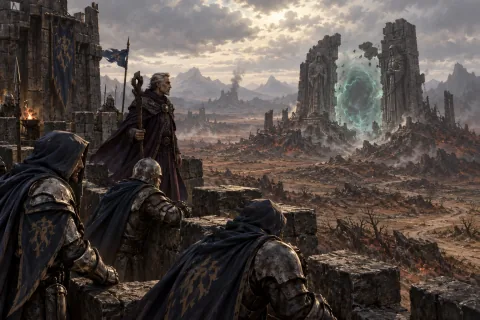
Following his warning, the Alliance built a fortress to monitor the Dark Portal. Nethergarde was not a monument to victory, but an outpost watching for the next disaster. Before the crumbled stones, soldiers and mages stood guard, knowing nothing of what lay on the other side. It was inconvenient for nations that believed the war was over to commit to renewed surveillance and supply. Yet, if they abandoned the watch, the meaning of their past victory could be jeopardized once more.
The official manual for Warcraft III states that not long after Nethergarde was completed, the power of the connection gathered again. The path to Draenor opened, and newly rallied orcs poured into Azeroth. The first destruction of the gate was not in vain, but it was not an eternal guarantee. The Alliance had to defend the results of their hard-won war once again.
If one reads that Draenor was already Outland at this time, the cause of these events is inverted. Draenor was still a single planet, albeit heavily damaged. The collapse that would later leave behind floating lands and a twisted sky was the result of Ner'zhul's plan, which was about to unfold.
Chapter 2 · The Remaining Clans Gathered Under Ner'zhul
Gul'dan died at the Tomb of Sargeras, and the Horde led by Orgrim was defeated on Azeroth. However, not all orcs of the Horde met the same end in the same place. On Draenor, there remained clans, warriors, and leaders capable of continuing the war. The one who gathered them was Ner'zhul, who had long ago been Gul'dan's mentor.
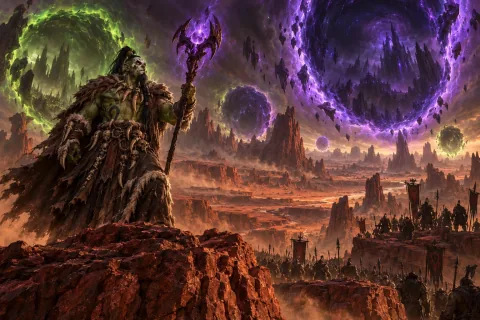
Ner'zhul's plan was not to repeat Orgrim's war. He intended to open multiple portals on Draenor to reach other worlds that had not yet been devastated. Azeroth became a place to obtain the necessary power rather than the final destination of his plan. This difference created a significant gap between the way the troops moved and the Alliance's assessment of those movements.
Under his command were forces such as Grom Hellscream's Warsong clan and Kilrogg Deadeye's Bleeding Hollow clan. Being gathered under the same command did not mean they were all the same. The character profiles in the Warcraft II manual state that while Grom did not fully trust Ner'zhul, he participated in the new war. The army, composed of the clans' powerful warriors, could share a single goal, but their loyalties were not merged into one.
The death knight Teron Gorefiend is also a crucial link in this era. Gul'dan's experiment of binding orc souls into the bodies of human warriors did not vanish when Gul'dan died. The official manual states that Gorefiend was connected to Ner'zhul's plan as an entity with knowledge of portals and that he contemplated deals for his own purposes. The death knights of this time are not a group with the same origin as the Scourge death knights later led by Arthas.
Leaders like Kargath Bladefist and Dentarg were also in the Horde's new military force. Binding the clans required not just the authority of a name, but the actual hands to lead the warriors and the power to push Ner'zhul's commands. The news from Azeroth that the war was over and the reality that an army was gathering again on Draenor existed simultaneously.
Chapter 3 · What Was the Returning Army Seeking?
The Horde that crossed the reopened gate shook the Alliance's defenses. Seasoned chieftains like Grom and Kilrogg led the surviving forces into Azeroth. The defenders first saw the attacked villages and the moving enemy troops. That the nations who had endured two wars suspected a new invasion was a judgment born of their experience.
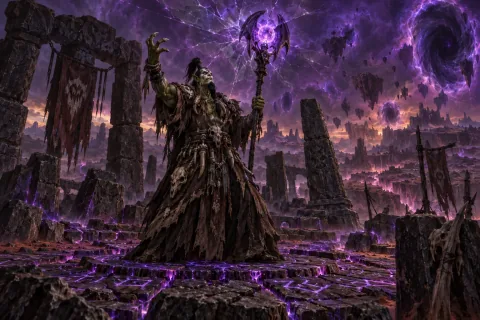
However, what Ner'zhul needed were the magical artifacts of Azeroth. To open multiple portals and move to other worlds, the power remaining on Draenor was insufficient. In official historical accounts, the new Horde's attacks are linked to securing the necessary artifacts and returning to Draenor. The enemy's retreat did not mean they had abandoned their goal. Rather, that retreat could be a signal that the preparations for the next phase of the plan were complete.
The Scepter of Sargeras is a concrete example of the danger of these artifacts. Later official Legion artifact lore explains that countless servants of Sargeras gathered their power to create this object, which can tear open portals between worlds. The scepter, long buried beneath the sea, was used by Ner'zhul to open the portals that destroyed Draenor.
Here, we do not create a scene where a demon appears directly beside Ner'zhul just by looking at the weapon's name. What is confirmed is the artifact's function and the history that led to the collapse of Draenor. The tragedy of this era is revealed in the difference between the size of the object held in one person's hand and the scale of the world that object changes.
The Skull of Man'ari, which appears in the Legion introduction, is an artifact of Thal'kiel and should not be conflated with other skulls mentioned in Ner'zhul's portal plan based on name alone. Just because they are listed in the same warlock equipment lore does not mean they are artifacts of the same individual. We leave the recovery paths and mission-specific conflicts of each artifact to be cross-referenced with official game materials, and in this installment, we focus on the central causes of the confirmed portal plan.
Chapter 4 · Five Names Came from Different Paths
Terenas perceived these movements as preparations for a new invasion. If the enemy crossed into Azeroth, attacked, and vanished back behind the gate, the threat could not be ended merely by guarding the front of the gate. He entrusted the Draenor expedition to Turalyon and Khadgar. Alleria, Danath, and Kurdran went with them. A mage, a paladin, an elven ranger, a veteran human soldier, and a dwarven warrior headed toward the same gate.
Khadgar faced the truth as Medivh's apprentice in the first war and investigated the power of the broken gate after the second. The man who had tried to understand the gate with the Kirin Tor of Dalaran now had to cross it himself. If he had severed the path into his homeland last time, this time he had to find the danger on the other side of that path. Knowledge did not end the war for them, but it was the most important power to understand what was collapsing.
Turalyon held the army left by Lothar and the responsibility of command. The early paladin, who had learned the power of the Light and endured the war, now led soldiers outside the human kingdoms. We do not describe the current Turalyon with the armor and experience of the figure who later returned from the Army of the Light. That long journey had not yet begun. At this time, he was a commander responsible for an allied army entering an enemy's unfamiliar homeland.
Alleria Windrunner was a ranger who had experienced the destruction of Quel'Thalas. To her, as described in the official manual, the war was not a distant military report from a kingdom. Her experience of searching for the ashes of her homeland and the loss of her family led her to the path of tracking orcs. Even the long life of an elf could not make the loss left by this war light. This is the era of the high elf who fought while carrying those wounds, not the version who later embraced the Void.
Danath Trollbane was a veteran commander of the Stromgarde militia. He made a name for himself in the war to reclaim Khaz Modan and later took responsibility for managing orc prisoners in the new Stormwind. The soldier who had done the work remaining after victory now went out into the enemy's world again. Kurdran Wildhammer was a dwarf who had fought dragons in the sky and was a warrior who had engaged in reconnaissance and combat with his gryphon, Sky'ree. The ability to read the high skies also required him to learn unfamiliar terrain and enemies on a new planet.
These were not heroes who grew up in the same city in the same way. The secrets of the first war, the death of Lothar, the burned elven lands, and the mountains and skies of the dwarves were gathered into a single expedition. That different memories could aim for the same goal was the strength of the Alliance. However, that does not mean that strength knew in advance of the disaster they would face.
Chapter 5 · The Alliance Entered the Enemy's World
When the expedition crossed the gate, what awaited them were not the familiar fields of Azeroth. It was the terrain of a devastated Draenor and the orc clans that were still holding out. The army that had blocked the invasion in their own land now had to cut off the enemy's movements in another world. Supplies and return were entirely dependent on the gate behind them. Each step forward placed the path back further away.
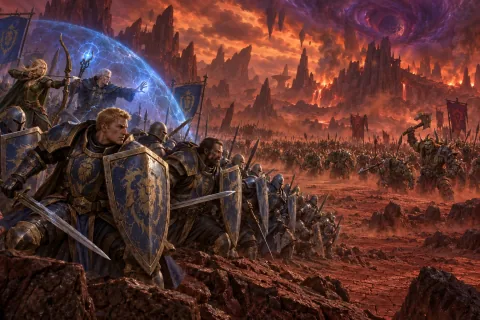
Official Warcraft III history states that the Alliance and Ner'zhul's clans clashed repeatedly in the devastated Hellfire Peninsula. The fact that the name is the same as the war in the Hellfire Peninsula of the later Outland does not mean it is a battle of the same period. Those fighting now are the original expeditionary force that entered Draenor, and the crisis they face is the portal plan before the planet itself has collapsed.
The expedition had to do more than just push back troops; they had to stop Ner'zhul's magic. While dealing with the clans and warriors before them, preparations to open the portals continued behind the scenes of that war. As long as soldiers held the line on one front, someone gained time to prepare. The remaining clans of Ner'zhul holding the Alliance at bay and the execution of his plan were different layers of the same war.
What Khadgar needed was to understand what the artifacts and magic were actually creating. Turalyon had the responsibility of ensuring the army could reach and hold its position for that understanding to occur. The forces of Alleria, Danath, and Kurdran were not decorations separate from these two. The expedition was not a journey where one person defeated all enemies, but a fight that pressured the enemy's time and space with various types of power.
Nevertheless, the portals opened. In official chronologies and manuals, this outcome is clear. The expedition could not stop Ner'zhul's plan to the end. The fact that brave people fought sufficiently and the result that the fight prevented the disaster are not the same. When one accepts that difference, this expedition becomes a story heavier than a simple tale of victory.
Chapter 6 · Countless Exits Tore the Homeland Apart
What Ner'zhul wanted were portals leading to new worlds. However, when multiple portals opened simultaneously within a single world, their powers overlapped, driving Draenor into an unbearable state. The act of creating an escape route made the disaster they needed to escape even greater. The plan to abandon a defiled homeland became an event that actually shattered the homeland.
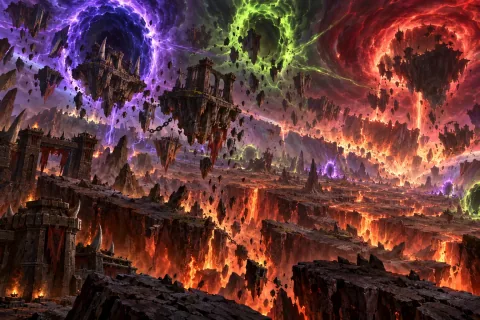
Official history tells of massive magical storms and the destruction of the planet's structure. The land split, and the continents of Draenor could not hold. The crisis on the battlefield was no longer a matter of which clan occupied a fortress. The ground that both enemy and ally stood upon, the world itself where armies and peoples could live, was disappearing.
This illustration is a scene of the collapse newly created by contrasting the official portrait of the living Ner'zhul with the image of the Scepter of Sargeras. We have not included his appearance as the Lich King or the Ner'zhul of the alternate timeline here. The exact number and shape of the portals, the posture holding the weapon, and the sequence of the land splitting are interpretations that visually unfold the planetary collapse, not a restoration of the official cinematic.
Ner'zhul did not end as a leader who took all the clans to safety. He escaped through one portal with his close followers. Those he left behind had to find other ways. The Warcraft III manual states that Grom and Kilrogg realized Ner'zhul's plan would destroy the entire race and gathered the remaining forces to return to Azeroth.
At this time, two directions of escape diverged even within the same Horde. Ner'zhul headed toward the portal to another world he had opened, while the warriors of the clans headed toward Azeroth, which they had invaded again. One was the exit for the one who executed the plan, and the other was the final escape route for those swept up in that plan. The leader's goal was not the same as the army's survival to the end.
Chapter 7 · To Save Home, One Had to Destroy the Path to Home
The expedition found the path back. However, there was a danger that the destruction of Draenor would spread to Azeroth through the portal. The gate had once been a passage for invasion, and this time it could become a passage for the world's disaster to cross over. Khadgar and his companions had to see the homeland they had left to save from beyond the gate once more.
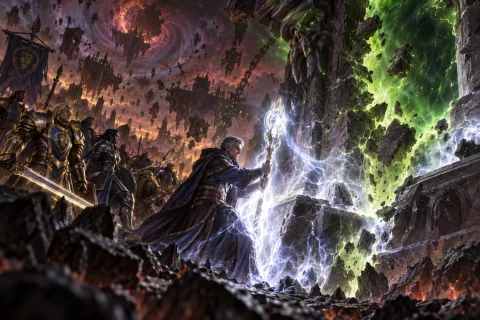
The choice left to them was not just returning. It was necessary to destroy the gate to separate Azeroth from the collapse of Draenor. In doing so, they could be trapped in the crumbling world. The Warcraft III manual and later official chronologies convey the outcome where they destroyed the gate and saved Azeroth. This was a different kind of victory than one that receives applause upon returning to the world.
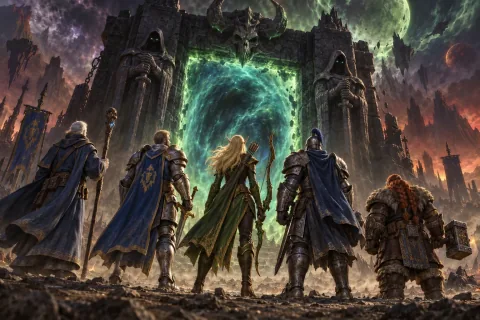
The five heroes in the new illustration were referenced from the portraits in the contemporary official manual and the official art of Alleria before the Void. The massive gate on the Draenor side was cross-referenced with the official chronology and the stone gate, hooded guardians, and skull decorations on the covers of authorized novels. The exact positions of the five people standing before the gate, the movement of their clothes, and the form of the final magic are reconstructions; we do not assert specific spells or dialogue from the original work.
The expedition for the homeland ended, for now, with the severing of the path to the homeland. That gate had been the path that connected the army, supplies, and return. The moment the gate was closed, the world the expedition protected and the world the expedition stood in drifted apart again. The people of Azeroth gained a tomorrow to live in, but those who protected it were not given a tomorrow to return to immediately.
We do not end this event with the confirmed death of the five heroes. The 2002 manual was a text from an era that still left their exact survival status open. Subsequent official chronologies explain this expedition with the fate of the heroes trapped in Outland, the debris of the destroyed Draenor. We do not repeat what early publications could not know as if it were an eternally unconfirmed fact today. However, the long paths that follow for each must be read along with the events of the next era.
Chapter 8 · Outland and Another Prison Awaiting Ner'zhul
Draenor did not remain an intact planet. The debris of the broken world became Outland. This is not a story of discovering a distant planet with a different name for the first time. It is the same world where the history of orcs and draenei had accumulated, now destroyed and surviving in that state of destruction. This is why the stories of the previous clans, cities, and lands must be connected to the desolate landscape of Outland.
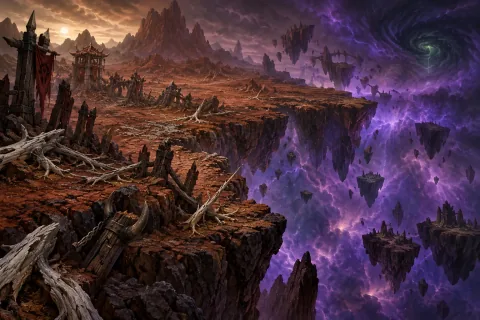
To the Alliance that entered there, Outland was the result of the expedition, and to the orcs who left their homeland, it meant their place of return had changed. The Warsong clan that escaped to Azeroth avoided capture, but the Bleeding Hollow clan was captured and sent to internment camps. Crossing the gate together did not mean they achieved the same freedom. The era in which the new Horde would be formed begins from these different circumstances.
For Ner'zhul, the exit was not salvation. Subsequent history in Warcraft III states that when he and his followers entered the Twisting Nether, they were captured by Kil'jaeden. His plan to abandon the Legion's will and flee did not end in a safe world beyond the Legion's reach. Ner'zhul's body vanished, and his remaining soul was placed under the compulsion to serve again.
The process by which that soul was bound in ice to become the Lich King is the origin of another disaster that follows this planetary collapse. Here, we highlight the connection of the transition conveyed by the 2002 manual. We do not mindlessly merge the entire later-supplemented lore of the creation of the gear of domination and the afterlife with the narrative of this era. The failure of the shaman who tried to leave Draenor would lead to the war of the undead that would later shake Azeroth.
The plan to leave one world left scars on two. Outland remained on Draenor, and the memories of the surviving clans and the expedition that could not return remained on Azeroth. Ner'zhul was given a prison of a different name instead of freedom. The fates of the people who had gathered under the single word of escape were thus scattered in completely different directions.
Paths of Terms and Characters
Draenor and Outland: At the beginning of this installment, it is Draenor, a damaged but still intact planet. The world remaining after Ner'zhul's multiple portals tore the planet is Outland, and it is distinguished from the Draenor of the alternate timeline.
Nethergarde Keep: A fortress built to monitor the remains of the Dark Portal on the Azeroth side. We did not place the same fortress in the landscape on the other side of the illustration where the Draenor expedition closes the gate for the last time.
Ner'zhul: Gul'dan's former mentor and the leader who rallied the remaining clans of Draenor. He opened portals to escape to other worlds and, after the planetary collapse, was captured by Kil'jaeden and led to become the Lich King.
Scepter of Sargeras: An artifact capable of opening portals between worlds. Official Legion lore conveys its use by Ner'zhul, the collapse of Draenor, and its subsequent history of being sealed and monitored by the Kirin Tor because they could not destroy it.
Teron Gorefiend: A figure of the early death knight lineage created by Gul'dan. The orc soul, human body, portal knowledge, and his own purposes are connected to Ner'zhul's plan.
Alliance Expedition: The force led by Turalyon, Khadgar, Alleria Windrunner, Danath Trollbane, and Kurdran Wildhammer. Experiences from different kingdoms and races meet in the same crisis on Draenor.
Warsong and Bleeding Hollow: The clans of Grom and Kilrogg return to Azeroth from the planetary collapse, but their subsequent capture status and circumstances of living differ.
Twisting Nether: The connecting space where Ner'zhul is captured by the Legion after fleeing through the portal. It is not read as the same place as the afterlife or the general sky of Azeroth.
Reading Along with Previous Public Serializations
The death of Lothar, the succession of Turalyon's command, and the reasons leading to the destruction of the first gate on the Azeroth side and Nethergarde can be read in Warcraft Part 29. /en/community/tm-warcraft-saga-part029-20261008
The process by which the Horde's dragons, navy, and Gul'dan's defection changed the direction of the war is in Part 28. /en/community/tm-warcraft-saga-part028-20261008
The connection created by Medivh and Gul'dan until the Dark Portal was first opened continues from Part 25. /en/community/tm-warcraft-saga-part025-20261008
The distant origins of Draenor and the distinction between the original timeline and the alternate timeline can be confirmed in Part 23. /en/community/tm-warcraft-saga-part023-20261008
Meeting in the Game
Warcraft II: Remastered includes both the Tides of Darkness and Beyond the Dark Portal campaigns. To experience the war the expedition passed through in the game, you can check the supported environment and terms of use on the official Battle.net page below. Price and regional conditions follow the current guidance on the purchase page. Warcraft II: Remastered — official Battle.net product page
Official Materials and Scope of Verification
Verification Date: October 8, 2026 (UTC). This was written based on settings and events confirmed in the official public materials below. Public samples and setting introductions were verified only for their respective public scope, and we do not indicate that the entire books were read. The illustrations are AI reconstructions, not official images.
Warcraft III: Reign of Chaos — official 2002 manual
Warcraft II: Battle.net Edition — Official Manual
Warcraft II: Beyond the Dark Portal
comments 1
넬쥴의 계획이 결국 고향을 찢어놓는 비극으로 이어지는 과정이 정말 몰입감 있네요. 돌아갈 길을 스스로 끊어야 했던 원정대의 선택은 언제 봐도 마음이 먹먹해집니다. 잘 읽었습니다! ⚔️