
Recommended Game Story · Warcraft Part 23
Chapters in this story
- Reading Guide
- Chapter 1 · Even the Endlessly Growing Forest Had an End
- Chapter 2 · The Death of the Giant Was the Beginning of the Descendants
- Chapter 3 · The Bird of Light and the Sacrifice of Shadow
- Chapter 4 · The Shadow of a Civilization That Weaponized the Sun
- Chapter 5 · The City of Ogres, the Expanding Path of the Orcs
- Chapter 6 · The Ship That Fell from the Stars, the Light Left on the Ground
- Chapter 7 · Making a Refuge into a City
- Chapter 8 · Those Who Seek to Use a World That Already Existed
- Index of Terms and Locations
- Further Reading
- Official Materials and Verification Scope
The Ancient Breath of Draenor · The War of Stone, The Civilization of Wings, The New Home of the Exiles
Reading Guide
This installment covers the period from the primordial era of Draenor to the time when Orc clans and Draenei lived together. We briefly depart from the history of Azeroth to examine the homeland of those who would later arrive from beyond the Dark Portal. It contains the connections between the ancient ecosystem, Arakkoa, Ogres, Orc society, and the Draenei settlement; the subsequent birth of the Horde and the Draenei War will continue in the next installment. There are spoilers.
What is followed here is the history of the original timeline. Since Warlords of Draenor features a Draenor of a different timeline, the invasion of the Iron Horde and the choices of characters in that game are not transferred to the events of this era. However, the terrain, creatures, and architecture explained by the official developers are used as reference materials to understand the world of Draenor.
Chapter 1 · Even the Endlessly Growing Forest Had an End
In an era before the towers of Shattrath or the tribal banners of the Orcs existed, the world later called Draenor overflowed with the power of life. The fifth element, the essence of life, permeated between wind, water, fire, and earth, enriching nature. If one remembers the primordial era where the elements of Azeroth clashed with fierce power, this star shows a different beginning. The abundant essence softened the intensity of the elements and instead pushed the growth of living things.
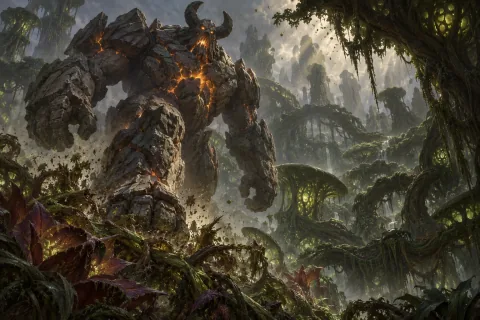
However, growth itself did not guarantee balance. The Sporemounds, giant plant entities, extended their vines to swallow beasts and claim more of the land's life. Roots and leaves did not remain as small, separate individuals. Connected through the essence of life, the plants were linked into a massive entity that reacted in unison: the Evergrowth. A world where if one forest was injured, another could react. It was difficult to fathom the magnitude of that power with the mere sentiment of beauty.
Aggramar visited such a star. Even to a Titan who traveled the cosmos hunting demons, this world was not simply a battlefield where one could cut down enemies. If everything were placed under a single plant network, other life would have no place to stand. Intervention to preserve the world was necessary, but that intervention could not destroy the world itself. He raised a massive species on the mountains of Draenor to act in his stead. Its name was Grond.
The mountain took a step. The power of the elements flowed through its stone body, and the vast forests of the continent were in the path of its movement. Now, the history of this star was not just a time of growth. A time when living forests and moving mountains clashed had begun.
Chapter 2 · The Death of the Giant Was the Beginning of the Descendants
Grond sought to divide and collapse the Evergrowth. The Sporemounds were not forests that simply rooted in the ground and waited. They gathered the surrounding life force to move, sensed each other's crises, and stood against Grond. The massive entities known as Zang, Nanu, and Botaan showed another face of nature. The power that creates life is also the power that defends its own domain.
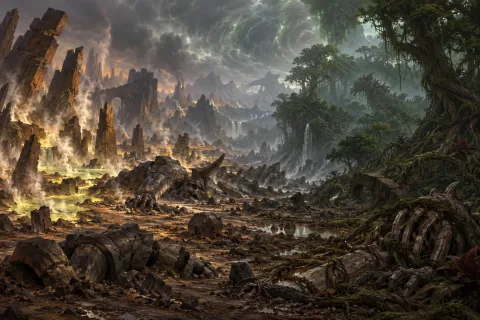
In this war, even victory left traces. Stones, seeds, and roots that fell from the bodies of the giants were scattered across the world. Some became the origins of new creatures. On the plant side, descendants like the massive Genesaur grew, and on the Grond side, the lineage of stone giants continued. The battles of the primordial era remained even in the appearance and living domains of creatures in later times.
Grond's sturdy body could not endure endlessly. Vines seeped into the gaps of its body, threatening the giant from within. Even after it fell, Botaan and its descendants expanded the domain of the Evergrowth again. Aggramar moved the Colossals, descendants of Grond, to continue this fight. The attacks where the Colossals released the power of Titan artifacts together brought down Botaan, but that did not turn the world into a peaceful garden.
Spores scattered from Botaan's remains changed the plants. The plants gained more diverse intelligence, and the stone entities also changed. The destroyers continuing Grond's lineage and the primal creatures of the plant side continued to clash while occupying different territories. Names like Magnaron, Gronn, and Ogron are the names of monsters adventurers would later encounter, as well as records of this ancient change.
One can feel this history more easily by thinking of the landscape of Gorgrond. On one side, there are forests with sparkling water and lush leaves; on the other, parched rocks, steam, and sulfur pools. The developers explain this contrast as the traces of an ancient hostility. Sometimes, beautiful forests trap visitors and turn them into food or materials for the plants. In this world, abundance was not synonymous with comfort.
Chapter 3 · The Bird of Light and the Sacrifice of Shadow
In a world where giants fought, the history of other life also began. In the high terrain and forests of Arak, there were Rukhmar, the fire bird connected to Light; Sethe, the wind serpent; and Anzu, the clever raven. They did not possess the same appearance or the same power. Rukhmar's lofty wings, Sethe's limitations, and Anzu's wisdom remained in the stories the Arakkoa told to understand their origins.
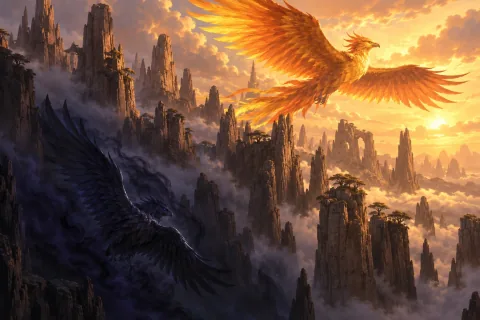
Sethe envied Rukhmar. That conflict did not end simply as a contest between two beings. Sethe's curse spread from body and blood into the land, threatening the life of Arak. Anzu swallowed Sethe to prevent that darkness from spreading further. It was a choice to contain the wounds the world would receive within himself. As a result, he bore the curse and subsequently hid his body in the shadows.
Here, Light and Shadow are not magic that differs only in color. Rukhmar's Light is connected to life and the appearance of the brilliant sky, while Anzu's Shadow is also connected to the pain he accepted to save others. To understand the relationship between the Arakkoa who live in high places and the wingless exiles in the future, one must first remember this ancient sacrifice.
Rukhmar watched the growth of the Arakkoa. The new race did not remain as beings merely imitating the shape of giant birds. Hearing of Sethe's darkness and Anzu's sacrifice, they built their own knowledge and culture. A civilization that accepted and interpreted the power of nature had now emerged on Draenor.
Chapter 4 · The Shadow of a Civilization That Weaponized the Sun
The Apexis civilization grew with high spires, brilliant architecture, and sophisticated magical knowledge. Light and Void were powers they had to study and wield. The Anhar line, which explored the Light, and the Skalax line, which explored the Void, supported the civilization through different paths. The crystals left behind by the Arakkoa were not mere decorations or wealth. They could be a means to preserve and transmit knowledge and memory.
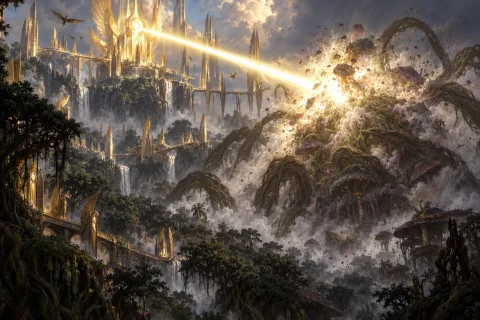
However, to the forces of nature, the high golden temples held a different meaning. The sight of a civilization cutting down trees and entering the domain of the forest clashed with the primal creatures. Amidst the movements of Naal and the Botani to revive the ancient Evergrowth, a new Sporemound, Taal, arose. Into the old fight between stone and plant, a civilization with technology and magic now intervened.
The Arakkoa built a massive device that gathered the power of the sun. It was a weapon called the Breath of Rukhmar. The attack that pierced Taal broke the power of the primal creatures and ended the return of the Evergrowth. It was a moment when a mortal civilization expanded its own place to survive in a world dominated by forest giants.
But defeating an external enemy and sharing power within are different problems. If knowledge contained in crystals accumulates on one side and the other fears exclusion, the common heritage becomes a resource for power. As Salavass and his followers of the Skalax line stood against the Sun Temples, the internal conflict of the civilization turned into a clash. The power created together became a power aimed at each other.
Even after the Apexis collapsed, the artifacts did not disappear. Descendants and wandering shamans sought the old crystals and knowledge. The memories of ancient devices and brilliant cities later influenced the power of other races as well. The ruins were not empty shells of a finished history, but resources that changed the next era.
In the Arakkoa chapter to be covered later, we will continue to examine the detailed development of this civil war, the successors of the Skyreach, and the history of Terokk and the exiles. Here, it is good to remember the connection that the Apexis changed the initiative of the world and left a legacy even after their own division.
Chapter 5 · The City of Ogres, the Expanding Path of the Orcs
The world of beings originating from stone also changed. Under the Gronn, who ruled only with massive bodies and strength, smaller ones formed groups and found ways to live. In Ogre society, magic and knowledge became means to stand against the power of the giants. The Gorian Empire grew centered on beings like the Gronn-slayer Gogg, and the civilization connected vast lands and strongholds.
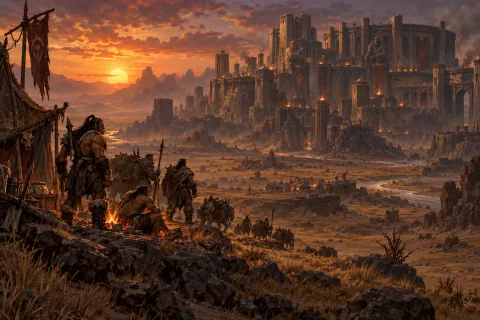
Highmaul and Bladespire are names left by that history. If one remembers the Ogres only as dull monsters, one cannot properly understand these cities. In the official introduction, Highmaul is a society with markets, nobles, the roar of the arena, slums, and the citadel of the Sorcerer King. The lives of the wealthy and the lives of the oppressed are together within the same walls. A massive physique did not mean the absence of civilization.
The expansion of the Ogres also influenced the lives of the Orcs. As the Gorian forces drove away some massive threats, the Orcs were able to emerge from the caves where they had hidden for a long time and build permanent settlements on the surface. As the population increased and hunting grounds became narrow, people moved to other regions. Even within a single race, the terrain of the homeland and the way of survival began to differ.
The plains of Nagrand, the harsh environment of Frostfire, the spiritual traditions of Shadowmoon, the jungles of Tanaan. The clans that settled in different lands became strong in their own ways. They clashed with other clans and also collided with the rule of massive neighbors. Even if they would later move under the name of a single Horde, they were not people who spoke with one voice before that.
There was also a time that connected the clans. The Kosh'harg was a place where they could briefly set aside daily competition and share news, relationships, and feasts. There, young Orgrim and Durotan built friendship while testing their strength and will. The fact that children of different clans were forming relationships before they became famous names of the future returns the scale of humanity to the history of politics.
The fact that Orcs formed clans does not just mean that armies were divided. It means there were hunting grounds and families, the hands of artisans and the memories of ancestors, and customs of competing and meeting again. Those who would later try to turn all of this into an organization of war would use the connections and trust that already existed.
Chapter 6 · The Ship That Fell from the Stars, the Light Left on the Ground
After the long history of the Arakkoa, Ogres, and Orcs continued, exiles wandering between the stars reached this world. They were Velen and the Draenei who left Argus. To them, the Genedar was a means of travel and a space where people who had lost their homeland had lived together. However, the Naaru inside the ship were weakening. Amidst the changes of Light and Void, K'ara's power collided with other Naaru, and that journey eventually led to the massive wreckage left on Draenor.
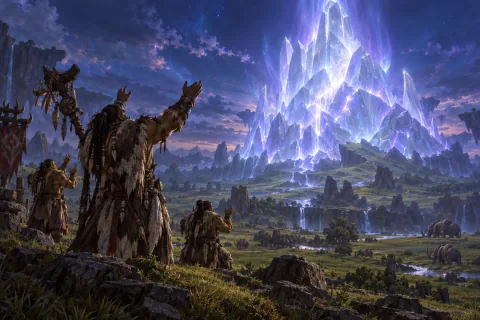
The Naaru K'ure allowed Velen and the Draenei to leave the wrecked ship. Because he himself was weakening, staying by his side was not safe for the refugees. The settlement obtained after a long flight was not like a peaceful arrival with a sturdy protector. They had to create a foundation to live on with their own hands again.
The wreckage of the Genedar, made of crystal, remained in Nagrand. It is the massive crystal mountain that the Orcs would later call Oshu'gun. K'ure's influence led the souls of dead Orcs to that place. Shamans visited the crystal mountain to meet their ancestors. It became a place of ancestors to be revered for the Orcs, and the wreckage of a ship containing long exile and loss for the Draenei.
There were people who looked at the same place and recalled different memories. That was not a difference that made one side's experience a lie. The Orcs met their own souls, and the Draenei knew of the Naaru weakening inside that mountain. Even the cautious investigation of the Sha'tari could not easily provide answers. Both breaking the connection between the Orcs and their ancestors and intervening blindly in K'ure's change could lead to danger.
The silence of Oshu'gun held such multi-layered history. A crystal mountain that looked like part of the earth from afar. Inside it, the time passed by people from other stars and the time when the people of this star remembered the dead overlapped.
Chapter 7 · Making a Refuge into a City
In the new homeland, there was not only the need for refuge. For the living, there was a need for homes, roads, and organizations to handle daily affairs, and for the dead, there was a need for a place of memory and rest. The Draenei divided search, construction, protection, and faith to continue their settlement. The Rangari, a ranger organization, surveyed the land, and cities like Shattrath took hold.
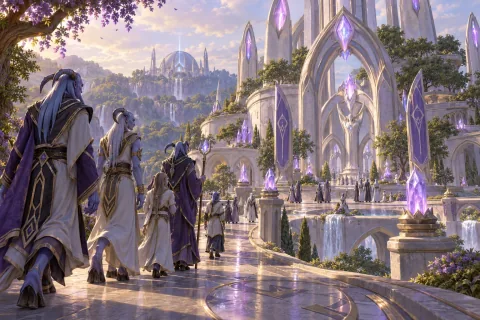
Karabor of Shadowmoon became the center of serving the Light, and cities and roads were laid in the lands leading to Terokkar and Talador. Movements of trade extending to Nagrand and the surrounding world also emerged. It was a process where Velen's people changed from refugees looking only for a place to hide into neighbors with their own lives. The name Draenor, the meaning of a refuge for the exiles, gains weight here.
The problem of the remains of the dead Naaru D'ore and the souls became the origin of another place. The Sha'tari built a massive mausoleum in a place separated from other civilizations. It was Auchindoun. This place should be understood not only for the beauty of the architecture built of stone and crystal, but also for the mission of protecting and caring for the souls of those who had departed. For those who knew that the Legion coveted the souls of the Draenei, protecting the dead was a practical responsibility.
The developers explain that they intended to show reverence for the entombed heroes through the corridors, water-like light, and golden surfaces of Auchindoun in later games. This explanation is not material to move the battles that occurred at the time to the original timeline, but help to understand what values and atmosphere that place possessed. When Karabor or Shattrath appear later in the name of war, one can first recall the prayers, trade, and life that existed here.
The Orcs and Draenei did not become the same community from the beginning. Unfamiliar technology and culture created wariness, and each contact brought different reactions. However, not every encounter was a war. The revealed scene of the Chronicle connects to the story of the Draenei hunter Restalaan and the Orgrim and Durotan in danger. Human experience was more complex than simple slogans about races. The memory of receiving help from a neighbor and the story of a clan doubting a neighbor existed together in one world.
Chapter 8 · Those Who Seek to Use a World That Already Existed
Let us not think of the Draenor of this era only as a cruel wasteland. There were wars of forest and stone, the knowledge of a civilization with wings, the cities of Ogres and the clans of Orcs, places that remembered ancestors and souls, and the new home of those who came from distant stars. The world was not a stage left empty for a single event. It was a homeland where people lived and others died, and where memories and artifacts influenced the next era.
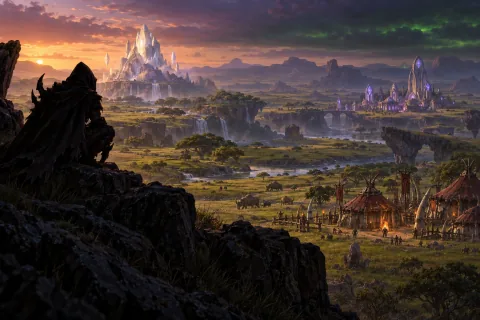
The Legion found that homeland. The energy of the Light that spread when the Genedar fell could become a trace of the exiles who were hiding endlessly. Talgath investigated those traces. And Kil'jaeden's revenge does not mean only the path of directly attacking the Draenei. This is because the traditions, trust, and solidarity possessed by the Orcs living beside them could be used for other purposes.
The heart to protect family, the customs of believing in ancestors, the gatherings connecting clans, the memory that they must face stronger threats together. These things were not evil in themselves. However, if someone who tells the name of the threat as a lie grabs that connection, an army that destroys the very homeland people were trying to protect can be created.
In the next installment, we will follow Ner'zhul and Gul'dan, Kil'jaeden and the Shadow Council, Blackhand and the clan leaders, and the resistance and tragedy of the Draenei. It is time to examine one by one what actually changed behind the short sentence that the Horde was formed.
Index of Terms and Locations
Aggramar · Grond: The Titan and the massive species he moved on Draenor. Distinguish from the guardians of Azeroth or later Gronn individuals.
Evergrowth · Sporemounds: The interconnected ancient plant ecosystem and the massive entities at its center. Not the same name as the later dungeon, The Everbloom.
Botaan · Breakers · Primals: The primordial war and its subsequent descendants. Distinguish the history surrounding the power of nature from the Legion's fel magic.
Rukhmar · Sethe · Anzu: Beings connected to the origins and faith of the Arakkoa. Do not assume they were evil from the beginning just because Anzu is connected to shadow.
Apexis · Gorian Empire: Separate civilizations of Arakkoa and Ogre. Distinguish the influence of magic, knowledge, and artifacts of the two societies.
Kosh'harg · Oshu'gun: The gathering of clans and the crystal mountain where one meets ancestors. The fact that it is the wreckage of the Genedar and the Orcs' experience must be explained together.
Karabor · Shattrath · Auchindoun: Places to understand the Draenei's faith, cities, and protection of souls. Remember the life and mission that existed before the names of later wars.
Draenor · Outland: The world before it was destroyed and the world that remained afterward. Read the Draenor of a different timeline as a separate story.
Further Reading
The Age of Titans and the Origin of the Legion — Connects the cosmic conflict of the previous Part 2 with the ancient history of Draenor.
/community/tm-warcraft-saga-part002-20261008
The Threat Permeating Azeroth — One can think about the point where the latent darkness of Medivh examined in the previous Part 21 and the changes in distant Draenor meet later.
/community/tm-warcraft-saga-part021-20261008
Those Who Left Argus — Read about the homeland the Draenei lost and the long voyage before starting this settlement in the previous Part 22.
Official Materials and Verification Scope
Verification Date: October 8, 2026 (UTC). Written based on settings and events confirmed in the official public materials below. Public samples and setting introductions were only verified for their respective public scope, and it is not indicated that the entire book was read. Illustrations are AI reconstructions, not official images.
World of Warcraft Chronicle Volume 2 — Authorized Public Preview
Warlords of Draenor Zone Preview: Gorgrond
Warlords of Draenor: Journey into Highmaul
Artcraft — Level Design Part 4: Nagrand
comments 0