
Recommended Game Story · Warcraft Part 13
Chapters in this story
- The War of the Ancients: Those Who Rose to Protect a Beautiful World
- Chapter 1: The Gate Was Not Opened Outside the Walls
- Chapter 2: What Collapses Before the Flames
- Chapter 3: The Forest Did Not Only Learn Silence
- Chapter 4: The Banner of Black Rook Hold
- Chapter 5: Visitors from an Unborn Era
- Chapter 6: The Same Brother, Different Dangers
- Chapter 7: Forces Joined from Beyond the Forest
- Chapter 8: The World to Protect, the Well to Sever
- Glossary and Character Guide
- Official Materials and Scope of Verification
The War of the Ancients: Those Who Rose to Protect a Beautiful World
Spoiler Notice: This entry covers the Burning Legion's first invasion of Azeroth approximately 10,000 years ago and the resistance of the Kaldorei. The Dragon Soul, the Great Sundering, and the choices made in the aftermath will be addressed in the next installment. This is a narrative commentary based on official events. We distinguish between characters who traveled through time in the novels and the time-travel dungeons experienced by later players, and we do not fabricate unconfirmed dialogue or internal thoughts.
Chapter 1: The Gate Was Not Opened Outside the Walls
It was not merely high walls that protected the beauty of Zin-Azshari; it was the conviction that they stood at the center of the world. The Well of Eternity granted the Kaldorei long life and magic, and the Queen’s court wielded that power at its source. As the city prospered, the authority of the Highborne who studied the Well grew. However, drawing power and understanding the extent of where that power led were two different things.
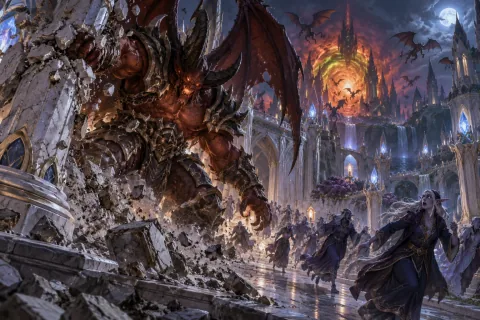
Xavius, advisor to Azshara, joined forces with Sargeras. The passage opened by the Highborne connected to the Twisting Nether, bringing the Burning Legion into Azeroth. The Queen did not order the gate closed. Instead, the court’s mages poured more power into it, preparing a path for Sargeras himself to cross over. The power at the heart of the capital was not protecting the city; it was widening the gateway for the invasion.
Remembering this, the War of the Ancients does not appear merely as a fight between strange invaders and those defending the walls. The elves had to stand against the decisions of those who ruled their civilization. Loyalty to the Queen could conflict with the duty to protect their homeland. As deep as their faith in the beautiful court was, acknowledging that the disaster originated from that very court was difficult.
The magical light that once shone near the Well now took on a different meaning. The light of learning and prosperity led to a gate that allowed armies to pass through. The streets in this installment are newly rendered landscapes, referencing the stone corridors and crystals confirmed in official scenes, alongside the iron armor and wings of the Legion. Even without inventing dialogue for a nameless citizen, the fact that an invading army entered a populated street is heavy enough.
Chapter 2: What Collapses Before the Flames
The invasion was a force that came from outside the order established on Azeroth. The official history introduction from Warcraft III in 2002 describes Archimonde and Mannoroth leading the Legion’s forces, with burning entities and winged demons sweeping through the lands of the elves. Some of the cosmology and character motivations from that initial version were supplemented in later materials. Here, we follow the major events of the invasion that persist through later iterations.
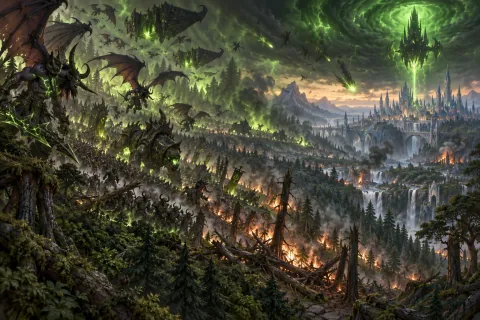
Reading with an awareness of these differences does not diminish the impact of the story. It allows us to appreciate both the scale of the disaster as first presented in old records and the complex choices of characters added in later works. While the fact that the Legion attacked the city remains, one cannot explain Illidan’s choices solely through jealousy, nor can the Sargeras origin from early descriptions be perfectly blended with the latest canon.
To the invading army, the cities and forests were merely places to cross for the next advance. To those living on that land, they were homes to return to and lives to continue. The same battlefield held different meanings. As threatening as the Legion’s mighty weapons were, the situation where familiar authority collapsed before one even knew what to protect was even more terrifying. The fact that the gate was opened in the name of the civilization they loved makes this struggle all the more cruel.
However, just because the court summoned the Legion did not mean all Kaldorei agreed with that choice. There were those who learned the ways of the forest, those who kept the faith of Elune, and soldiers of the citadel. The invasion did not erase their differences to make them one. It created a reason for people with different strengths to endure together. The beginning of the resistance lay in gathering those very differences.
Chapter 3: The Forest Did Not Only Learn Silence
The path Malfurion Stormrage learned did not lead only to the Highborne court. In Val’sharah, there was the forest where Cenarius met and taught him. While the authority of magic grew around the Queen, Malfurion learned a different power connected to nature. The teachings of Cenarius opened a path for him that did not view the world merely as a place to extract more energy.
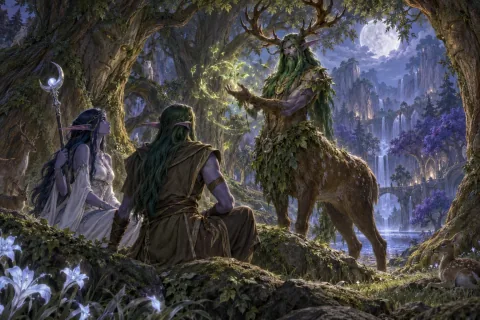
The connection to nature did not stop at appreciating peaceful scenery. When the world was under attack, that relationship could become a power to protect it. The old official history retains the image of living trees standing against the Legion and the flow of Cenarius helping the resistance. The forest was not just a backdrop where soldiers hid while retreating; it was the life at stake in the war and a part of those fighting back.
When understanding Malfurion’s power, one need not look only at the size of his massive spells. One must look at what he is connected to. The study of drawing greater power from the Well and the learning of listening to and helping the living world were not the same method. One cannot read this as a simple law where one path is always good and the other always evil. However, in this war, the path of learning nature becomes the way to counter the crisis opened by the court.
By his side was Tyrande Whisperwind. Tyrande, a priestess of Elune, fought against the Legion. Her faith and Malfurion’s druidic learning did not erase each other. Different powers were needed to protect the same world. The War of the Ancients was not an era where those who would become great leaders appeared as fully formed heroes, but an era where they had to bear the weight of their choices amidst disaster.
Chapter 4: The Banner of Black Rook Hold
Nature’s power and faith alone could not stop the Legion. The resistance needed leadership to gather soldiers and maintain the front lines. Kur'talos Ravencrest led the Kaldorei resistance. Black Rook Hold, where his family resided, was a fortress carved from the great mountains of Val’sharah and became a bastion against the Legion in the War of the Ancients.
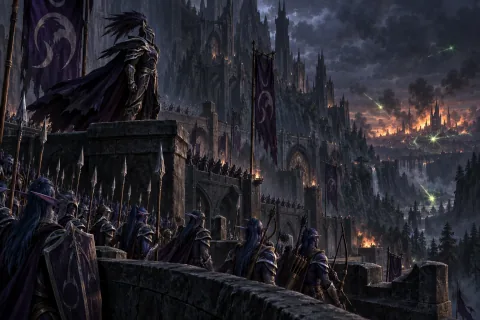
This fortress changes the perspective that viewed elven civilization only as light gardens and beautiful towers. There were sturdy walls, corridors, family tombs, and spaces for command. It was the image of a civilization enduring war. Ravencrest was also Illidan’s mentor. The fact that a young mage who knew the power of the Highborne and a commander of the resistance were connected shows what kind of abilities those who opposed the court’s choices needed.
Public previews of the official novel show the spearmen, infantry, and archers who followed him. It was not only scattered heroes who stopped the demons. There were those who rode horses to deliver orders, those who waited for those orders, and those who lined up for the next attack. When remembering the existence of soldiers whose names were not recorded in detail, the banner of the fortress gains a meaning greater than the crest of a single noble.
However, the commander facing the Legion was also an enemy to the court. Blizzard’s official dungeon introduction explains that Varo’then, under Azshara’s orders, assassinated Ravencrest. The resistance did not only have to endure the enemy’s frontal assault. The person who bound the fighters together could disappear. Even if the fortress stood, the orders descending from within it could be cut off.
We do not pull in later events all at once here. The awakening of the fortress’s spirits by Gul’dan thousands of years later and the return of Illysanna Ravencrest are stories of the Legion era. What is important in this era is the commander lost by the living resistance. The fact that the fight did not end even after his death leaves a more difficult responsibility for those who remained.
Chapter 5: Visitors from an Unborn Era
The story that expands the War of the Ancients into a novel features three people from different eras: the dragon mage Krasus, the human mage Rhonin, and the veteran orc warrior Broxigar. They were swept into a rift in time after the Battle of Mount Hyjal and entered the past. This does not mean humans and orcs lived alongside ancient elven society from the beginning. They are visitors from the future.
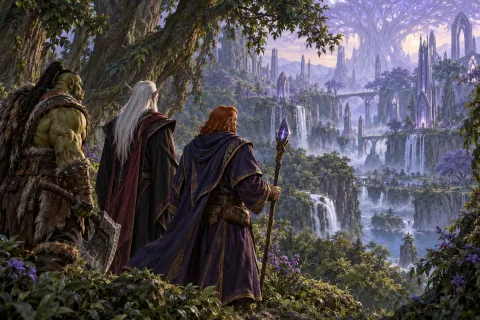
The publisher’s authorized public introduction explains Krasus’s power and his fading memory of the past war, Rhonin’s situation caught between his feelings for his family and his growing magical power, and Broxigar’s attitude toward facing death as a warrior. Knowing the outcome of the war to some extent does not mean those who entered the past can easily solve every problem. There is knowledge that does not reach them and changes they cannot control.
These visitors become important not just because familiar names appear in a different era. People of races the Kaldorei had not yet met could stand on the side of protecting their world. One could not solve the crisis at hand by bringing the criteria for distinguishing enemies and allies from one’s own era. People who lacked the basis to trust each other face the same disaster.
Public previews contain passages where Broxigar observes the firm faith the elves have in their Queen, and where Rhonin conveys his experience with the Legion to the resistance commander. That fact shows the role of an outsider. What looks too familiar from the inside can appear as a sign of danger to someone from the outside. However, convincing others of what they see was another difficulty.
This time travel must also be distinguished from the game’s journey where Nozdormu sends later players to the Well of Eternity dungeon. These are different ways in which different works look back at the War of the Ancients. While using events confirmed in public introductions and some previews as a narrative connection, we do not indicate that every scene of the three novels has been read and verified. The deeper flow regarding the final battle of Broxigar and the dragons will be continued with the materials in the next installment.
Chapter 6: The Same Brother, Different Dangers
Illidan, Malfurion’s twin brother, was a powerful mage. He had the ability to fight against the court’s magic, but the method he chose left behind long-standing debate and scars. Blizzard’s 2016 character introduction explains that he craved power and sought to destroy the Legion at any cost. Illidan briefly stood on the side of the Legion to learn the demons’ spells before returning to the defenders of Azeroth.
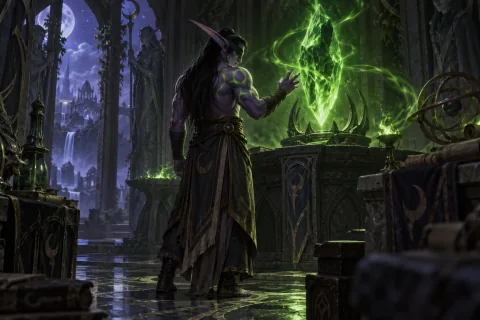
It is difficult to easily summarize this choice by the result alone. The idea of learning from the enemy to destroy the enemy contained danger. Even if the knowledge he gained could help the resistance, the relationships he formed and the actions he committed to gain that knowledge did not disappear. Sharing a goal did not mean the brothers’ methods were the same.
One should not project the fact that Illidan later gained a demonic form onto his body in this era. The event that changes him into one with wings, curved horns, and cloven hooves occurs when he absorbs the Skull of Gul’dan in the Third War. There is a distance of thousands of years from the viewpoint of this installment. In a story where characters survive for a long time, it is important to look at what stage of choice they are in now, rather than their familiar final form.
The conflict between the brothers is not a side branch of the war against the Legion. It shows what can collapse when people trying to protect the same world choose different methods. Illidan helps the resistance again, but even after that, the responsibility surrounding his choices does not end. The events that will finally unfold at the Well of Eternity and his actions to create a new source of power reveal that responsibility even more clearly in the next installment.
Chapter 7: Forces Joined from Beyond the Forest
This war did not remain only a war of the Kaldorei. The ancient Tauren hero Huln Highmountain also stood against the Legion. His name remained in the history of Highmountain, and features like large deer antlers were passed down to those blessed by Cenarius. If one traces back why modern Highmountain Tauren look different from other Tauren, one meets the War of the Ancients.
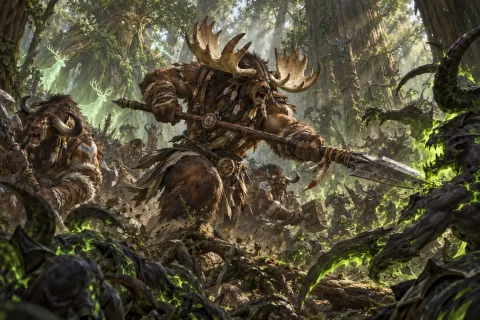
Although the gate opened in the capital of one race, the threat it brought reached the lands of other races as well. This fact changes the reason for the alliance. They did not gather because everyone considered the Queen’s court their own center. They had to stand together because those living in different lands could lose the same world. Beyond the elven front lines, there was the Tauren’s fight, and the power of Cenarius continued across those boundaries.
The story of characters like Shandris Feathermoon also touches this war. The public context of the official chronicle conveys the flow where Malfurion and Shandris oppose Xavius, and the soul dwelling in his satyr body is trapped in a twisted tree. Those responding to the threat opened by a court advisor were not only other high-ranking figures of the court. There were characters in that fight who would endure the war and live long lives thereafter.
That victory did not mean the defeat of the entire Legion. Stopping Xavius and closing the gate for Sargeras were not the same thing. Even after one battle won on the field, a larger passage could remain. The resistance had to decide how to end the source from which demons kept crossing over, while simultaneously striking down the demons in front of them.
Chapter 8: The World to Protect, the Well to Sever
The power to oppose the invasion was gathering. Military command, magic, the faith of the priestesses, the life of the forest, and warriors of other races supported the battlefield. However, even gathering all that power, one could not win while leaving the path open at the Well of Eternity. This was because the source that birthed the prosperity of the Kaldorei had become the passage for the invasion.
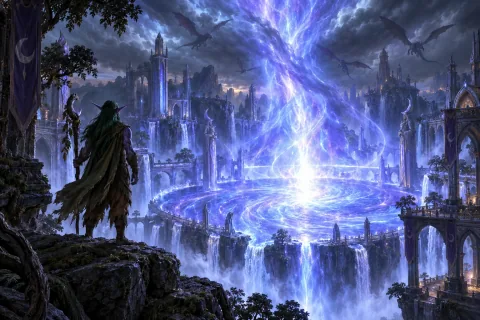
The decision Malfurion faces here is different from the decision to cast a stronger spell toward a single enemy. It is a question of whether to hold onto the beginning of one’s civilization or to accept the risk of losing it to protect the world. The Well of Eternity was not just energy for a mage to use. It was connected to who a race was, where they came from, and what they believed they could achieve.
For this reason, the conclusion of the War of the Ancients cannot end only with the celebration of the victors. A fight that requires severing what gave them life carries a different weight. The lives the resistance sought to protect and the order that supported those lives were already deeply intertwined. It was difficult to return everything to its original place without any scars from any decision.
And then, disaster was growing even among the guardians of the sky. The Dragon Aspects seen in the previous installment each took on different roles in protecting the world. The plan to gather that power into a single artifact might have seemed like a possibility to end the war. However, Neltharion was not free from the ancient whispers. The next installment follows how the Dragon Soul changes from a promise of salvation into a weapon of betrayal, and what kind of world the end of the Well and the Great Sundering leaves behind.
Glossary and Character Guide
War of the Ancients: The Legion’s first invasion of Azeroth about 10,000 years ago. It is a different era from the Battle of Mount Hyjal in the Third War.
Xavius, Varo’then: Azshara’s advisor and a mage who contracted with the Legion, and the figure who assassinated Ravencrest by the Queen’s order. These are not two names for the same person.
Cenarius, Malfurion, Tyrande, Illidan: The demigod of the forest and his disciple learning the druid path, the priestess of Elune, and Malfurion’s twin mage brother. Even within the same resistance, their powers and methods differed.
Ravencrest, Black Rook Hold: The resistance commander and the fortress where his family resided. The resurrected spirits in the later Legion expansion are distinguished from the living commander in this installment.
Krasus, Rhonin, Broxigar: The dragon mage, human mage, and orc warrior who traveled from the future to the past in the official novel. Do not mistake them for human or orc groups that settled in Azeroth since ancient times.
Huln, Shandris: The Tauren hero and Kaldorei figure who are connected to the ancient resistance and left their names in later history. The individual backstories of these characters are subjects to be continued in the character track.
Further Reading: Part 12 shows the civilization that grew at the Well and the court of Azshara. The next installment continues with the Dragon Soul, the Legion’s gate, the Great Sundering, and the choices made in the aftermath. Already published parts can be found in the serial index in the same language below.
Official Materials and Scope of Verification
Verification Date: October 8, 2026 (UTC). Written based on settings and events confirmed in the official public materials below. Public samples and setting introductions were verified only within their respective public scope, and we do not indicate that the entire books were read. Illustrations are AI reconstructions, not official images.
Well of Eternity — official ancient-city and Dungeon Journal preview
Legion Zone Preview: Val’sharah
Legion Dungeon Preview: Black Rook Hold and Darkheart Thicket
Legion Zone Preview: Highmountain
March Badness — Illidan’s ancient-war motivation
Burning Crusade Classic: The Story So Far
Warcraft III: Reign of Chaos — official 2002 manual
WarCraft: War of the Ancients Archive — licensed public book description and search snippets
World of Warcraft: Chronicle Volume I — publisher-authorized Google Books preview/search
comments 0