
Recommended Game Story · Warcraft Part 12
Chapters in this story
- The Rise of the Kaldorei and Azshara: Shadows over the Well of Eternity
- Chapter 1: The Path That Opens Only at Night
- Chapter 2: Life Changed by the Well
- Chapter 3: The Capital Where Brilliance Gathers
- Chapter 4: One Civilization, Many Strands of Power
- Chapter 5: A Voice Left at the Edge of the Kingdom
- Chapter 6: From Wonder to Arrogance
- Terminology and Character Guide
- Official Materials and Verification Scope
The Rise of the Kaldorei and Azshara: Shadows over the Well of Eternity
Spoiler Notice: This covers the origins of the Kaldorei approximately 15,000 to 10,000 years before the opening of the Dark Portal, and the elven civilization just before the War of the Ancients. Ruins revealed in the later Legion era are examined only as windows to understand the traces of antiquity. This is a narrative commentary rewritten based on events, and the composition and atmosphere of the illustrations are reconstructions.
Chapter 1: The Path That Opens Only at Night
Those who moved the history of Kalimdor did not seek the center of the world from the beginning. In the days when troll tribes fought over hunting grounds and territories, the dark trolls living in caves beneath Mount Hyjal sought a different life. Avoiding the day and emerging at night, their skin shifted from blue to shades of gray. Distancing themselves from other tribes and attempting to connect peacefully with nature, they gradually moved to the forests in the heart of the continent.
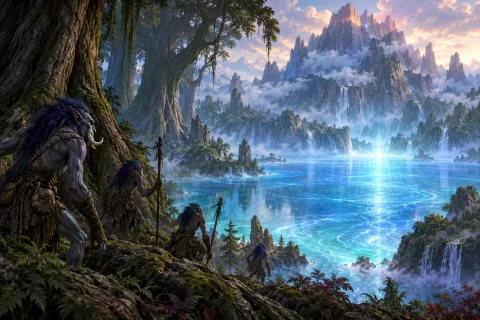
On that path were faerie dragons, chimaeras, and dryads. Recalling the forests they passed through changes the scale of this world. The land was not merely an area for armies to march across. It was a place where strange life resided, a place imbued with relationships that would be missed if viewed only as an object of conquest. The migration of the dark trolls was not a march to build an empire from the start. Steps taken to be closer to nature led to a greater discovery.
A vast lake appeared before them. A special energy shimmered upon the water, and that light would later earn the name the Well of Eternity. The source of Azeroth's wounds and power, examined in previous parts, had now entered the close proximity of a race's daily life. Distant cosmic events connected to the waterside where they lived. Even without knowing the birth of the world, the power it held could change their lives.
There is no record in this public material that leaves the moment of discovery in exact dialogue. However, the meaning of this change is clear. A small group that left to find their own path arrived at a place that would become the center of an era. Their descendants would gaze upon those waters for a long time. Whether that initial wonder would remain as wisdom or harden into a conviction for power was not yet decided.
Chapter 2: Life Changed by the Well
The energy of the Well did not change them in a single flash of ritual. After settling by the water, it permeated their bodies and minds over many generations. They gained higher intelligence, elegant appearances, and lives that were effectively immortal. Those who became new beings, gradually drifting away from the old troll traditions, were the night elves, the Kaldorei.
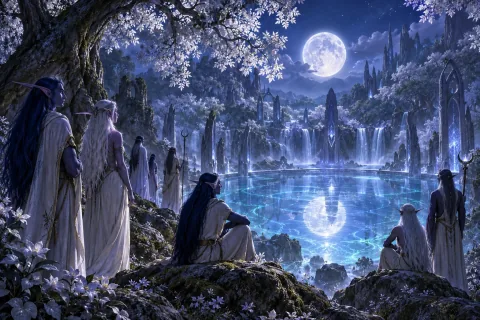
A long life is also a power that changes the time of a story. A stone wall that appears only as a ruin to a human might be a city that someone once frequented. A war from thousands of years ago does not remain just as a date in a book, but can lead to the choices and silences of the people who experienced it. This is one of the reasons why the story of the Kaldorei is both beautiful and heavy. Being able to live a long time overlaps with the meaning of having to remember for a long time.
Interest in the mystical also led to a faith serving the moon goddess, Elune. Early mystics believed the goddess was connected to the Well and slept in its depths during the day. This was the content of the faith they held at the time. The reader need not accept this as a definitive cosmic law explaining the entire essence of Elune. Faith was the way they understood the world, and the world as a whole was wider than what they knew.
Through surrounding artifacts and communion with Elune, they learned the name Kalimdor and words derived from the language of the Titans. The learning of the new civilization did not begin on completely empty ground. It was a matter of reading the traces left by the previous era. Even the world they felt they had newly discovered had older orders and wounds. Remembering this fact allows one to see both the achievements of the Kaldorei and the dangers they did not yet know.
Chapter 3: The Capital Where Brilliance Gathers
As time passed, life by the water grew into a massive civilization. Around the time of the War of the Ancients, the capital Zin-Azshari, located beside the Well of Eternity, was a dazzling metropolis. The capital built near the source of magic and Queen Azshara, who ruled it, represented the brilliance of the elven world. The Well became both the origin of civilization and a place that drew upon immense power.
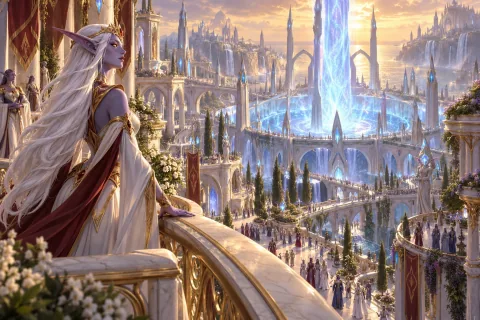
When imagining the scale of the architecture, one must not lose sight of its center. A city is not made only of high palaces and beautiful streets. It includes the people who frequent them, the mages who study power, and the order of the court that serves power. The illustrations in this part redraw that prosperity by referencing the curved columns, gray stone corridors, and blue crystal lighting seen in the official game. This is to show the size of a world not yet lost, which is difficult to understand by looking only at the ruins after the disaster.
Around the queen were the noble class known as the Highborne. Their magic, which sought to draw greater power from the Well of Eternity, would later be used to open a door leading out to the world. What is important here is not the name 'noble' itself, but the direction in which power is concentrated. The fate of a race that began at the same Well becomes increasingly deeply connected to the judgment of one court and the hands of the mages who execute that judgment.
The image of praising Azshara's beauty, majesty, and magical power remains in official setting introductions. However, the decisions of a widely beloved ruler are not necessarily decisions that protect the world. The greater the praise and trust, the further the consequences of a wrong choice can spread. In this passage, looking at the light of Zin-Azshari, the reader already knows the name of the coming invasion. For the people inside the city, it is a future that has not yet opened.
Chapter 4: One Civilization, Many Strands of Power
If one thinks of the ancient elven world only as the queen's palace, many stories disappear. That civilization had cities like Suramar and traditions of mages. The official introduction of later Suramar explains the history of the ancient Moonguard organization and powerful mages, and also conveys the fact that Illidan was a commander of that organization. The selection tradition of the time, which accepted those with golden eyes, shows what kind of honor and expectations magical potential gained within society.
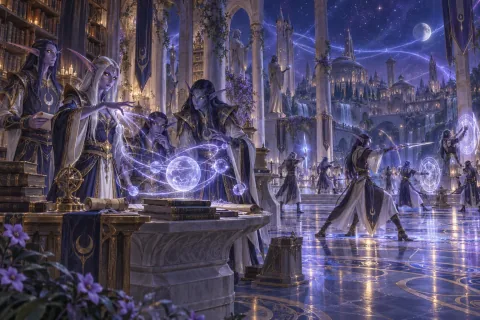
This does not mean that this was a rule applied exactly to all eras and all Kaldorei. However, at least within that old tradition, ability was not solely an individual's own. It was a power that the community recognized, expected a specific role from, and nurtured within an organization. The fact that there is a path open to those with talent and where that path leads a person are different issues. The reason Illidan's later choices are heavy is not simply because he possessed strong magic.
The faith in Elune and the relationship with nature had not disappeared either. The sight of Tyrande and Illidan fighting against the Burning Legion and the Highborne in the later War of the Ancients reveals that the invasion was not the singular will of all elves. A civilization that began at the Well did not move in only one direction. Someone was close to the power the court pursued, and someone remained as a person to stand against it when that power tore the world apart.
If one divides them into winners and traitors from the beginning, the weight of the choice fades. What the reader should see is that even if they share the name of power, what they intend to protect with that power can differ. The history of a race that gained mystical life included research and faith, community and power, nature and city. The war that will unfold will violently tear those relationships apart.
Chapter 5: A Voice Left at the Edge of the Kingdom
The perspective on Azshara's rule was not always the same. The later history of Azsuna remembers the resistance of Prince Farondis. He tried to use a Titan artifact, one of the Pillars of Creation, to stop the queen's plans and the disaster beginning from the Well of Eternity. That attempt, thwarted first by the queen, drove his people into a long curse. The choices of antiquity extend even to the ruins and ghosts of the Legion era.
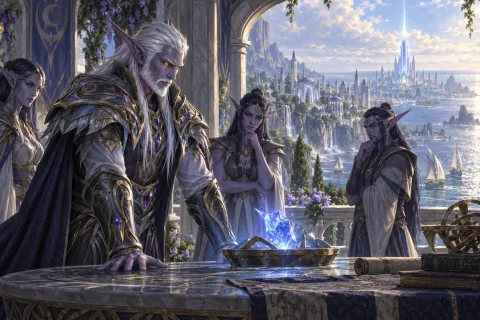
The detailed unfolding of that tragedy and the salvation that follows in later generations is a story to follow in the parts for that era. Here, one only needs to remember the rift it reveals. The person who stood against the queen is not immediately recognized as a hero by everyone. If suffering remains due to failure, resentment also remains for those who had to trust him. The choice to do the right thing and the result that actually occurred at the end of that choice do not easily overlap into one.
The reason the story of an ancient civilization is interesting is that not only the victory of the capital is recorded. There were other choices in lands far from the center. In places that looked like ruins that had lost their names, there were people someone tried to protect, and there was a reason why the stone was broken. Once you know that reason, the scenery goes beyond a background painting. Every time the reader walks the path, the weight of a different era is placed under their feet.
Chapter 6: From Wonder to Arrogance
The dark trolls crossed the forest in search of a connection with nature. Their descendants gained new life and a brilliant civilization within the energy of the Well. The distance between these two scenes is not merely the distance the civilization has progressed. It is a distance where the attitude toward meeting the world can change. What was initially a mystery to be learned begins, at some point, to look like a power that can be used as one wishes.
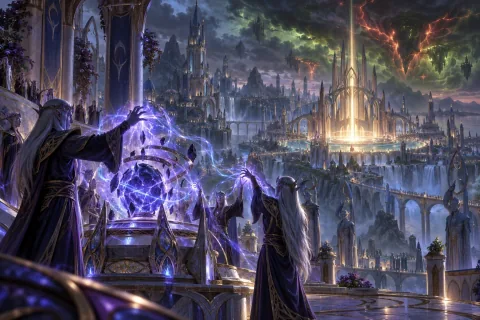
The previous story of Pandaria showed another aspect of dealing with that power. Jiang cared for injured life and formed friendships. The court near the Well drew in greater power and sought ways to execute that power. One cannot simplify different regions and events with the same law. However, if one reads the two flows together, it becomes clear that becoming powerful and protecting relationships are not always the same thing.
Azshara's vanity eventually leads to the choice of the Highborne to summon the Burning Legion. They prepare for the arrival of Sargeras while living by accepting the power beyond the door they opened. The walls of a beautiful capital do not block the dangers of the outer universe. Rather, the people who gained the highest authority within it bring that danger inside. At this moment, the brilliance of civilization does not become proof of safety.
The continent has not yet split at the end of this part. What the reader should remember last is not the collapsed city, but the possibilities that existed there before it collapsed. A free life that began in the forest, a life that could learn over a long time, a civilization that could hold different paths. The war in the next part is a fight waged with such things at stake. When the Burning Legion swarms in, the elves must choose not whether they will gain greater power, but what they will not lose.
Terminology and Character Guide
Kaldorei, Night elf: Descendants of dark trolls who changed over many generations near the Well of Eternity. In the modern era, they are not grouped into the same political faction as other elven groups like Nightborne or Blood Elves.
Well of Eternity: The source of power where the origins of the ancient Kaldorei and their magical civilization were connected. The Nightwell of later Suramar is a source with a different name and location.
Azshara and Highborne: The ancient elven queen and the noble class of the court. The queen in this part is in her form before turning into a naga. The Legion's door opened by the Highborne and its consequences become the center of the next war.
Zin-Azshari, Suramar, Azsuna: The capital, an old elven city, and a region that left behind ancient curses and ruins. These are not three names for one place.
Moonguard: An ancient elven mage organization. Its traces can be confirmed in the traditions and history remaining around modern Suramar.
Farondis: A prince who was cursed along with his people while trying to stop Azshara's plans. A figure who connects the choices of antiquity with the recovery of the Legion era.
Further Reading: Jiang and Lo in Part 11 convey the process of other ancient civilizations gaining and sharing power. The War of the Ancients after this text is a flow where the crisis that opened at the Well and the court spreads to the entire continent. Language links for published parts can be found in the series table of contents.
Official Materials and Verification Scope
Verification Date: October 8, 2026 (UTC). This was written based on settings and events confirmed in the official public materials below. Public samples and setting introductions were checked only for their respective public scope, and it is not indicated that the entire book was read. Illustrations are AI reconstructions, not official images.
World of Warcraft: Chronicle Volume I
Well of Eternity — official ancient-city and Dungeon Journal preview
Legion Zone Overview: Suramar — ancient elven heritage
Legion Zone Preview: Azsuna — Farondis and ancient curse
Warbringers: Azshara — official introduction and pre-naga visual
comments 1
고대 칼도레이 사회가 마법적 잠재력을 공동체적 자산으로 보았던 전통과, 이것이 아즈샤라 여왕의 통치 아래에서 어떻게 권력의 도구로 변질되었는지에 대한 구분이 흥미롭습니다. 당시 마법사들이 가졌던 사회적 지위와 그들이 수행했던 역할이 이후 군단 침공 과정에서 조직별로 어떤 다른 행보를 보였는지 궁금합니다.