
Recommended Game Story · Warcraft Part 28
Chapters in this story
- Chapter 1 · War Has Come to the Mountains of Khaz Modan
- Chapter 2 · The Sea Turned from a Path of Refuge to a Battlefield
- Chapter 3 · When Wings That Cared for Life Became Weapons
- Chapter 4 · The Forests of Quel'Thalas Could Not Remain Apart from Others' Wars
- Chapter 5 · Within One Horde, They Looked Toward Different Ends
- Chapter 6 · Troops That Disappeared Before Lordaeron
- Chapter 7 · The Voyage Toward the Tomb Was Not a Path of Gods
- Chapter 8 · What the Burnt Forest and the Surviving Capital Left Behind
- Criteria for Reading Eras and Editions
- Reading the Terminology
- Reading Together
- Official Games to Experience This Story Directly
- Official Materials and Verification Scope
Chains of the Red Wings · The War of the Forests and Gul'dan's Voyage
The armies gathered under their banners now truly traverse each other's lands. This chapter follows the invasion of Khaz Modan and Quel'Thalas in the original timeline of the Second War, the forced conscription of the Red Dragonflight by the Dragonmaw clan, the conflicting agendas within the Horde, and the process by which Gul'dan abandoned the army threatening Lordaeron to head toward the Tomb of Sargeras. Spoilers regarding the war and Gul'dan's fate are included. This is a commentary written by synthesizing events confirmed in official manuals and later official retrospectives. The atmosphere of the nameless battlefield is a reconstruction; fabricated dialogue or the inner thoughts of specific characters are not presented as official records. Later events involving the liberation of Alexstrasza and the Gul'dan of the alternate Draenor are not mixed into this war.
Chapter 1 · War Has Come to the Mountains of Khaz Modan
The road leading north from Stormwind was not just an empty line on a map. Between them lay mountain ranges, mountain passes, the lands of the dwarves, and the people who lived there. While the kings of Lordaeron prepared for war, Khaz Modan was already facing the Horde's advance. The news that the southern kingdom had fallen was no longer just news from beyond the mountains.
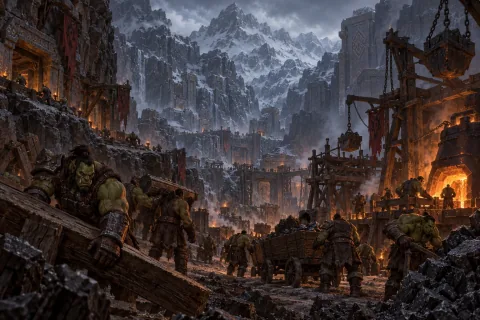
The Horde expanded its occupied territories while passing through Khaz Modan. The official historical account in Warcraft III reflects on how the orcs trampled the lands of the dwarves and destroyed various regions of Lordaeron and even Quel'Thalas. The scope of the war expanded from a single capital to various peoples of the continent. The Alliance formed by Lothar was the answer to a threat that no individual nation could handle on its own.
Occupation does not end the moment a victorious army plants its flag. For the next force to move, paths had to be secured, and resources for the fleet and equipment had to be supplied. In the old Warcraft II manual, the Bleeding Hollow clan is tasked with guarding the refining operations in occupied Khaz Modan. Kilrogg Deadeye's warriors were responsible not only for the axes on the battlefield but also for the logistical work behind the scenes that kept the army moving.
Mines, refining facilities, timber-laden wagons, and the troops guarding them are all interconnected. If this connection is severed, the strength of the army that has advanced far is diminished. To a commander leading a war, territory is both a map painted in broad strokes and a multitude of paths that must be held. As the Horde engaged more kingdoms, those paths became longer and more complex.
Dwarven resistance also continued from the outside. Those who knew the mountains understood the narrow passages and sturdy walls of their own land. The Alliance fighting to reclaim Khaz Modan was not just helping the honor of a distant ally, but making it possible for one of the pillars of the Alliance to live in its own land again. There is a desperation in the reason why dwarven equipment and technology were added to the front lines.
However, the clan-based territory markings in the old manual should not be read as a record of the fall of every city. Specifically, the name Ironforge written in the Bleeding Hollow clan entry does not mean the entire dwarven capital fell to the Horde. This chapter follows the invasion of Khaz Modan and the management of occupied territories; the sieges and defenses of individual cities are connected separately by cross-referencing relevant battle data.
Chapter 2 · The Sea Turned from a Path of Refuge to a Battlefield
In the First War, the sea was a path for Lothar and the survivors to head north. In the Second War, that same sea became a path for transporting armies and a battlefield where enemy navigation had to be blocked. If one had a port, it was easy to send troops; if one lost a port, it was difficult to help distant allies. The coast where ships landed was no longer just the edge of land warfare.
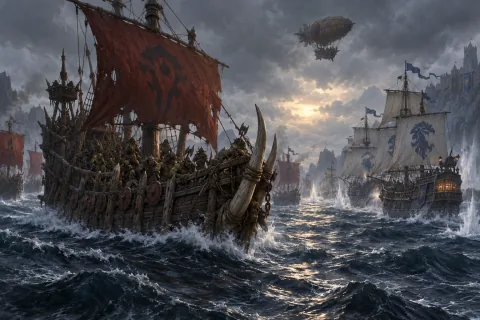
Quel'Thalas destroyers and human battleships guarded the Alliance's seas. The Horde had fast troll destroyers, heavy battleships operated by ogres, and transport ships that moved troops to the other side. These ships, introduced separately in the official game manual, each performed different tasks. The ship strong in combat and the ship that carried many people did not need to be the same vessel.
Horde transport ships are depicted as massive hulls with exposed wood and bone. For the troops on deck to reach the shore, other ships had to protect them while the slow vessels moved. Conversely, the defending side had to stop those troops on the sea to reduce the threat that the land's villages and walls would have to endure. A single landing was the result of various choices made on both sea and land.
The role of reconnaissance also changed. Gnome flying machines and goblin zeppelins flew high to observe enemy movements. It was difficult to know the movements of fleets beneath the sea or far away by looking only at the infantry in front of one's eyes. It was a war where the ability to discover things early became as important as large and heavy weapons.
The descriptions of these ships and machines are not converted into records of unconfirmed battles at specific ports. The significance of the naval warfare in Warcraft II lies in the fact that the space where different forces met did not end with the continent's roads and forests. The places to defend increased, and maintaining an army became more difficult. When Gul'dan later escaped to the sea with his followers, that voyage became a movement significant enough to change the war situation on land.
Chapter 3 · When Wings That Cared for Life Became Weapons
There was another power in the sky. Originally, the Red Dragonflight was not an army born for the orcs' war. As the Aspect of Life, Alexstrasza had long held the responsibility of caring for life on Azeroth. The birth of the Aspects followed in Part 4 and the betrayal of the Dragon Soul encountered in Part 14 were not distant, ancient stories in this war either.
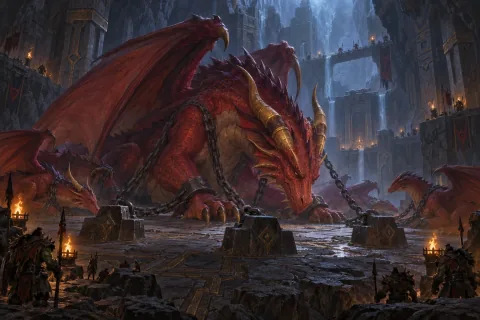
The Demon Soul obtained by the Dragonmaw clan was an artifact capable of controlling dragons. Using that power, they captured Alexstrasza and the Red Dragonflight, dragging the dragons' power into the Horde's war. The scene where a powerful being chooses an alliance on their own and the scene where they are forced to submit under the power of an artifact are not the same. Behind the aerial power the Horde gained lay that difference.
Grim Batol became the center of that captivity. The massive mountain fortress built by the dwarves was a place that already bore the traces of internal wars and curses from long ago. Into the deep corridors of a structure once intended to create a new home, this time came the war plans to suppress the Red Dragonflight. The fact that the fortress was large and deep inside could be a reassuring condition for those being protected, but for those trapped, it was a condition that distanced them from the outside world.
The old manual explains that the offspring of the captured queen were raised under the Dragonmaw clan to attack the enemies of the Horde. If one reads the appearance of young red dragons on the battlefield simply as the addition of a new unit type, what was forced behind it disappears. The flames crossing the sky were also the result of a life-protecting power being mobilized for someone else's conquest.
The contrast between the giant bodies in the pictures and the small guards shows that contradiction. Looking only at size, it is clear which side is stronger, but whether that power can be used according to one's own will is another matter. The means of oppression more important than chains was the Demon Soul. The fact that depriving a being of their freedom could also threaten the many lives they sought to protect reveals the ancient betrayal of this artifact once again.
At this time, the story is not changed to have Alexstrasza escape immediately and end the war. The liberation of Grim Batol leads to a separate event later. The Warcraft III manual places that fight in the history after the second Dark Portal was destroyed. If the intervention of Rhonin, his companions, and the dragons is moved forward to the current front line, the duration of the captivity and the dangers before and after are lost.
Chapter 4 · The Forests of Quel'Thalas Could Not Remain Apart from Others' Wars
Quel'Thalas was a kingdom of high elves that had protected its own borders and culture for a long time. The troops that initially responded to Lothar's request for help were not large. The ancient pact between humans and elves was still alive, but there remained a distance regarding how much power they actually had to provide to keep that promise.
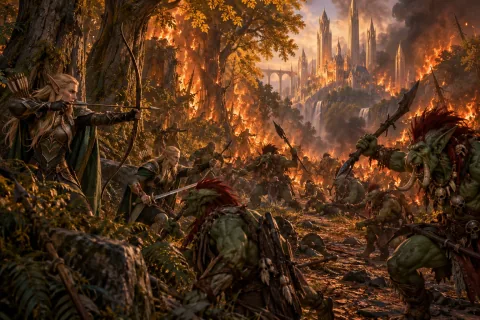
However, the war spreading north approached regardless of that distance. The orcs brought destruction to Quel'Thalas as well. The official history of Warcraft III explains that the burning of the elven forests during the war left memories that remained in the relationship between the Alliance and the elves later on. This is why all damage cannot be explained solely by whether the capital was defended. A kingdom is not composed only of the central city within the walls.
Those who lived on the forest paths and borders had to stop the orcs and their allies. The bows of the rangers led by Alleria Windrunner were not weapons that watched this war from afar. The elves who set out following Lothar's request for support ended up fighting a threat that had reached their own kingdom. The participation that began for an old promise became linked to the survival of their own homeland.
For the Amani forest trolls who joined hands with the Horde, Quel'Thalas held a special meaning. The conflict that had existed before the alliance of humans and elves did not disappear just because the orcs arrived. Zul'jin's warriors did not share all the same goals as the orcs, but they gained an opportunity to attack opponents they had fought for a long time. The invasion of the Horde from the outside world re-embraced the old wars within Azeroth.
From the Alliance's perspective, it was the cooperation of people fighting together. From the Amani's perspective, it was the sight of enemies they had faced for a long time becoming the same side again. Different memories enter the same forest. One must understand that difference to follow why the relationship between the Amani and the Horde would harbor long-standing grievances later.
Zul'jin's personal captivity and wounds, and the losses suffered by each member of the Windrunner family, are dealt with alongside data to be checked directly in separate character chapters. This main text does not fabricate unconfirmed dialogue from the scene or the final moments of the family. What is clear here is that the destruction of the borders changed the kingdom's politics and the warriors' next choices together. The war that was being helped in a limited way from afar soon became a wound on their own land.
Chapter 5 · Within One Horde, They Looked Toward Different Ends
Orgrim Doomhammer's war moved in the direction of collapsing the Alliance. Since the survivors of the south had gathered greater strength in the north, the Warchief had to strike down the center of that power. For him, the territories conquered so far, the enemies to be attacked in the future, and the various clans that had to move according to his orders were all placed within one war.
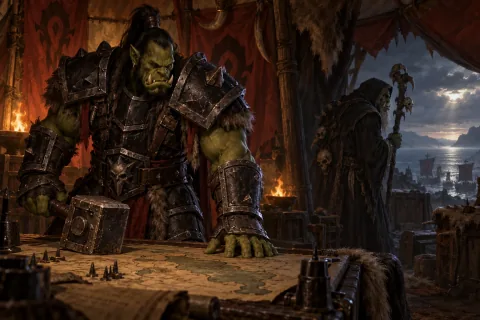
To Gul'dan, the Horde had a different meaning. The magic and troops he provided to survive under Orgrim did not mean he had made the Warchief's goal his own. He cooperated when he could increase his own power and protect his own base. The promise of greater power he had glimpsed in his deal with Medivh did not end even after Stormwind fell.
The Stormreaver clan was a new base for him. The old official manual introduces that Gul'dan created his own clan in preparation for Orgrim's distrust and threats, and sought the Tomb of Sargeras with that force. Just because everyone is under the same banner does not mean they agree on what to sacrifice for that banner.
The Twilight's Hammer clan, led by Cho'gall, also harbored different goals. For those who considered destruction a sacred mission, the direction of the world collapsing might be more important than the stable rule of the Horde. The old clan introductions explain that the relationship between the Twilight's Hammer and the Stormreaver was strong, showing why that loyalty was deeper than loyalty toward the Horde as a whole.
In the Black Tooth Grin clan were Blackhand's sons, Rend and Maim. In the Blackrock clan were warriors loyal to the Warchief. The Bleeding Hollow clan supported the army in occupied territories, and the Dragonmaw maintained the power of the captured dragons. This massive army could not be explained by the role of any one clan alone. However, each role did not unite their purposes into one either.
The pressure of war can temporarily cover these differences. When the same enemy is in front and victory seems near, fighting together is beneficial to each. Nevertheless, the question of what one chooses first at a decisive moment remains. While the Warchief looked toward the enemy's capital, the warlock looked toward the tomb beneath the sea. The two paths could never be the same.
Chapter 6 · Troops That Disappeared Before Lordaeron
The Horde's advance became close enough to threaten the heart of Lordaeron. The formation of the Alliance did not mean immediate safety. While the power of various kingdoms and races held the line on the actual front, the enemy continued to move north. It was a moment when the refuge hoped for by those who lost their capital in the First War became dangerous again.
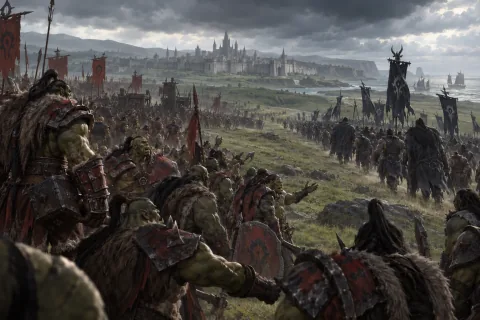
At that critical time, Gul'dan departed from the front line with his followers. Blizzard's official chronicle summarizes that the act of leaving to find a powerful artifact when the Horde was on the verge of victory weakened the army and forced a retreat. Later retrospectives specifically connect the destination to the Tomb of Sargeras. Those who left the front were not just a few soldiers who disobeyed orders. The base and power Gul'dan possessed moved with him.
To a commander trying to continue the attack, that movement itself was a betrayal. If the power intended to break the enemy's defense disappears, the plan must change. The tasks to be assigned to other clans increase, and the burden of holding the already extended front line grows. The power of the Horde, which should have been concentrated toward the Alliance, was scattered by internal conflict.
There was a gap in the process of Lordaeron surviving. Of course, the defending people did not win automatically just because the enemy split. They had to survive, hold their formation, and not miss the opportunity they gained. If Gul'dan's departure created the conditions to change the direction of the war, it was the Alliance's army that turned those conditions into a counterattack.
This passage is not reduced to a story where one warlock created all the results alone. The clan relationships that allowed him to leave, the power he aimed for, and the deal for which Orgrim had previously left his power behind were all piled up together. The relationship that had covered small distrust with convenient cooperation returned as the most dangerous weakness when the greatest power was needed.
The future war changes in the direction of the Horde, which was advancing north, being pushed south. For Lothar and his companions, a path opens to return to the lost lands. That path was not immediate safety or total victory. The fortress of Blackrock and the Warchief still remained. The fight in the next chapter waits there.
Chapter 7 · The Voyage Toward the Tomb Was Not a Path of Gods
Gul'dan's voyage was not to reclaim anyone's homeland. What he sought was power that would elevate his own strength beyond the limits of humans or orcs. Following the promise that began with the deal with Medivh, he headed toward the Tomb of Sargeras and the powerful artifacts there. It was a moment when he chose personal deification over the army's victory.
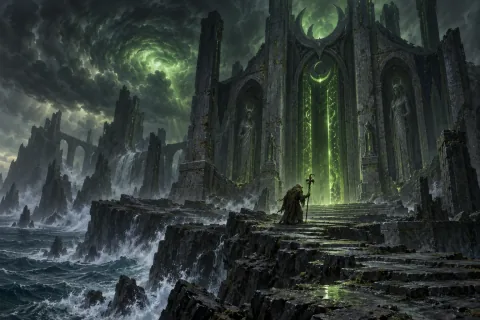
The name Sargeras had been behind this war for a long time. The corruption that opened the Dark Portal and the tragedy of Medivh were linked to that name. Yet Gul'dan saw that danger as an opportunity to gain his own power. To someone who had moved the Horde and used the submission of others, the plans of a demon even greater than himself could approach.
The tomb he found was not the promised throne. The Gul'dan of the original timeline is killed by the demons waiting inside. Official character introductions also convey that his greed ultimately returned as death. This chapter does not change that death into a scene fabricating exact wounds or final screams. What is important is the result that he failed to become a god and lost his life in front of the power he believed he could control.
The betrayal seen on the Horde's front and the death met at the end of the sea might seem like different lessons. However, both were the front and back of the same choice. Gul'dan used other people's war as a means to reach the destination he wanted. He abandoned that means and arrived at the tomb, but he could not make the power there his own means.
Just because he died does not mean all the dangers he left behind disappeared. The tomb, the artifacts, and the traces of the warlock return as stories even in later times. However, events after that should not be explained by the survival of the same Gul'dan. The Gul'dan from the alternate timeline appearing in Warlords of Draenor and Legion is a different incarnation. One cannot combine this voyage with those later events just because the face of the later era is familiar.
Chapter 8 · What the Burnt Forest and the Surviving Capital Left Behind
The forests of Quel'Thalas were left with the scars of war, and Khaz Modan was left with the fight to reverse the occupation. The queen of Grim Batol also had not yet gained her freedom. The fact that Lordaeron did not fall does not mean all those things were solved at once. Even as the direction of the war changed, the suffering of different lands continued in their own time.
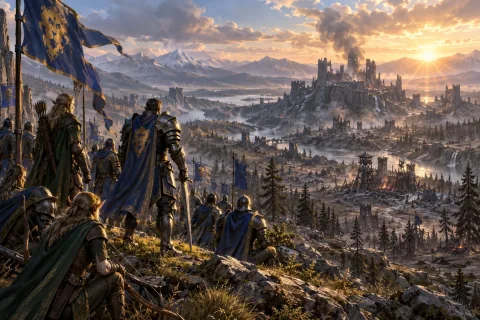
If one follows this difference, one can understand why the Alliance's victory left difficult problems even afterward. For some, it was a war that defended the capital; for others, it was a war that lost the forest. Even if the army that fought together recorded the same result, the price remembered in each homeland was not the same. Those memories influence post-war alliance relations and new conflicts again.
Similar cracks remained in the Horde's alliance. The fight with the elves that was important to the Amani, the conquest of the continent that was important to Orgrim, and the personal power that was important to Gul'dan never merged into one. The fact that adding several forces together does not automatically make a single community is revealed even in the midst of this massive invading army.
Now the story heads south again. The throne Gul'dan tried to obtain at sea has disappeared, but the last power Orgrim tries to protect remains in Blackrock. Lothar has the path to return to the lost Stormwind and the responsibility to the survivors. The fight those two leaders will face ends the long-standing war while leaving the name of the next era.
Criteria for Reading Eras and Editions
This chapter follows the original timeline of the Second War. The power and clan descriptions of Warcraft II were cross-referenced with later official chronicles, and the clan-specific territory names from the old manual were not expanded into modern canon records of city falls. Items organized in more detail later, such as early ogre descriptions or the scope of clan rule, maintain the context of the original game's introduction.
Quel'Thalas is still a high elf kingdom. The destruction of the Sunwell and the use of the name blood elf in the Third War are later events. The cooperation between the Amani and the Horde of the Second War is not expressed as the same situation as the later blood elf joining of the Horde. All mission sequences and regional battles of individual campaigns are subject to additional official cross-referencing, and this chapter does not indicate that it has verified all those records.
The Demon Soul is an artifact connected to the Dragon Soul of an earlier era. The captivity of Alexstrasza and the subsequent liberation of Grim Batol are distinguished, and the event of the fortress being occupied again by the Twilight's Hammer during the Cataclysm is different from this era. The arrangement of chains in the drawing, the number of young dragons, the guards, and the array of the fleet are interpretations based on official appearances. They are not battle site photos or accurate fortress blueprints.
Reading the Terminology
Khaz Modan — The mountain region of the dwarves. The land where the Horde's invasion, occupation management, and the Alliance's liberation war take place.
Dragonmaw Clan — The orc clan that forcibly mobilized Alexstrasza and the Red Dragonflight for the Horde's war.
Demon Soul — An artifact capable of suppressing and controlling the power of dragons. It is connected to the history of the Dragon Soul that appeared in the War of the Ancients.
Grim Batol — An old dwarven mountain fortress. In the Second War, it was the place where Alexstrasza was imprisoned; the liberation and later new occupation events continue in different eras.
Quel'Thalas — The kingdom of the high elves. The damage suffered from the invasion of orcs and forest trolls leaves traces on alliance relations afterward.
Stormreaver Clan — The clan organized by Gul'dan to protect his base and continue his pursuit of power.
Twilight's Hammer Clan — A force that considers destruction a sacred mission under the command of Cho'gall. One should distinguish the transition between the clan of this era and the Old God-worshipping organization of later times.
Tomb of Sargeras — The place Gul'dan headed to find the power of deification. The arrival did not lead to a successful ascension but to his death.
Reading Together
The Alliance and the Birth of the Order of the Silver Hand: /en/community/tm-warcraft-saga-part027-20261008
Dragon Aspects and the Responsibility of Life: /en/community/tm-warcraft-saga-part004-20261008
Ancient Betrayal and the Dragon Soul: /en/community/tm-warcraft-saga-part014-20261008
The Ancient Pact Connecting Elves and Humans: /en/community/tm-warcraft-saga-part018-20261008
Official Games to Experience This Story Directly
Warcraft II: Remastered includes the Tides of Darkness and Beyond the Dark Portal campaigns. It is the official Battle.net page where you can directly experience the battlefields of the story and the two faction campaigns of the original game. Regional availability conditions and account/platform requirements can be checked on the sales page.
Warcraft II: Remastered — official Battle.net product page
Official Materials and Verification Scope
Verification Date: October 8, 2026 (UTC). This was written based on settings and events confirmed in the official public materials below. Public samples and setting introductions were verified only for their respective public scope, and it is not indicated that the entire books were read. The illustrations are AI reconstructions, not official images.
Warcraft II: Battle.net Edition — Official Manual
Warcraft III: Reign of Chaos — official 2002 manual
Warcraft III: The Story So Far
Warcraft II: Tides of Darkness
Cataclysm: Grim Batol — Blizzard historical introduction
Gul’dan, The Warlock — Blizzard original-timeline historical biography
comments 1
굴단은 정말 대단한 야망가였지만, 결국 살게라스의 무덤에서 혼자만의 파티를 열려다 쓴맛을 보고 말았네요. 흑마법사가 길을 잃으면 호드 전체가 얼마나 고생하는지 잘 보여주는 사례 같아요. 🐉