
Recommended Game Story · Warcraft Part 10
Chapters in this story
- Kang's Fist and the Liberation of the Pandaren
- Chapter 1: A Nation That Tears Families Apart to Create Submission
- Chapter 2: Finding a Weapon That Cannot Be Taken Away
- Chapter 3: The Winds of Kun-Lai and the Teachings of the Trapped White Tiger
- Chapter 4: Striking Where the Empire's Power Is Created
- Chapter 5: The Fist of the First Dawn, the Master Who Did Not Return
- Chapter 6: The Test After Liberation
- Chapter 7: How Hidden Wisdom Crosses Eras
- Chapter 8: Ambitions Across the Sea Remained Even in the New Era
- Names and Concepts in This Part
- Official Materials and Scope of Verification
Kang's Fist and the Liberation of the Pandaren
Spoiler Warning: This article covers the path of the monk born under Mogu rule, the uprising led by Kang, and the traditions following liberation. The later wars of Pandaria and the era of Shaohao will be discussed in subsequent parts. This is a commentary reconstructing official events; creative dialogue is not cited as official dialogue.
Freedom did not arrive on the same day as the emperor's death. Even after the Thunder King vanished from Uldum, the pandaren still had masters. The new Mogu rulers did not discard the old chains but took them up with their own hands. The days outside the palace remained filled with commands, labor, and the fear of punishment.
When one looks at the darkness of that era through the life of a single person, the face hidden by the word 'empire' is revealed. Kang was a brewer. His son was sent to die before the mantid, and his wife lost her life trying to prevent it. For the one left behind, the world was no longer a familiar home. However, the path Kang found after that loss did not end with the rage that destroys oneself.
Chapter 1: A Nation That Tears Families Apart to Create Submission
Lao-Fe the Slavebinder was the Mogu ruler who followed the Thunder King. While he enjoyed abundance and luxury, the lives of slaves were treated as materials to maintain control. Tearing families apart was one such method. It was believed that if people who lived together were separated, their desire to protect one another and the potential for resistance would weaken.
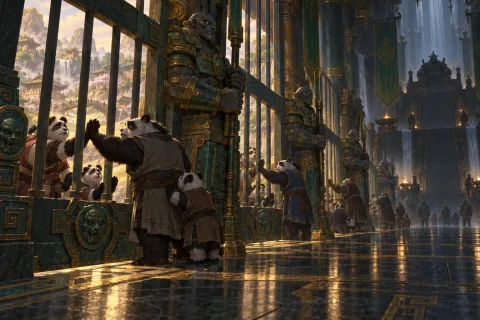
Kang's tragedy occurred within that system. It is not strange for someone who lost their loved ones without cause to fall into despair. What mattered was what came next. Kang pondered why the Mogu inflicted such pain. The path of returning a greater wound because one was wounded, and the path of escaping the structure that creates wounds, may start from the same anger, but their ends are different.
This difference returns repeatedly throughout the history of liberation. Simply tearing down an empire does not automatically lead everyone to a better life. If one repeats what was done to them upon others, only the face of power changes. The reason those who remember Kang's teachings later sought to distinguish between justice and revenge was that they did not take suffering lightly from the beginning.
Chapter 2: Finding a Weapon That Cannot Be Taken Away
The Mogu forbade slaves from carrying weapons. The calculation was that if the rulers monopolized swords and spears, it would be easier to maintain submission. However, forbidding the metal in one's hand could not strip away the potential of the body and mind. The pandaren sought out techniques for fighting with bare hands and the path to mastering the chi within themselves.
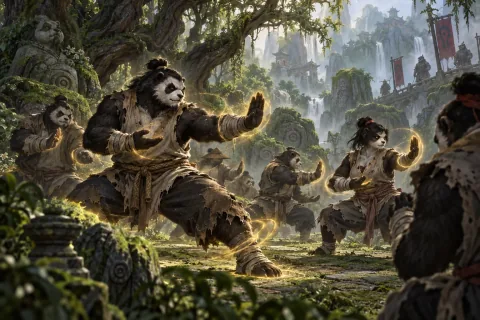
Official monk introductions clearly link to this origin. To the oppressed pandaren, the monk became a hope, and the training prepared without weapons became real strength when the opportunity for an uprising arrived. The game's depiction of monks later using staves or various weapons and the origin of bare-handed training being crucial due to weapon bans in the slave era are stories of different times.
Kang's techniques did not remain within one person. Other slaves wanted to learn, and Kang taught them. Rumors spread, and more people gathered. What they gained was not just fighting moves. It was the sensation of stepping out of the role of a helpless being defined by the Mogu, and the realization that they could learn, prepare, and be a strength to one another.
In the labor forced by the empire, hands and feet were tools to perform the master's work. In training, those same hands and feet became possibilities to protect one's own life. The body did not change into a different body. What changed was the purpose for which that body moved. This is the weight carried by the origin of the Pandaria monk.
Chapter 3: The Winds of Kun-Lai and the Teachings of the Trapped White Tiger
As the movement grew, the Mogu learned of the rumors. Kang moved his disciples to the peaks of Kun-Lai. On the mountain where the winds blew fiercely, they built a monastery and continued their training. It was a process of building a foundation for a secretly formed resistance to endure longer. Even with a few strong individuals, a movement can easily scatter if there is no place to teach each other and prepare together.
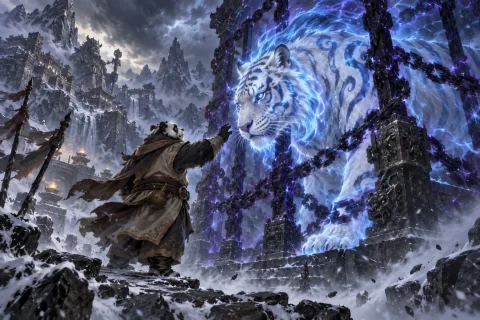
There, Kang discovered an unexpected presence. Xuen, the White Tiger, who had been defeated and imprisoned by the Thunder King. Even a great celestial remained, bearing the marks of oppression. Just because the pandaren learned strength did not mean all previous wounds had vanished. However, Kang communed with the White Tiger, learned teachings about the power within himself, and passed them on to his disciples.
This encounter contains a connection where the defeat of the previous chapter turns into the possibility of the next. Lei Shen believed that if he suppressed the Celestials, the hope they gave to the people would also end. However, the fact that Xuen was alive, and that someone had come to learn that wisdom, left a future outside the emperor's intentions.
Technique and control were needed together. Anger can raise the body, but it does not tell it where to go. Kang's disciples had to gain strength while learning who that strength was for. Training oneself for justice was a different choice than becoming stronger to dominate others like the Mogu.
Chapter 4: Striking Where the Empire's Power Is Created
The uprising only entered the battlefield after it was prepared. In the official Chronicle, the monks' first significant victory occurs at the Mogu'shan Vaults. That place, where Nalak'sha's power source and the Mogu's flesh-shaping abilities were connected, was not merely a warehouse filled with treasures. It was the foundation where the empire created new power.
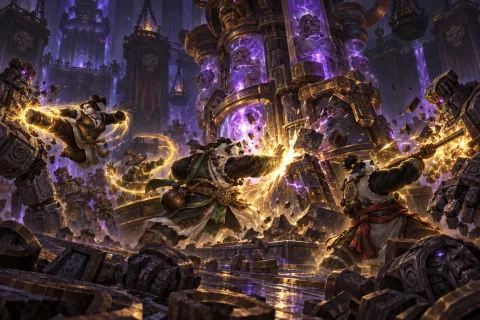
The rebels pushed the Mogu out of the source of that power. Let us consider why this event is important. Defeating one soldier of the ruler and seizing the facility where that ruler maintains power by creating new troops and slaves produce different results. For an uprising to endure, it had to remove the opponent's fearsome power one by one.
The Mogu were still strong, and not every battle became easy just because the pandaren had mastered bare-handed techniques. It was necessary to judge when to attack and when to retreat, and to survive until the next fight. Lao-Fe's army eventually retreated to the Vale of Eternal Blossoms. The rich valley gave them a base to hold out. If the ruler remaining at the center of the empire could continue to maintain power, liberation could not be completed.
The uprising now demanded the most dangerous choice. It was a moment where one could not progress further by merely training in a safe mountain and waiting for an opportunity. Kang had taught his disciples the strength to protect their lives, but to open the final door, he had to enter that danger himself first.
Chapter 5: The Fist of the First Dawn, the Master Who Did Not Return
Kang led the attack deep into the valley himself. At the end, the slavebinder and the former slave faced each other. One was a ruler who believed he could own people, and the other was one who sought to return the lives stolen in that way back to the people. Their fight was a clash beyond personal grudges, concerning how the empire treated people as beings.
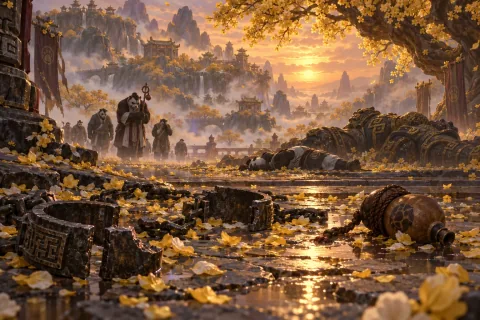
Kang defeated Lao-Fe with his bare hands. However, he himself suffered a fatal wound. Both men died together. It was not a conclusion where the victorious master enjoyed a new world with his disciples for a long time. The one who fought to open the door of liberation could not continue to live beyond that door.
Thus, Kang's death prevents victory from ending as a simple cheer. For some, the first day of a new era was an extension of the day they lost their family and master. There were those who did not return, and there were people who only had what they had been taught. How to protect those teachings in the new world had not yet been decided.
In the history of domination that followed the Thunder King, there were emperors who inherited power. In the legacy Kang left behind, there were people who learned his strength and shared it again. The method of concentrating power in one person's body and the method of continuing learning in the lives of many people diverge here. The master died, but the path of the monk did not end with that death.
Chapter 6: The Test After Liberation
Among those who were victorious, there were some who wanted to take revenge on the surviving Mogu. The desire of those who had been treated cruelly for a long time to return the same cruelty is a realistic danger in this story. The pain did not disappear, and memories did not suddenly become clean. There was a possibility that the new era could repeat the same violence with a different face.
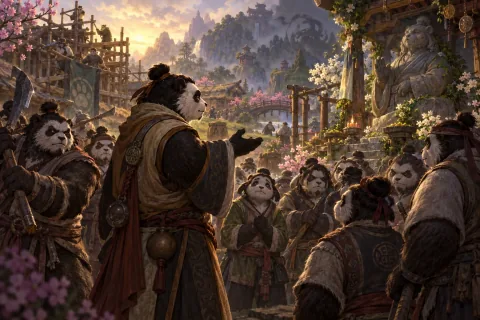
Song remembered Kang's philosophy and stories. He walked among the liberated people and conveyed the justice his master had aimed for. He reflected on what needed to be remembered so that the heat of retaliation would not be taken as the principle of the new life. A messenger who might seem to have played no significant role in the war thus influences the direction of the era.
However, in Pandaria, the darkness of emotions does not remain only within the heart. The influence left by Y'Shaarj inflated negative emotions and appeared as the threat of the Sha. The wounds of oppression and the impulse for revenge could shake individuals and society while simultaneously becoming a path for the ancient evil left beneath the land to reach them. Song's act of conveying the teachings was more than just a story to soothe the heart.
Here, one can understand why Pandaria's culture examines the emotions within oneself. Equanimity is not just a leisurely habit in a place where nothing happens. It is wisdom for a society that has actually suffered to confront the power that could tear it down again. This issue comes alive again when the wars of outside powers enter Pandaria later.
Chapter 7: How Hidden Wisdom Crosses Eras
Even before Kang's uprising, there were those who sought to maintain their connection with the Celestials. In the official short story 'The Jade Hunters,' there is a passage where later characters read old records and learn the stories of miners who worshipped the Celestials while avoiding Mogu surveillance. The story conveys that history in the form of ancient records being rediscovered and interpreted.
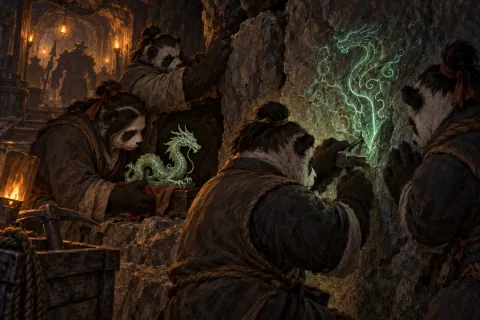
In those records, the miners hid the wounded Yu'lon and tried to preserve wisdom and hope. The statues and records left behind connect Kang's liberation and, further, the era of Shaohao with the teachings of the Celestials. Even without turning the later dwarven adventure in this short story into a scene of an ancient war, one can sufficiently feel how wisdom was transmitted.
History does not continue only by the movement of leaders. There are miners who prepared a place to avoid surveillance, monks who taught disciples, Song who memorized the master's story and told it to people, and visitors who read the records after a long time. Although their eras were different, the choice not to lose certain memories reached the next person.
The beauty of Pandaria is not proof that there was no pain. Rather, it is the result of having reconnected farming, learning, and community so that they could live beyond that pain. Under the high peaks, people had to reclaim their daily lives. Passing through the door opened by someone's death, the work of creating a world where the survivors could actually live was waiting.
Chapter 8: Ambitions Across the Sea Remained Even in the New Era
Just because Mogu rule collapsed did not mean all surrounding ambitions vanished. The Zandalari remembered the old alliance and expectations they had formed with the Thunder King. The empire's technology, power, and promised land were still important to them. While the pandaren were building their own lives, plans that did not recognize that new era were moving across the sea.
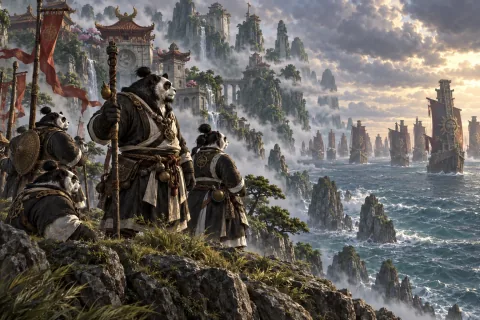
The next story continues with the invasion descending from the sky and those who reclaim that sky. It is the memory of Jiang, the cloud serpent Lo, and the order they left behind. If Kang found the possibility of freedom within his hands and feet, the subsequent guardians discover another possibility in their relationship with strange wings. The liberation of Pandaria is the name of a finished war, and also the moment when the life to be protected first came into being.
Names and Concepts in This Part
Kang, the Fist of First Dawn: A pandaren who stood against Mogu oppression, spread the teachings of the monk, and led the uprising. His life as a brewer and the loss of his family are connected to his journey.
Lao-Fe, the Slavebinder: A Mogu ruler. He falls in the final battle with Kang.
Chi: The inner life force handled by a monk. We do not interpret the resource used in the game and the historical scenes of the old uprising as being one-to-one identical.
Song: One who remembered and told Kang's story. A connection point for understanding the difference between justice and revenge, and the threat of the Sha.
Sha: A threat related to the remnants of Y'Shaarj and negative emotions. An influence that remains even after the Old God has vanished.
Jiang and Lo: The figure of Pandaria defense and the cloud serpent to be met in the next part. Read by distinguishing between Kang's uprising and the later Zandalari invasion.
Official Materials and Scope of Verification
Verification Date: October 8, 2026 (UTC). This was written based on settings and events confirmed in the official public materials below. Public samples and setting introductions were checked only for their respective public scope, and it is not indicated that the entire book was read. Illustrations are AI reconstructions, not official images.
World of Warcraft: Chronicle Volume I
World of Warcraft Chronicle Volume 1: Kang and pandaren revolution public previews
comments 0