
Recommended Game Story · FINAL FANTASY VI Part 28
Chapters in this story
Names That Remain After Magic Fades
Spoiler Notice: This series covers the major events and ending of Final Fantasy VI. If you are new to the game, you may want to read only up to your desired chapter and experience the choices and music firsthand. This text contains both descriptions of events and interpretations of the characters' inner thoughts; it is not a translation of original dialogue or an official novel. Illustrations are AI reconstructions based on public materials.
After dismantling the source of the world, we illuminate the final steps taken toward tomorrow amidst the crumbling debris. What remains where the immense power of magic once stood are the small, fragile hands that guide one another. The end of this journey is filled not with the ecstasy of heroic victory, but with the quiet determination of people trying to live again despite their losses. This escape, where the faces of those who accompany you change based on the player's choices, asks us about the weight of the relationships we have forged.
Chapter 1 · The Last Shadow and the Family That Follows
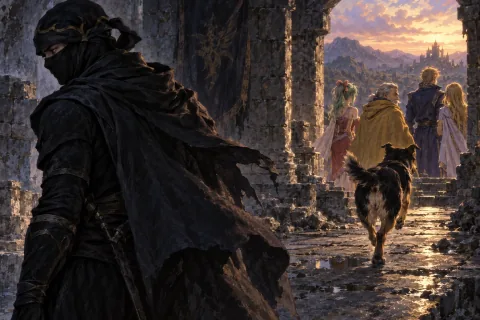
As Kefka's Tower collapses, Shadow sends Interceptor away first. He remains alone in the crumbling ruins, calling out to past comrades before disappearing; meanwhile, Relm continues her escape on the conveyor belt, either helping Strago or being rescued by other allies. In this process, Shadow's final appearance is handled by him simply vanishing from the screen, and his death is not explicitly depicted.
The path changes if you did not recruit Strago. This difference shows that the people you have been with are reflected even in the small actions of the ending. Meanwhile, the scene where Shadow remains is not a conclusion where all his motives are explained. While we can observe that relationships that survive and empty spaces that vanish are placed side-by-side within the same escape, there is no need to finalize all his actions with the single answer that he could not escape his past. The poignancy arises from that unexplained void.
Shadow's act of pushing Interceptor away can be read as an extreme severance, an attempt to cut ties with others. He ultimately refuses the chance to save himself and chooses to remain beside the ghosts of his past. Such a choice cannot be packaged as a beautiful sacrifice or peaceful rest; rather, it remains a record of painful loss where the efforts of those who tried to connect him to the world could not reach.
Some might consider his disappearance the completion of atonement, but from the perspective of those left behind, it is the pain of an irreversible severance. The player's expectation that Relm or other allies would fully understand and embrace him scatters along with the debris of the collapsing tower. This comes across as a directorial choice that heavily questions how difficult and heavy a task it is to truly save another person's heart.
On the other hand, the actions Relm shows on the conveyor belt have a directionality opposite to Shadow's isolation. She leads the elderly Strago or willingly takes the hands of other allies who have come to save her. This natural communion of relying on others and helping them in moments of crisis quietly proves the value of the dependent relationships we must inevitably form to survive.
The variation where other allies take the place of Strago if he is absent suggests the possibility of solidarity, implying that we can willingly save each other even without blood ties or long-standing connections. Even in the despair where the world seems to be ending, someone reaches out a hand, and someone else takes it. This small, ordinary action can be a foundation that supports human life more tenaciously and firmly than any immense magical power.
The moment he recalls the names of old comrades suggests that the memories of the past remain until the very end. While there are clues that can be linked to guilt, the motive that he intended to punish himself as he deserved is not confirmed. It cannot be said that death or disappearance is a completion that washes away that responsibility. This scene is sad in that the possibility of living with him seems closed. The reader can think of his past, yet not judge that this end was inevitable because his current relationships failed.
The hesitation in the moment Interceptor had to leave his master's side shows the tenacious bond that even a speechless beast can feel. How deeply stained with resignation must Shadow's inner self have been to push away even his most loyal companion? The regret of not being able to break that resignation and pull him into the light brings to those watching the game both the limitations and the sadness of knocking on the closed hearts of others.
The process of Relm escaping safely is like a small promise for the days she will live ahead. Although someone chose to remain in the darkness, those moving toward the light must keep walking even after stepping over the remaining sorrow. The collapsing tower is a space where the remnants of the past crumble, and the act of escaping it is a determined will to face tomorrow willingly, even while wounded, without being bound by the past.
This escape is not just a scene to count who was saved, but one that makes us look at the different weights left by each relationship. There is no need to read the failure to stop Shadow's disappearance as proof that the allies' love was insufficient. The sight of Relm and Strago helping each other is not a standard that everyone must reach the same ending. We can remember the meaning of the time spent together and the loss left at the end simultaneously. A reading that looks at the next possibilities of those who survived without erasing the regret is necessary.
Chapter 2 · The Path of Escape Opened by Small Companions
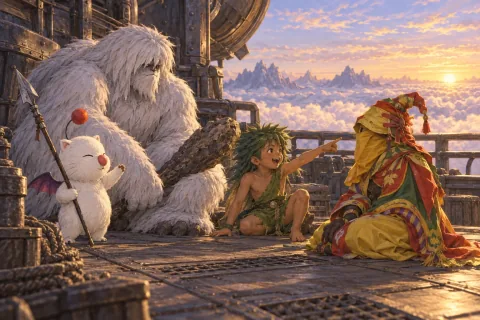
Within the crumbling structure, the small companions also open paths in their own ways. Edgar operates a crane to rescue Mog from a crisis, and Umaro breaks through a solid wall blocking the way with his body, pioneering a route. Gau scouts the rugged rocky terrain with his unique senses to lead the party, and Gogo joins the escape, creating a dizzying moment where he falls off the screen while mimicking Celes's movements.
The allies participating in this process may or may not be there depending on the player's prior exploration. The sight of optional allies breaking through crises by utilizing their unique characteristics is a result showing that the player's effort in finding them and building relationships was not in vain. Even if Gogo falls off the screen, his survival is confirmed as he is seen together in the final airship scene.
The scene where Edgar uses machinery to save Mog shows how heterogeneous beings can be connected through each other's skills and abilities. The sight of a human king and a small Moogle relying on each other at a crossroads of life and death allows us to guess the power of solidarity formed beyond race and background. This means that each other's differences become perfect pieces that fill in the lacking parts of one another in a crisis situation.
Umaro's act of breaking a massive wall comes across as having a meaning beyond simple physical destruction. In front of a firmly closed wall of despair, someone might lose their way and sit down, but even rough and crude strength can become a passage of salvation that saves everyone when directed in the right way. His actions show how powerful a breakthrough a pure will to protect others can be, even without sophisticated magic or elaborate plans.
The sight of Gau, who grew up in the wild, scouting the rocky terrain in the lead proves how much of a reliance his way of connecting with the world is to the party. The process of an abandoned child now becoming a guide for someone else suggests that even a wounded being can find their place while communing with others. His footsteps become a reliable signpost that the party can trust and follow in a confusing maze.
The scene where Gogo mimics Celes's movements makes us question the strange sincerity inherent in the act of imitation. The fact that one can share the same crisis and move in the same direction just by following another's actions can be read as part of the effort to understand and empathize with each other. Although it is accompanied by the dizziness of falling off the screen, that imitation is not a failure in that they ultimately survive together.
The moments of crisis Celes experiences reveal the fragility hidden behind the strength she possesses. The process of her, who once tried to give up everything, now struggling to live and accepting someone's help, shows how attachment to life is restored. The reason she can continue to live is that she has let go of the obsession that she must handle everything alone and has accepted the continuous care of her allies.
The structure that allows for the absence of optional allies paradoxically makes the full sense of solidarity when they are together stand out even more. The possibility that empty seats can occur makes us not take the existence of those by my side for granted. The fact that someone is by my side, and that they are helping me in their own ways, is perhaps the most certain and warm comfort one can feel in a collapsing world.
The activities of these small companions illuminate the struggles of ordinary people that are easy to be hidden behind heroic narratives. Just as much as defeating a great evil, the process of finding a path without letting go of each other's hands amidst the crumbling rubble is also a fierce and valuable fight. They fit the puzzle of survival in their own unique ways, silently proving that there is no unnecessary existence.
Ultimately, the path of escape they opened is the result of firm trust in each other built up. Even in despair where the front cannot be seen, someone breaks a wall, someone finds a path, and someone catches the one who is falling. This seemingly chaotic process of cooperation comes across as the most beautiful way of survival created by imperfect beings gathering together, and a reliable trailer for the life that will continue ahead.
Chapter 3 · The Morning When Terra Returns as a Human
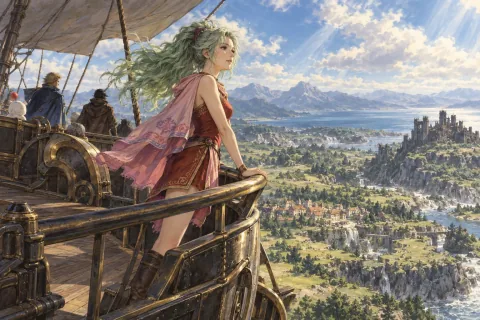
Terra, who is losing her power as an Esper as the source of magic disappears, is drawn to the place of the ending even if she was not recruited as an ally again. The thought of Maduin remaining in her inner self tells her that even if magic vanishes, she can remain in the world if she has attachments formed as a human. As the airship rises and she finally becomes a complete human, Terra lets down her tied-up green hair and gains new vitality.
Along with this, a new life born by Katarin is reflected on the screen, symbolically showing the future sprouting in a world where magic has disappeared. The process of Terra losing her Esper power and returning to an ordinary human means not a loss, but a transition to a new way of existence. She has stood at a starting line where she must face the world only with her own will and affection for others, leaving behind the past where she was swayed by immense power.
The words conveyed by Maduin's thought point out that what proves existence is not innate power or bloodline, but the exchange of hearts shared with others. The reason Terra can remain in the world is not because she was a powerful mage, but because the memories of having cherished and tried to protect someone held her. This casts a heavy insight that the bonds we form with the world become the reason we ourselves exist.
The sight of Terra letting down her hair is an excellent directorial choice that visually embodies the liberation from the oppressed past. It is the moment when she, who was manipulated by the Empire and constantly wandered regarding her identity, finally casts off all shackles and regains her natural self. The hair fluttering in the wind is like a flag announcing the freedom she will enjoy in the future and the beginning of the joys and sorrows she will experience as a human.
Katarin's newborn baby creates a strange emotion in line with Terra's change. That the most fragile and helpless life is born in the place where destruction and death have swept through is proof of the persistent resilience life possesses. Terra also lost the weapon called magic and became a fragile human, but these two lives side-by-side prove that that fragility is the most powerful possibility to embrace each other and conceive a new future.
The structure where she appears in the ending even if Terra did not join as an ally again suggests that the thread of relationships she has forged is never easily broken. The sight of her finding her place regardless of the player's choices shows that the connection with others is deep and firm enough to embrace even temporary departure or wandering. This means she has already taken deep root as a part of the world.
The world where magic has disappeared foretells a barren reality where problems can no longer be solved by relying on miracles or transcendental power. However, the light appearance of Terra with her hair down and the warmth of the allies filling the airship argue that there is still enough reason to live even in the place where miracles have disappeared. The solidarity of ordinary people who fill each other's lacks and soothe wounds will be the true magic that will support the world in front of any crisis that will come in the future.
This ending does not specifically present the flashy aftermath or completed happiness of specific characters. It leaves it as a thoroughly unknown territory what kind of life they will live in the future and with whom they will form a family. This acts as an aesthetics of emptiness that grants freedom so that the characters can live according to their own will even after the story ends, while simultaneously making one quietly cheer for their tomorrow without concluding it.
At the end of a long journey, we learn how to stand up after stepping over loss and the courage to hold someone else's hand. The story of those who found their own paths in a collapsing world leaves a deep question for us beyond the screen. Whose hand will you hold, and with what heart will you face tomorrow? The answer to this question can only be found by those who have walked this world themselves.
This series is a commentary reading the context of major events and the hearts of characters, and did not reproduce the original dialogue and music. The experience of finding hidden allies yourself and learning the conditions of choices, and the emotions created by the silence between scenes and the music, come across with a different density when playing. Even a reader who already knows the plot can leave it as their own experience which order they meet whom. If you have become curious about the relationships read so far, it is time to stand beside their footsteps yourself. The emptiness left by the story continues in the player's time.
Scope of Materials and Interpretation
We have based this on the major story flow of the Super Famicom original and the Pixel Remaster. Differences in survival, ally recruitment, and endings based on choices are distinguished in the relevant scenes, and GBA version additional dungeons are explained as separate edition elements. Unspecified inner thoughts of characters are interpretations read based on the context of events, and the unknown identity of Gogo, etc., are not concluded as facts. Material verification date: October 15, 2026 (Bangkok time).
Square Enix · FINAL FANTASY VI Official Introduction and Characters
comments 0