
Recommended Game Story · FINAL FANTASY VI Part 5
Chapters in this story
The Day the River of Doma Stopped
Spoiler Notice: This series covers the major events and the ending of FINAL FANTASY VI. If you are new to the game, you may wish to read only up to your desired chapter and experience the choices and music firsthand. This text combines descriptions of events with interpretations of the characters' inner thoughts; it is not a translation of original game dialogue or an official novel. Illustrations are AI reconstructions based on public materials.
Separated from his companions by the rushing currents, Sabin faces a new phase on the eastern continent. With the Imperial army laying siege to Doma Castle, the internal conflict within the Empire regarding the methods and justification of war rises to the surface. This journey is not merely a path to regroup, but a process of witnessing how war destroys the daily lives of ordinary people. We follow the record of loss left behind by the intersection of an honorable knight, a cruel clown, and a warrior who has lost everything.
Chapter 1 · Hearing Different Orders at the Ramparts
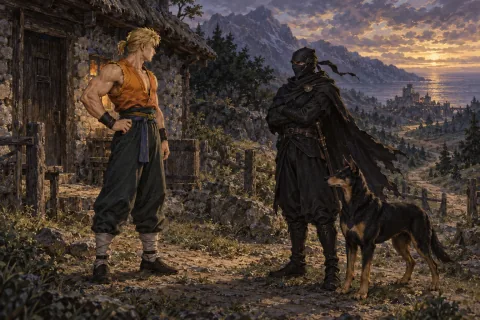
While wandering the unfamiliar continent, Sabin encounters Shadow, an assassin and mercenary, and his companion, the dog Interceptor. Shadow, who operates for money, agrees to be Sabin's guide with the cold condition that he may leave without notice based on his own judgment. This unstable companionship serves as the first clue to how individual interests and survival are calculated and traded in the face of the immense violence of war.
Beyond the Imperial encampment where they arrive, Doma Castle stands with its gates tightly shut. General Leo, leading the Imperial forces, maintains a standoff, refraining from reckless attacks to minimize unnecessary casualties. He is portrayed as a figure who strives to maintain a minimum level of morality while carrying out his duties as a soldier. He balances precariously between the mission to occupy an enemy nation and his conviction not to treat human lives lightly.
Conversely, Kefka, staying in the same camp, openly mocks Leo's moderate approach and grows impatient. To him, war is not a process of upholding honor or discipline, but merely a means to confirm his control through quick and certain destruction. The conflicting attitudes of the two commanders clearly reveal the contradictions held within the massive machine that is the Empire. When those in power pursue different goals, the fates of the people beneath them are shaken uncontrollably.
Sabin sneaks into the camp and overhears their conversation, sensing the cracks within the Empire. The fact that even a war of conquest driven by force does not move with a single will suggests that the enemy they will face is not merely a massive nation. A battlefield where individual desires and values collide is like a powder keg waiting to explode. The coexistence of a general who values justification and a clown who pursues only results is structured to inevitably head toward catastrophe.
Shadow's presence feels even more alien on this chaotic battlefield. He has no interest in the Empire's atrocities or the crisis in Doma, wielding his blade only by contract. His behavior, which may lead him to leave the party without warning depending on the player's progress, reflects the dry attitude of someone who remains strictly an individual within the grand narrative of war. His silence, taking no one's side, paradoxically forces one to ask how much this fight relies on blind violence.
As General Leo is called away by the Emperor, even the minimal discipline that suppressed the camp vanishes. This is a chilling moment showing how easily a power vacuum can unleash malice. In the place of a rational controller, only the fierce destructive impulse of one who cannot empathize with the suffering of others remains. Even the Imperial soldiers express concern over Kefka's extreme methods, but bound by the chain of command, they lack the power to stop this runaway train.
Sabin struggles to cross the camp to stop this situation, but the power of an outsider alone cannot stop the wheel of tragedy that has already begun to turn. The battles he faces against soldiers are a desperate struggle to save Doma, but they simultaneously emphasize the helplessness an individual feels in the face of a massive disaster. No matter how hard he throws his fists, he cannot reverse the malicious decisions of those in power. Even a master of martial arts is reduced to a mere witness in the face of the war's cowardly tricks.
The situation inside Doma Castle is equally desperate. While the tightly closed gates can block the enemy's physical attacks, they also become a prison that isolates the people inside. The disconnection from the outside makes the most basic conditions for survival—food and water—vulnerable, which becomes the most fatal weakness that Kefka targets. A choice made for defense becomes the cause of ruin. The cruel reality that the height of the castle walls cannot protect people's daily lives is slowly approaching.
This standoff suggests that war is not merely a test of strength between soldiers. Inside the walls, not only soldiers with weapons but families living their ordinary lives are holding their breath. The blade pointed by the Empire is ultimately aimed at their entire existence, foreshadowing that the events to come will be a horrific massacre beyond a simple defeat. The true face of violence, hidden behind the justification of military objectives, is ready to be revealed.
The fact that Shadow can leave at any time heightens this tension. Sabin must navigate the crisis in the middle of enemy territory, where he has no one to rely on, alongside a companion who might disappear at any moment. Sabin's figure, running to prevent the tragedy of strangers in a relationship where trust cannot be guaranteed, conveys heavily how lonely and precarious it is to uphold goodwill in this world of chaos. The resolve to help someone in a battlefield rife with selfishness and malice demands a heavy responsibility in itself.
Chapter 2 · Betrayal Mixed into a Nation's Water
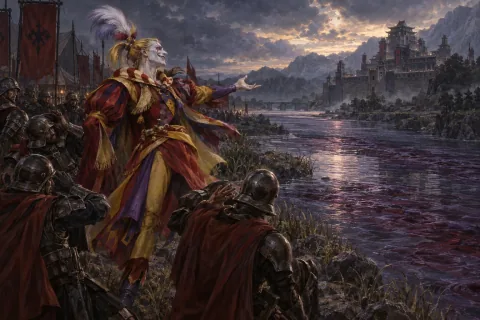
As soon as General Leo leaves, Kefka executes his plan to poison the river flowing into Doma Castle. This is such a cowardly act that even his own Imperial soldiers are shocked and try to stop him. The river is the foundation of survival shared by all life within the castle, and contaminating it means indiscriminate slaughter beyond military impact. This action, which tramples even the minimum rules of war, clearly reveals the blind malice possessed by the figure known as Kefka.
The poisoned water renders the physical defensive line of the castle walls useless all too easily. The tightly closed gates and high walls were useful for blocking external enemies, but they were of no use against an invisible threat seeping inside. The process of a fortress believed to be the safest place turning into a massive tomb in an instant shows how cunningly violence can destroy daily life. A terrible paradox is completed where the barriers built to protect people end up blocking their escape.
Those who drank the water fall without even a chance to resist. If it were a battlefield where swords and spears clashed, there might be room to fight for one's life, but in a situation where the water essential for life turns into a weapon, any courage becomes meaningless. This is not a battle but a one-sided massacre, the naked face of blind violence that does not distinguish between those who carry weapons and those who do not. The terror that the natural acts of breathing and drinking water lead directly to death weighs heavily on all of Doma Castle.
The King of Doma also cannot avoid this cowardly attack and passes away. The futile death of a leader who tried to protect his country symbolically shows the collapse of the nation of Doma. The sight of the one responsible for protecting his people falling while drinking the poison alongside them proves how helplessly the fence of a nation can crumble in the face of massive malice. The history of a kingdom that has continued for a long time is severed helplessly before a moment of cowardly trickery.
This event exposes how deceptive the justifications of unification or order put forward by the Empire are. They wage wars of conquest under the pretext of opening a new era, but in the process, they thoroughly trample the lives and homes of ordinary people. The act of poisoning the water is a vicious insult to all life rooted and living on that land, going beyond simply suppressing enemy troops. It is the moment that makes it clear that no hope for the future can be found in those who contaminate the source of survival.
The suffering that the survivors must endure is harsher than death. This is because they must accept the reality that neighbors and family with whom they laughed and talked until yesterday have turned into cold corpses for no reason. The fact that the cause of the tragedy is not their own fault or a fair defeat, but someone's one-sided and cowardly malice, carves deep despair and anger into the hearts of those left behind. Death without reason drives the survivors to the edge of a cliff without even allowing time for mourning.
Kefka's actions are even more chilling in that he thoroughly objectifies and mocks the suffering of others. He merely enjoys the joy of victory while watching the castle where the poison spreads, feeling not a shred of remorse for how many lives he has trampled. It is an extreme example showing what a terrible disaster power lacking empathy can bring. His attitude of using the tragedies of others as his own entertainment allows one to guess the depth of the darkness this world will face in the future.
Sabin can only watch this horrific scene from outside the castle. His efforts to stir up the camp and stop Kefka ultimately ended in failure, which serves as a painful reminder that heroic actions alone cannot stop every tragedy. The helplessness that goodwill and courage alone cannot fully control cunning, malicious intent casts a dark shadow over Sabin's journey. The self-reproach of 'if only I had been a little faster' remains a heavy burden that one who has witnessed the suffering of others must carry.
The tragedy of Doma declares that war can never be a romantic or honorable narrative. Some discuss chivalry and some speak of great causes, but behind it all flows the blood of countless people who have had their daily lives stolen and have died unjustly. The poison mixed into the river takes the lives of the people of Doma and simultaneously corrodes all the fine-sounding justifications surrounding the war. Beyond the dichotomy of winner and loser, it is the moment when only the destructive essence of violence itself remains bare.
This horrific event confirms once again the fundamental reason why the scattered companions must fight against the Empire. Before the grand goal of simply saving the world, a desperate anger takes root that one cannot overlook violence that tramples people's lives in such a cowardly way. The stopped river of Doma now becomes a sad signpost pointing to the direction those remaining must go. The fight to reclaim the lost daily life gains even firmer justification at this scene of terrible betrayal.
Chapter 3 · The Home to Which the Sword-Wielding Father Returns
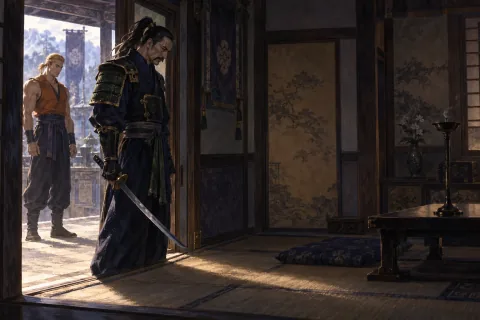
Cyan, the samurai of Doma, searches for his wife, Elayne, and his son, Owain, amidst the shadow of death that has swept through the castle. To him, who has dedicated his life to protecting his country and his lord, his family was the only sanctuary to which he could return after taking off his heavy armor. However, what he encounters are only the cold bodies of his family who have already passed away. The moment he loses those he wanted to protect most, his identity as a steadfast samurai shatters into pieces. A painful realization that even though he held his sword and guarded the ramparts, he could not prevent his own world from collapsing, washes over him.
The emotions Cyan feels in the face of his beloved family's death go beyond simple sadness to intense self-reproach and uncontrollable anger. The fact that they were not felled by an enemy's blade but had their lives stolen by cowardly poison pours fuel on his anger. A death that does not even allow for an honorable duel robs the survivor of even the time for mourning, leaving only a blind impulse to avenge the enemy. Having lost his reason, he carries out a reckless charge toward the Imperial camp alone.
Cyan's appearance as he leaps into enemy lines alone is closer to desperation than bravery. Forgetting even the thought of returning alive, he is absorbed only in cutting down the enemies before him. This is packaged under the name of revenge, but in reality, it is a destructive struggle to escape from an unbearable sense of loss. His swordplay, which defies death, is like the scream and cry of one who has lost his family. It is a heartbreaking scene showing how easily a human who has lost his purpose in life can drive himself to the jaws of death.
Cyan's desperate anger makes one understand his deep sadness, but it does not justify collective revenge or indiscriminate slaughter. His actions only show the process of an individual in extreme pain losing control and running wild, subtly revealing that the method of covering violence with violence cannot be a solution. His blade is aimed at the enemy, but at the same time, it is consuming himself. Blind desire for revenge ultimately does not become a way to honor the dead but only a poison that destroys even the remaining life.
At this time, the process of Sabin intervening to help Cyan holds a very important meaning. Sabin jumps into the fight not to complete Cyan's revenge, but to prevent him from meeting a meaningless death. Sabin's action of reaching out without ignoring the suffering of a stranger becomes the only lifeline that pulls Cyan, who is engulfed in a blind destructive impulse, back to reality. The will to empathize with and stand in solidarity with the sorrow of others plays a decisive role in stopping the footsteps that were heading toward destruction.
The scene where the two steal the Empire's Magitek Armor and escape the camp provides an ironic sense of liberation. Taking the mechanical weapons that symbolize the Empire's violence and breaking through their encirclement visually shows the will to resist that will not submit even in the face of overwhelming power. Although Doma has collapsed, the survivors must move forward even by stepping on the enemy's weapons. Their escape, seeking survival in the midst of despair, provides a small breath of air within the heavy tragedy.
However, succeeding in the escape does not mean that Cyan's deep sense of loss is healed. Even while riding the Magitek Armor, the home to which he would return no longer exists in the world. Although he saved his life with Sabin's help, Cyan must now walk alone through an empty world without family or country. It is read with the perspective that the fact of having survived can feel like an unbearable punishment to him. Even if he has escaped physical threats, the massive hole that has taken root in his heart cannot be easily filled in any way.
The situation where Cyan comes to accompany them cannot be judged as weakness unable to endure loneliness. To a person who has suddenly lost their home and family, the fact that there are people to move with has meaning even without declaring that they have explained or overcome the pain. The relationship with Sabin is read not as a device to make him return to normal in a hurry, but as a connection that allows them to escape immediate danger together. The time for him to examine his heart again becomes possible only after such concrete safety is provided.
This event shows that the game's narrative expands beyond the confrontation between good and evil into a story about how individuals who have experienced loss continue their lives. Cyan's pain is the clearest scar left by the war, and the player realizes the weight of the atrocities committed by the Empire through his anger and sadness. His presence will represent the voices of those whose daily lives have been destroyed throughout the journey ahead. His struggle to stand up again on the collapsed ruins asks a heavy question in itself.
The sword-wielding father could not protect his family in the end, but the tears and anger he shed leave room to change into a different form within new relationships. Even if he burns with blind desire for revenge for now, the possibility of gradually exploring the meaning of the lost life while rubbing shoulders with companions like Sabin is open. The river of Doma has stopped and the home to which he would return has disappeared, but the time of those who survived begins to flow again persistently even in the midst of pain. This tragic starting point is merely the prelude to the long journey he will face in the future.
Scope of Materials and Interpretation
The main story flow of the Super Famicom original and the Pixel Remaster is used as the standard. Differences in survival, companion recruitment, and endings based on choices are distinguished in the relevant scenes, and the GBA version's additional dungeons are explained as separate edition elements. The unstated inner thoughts of characters are interpretations read based on the context of events, and the identity of unknown figures is not asserted as fact. Material verification date: October 15, 2026 (Bangkok time).
Square Enix · FINAL FANTASY VI Official Introduction and Characters
comments 0