
Recommended Game Story · FINAL FANTASY VI Part 9
Chapters in this story
Two Coins Hiding the Past
Spoiler Notice: This series covers the major events and endings of FINAL FANTASY VI. If you are new to the game, you may wish to read only up to your current progress and experience the choices and music firsthand. This text contains both descriptions of events and interpretations of the characters' inner thoughts; it is not a translation of original game dialogue or an official novel. Illustrations are AI reconstructions based on public materials.
After Terra transforms into an unknown entity and flies away, the remaining party must find her and seek a new path to oppose the Empire. In this process, we encounter the deeply personal pasts of the characters, which were hidden beneath the grand objective of saving the world. The twin brothers of Figaro Castle, the time that stopped for Locke in Kohlingen, and the new play beginning in Jidoor all illuminate the weight of the loss and responsibility each carries. This journey serves as a crucial turning point that goes beyond mere power reinforcement, allowing the companions to understand each other's hidden sides and strengthen their bonds.
Chapter 1 · The Brother Who Stayed on the Throne and the One Who Left

If you return to Figaro Castle with Sabin in your party, you can reach an optional scene that offers a glimpse into the brothers' hidden past. After their father passed away suddenly, the two, conflicted over the heavy burden of royal succession, decided their fates through a coin toss. Behind this ritual, which appeared fair on the surface, lay the brother's deep intention.
Edgar secretly used a special coin with heads on both sides, cleverly manipulating the situation so that Sabin could escape the shackles of royalty and leave to find his freedom. This short but powerful flashback scene conveys how much deep responsibility Edgar has shouldered alone, despite always appearing cheerful and lighthearted on the surface, and allows for a multi-dimensional reconstruction of his character.
The act of tossing a coin usually signifies entrusting one's fate to uncontrollable chance, but Edgar quietly practiced his affection for his brother by controlling even that chance with his own will. This reveals a facet of the unique and poignant relationship between the brothers, showing that sometimes a white lie and concealment can be the deepest form of consideration rather than revealing the truth entirely.
Sabin must have firmly believed for a long time that he left the castle through his own free will and the result of chance. The time he spent living without knowing that his brother had willingly shouldered the heavy and lonely burden of the throne for his sake leaves behind a quiet, significant emotional space that can be reinterpreted as a new sense of indebtedness and deep gratitude in the face of this hidden truth.
The way Edgar leads the Kingdom of Figaro is also deeply similar to the two-sided nature of the coin he tossed that day. While pretending to maintain a friendly alliance with the Empire, he has maintained a dangerous double life, actively supporting the Returners who resist the Empire behind the scenes. His political maneuvering, where the outside and inside are completely different, may have already sprouted from that day of firm resolution when he deceived his brother to grant him freedom.
It is a very interesting directorial choice that the game places such important character background narratives as optional events that the player must find, rather than as an essential path. This can be read as a meticulous consideration that adds narrative depth, designed so that players can discover the characters' true faces only when they actively pay attention to their pasts and relationships and take the time to explore.
Even though much time has passed and the brothers have reunited to walk the difficult path together, Edgar does not go out of his way to loudly explain the truth of the past to Sabin or seek credit. This is because a firm trust is already established between the two without needing to be spoken, quietly proving that the affectionate deception of the past never damages the solid bond they share in the present.
The path of the unburdened, free martial artist that Sabin is currently walking could only be fully established upon the solid walls of Figaro, which Edgar is guarding alone. Although they chose and walked completely different ways of life, this short flashback scene subtly implies that at the root lies an invisible sacrifice and tacit understanding that sustains each other's lives.
A coin with two heads means that there is physically no room for choice, but at the same time, it is an expression of a firm will to willingly stand by your side and carry all the burdens regardless of the outcome. This quiet but resolute determination of Edgar makes the immense weight and loneliness of a monarch he had to shoulder at a young age approach the player with more poignancy and gravity.
After witnessing this hidden past, walking through Figaro Castle again allows you to rediscover the warmth of the brothers flowing among the cold mechanical devices that move the castle. Their silent story of protecting each other's well-being in their own unique ways within lost time serves as a solid foundation and comfort that will not waver on the difficult journey the party must face ahead.
Chapter 2 · Rachel Sleeping in Kohlingen
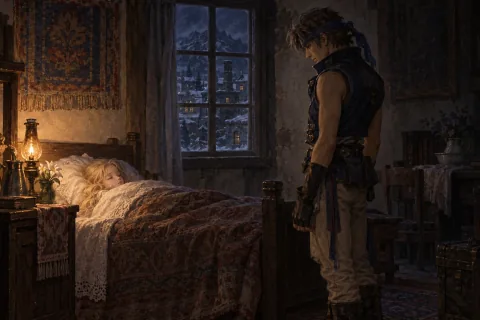
Upon arriving in the village of Kohlingen, the dark past of Locke, who always seemed bright, is finally revealed. Rachel, a precious lover who was once with Locke, lost her memory in an unfortunate accident, and while Locke was away, hurt, the village was attacked by the Empire, and she lost her life. It is quietly conveyed that she regained her lost memories only at the very last moment when death was imminent and desperately called out Locke's name.
Currently, Locke is wandering the world in search of a legendary, miraculous treasure said to be able to revive the dead. With her body preserved in the cold basement of Kohlingen, he is deeply bound by the irreversible mistakes of the past and a heavy sense of guilt. This clearly shows his precarious state, where he cannot fully live in the present time and is wandering, captured by the ghosts of the past.
The cruel fact that Rachel's lost memories returned only at the threshold of death must have acted as a harsher punishment for Locke than anything else in the world. The deep self-reproach that he could not protect her because he was not by her side when she needed him most becomes the decisive cause that manifests as an excessive and obsessive protective instinct toward other women he meets later, dominating his life.
Locke's act of searching for the miraculous treasure can be read as containing both his affection for Rachel and his desire to turn back reality. However, one cannot immediately judge that love as a selfish desire. There is the circumstance that a person important to him disappeared too suddenly, and he was not by her side when she actually regained her memories. The point for the reader to examine is not whether that sadness is right or wrong, but how the heart that cannot let go of the past makes present relationships difficult.
This closed-off attitude of Locke makes forming healthy, new relationships with others extremely difficult. His obsession that he must protect someone unconditionally contains the danger of viewing the other person as a means to make up for his past failures and lighten his emotional burden rather than respecting the independent will and strength the other person possesses, thus becoming a major obstacle to building trust in the true sense.
In particular, the dark shadow of the deceased Rachel is constantly cast over Locke's attitude toward Celes, who was a general of the Empire. His behavior of insisting on rescuing her, a general of an enemy nation, and blindly protecting her stands on a vague boundary between whether it is pure goodwill or the result of unconsciously projecting the target he could not protect in the past, which causes constant tension and misunderstanding in their relationship.
However, Celes cannot, and should not, be a replacement to fill the empty space of the deceased Rachel. She is a person who holds the sword herself and carves out her own path, and she does not intend to remain passively within Locke's narrow protective shield. For Locke to truly bond deeply with someone, he must face the other person as an independent subject living in the present, not as a being overlaid with the ghosts of the past.
The entire quiet village of Kohlingen is a giant tomb for Locke and a clock where time has stopped forever. The tragic events of the past, slowly reconstructed through the fragmentary testimonies of the villagers, play an important role in leading the player to finally understand and deeply empathize with the deep depression and unhealed wounds hidden in layers behind Locke's bright and light appearance.
The heart that wants to care for someone and the heart that wants to turn that person's life back according to one's own will can diverge within the same action. To understand Locke, one must examine what the one left behind desires without erasing that affection. Kohlingen leaves that question very quietly. Because the person by his side can no longer speak, and only the memories conveyed by others in the village reflect his choices. In front of this silence, it is difficult for the reader to rush to judge the boundary between love and guilt.
For Locke to fully escape from this cycle of terrible guilt, he will need not the miraculous treasure of legend, but the courage to accept the irreversible loss as it is, painfully. The cold truth left in the basement of Kohlingen clearly and chillingly shows the huge internal barrier he must face head-on and painfully overcome to move toward his future life.
Chapter 3 · Why Jidoor Needs a Stage
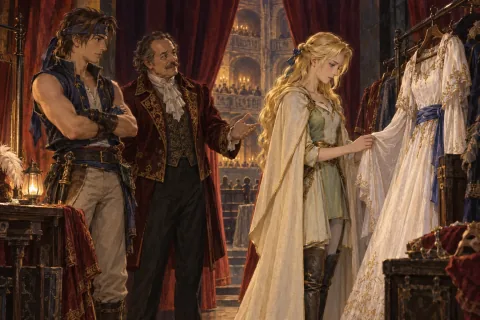
The party realizes that an airship capable of flight is essential to cross into the firmly closed Imperial continent and heads to the glamorous city of Jidoor. There, they learn of a bold plan by the wandering gambler Setzer, the owner of the airship, to kidnap the famous opera singer Maria, and the party meticulously sets up a new and dangerous operation to use this crisis to their advantage and obtain the airship.
The core of this operation is to have Celes, who looks remarkably like Maria, stand on the opera stage as a double to deceive Setzer and lure him in. For Celes, who has lived her whole life on blood-soaked battlefields as a cold general of the Empire, taking on the role of a singer who wears a glamorous dress and sings of love in front of a huge audience is an unexpected, strange, and bewildering challenge in her life.
This seemingly reckless plan holds more meaning than a shallow trick to obtain a means of transportation and acts as a very important catalyst for bringing about internal change in the closed-off character of Celes. The setting where she, who was only accustomed to a cold world of blood and iron, must stand at the center of a stage where art and passionate emotions intersect creates a powerful and fascinating contrast between the character's past and present in itself.
Celes's deep hesitation about taking on the role of the double will not stop at the superficial fear that she might ruin the song or the performance. It can be seen as much closer to a fundamental and deep rejection of showing a disarmed self, coming from the fact that she must honestly reveal her hidden emotions to others and act out a fragile appearance that desperately craves someone's love.
However, paradoxically, this theater stage, thoroughly decorated with lies, becomes a special space where Celes can safely face her true emotions that she has suppressed for a long time. By borrowing the mask of another person named Maria, she gains a precious opportunity to briefly put down the heavy responsibility of being an Imperial general and cautiously explore the senses as a human being who loves and gets hurt normally.
The plan that Setzer intends to kidnap Maria is an uncomfortable starting point that makes it impossible to simply affirm his freedom. Having a reason to want someone does not give one the right to ignore that person's will. The party uses the plan to their advantage to obtain the airship, but the efficiency of the operation does not turn the kidnapping itself into a romantic act. If you remember this contradiction together, the process of cooperating with Setzer later is read not as a moment where perfect heroes meet, but as a scene where a relationship begins while carrying dangerous differences.
This unique development, which seeks to achieve its goal by borrowing a highly refined artistic form like opera rather than a rough frontal breakthrough through force, makes the game's narrative even more elegant and rich. This operation implicitly and beautifully suggests that even in a desperate era where violence and destruction are rampant, beauty and romance can still be the most powerful and effective weapons to move a person's hardened heart.
The process of Locke and other companions actively helping with Celes's awkward transformation and preparing for the operation together shows that they are moving beyond a group gathered only for battle and developing into a relationship where they discover and support each other's unfamiliar sides. The time spent being nervous and breathing together behind the glamorous stage forms a kind of warm and deep bond among the party that is completely different from that just before a bloody battle.
The affluence shown by the opera house near the mansion in Jidoor contrasts with the war and poverty in other regions. It is not necessary to explain all those differences with a single cause, the Imperial occupation. It is important that even within the same world, some people enjoy performances and others have lost even the path to move safely. Music and theater make a new operation possible for the party, but behind that beauty lies the reality of having to rely on Setzer, who has the means of transportation. The needs of art and survival meet at such an unexpected point.
The upcoming opera performance is a stage that began as a lie to deceive the enemy, but the songs to be sung and the emotions to be poured out on it are all prepared to create a resonance more truthful than anyone else's. The first step Celes takes toward the stage with a trembling heart, wearing Maria's glamorous clothes, will be the most beautiful attempt to break out of the hard shell of the past that has bound her for a long time.
Scope of Materials and Interpretation
The main story flow of the Super Famicom original and the Pixel Remaster was used as the standard. Differences in survival, companion recruitment, and endings based on choices are distinguished in the relevant scenes, and the additional dungeons of the GBA version are explained as separate edition elements. The unstated inner thoughts of the characters are interpretations based on the context of the events, and the identity of the unknown, etc., are not concluded as facts. Material verification date: October 15, 2026 (Bangkok time).
Square Enix · FINAL FANTASY VI Official Introduction and Characters
Thonky · Figaro Castle Event Progress Reference
comments 0