
Recommended Game Story · FINAL FANTASY VI Part 17
Chapters in this story
Learning to Live Again on a Remote Island
Spoiler Notice: This series covers the major events and the ending of FINAL FANTASY VI. If you are new to the game, you may wish to read only up to your desired chapter and experience the choices and music firsthand. This text combines descriptions of events with interpretations of character motivations and is not a translation of original game dialogue or an official novel. Illustrations are AI reconstructions based on public materials.
One year after the world has crumbled, Celes wakes up alone on a remote island in a land where everything has been shattered. Once a general of the Empire, she is now reduced to surviving day by day while caring for the ailing Cid. This period of isolation is not a grand heroic epic, but a quiet question asking how those left behind can once again sense their daily lives and connect with others. This journey shows that living again in a broken world is not about miraculous salvation, but the process of recovering the small, concrete senses of care.
Chapter 1 · The Branching Path Left by Days of Caring for Cid
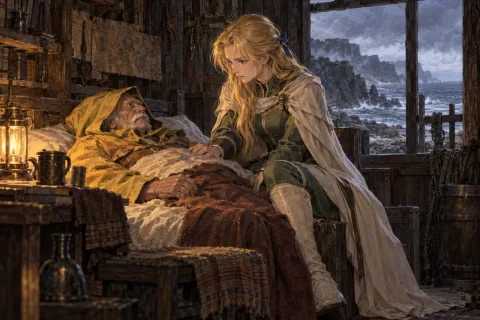
A year has passed since the world was torn apart, and Celes finally regains consciousness in a small house on a remote island. When she opens her eyes, the only person by her side is Cid, a former researcher for the Empire, who now lies bedridden and severely weakened. The first mission for the woman who was once a powerful Magitek Knight is not to defeat a massive enemy, but the mundane labor of going to the shore to catch fish for the bedridden old man.
Depending on the player's choices and actions, the result of this arduous care splits into two completely different realities. If you consistently catch and feed him lively fish, Cid gradually recovers his strength and survives, but if you provide fish in poor condition or delay too long, he eventually passes away. This crossroads does not offer a grand goal like world peace, but imposes a heavy and concrete sense of responsibility where the life or death of a single person rests on your fingertips.
The act of fishing makes one painfully realize a reality where magic and swordsmanship are of no use. Celes once commanded numerous soldiers and traversed battlefields as a general of the Empire, but now there is nothing she can do but silently pace the beach to keep the frail person before her alive. Her past status and destructive power become utterly meaningless on this isolated island, leaving only desperate and cautious devotion toward another as the sole value.
On the path where Cid survives, we realize how much time and attention it takes to care for someone. The repetitive effort of observing the movement of fish and selecting the best ones reflects a persistent will to continue life even amidst immense despair. This experience of being fully responsible for another's life can be the first exercise for Celes to re-establish a relationship with the lost world.
Players who encounter the branch where Cid dies may not have fully understood what conditions influenced the outcome. The fact that life and death are decided in the game and the judgment that one should blame oneself for the person they were caring for are different issues. There is no need to read this as a failure of Celes's care or a lack of her affection. The regret left by this result lies in the fact that the relationship that continued in the small house has been severed. Rather than calculating what should have been done, examining what that relationship meant makes the isolation of the next scene feel closer.
What is important in both outcomes is the fact that Celes willingly devoted her time to Cid. Rather than resenting Cid, a figure from the Empire who modified her and used her as a tool, she cares for him as if he were her only family. This change in relationship quietly proves how past wounds and hostility can fade in a broken world and be replaced by compassion that relies on one another.
The short conversations exchanged during the process of care show how cautiously trust is formed between the two. Cid worries about Celes, and Celes tries to reassure him. The words shared in this narrow room feel much heavier than the grand tragedy of the world's destruction, delicately depicting the desperate bond of isolated individuals who have become each other's only world.
The time on this island can be read as a process of laying down one's identity as a hero and returning to being an ordinary human. The grand sense of mission to save the world disappears, leaving only the simple but desperate goal of finding food for Cid for the day. This narrowed worldview awakens the most primal sense of survival and asks what the true strength needed to sustain life really is.
Regardless of whether Cid lives or dies, this time of care becomes a grace period for Celes to prepare to reconnect with others. The sense of striving and worrying for someone will act as an inner engine that later drives her to seek out her other companions. The hard labor on the isolated island is not merely passing time, but a quiet process of breathing warmth back into her frozen heart.
Ultimately, this branch extends beyond the results of life and death to a story about how humans maintain dignity in a broken world. Celes's appearance, trying to do her part without ignoring the suffering of others, shows the minimum kindness we can choose even in desperate situations. Even if it cannot perform a miracle, it serves as an anchor that keeps her from forgetting who she is.
Chapter 2 · Possibilities Discovered in a Bird's Bandage

In the branch where Cid dies, Celes falls into deep despair and faces a life-threatening crisis, but she survives. There is no need to embellish this scene as a beautiful choice or an expression of courage. It is a painful moment that shows how much isolation has surged upon her, and the story does not leave that crisis as the ending. By placing the fact that she discovers the possibility of connecting with others again at the center, the reader can look at the next step without lightly romanticizing the time she had to endure.
What appears before her eyes after she regains her senses is a bird that has flown in with a familiar bandana wrapped around its wound. That old piece of cloth, which appears to be Locke's, presents a faint but decisive possibility that her companions might still be alive somewhere across the sea. Meanwhile, whether Cid survived or passed away, it is revealed that he had secretly built a raft so that Celes could one day leave this isolated island and head out into the wide world.
The extreme crisis Celes experiences painfully shows how difficult it is to live without hope in a broken world. When even the only bond is severed in a reality where everything is destroyed, survival itself transforms from a blessing into an unbearable pain. This scene reveals her fragility without addition or subtraction, emphasizing that even a character who played a strong role is a person who needs care and support.
The bandana the bird brought is more than a simple coincidence; it symbolizes a link to the severed past. The fact that a single small piece of cloth gives Celes the strength to stand up again suggests that the engine that makes humans live lies not in grand causes, but in the simple expectation of meeting someone again. This shows how powerful a very small and concrete trace found at the bottom of despair can be as salvation.
The raft left by Cid can be read as his silent support for Celes and an earnest request for the future. Whether he was alive by her side or had already passed away, he did not want her to be trapped on this narrow island and live in despair. This raft is not just a means of transportation, but a result of the dedication and quiet consideration of the preceding generation, wishing for the next generation to continue living.
Celes's appearance as she discovers the bandana and boards the raft contains a change from a passive attitude of waiting for external salvation to one of venturing into the unknown sea on her own. This step, taken to believe in connection with others once again despite having experienced failure and loss, carries a heavy resonance. Her determination to move forward while carrying her wounds becomes the only engine capable of traversing the broken world.
The emotions Celes feels during this process are likely not simple joy or relief. Behind the hope that her companions might be alive exists a deep fear that they, too, might have changed or already been lost. Nevertheless, the act of placing herself on an uncertain sea comes across as a courageous decision to choose to relate to someone again, even at the risk of being hurt.
The bird, as a medium, acts as a messenger of freedom and news, forming a stark contrast to the closed nature of the isolated island. The bird that flew through the sky implies that life is still circulating in the collapsed world and that physical separation does not mean the complete end of a relationship. The fact that the wounded bird has a bandana wrapped around it suggests that someone across the sea is also enduring while caring for each other amidst their own wounds.
The path taken after losing Cid and the path taken leaving behind the house where he is alive have different emotional textures, even if they head toward the same sea. The former leaves behind the sorrow of losing one's last place of reliance, while the latter leaves behind a living relationship on the island. One must acknowledge this difference to avoid reading only one branch as the 'true' story. While the common direction of Celes setting out to find people is important, there is no need to equate the loss at the starting point just because they head toward the same destination.
On the raft heading out to sea, Celes is no longer a general of the Empire, nor a patient under someone's protection. She establishes a new identity as a solitary traveler searching for lost bonds. The experience on this remote island taught her how to care for others and how to endure loss, and now, carrying those lessons, she begins a long journey to pick up and collect the fragments of the shattered world one by one.
Chapter 3 · Two Arms Supporting Tzen's House
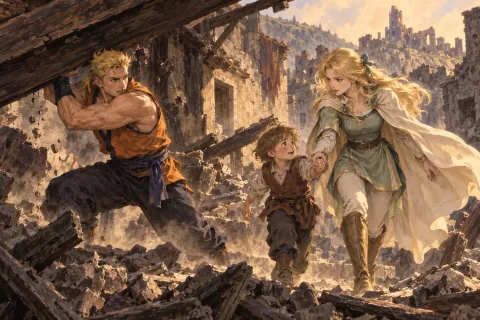
Arriving on an unfamiliar continent by raft, Celes stops by the village of Albrook and faces the horrific reality of how the world has changed. The news that Kefka is oppressing people with the overwhelming violence of the Light of Judgment deepens her sense of despair. Later, when she arrives at the village of Tzen, it is in great chaos, with buildings collapsing and people screaming and fleeing due to the impact of the Light of Judgment.
Inside the chaotic village, Celes discovers a familiar face, Sabin, holding up a house on the verge of collapse with his bare body. Sabin desperately holds up a pillar, saying he must save a child trapped inside, and Celes rushes into the collapsing house within the time limit, breaking through monsters to safely rescue the child. This dramatic reunion urgently shows the process of the two filling each other's gaps and cooperating.
Sabin's act of supporting the house symbolizes a blind and honest will to protect others in a broken world. He prioritizes the life inside the house over his own safety and willingly endures the physical pain of bearing an immense weight. This shows that even in a desperate situation, someone is still offering their shoulders for others, instilling deep relief and trust in Celes.
Celes's decision to risk danger and enter the house also proves her internal change. Having suffered from a sense of helplessness while caring for Cid on the remote island, she is now reborn as an active subject who takes action to rescue others. She is no longer a general moving according to the Empire's orders, but a protector in the true sense who jumps into danger herself to save the weak before her.
This rescue operation has an interdependent structure that could never succeed with the power of only one person. If Sabin had not held up the weight of the collapsing world from the outside, Celes could not have entered, and if Celes had not found the child inside, Sabin's sacrifice would have been meaningless. This cooperation, which is only possible when based on firm trust in each other, explains why the fragmented companions must unite again.
The process of rescuing the trapped child is not a magical healing that washes away all trauma at once. It is a series of concrete and practical labors of finding a path through collapsing debris and overcoming threats. This scene silently conveys that hope is not a miracle that falls from the sky, but takes shape only through physical practice of getting covered in dust, sweating, and holding another's hand.
Kefka's destructive power, the Light of Judgment, and Sabin's protective power of holding up the collapsing house form a stark contrast. Absolute power exerts violence randomly from afar, while human goodwill struggles to protect concrete lives in the closest proximity. Even if the scale of that power is incomparably small, that desperate gesture to save another is the most powerful resistance against the broken world.
The moment Sabin joins as a companion after the rescue of the trapped child is an important turning point where the heavy burden of survival that Celes carried alone is finally shared. The time of isolation, where she had to handle everything alone on the remote island, is over, and now she has a reliable helper to whom she can willingly entrust her back. This reunion means more than just an increase in combat power; it means that a foundation of emotional support to traverse the broken world has been re-established.
The child's survival becomes evidence to the villagers, and to Celes and Sabin, that the future is not yet completely closed. The fact that they saved the life of the next generation amidst the ashes where everything burned casts a positive light on the survival possibilities of other companions they will seek out in the future. This concrete experience of success in saving a small life becomes solid firewood that can sustain the arduous journey.
The incident in the village of Tzen presents one answer to how we can save each other in a world fallen into despair. It is not a grand ideology or a perfect plan, but a crude devotion of holding up a collapsing pillar with one's shoulder and jumping into the flames right before one's eyes. When wounded people share the weight of each other, a small gap through which one can live again begins to open in the shattered world.
Scope of Materials and Interpretation
The main story flow of the Super Famicom original and the Pixel Remaster was used as the standard. Differences in survival, companion recruitment, and endings based on choices are distinguished in the relevant scenes, and the additional GBA dungeons are explained as separate version elements. Unstated inner thoughts of characters are interpretations based on the context of events, and the identity of unknown figures is not asserted as fact. Material verification date: October 15, 2026 (Bangkok time).
Square Enix · FINAL FANTASY VI Official Introduction and Characters
comments 0