
Recommended Game Story · Final Fantasy VI Part 25
Chapters in this story
Forgotten Castles and Nameless Companions
Spoiler Notice: This series covers major events and the ending of Final Fantasy VI. If you are new to the game, you may wish to read only up to your current progress and experience the choices and music yourself. This text combines descriptions of events with interpretations of character motivations; it is not a translation of original dialogue or an official novel. Illustrations are AI reconstructions based on public materials.
Even after the world has crumbled, those who remain rebuild the meaning of their lives in their own ways. The addition of Gogo, the mimic whose past and identity remain unknown, shows that one can connect with others even amidst anonymity. The traces of Odin and the Queen discovered in the ancient castle buried in the sand ask how a heart that transcended species can be conveyed across a thousand years. And the battle against the legendary dragons scattered across the world is a quiet yet intense time of preparation, where the party steels their resolve before the final showdown. This journey becomes a step toward confirming what they will protect in a lost world.
Chapter 1 · Gogo and the Mimicked Act of Salvation
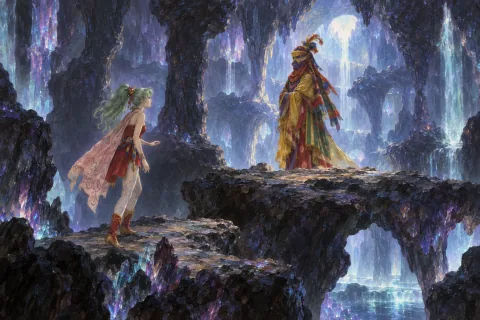
In the place swallowed by the Zone Eater on the Triangle Island, the party meets the mimic Gogo. While the name Gogo is known, the character's true identity, gender, and past are not defined in the story. It is a brief encounter where, upon hearing that the party intends to save the world, Gogo expresses a desire to join and mimic them. What is needed when interpreting this optional recruitment is not the answer to every identity question, but the possibility that relationships can form through the act of doing things together.
While various speculations can be made about Gogo's true identity or past, the story itself leaves Gogo undefined. What is truly important here is not who Gogo was in the past, but the fact that they decided to willingly join the party's grand purpose of saving the world at this very moment. Gogo's choice to mimic the actions of others while maintaining anonymity to the end carries a strange weight.
The act of mimicking might at first glance appear to be a very passive attitude lacking one's own subjectivity. However, in an era filled only with despair, the declaration to faithfully copy someone else's goodwill and struggle becomes, in itself, an active form of participation that fully affirms and supports another person's life. Gogo silently becomes their shadow, imbuing every action the party takes with their own hidden will.
The fact that Gogo's identity is unknown is not evidence that names and memories were lost when the world collapsed. There is no need to fabricate a past that the game does not explain. Instead, we can focus on the present action where the party can fight alongside Gogo. The experience of participating in the same goal without fully knowing each other brings to mind the concept of anonymous solidarity. This interpretation is not an answer that defines Gogo's hidden life, but a way of reading that keeps an undisclosed character by one's side.
The performance in the battle system where Gogo perfectly reproduces the various skills of the companions visually maximizes this thematic consciousness. Whether it is magic, swordsmanship, or operating machinery, Gogo accepts and mimics the unique abilities of the companions without any discrimination. This can be read as perhaps the most extreme and devoted form of empathy, fully respecting and accepting the experiences and abilities of others as if they were their own.
The reason Gogo remained in such a terribly isolated place as the interior of the Zone Eater also provides interesting room for thought. The belly of a monster that indiscriminately swallows everything is like a microcosm showing the despair of the collapsed world. The process of Gogo, who had been silent for a long time in that deep darkness, finally stepping out in response to the party's movement toward the light, offers a strange sense of liberation as if a trapped possibility is awakening.
Gogo never forces their own way upon the party, only quietly supporting the path they have chosen from behind. This strange, silent companion becomes a much stronger support than a hundred words of comfort. To companions struggling with their own deep wounds, the presence of someone who fights alongside them while reflecting their actions like a mirror creates a deep sense of solidarity that is hard to explain in words.
To perfectly mimic another person inevitably presupposes a difficult process of emptying one's own self. Perhaps Gogo's refusal to reveal their identity to the end is a firm determination to remain a transparent vessel, fully containing the diverse colors and wills of the companions. Because it is an empty space that has emptied itself, Gogo's characteristic of being able to become anything takes on a strange sublimity amidst despair.
After the world was destroyed, people have dealt with immense loss in their own ways. Some were deeply bound by memories of the past, while others struggled to find new hope. The coping method Gogo chose is to completely synchronize their body and mind with the hope held by others. This warmly shows that even those who lack the strength to create hope on their own can embark on a journey of salvation through solidarity.
Gogo's story asks whether one must know everything about an identity and past to connect with others. Gogo is not a person who has erased their name, but a person who accompanies others through action without much explanation. The ability to mimic is not defined as a lack of personality, nor as unconditional devotion. The reader can read the meaning of this encounter through the fact that the ability actually helps the companions. Leaving the identity undisclosed until the end is also a way to faithfully understand the story.
Chapter 2 · The Petrified Odin and the Queen's Tears
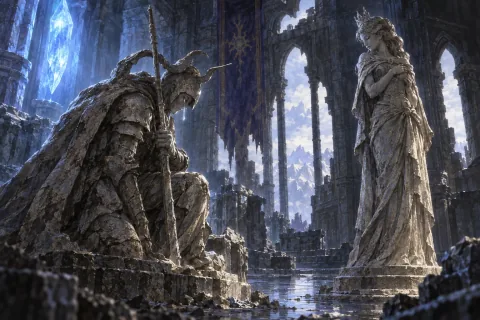
The ancient castle accidentally discovered while moving through the underground of Figaro Castle holds the traces of a tragic love intertwined with the War of the Magi from a thousand years ago. Deep underground, the statues of the Esper Odin, who turned to stone, and the human Queen who loved him deeply, remain in silence. Through the old diary of the Queen, the party quietly faces the sorrowful and unreached hearts of two beings who sought to cross the massive wall between human and Esper.
The emotions that bloomed amidst the horrific and destructive war of the War of the Magi naturally make the tragic story experienced by Terra's parents, Maduin and Madeline, overlap. The union of human and Esper always had to face painful frustration in the face of the era's massive violence. However, the hearts they held remained unfaded even after a thousand years, proving their depth in the heavy silence of the ancient castle.
The steadfast figure of the petrified Odin visually embodies the deep regret of one who could not protect the precious object they sought to guard until the end. His cold exterior, hardened by the terrible power of magic, conveys the utter helplessness an individual had to endure in the face of a massive disaster like war. Before his hardened form, the party quietly reads the indelible scars of tragedy left by a past era.
The scene where the tears flowing from the Queen's statue transform Odin into the more powerful Raiden is the highlight of this ancient castle episode. This process, where the sorrow that had been coldly trapped for a thousand years is finally liberated and sublimated into new power, beautifully shows that the pain of loss does not remain merely as suffering. The Queen's tears slowly melt the frozen time, finally completing the sorrowful narrative of the two beings who had been stopped for so long.
This change holds a deeper meaning than the functional achievement of obtaining a more powerful Esper in the game. Odin's new awakening as Raiden can be interpreted as the Esper's response to the party's firm resolve to rise above past painful failures and regrets to save the current collapsed world. It is as if a love that could not be fulfilled a thousand years ago transcends time to connect as a warm power that helps the current struggle.
The calm yet sad sentences contained in the Queen's old diary have a much deeper appeal than grand historical records. The fact that only an individual's desperate heart toward a loved one survived in the ruins, rather than the victory or defeat of a war or the rise and fall of a great nation, offers a strange comfort. This is because it is clear evidence that even if the world is destroyed, the memory of having genuinely cherished someone will never disappear.
The mindset of the party exploring the depths of the ancient castle is also greatly influenced by the heavy weight this space holds. For those who have gathered to reclaim what is precious, the experience of witnessing the massive loss of a thousand years ago firsthand makes them reflect once again on the true meaning of their fight. Using the tragedy of the past as a mirror, they will surely resolve deep in their hearts not to leave the same regrets in the world they live in now.
This mysterious place where the strict boundary between human and Esper is blurred also poses a heavy question about the essence of the power of magic. While Kefka uses magic only as a cruel tool of destruction and domination, the traces of magic left in the ancient castle are the result of an affectionate wish to protect and remember someone forever. The stark contrast regarding for what purpose one should use great power is clearly revealed in these quiet ruins.
The process of finding the secret passage quietly hidden deep underground is like a cautious and reverent step toward the truth of forgotten history. The setting that behind the tragic appearance of the petrified Odin on the surface, there exists a hidden truth called the Queen's tears, excellently shows the depth of a multi-layered narrative. True salvation and liberation can only be completed when one fully faces the deep sorrow of others hidden beyond the surface.
Ultimately, this sad episode contained in the ancient castle is a warm comfort from a thousand years ago offered to the party struggling to live in the collapsed world. Even if the flesh turned to cold stone and the great empire perished, the true heart toward each other endures the harsh time and becomes a light that illuminates someone's path. The sword of Odin, reborn as Raiden, will now become a solid power that cuts through the heavy regrets of the past and opens a new future.
Chapter 3 · The Eight Dragons and the Shadow in the Sky
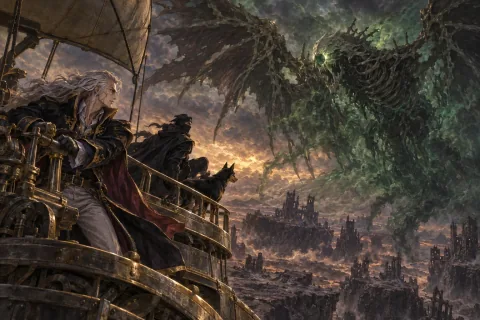
After the world was brutally torn apart and the land twisted, the eight legendary dragons released from their long seals and Doom Gaze roaming the sky are new trials facing the party. The battles with them are not an essential process that must be gone through in the flow of the story. However, the party's move to seek out the terrible threats lurking in various parts of the world before the final showdown shows, in itself, a firm determination to fully reclaim the world.
The act of seeking out and hunting legendary monsters on a world standing on the edge of destruction is far from a blind display of force. This is a silent devotion to cleaning up the remnants of despair that Kefka scattered across the world, one by one, to prepare a foundation where the remaining people can live safely again. The heroes are focusing all their strength on restoring the order of the collapsed world, even if only a little, rather than their own safety.
The eight dragons each possess different attributes and powerful strength, requiring the party to have various tactical flexibility and deep trust in each other. The overwhelming force of one or two people cannot defeat all these massive threats; close cooperation and sacrifice among the companions are essential. This process of arduous struggle becomes an important opportunity for the companions who had been scattered to unite as a solid team once again.
In particular, the sudden encounter with Doom Gaze, who wanders the sky randomly, chillingly symbolizes the unpredictable terror that the collapsed world holds. The shadow of death that does not know when or where it will strike constantly threatens the daily lives of the survivors. The act of the party riding the airship to persistently track down and finally extinguish this invisible terror is a highly symbolic struggle to clear away the vague fear hanging over the world.
The dilemma of Ragnarok, where one must choose between a Magicite and a sword in Narshe, also adds to the weight of this preparation process for the final battle. This choice, of how to accept the powerful legacy of the past and use it in the fight for the future, brings a heavy contemplation with no correct answer. The game quietly asks the player that determining the form of power ultimately depends on the philosophy and responsibility of the one who will wield it.
The arduous process of breaking the terrible seal of the Cursed Shield also follows this trajectory. The setting that one can only obtain the true power of the Paladin Shield after silently enduring the curse that constantly eats away at vitality and fighting numerous battles leaves a deep impression. Perhaps the party is moving forward while sharing the massive pain the destroyed world is experiencing with their own bodies by willingly shouldering the terrible curse themselves.
This series of optional challenges excellently visualizes the solid inner maturity the party undergoes before the final battle with Kefka. Far beyond the mechanical process of leveling up and obtaining good equipment, they slowly learn how to directly soothe the deep wounds of the world and correctly inherit the legacy of the past. It is a sublime time of proving for themselves that they are qualified to handle that power, rather than blindly chasing it.
Every time one of the legendary dragons is defeated, a very small peace quietly settles on the collapsed land. Although complete salvation seems distant as long as Kefka reigns, the local victories they silently create ignite sparks of hope for people in despair that they can still resist. Their fierce struggle, taking place in invisible places, becomes a solid, invisible pillar supporting the collapsed world.
The Magicite of Bahamut obtained after finally defeating Doom Gaze is a valuable reward given to those who have overcome the deep terror of death. This new Esper power, obtained after clearing away the shadow of death that dominated the sky, is like a firm declaration that the party will never again succumb to unknown terror. This valuable experience of facing and overcoming fear head-on will become the most reliable weapon for the upcoming final battle.
This installment's optional preparations were read based on the main composition of the Super Famicom original and the Pixel Remaster. The GBA version's additional dungeons, the Dragon's Den and Soul Shrine, are elements of a separate version that expands the same basic story, and they cannot be mixed as if they were events that must be experienced in the Pixel Remaster. Depending on which challenges are completed, the combat experience may vary, but obtaining all rewards is not necessary to understand the meaning of the ending. It leaves room to head to the final tower with the companions prepared by each player.
Scope of Materials and Interpretation
This text is based on the main story flow of the Super Famicom original and the Pixel Remaster. Differences in survival, companion recruitment, and endings based on choices are distinguished in the relevant scenes, and the GBA version's additional dungeons are explained as separate version elements. The unstated inner thoughts of characters are interpretations read based on the context of events, and the unknown identity of Gogo, etc., are not asserted as facts. Data verification date: October 15, 2026 (Bangkok time).
Square Enix · FINAL FANTASY VI Official Introduction and Characters
Thonky · New Friend Triangle Island Event Walkthrough
Thonky · The Ancient Castle Event Walkthrough
comments 0