
Recommended Game Story · FINAL FANTASY VI Part 10
Chapters in this story
Sincerity Learned on Stage
Spoiler Notice: This series covers the major events and the ending of Final Fantasy VI. If you are new to the game, you may read up to your desired chapter and experience the choices and music firsthand. This text includes both descriptions of events and interpretations of the characters' inner thoughts; it is not a translation of original game dialogue or an official novel. The illustrations are AI reconstructions based on public materials.
The party, seeking a way to infiltrate the Empire, heads to the Opera House to approach Setzer, a wanderer who owns an airship. This strange operation, where Celes, a former Imperial general, plays the prima donna on stage, becomes more than a simple disguise; it serves as an opportunity for the characters to face their respective pasts. The song sung under brilliant lights, the commotion occurring on the ceiling, and a single coin tossed on the flying ship all demonstrate how they persuade and bind one another.
Chapter 1 · Becoming Maria, Not a General

To obtain an airship to infiltrate the Empire, the party devises a plan to put Celes on stage in place of Maria, the opera singer whom Setzer intends to kidnap. Having lived her entire life as an Imperial general wielding a sword, she is placed in an unfamiliar and bewildering situation where she must wear a gorgeous dress and sing of love before a massive audience. Locke encourages her in the dressing room, pushing her toward the stage.
The opera 'Maria and Draco' is a fictional play dealing with the loss and longing of lovers separated by war. Celes memorizes the script, takes the stage, and begins to act as Maria, expressing a sorrowful heart toward a lover left on the battlefield. As the lights turn on and the accompaniment flows, her voice fills the theater, and the audience gradually becomes captivated by the song of this fake Maria. Her appearance, having shed the general's armor for a stage costume, creates a strange sense of tension.
The stage costume she wears instead of the general's armor likely carries more weight for her than a simple disguise. Having been accustomed to hiding her emotions and obeying orders her whole life, she is now tasked with a role that requires her to reveal her most vulnerable heart. Expressing love and sorrow on stage may have been a more unfamiliar and frightening test than any battle she had faced until now. The experience of pouring out her emotions completely in front of others is a realm that did not exist in her life.
The pain of war and separation experienced by Maria in the play touches upon the horrors of reality that Celes either directly or indirectly created or witnessed as an Imperial soldier. While singing the fictional script aloud, she indirectly experiences the loss that the Empire she served left upon countless people. This can be read as a strange moment of reversal where one who was in the position of the perpetrator vicariously experiences the sorrow of the victim. The lyrics of the song are fiction, but the emotions within them carry the weight of reality.
Locke's gaze as he watches this performance from the audience also holds complex layers. He is a person who lives with a sense of responsibility bordering on obsession to protect someone due to past loss. Celes's appearance, singing sorrowfully on stage, likely serves as a catalyst that stimulates memories of the past he could not protect, while simultaneously allowing him to discover a new side of the person standing before him. It is a time to face the face of an ordinary human hidden behind the label of a general.
The acting on stage is a lie, but it is difficult to conclude that the emotions ignited in that moment are entirely fake. The longing and loneliness Celes sings of, borrowing Maria's lines, overlap with her cautious reliance on those who saved her from being branded a traitor and accepted her as a comrade. Because she wore the mask of a role, her inner voice, which she might not have been able to reveal otherwise, was able to flow out through the song. Amidst the unfamiliar melody, she gradually finds her place.
This opera scene shows the moment when a character becomes most defenseless within the game. The situation of having to put down weapons and fill a large space with only one's voice and gestures is accompanied by greater psychological pressure than physical threats. Her appearance, standing alone before the audience's gaze, seems to visually metaphorize her current situation of having lost the grand background of the Empire and needing to reconstruct her identity. She may be learning for the first time on stage how to face the world without a shield.
The fantastical nature of the theater space itself adds to the meaning of this scene. The stage, where the reality of war and the tyranny of the Empire are momentarily forgotten and only love and promises are treated as the most important values, is a kind of escape and utopia. The party entered this space of fantasy for the sake of the operation, but paradoxically, they experience a very real exchange of emotions—understanding and compassion for one another—within that fantasy. The fake stage became a medium that drew out true hearts.
The direction, which conveys the character's inner self through music rather than dialogue or explanation, leaves a deep impression on the player. Even within limited graphics and text, the rise and fall of the melody combined with the character's movements allow one to guess at complex feelings that cannot be fully expressed in words. This persuades the player that Celes is not merely a cold warrior, but a multi-dimensional being who is hurt, shaken, and wishes to connect with someone. Music acts as the key to opening her closed heart.
What she had to accomplish on stage was not a perfect song, but a process of resonating with the emotions of others and acknowledging her own vulnerability. Through this short performance, she sheds at least a little of the old shell of being an Imperial general and prepares to walk into a new network of relationships. The fictional love song she sang on stage is like a preview of the real bonds she will form in reality later on. This operation provided her with an unexpected internal turning point.
Chapter 2 · Laughter in the Audience and Threats from the Ceiling
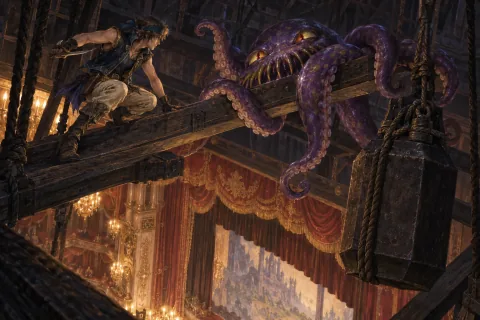
While the opera is proceeding smoothly, it is discovered that Ultros, who has hidden in the theater's ceiling structure, intends to drop a heavy weight onto the stage. Locke and his companions rush up to the narrow, dark ceiling to stop this threat that could ruin the performance and hurt Celes. A tense situation unfolds above the theater as they must reach Ultros and prevent the fall within a limited time while fighting through swarms of rats.
The party narrowly stops Ultros, but in the process, they fall onto the stage, completely breaking the flow of the play. Just as they try to handle the situation with wit in front of the flustered director and audience, Setzer, who had been targeting Maria, breaks in. Mistaking Celes on stage for the real Maria, he kidnaps her and disappears on his airship. The operation takes an unexpected turn.
This scene contrasts the acting on the gorgeous stage with the life-or-death struggle occurring in the unseen places to protect that stage. The audience is intoxicated by the beautiful song on stage, but that peace is maintained thanks to the efforts of the companions running and sweating above the ceiling. This can be seen as an interesting spatial direction that visually embodies someone's dedication and risk-taking existing behind a beautiful result. Light and shadow intersect simultaneously within the single building of the theater.
Locke's desperate running across the ceiling once again emphasizes his instinct for protection. His desperation not to repeat the failures of the past can be read as a will to protect a comrade standing alone on stage, beyond simply the success of the operation. The pressure given by the time limit is conveyed intact to the player, allowing them to directly experience the impatient psychology of a character running to save someone. Every step is imbued with the earnestness of not wanting to lose.
Ultros's intrusion serves to relax the atmosphere of the play, which could be serious and heavy. Unlike the massive and systematic evil of the Empire, his actions carry unpredictable and whimsical malice. This uncontrollable variable ruins the party's meticulous plan in a ridiculous way, reminding them in a humorous yet annoying manner that the world's affairs never flow exactly as calculated. The perfect play ends in a mess with the appearance of an uninvited guest.
Setzer's appearance brings this chaos to its peak. His act of believing Celes is Maria and taking her away is a clear kidnapping; it is not a romantic rescue or an escape by consent. The party had induced this situation to approach him in the first place, but seeing a comrade dragged away right before their eyes brings a sense of helplessness at having completely lost control. It is the moment of paying the price for courting danger for a purpose. The plan to deceive the opponent ends up tripping them up instead.
From Celes's perspective, this kidnapping means another form of isolation. While she was barely feeling a sense of connection with her companions and performing on stage, she is suddenly dragged onto a stranger's airship. The situation of being trapped again by someone else's will, not long after being rescued from an Imperial prison, seems to show that she still cannot fully control her own destiny. She is placed back in a passive position, swayed by the desires of others.
The opera, which ended with the party falling onto the stage and a kidnapping, shows how a space of fantasy is shattered by the violence of reality. The people in the theater were lost in a beautiful story for a moment, but they wake from the fantasy with the appearance of uninvited guests who fell from the ceiling and a wanderer who forcibly takes someone away. This reminds us that the world within the game is a rough reality that cannot be solved by romantic songs alone. Even beautiful art is forced to stop in the face of physical force.
The contradiction inherent in the party's plan to achieve their goal by deceiving someone is also revealed. Using Celes as bait to deceive Setzer was an unavoidable choice to oppose the Empire, but the fact that they put a comrade in danger in the process remains unchanged. This commotion seems to ask a quiet but heavy question: is it truly right to instrumentalize an individual for a greater cause? The dilemma that a good purpose does not always guarantee good means is glimpsed.
In the end, this messy stage becomes a rough passage leading the party to a new stage: the airship. They could not proceed with the negotiation elegantly as planned, but they succeeded in entering Setzer's space one way or another. The curtain of the theater has fallen, but the time for real negotiation and persuasion to take place in the sky is just beginning. The crisis becomes a key to opening a new phase. An accident that went beyond expectations opened the way to the destination they wanted.
Chapter 3 · The Coin That Flipped the Bet and the Airship
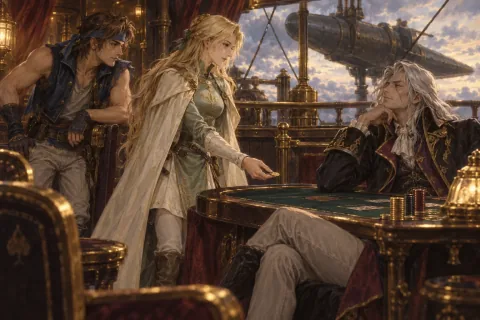
The party, having boarded Setzer's airship, the Blackjack, demands that he lend them the ship to fight against the Empire. Setzer, who was disappointed that Celes was not Maria, tries to refuse this reckless proposal, but Celes proposes a coin-toss bet to him. The unconventional condition is that if it comes up heads, he lends them the airship, and if it comes up tails, she remains by his side. Setzer, like a gambler, readily accepts this dangerous bet.
The coin Celes tossed was one secretly given to her by Edgar, a trick coin with heads on both sides. The result was naturally heads, and even though Setzer notices it is a trick, he is intrigued by their guts and purpose, lends them the airship, and joins the rebellion. If Sabin is in the party, a scene is added where he recognizes this coin and realizes the truth of the bet his brother once made over the throne. A single coin unravels both the current negotiation and the secrets of the past.
Celes's act of putting herself up as the stake in this bet may appear passive on the surface, but in reality, it is an active decision to seize the initiative in the situation. She does not remain in the position of a kidnapped victim, but uses the gambler's rules against him to bring him to the negotiating table. In that she tossed it knowing it was a trick coin, this is an expression of her will to control the outcome herself rather than relying on fate. She knows how to flip an unfavorable board.
Setzer's act of acknowledging his defeat even after noticing the secret of the coin shows his unique values. He is captivated by the party's desperation and boldness in trying to win against the massive enemy of the Empire, even by cheating, rather than a fair game. Their appearance, jumping into a fight where loss is certain, may have made the blood of the gambler in him boil. It is the moment when impulsive trust, beyond rational calculation, sprouts. The perfect trick became a medium that conveyed sincerity.
The double-headed coin Edgar handed over is a tool for deceiving someone, and at the same time, an object symbolizing his past where he tried to shoulder responsibility alone to protect someone precious. The fact that this coin is now used to save a comrade from a crisis and gain a new helper is significant. It can be read that the object, which was a symbol of personal sacrifice, has now had its usage expanded into a weapon for solidarity and resistance. The weight entangled in a single old coin is by no means light.
The branch where Sabin realizes the secret of this coin leads to a fundamental reinterpretation of their brotherly relationship. He belatedly learns that the life he believed he had left to find freedom was actually made possible by his brother's thorough manipulation and consideration. This short moment of understanding the weight of the crown his brother shouldered, rather than anger at being deceived, is a quiet moment of reconciliation where the hearts of the two, which had been at odds for a long time, finally find their place. The sincerity that is conveyed without words is there.
Setzer's joining does not start from firm loyalty or a grand cause. Their companionship, which began with a deformed relationship as kidnapper and swindler, is closer to a result of their goals coincidentally aligning. However, it is not only perfectly innocent and pure motives that save the world. It is interesting that this imperfect alliance, bound together by force while carrying each other's deficiencies and desires, and sometimes even mobilizing tricks, becomes the power to crack the Empire. Even flawed trust can sometimes be a powerful weapon.
The airship Blackjack symbolizes a free space beyond the reach of the Empire's control, beyond a mere means of transportation. The party, who were chased by the Empire's army and surveillance network on the ground, finally gains the initiative for a counterattack by flying into the sky. This ship, which retains the splendor of a gambling hall, contrasts with the oppressive landscape of the Empire and seems to visually represent the free and colorful way of life they wish to protect. The flying ship itself becomes a grand metaphor for hope.
From the Opera House to the airship, Celes undergoes the most dramatic change. She, who was forced to stand on stage, has now jumped into the gambling table of her own will and achieved victory. She has been reborn as a proactive character who designs the board herself and takes risks for her companions, moving away from the position of being protected by someone or following orders. This series of events is a rite of passage where she establishes herself as a comrade in the true sense. Even without the general's armor, she is a sufficiently strong person.
Like the two sides of a coin, only two possibilities exist in their future: success and failure. Although they have gained a powerful helper in Setzer and an airship, the road to the heart of the Empire is still full of danger. Behind the thrill of the first victory won by trickery, a heavy reality awaits where they must now risk their lives to face the Empire. A strange tension remains as to what kind of ending this precarious alliance formed in the sky will fly toward. The die has already been cast, and the airship turns its bow toward the Empire.
Scope of Materials and Interpretation
The main story flow of the Super Famicom original and the Pixel Remaster was used as the standard. Differences in survival, joining of companions, and endings based on choices are distinguished in the relevant scenes, and GBA-exclusive dungeons are explained as separate version elements. Unstated inner thoughts of characters are interpretations read based on the context of events, and the identity of unknown figures is not asserted as fact. Date of material verification: October 15, 2026 (Bangkok time).
Square Enix · FINAL FANTASY VI official introduction and characters
Thonky · Reference for the opera Maria and Draco event progression
comments 0