
Recommended Game Story · FINAL FANTASY VI Part 14
Chapters in this story
The Embers Hidden in Thamasa
Spoiler Notice: This series covers the major events and the ending of FINAL FANTASY VI. If you are a first-time player, you may wish to read only up to your desired chapter and experience the choices and music firsthand. These entries contain both descriptions of events and interpretations of character motivations; they are not translations of original game dialogue or official novels. Illustrations are AI reconstructions based on public materials.
Following the peace negotiations with the Empire, the party heads to the village of Thamasa on the Crescent Island, where the Espers are said to be hiding. While it appears to be an ordinary rural village, it is actually a settlement of the descendants of mages who have lived in hiding since the War of the Magi. This chapter illuminates how these people, who have been cut off from the world for so long, open their hearts to outsiders and find the clues to understanding the disparate existences of humans and Espers. We examine the shifts in their relationships through the moment the hidden embers begin to glow.
Chapter 1 · The Old Man of the Village That Denies Magic
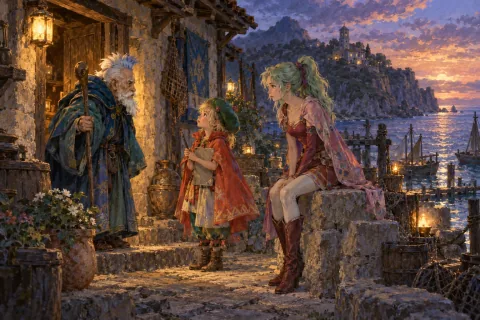
Upon arriving in Thamasa, the party asks Strago, an old man standing near the village elder, about the Espers, but he strongly denies knowing anything. The villagers also show a guarded attitude toward outsiders, thoroughly concealing the existence of magic. While not Espers themselves, they are descendants of mages who inherited magical power in the aftermath of the War of the Magi, and they have kept their identities hidden for a long time. Deep fear lies beneath the surface of this ordinary rural village.
Strago is accompanied by his adopted granddaughter, Relm. The old man attempts to block any potential risks that could entangle them with the Empire to protect his young granddaughter and the peace of the village. The visit of outsiders likely feels like a threat that shakes the defensive barrier he has spent his entire life maintaining. The fear that they will become targets of the Empire if it is discovered that they possess the alien power of magic is the primary force suppressing their lives.
Strago's firm attitude in denying magic paradoxically proves the weight of what he is trying to protect. Because the entire village could be swept into the vortex of war the moment the truth is spoken, his lies are not selfish deceptions but stem from a heavy sense of responsibility for his community. The scars of the past and the peace of the present are in such intense conflict that he cannot easily offer the truth to strangers.
The people of Thamasa sought to secure their safety by isolating themselves. This can be read as the result of internalizing a history where magical power acted as a curse rather than a blessing. Even if their daily lives, where they must hide their true nature, appear peaceful on the surface, they contain a constant tension of not knowing when they might be discovered. Disconnection from the outside world was likely their only way to survive.
Relm's presence brings a strange vitality to this closed-off village. The curiosity and boldness of a young child who has not yet fully experienced the cruelty of the world clash with Strago's overprotectiveness, revealing the generational gap in perspective. Relm's unhesitating interest in outsiders acts as a natural crack, hinting that the village cannot remain isolated forever. One can glimpse the potential of a new generation growing up within a repressed society.
In this village, magic is not a tool to make daily life convenient, but a dangerous secret that must be strictly controlled. While characters like Terra struggle to find their magical origins, the residents of Thamasa strive to erase the power they were born with. The contrasting attitudes toward the same power shed deep light on the complex impact magic has on individuals and society. An environment where the mere possession of power is treated as a sin constrains the choices of the characters.
The scene where Strago draws a line at the party's questions allows us to guess the internal conflict he is experiencing. Even though he senses the party's goal of seeking peace to some extent, the old man's caution, which forces him to be wary of the catastrophe that premature trust might bring, is palpable. The weight of the villagers' lives he carries is too heavy for him to trust others completely. The wariness accumulated over many years cannot be easily broken down by a few words.
The conversations here say more through the silence hidden behind them than through their surface meaning. The short answer that they do not know of any Espers contains a resolute will not to repeat the tragedies of the past. The tense tug-of-war between those asking for the truth and those trying to hide it draws a tragic parallel line where both sides understand each other's positions but cannot set down their respective responsibilities. Language acts as a tool for communication and a thorough defense mechanism simultaneously.
The peace of Thamasa is like a thin sheet of ice that could break at any moment. With the threat of the Empire not fully gone, the seclusion they have chosen cannot be a fundamental solution. The party's visit serves as an opportunity to test the limits of this precarious peace, subtly suggesting that the villagers must eventually come out into the world and face their own identities. Hiding is not enough to avoid the coming wave of massive change.
The old man's denial of magic serves as a backdrop that heightens the dramatic tension of the events to come. It makes one anticipate what meaning that power will have when the secret they most wanted to hide is revealed at the most desperate moment. The process of opening a heart that has been thoroughly closed suggests that, in the end, humans must reveal their most vulnerable parts to save one another. It is likely not an external force, but internal desperation, that breaks down the defensive walls.
Chapter 2 · A Family Returns to the Flames
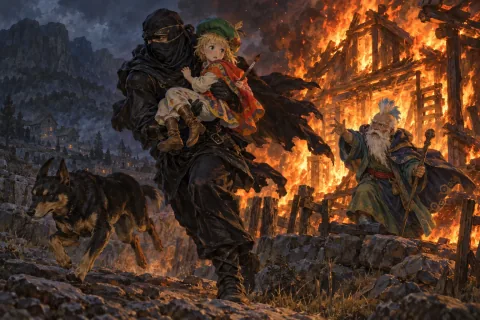
In the middle of the night, a fire breaks out in the village, and Relm is trapped inside the burning house. Strago, in a panic, uses the magic he has hidden his whole life to try to extinguish the flames, and the villagers also break their secret to use magic to help. Terra and Locke jump into the burning house to assist him, and Shadow and his dog, Interceptor, also provide decisive help in the rescue process.
This fire is more than a simple disaster; it creates a decisive moment where the taboos kept by Thamasa are broken. The sight of the entire village risking their fear to use magic, driven by the single desire to save their family, shows that the essence of the power they have hidden lies in protection, not destruction. Even without a specific description of the wounds sustained in the flames, the fear of losing someone precious is vividly conveyed beyond the screen.
The moment Strago brings out his magic is an act of self-destructively dismantling the beliefs he has spent his life protecting. However, there is not a moment of hesitation in that choice. The fact that saving the family before his eyes is overwhelmingly more important than maintaining ideologies or secrets is proven through his actions. Breaking a taboo is a frightening thing, but one can infer that it is nothing compared to losing a loved one.
The scene where the villagers use magic in unison evokes a strange sense of emotion. This is because the alien power they so desperately wanted to hide paradoxically transforms into the most powerful means of confirming communal solidarity and saving lives. This aligns with the game's core theme that magic itself does not possess good or evil, but its meaning is determined by the will of the person using it. The hidden power finally finds its proper use.
Terra and Locke's actions of jumping into the flames despite the danger leave a deep impression on Strago. To him, who was thoroughly wary of outsiders, the sight of these people risking their lives without any reward to save his family becomes the key that opens his tightly closed heart. Selfless devotion toward others exerts a power that breaks down distrust more strongly than any logical persuasion. Their solidarity is formed beyond bloodlines or origins.
The intervention of Shadow and Interceptor adds another layer to this event. The sight of a mercenary who seemed to move strictly according to his own interests appearing to help in a moment of crisis subtly reveals the human side hidden within him. In particular, the special intimacy Interceptor shows toward Relm hints at the existence of a deep, unspoken bond and exchange of emotions, adding complexity to their relationship.
The raging flames act as a furnace that burns away the characters' pretenses and defensive barriers while being a physical threat. In the midst of a life-or-death crisis, people are bound to reveal their most honest intentions. Experiencing this fire allows the people of Thamasa and the party to confirm each other's sincerity, breaking down the walls of wariness that had built up for so long and laying the foundation to be reborn as true companions.
There is no need to consume the danger of Relm being trapped in the flames as a lesson that a child must become strong on their own. What allows a child to survive is, first and foremost, the adults noticing the danger and gathering to help. When the way Strago hid and protected things alone is not enough, the strength of others is added. The fact that Relm soon shows her own talent after this rescue does not mean that the right to be protected has disappeared. Care and the recognition of ability can exist together.
After the fire is extinguished, the party and the villagers become people who share the great secret of magic. The embarrassment of having their secret discovered soon turns into understanding and trust toward one another. The experience of showing one's greatest weakness and having it fully accepted becomes an opportunity for the relationship to develop dramatically, providing a solid psychological background for Strago's decision to join the party's journey. Sharing the truth is the starting point of a new solidarity.
The emotions the characters feel in front of the house turned to ashes are likely a sense of relief combined with a heavy sense of responsibility that they must move toward a new world. The process of an old man who lived in hiding his whole life jumping into a fight that determines the fate of the world is not forced. It creates a natural flow where the desperate power he exerted to protect his family now expands into a driving force to protect the peace of the wider world.
Chapter 3 · Recognizing Each Other in the Cave of the Espers
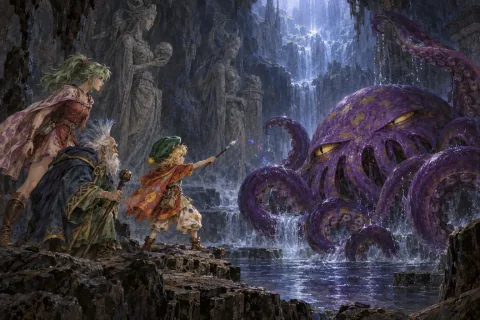
Together with Strago, who has confessed his secret, the party heads to the cave where the Espers are gathered. There, they face the golden statues of the Warring Triad and the horrific history of the past War of the Magi. During their exploration, they are attacked by Ultros, but Relm, who secretly followed the party, uses her unique sketching ability to overcome the crisis. Afterward, the party meets the Espers, who have been hiding in regret over their conflict with humans, and prepares to discuss peace.
This cave is not just a hideout, but a historical space where the wounds of the past and the conflicts of the present intersect. The reason the Espers had to seal themselves away and hide is revealed, and it becomes clear that both humans and Espers are victims of the war. The way Relm's artistic talent intervenes in battle interestingly presents how a form of power different from destructive magic can change a situation.
The golden statues of the Warring Triad located deep in the cave visually symbolize the source of the power of magic and the tragedy derived from it. The history that shows how humans and Espers were reduced to tools and destroyed each other in the face of absolute power is like a mirror warning of the dangers of the war the Empire is currently waging. It serves as a reminder that to avoid repeating the mistakes of the past, the blind pursuit of power must stop.
Relm's sketching ability is an artistic act of observing the subject as it is and capturing it on canvas. This follows a different path from the omnipotent magic that indefinitely controls or manipulates reality. Unlike existing combat methods aimed at killing or destroying the opponent, Relm's talent for grasping the essence of the target and using that power against them provides a new perspective on viewing the world, giving a fresh shock to the hardened ways of thinking of the adults.
The direction of Relm's ability shining in the battle against Ultros is quite symbolic. Even a nuisance who has persistently tormented the party becomes powerless or a ridiculous existence in the face of a young child's pure observation and expression. In a serious and heavy atmosphere, Relm's boldness relaxes the tension, while also showing that a flexible approach can sometimes be the clue to solving a problem rather than a head-on breakthrough.
The attitude of the Espers encountered inside the cave is quite different from the party's expectations. Rather than anger or hostility toward humans, they are immersed in deep regret, fearing that their power will be used in war once again. The moment it is revealed that those considered perpetrators are actually victims hiding with the deepest wounds, the boundary between enemy and ally becomes blurred, and room for mutual understanding is created.
The conversation with the Espers poses a heavy question about how different species can coexist. Terra's identity as a person on the boundary of two worlds plays an important mediating role in this conversation. The fact that a being who can understand the pain of both sides is present makes a decisive contribution to opening channels of communication that have been cut off for a long time and dispelling vague fears. Empathy is the strongest weapon to overcome fear.
The process of the Espers accepting the offer of peace is the result of a decision that was by no means easy. Going back out into the world means taking the risk of becoming a target of the Empire. Nevertheless, the reason they reach out toward peace is likely because they realized that hiding alone could never free them from the shackles of the past. True atonement and peace can only be obtained through confrontation.
The events in this cave clearly show the contrast between the Espers and the older generation, who are bound by the past, and the future generation, like Relm, who views the world without prejudice. The structure where those who locked themselves away due to fear gain the courage to step out into the world, led by the unhesitating footsteps of a child, is very hopeful. The new generation faithfully performs the role of a bridge that heals the wounds of the past and connects severed relationships.
The meeting in the Cave of the Espers seems to signal the end of a long conflict and the beginning of a new peace. The effort to recognize and understand each other is noble in itself, and it ignites the embers of hope that humans and Espers can coexist. Although it is unknown what trials this precarious peace will face in the future, the warmth of the hands extended to soothe each other's wounds in the darkness leaves a deep mark that will not be erased from this journey.
Scope of Materials and Interpretation
The main narrative flow of the Super Famicom original and the Pixel Remaster was used as the standard. Differences in survival, companion recruitment, and endings based on choices are distinguished in the relevant scenes, and the additional GBA dungeon is explained as a separate version element. The unstated inner thoughts of the characters are interpretations based on the context of the events, and the identity of the unknown 'Gogo' is not asserted as fact. Date of material verification: October 15, 2026 (Bangkok time).
Square Enix · FINAL FANTASY VI Official Introduction and Characters
comments 0