
Recommended Game Story · FINAL FANTASY VI Part 6
Chapters in this story
The Phantom Train
Spoiler Notice: This series covers the major events and the ending of FINAL FANTASY VI. If you are new to the game, you may wish to read only up to the desired chapter and experience the choices and music yourself. This text contains both descriptions of events and interpretations of the characters' inner thoughts; it is not a translation of the original dialogue or an official novel. Illustrations are AI reconstructions based on public materials.
After escaping the Imperial camp, Sabin, Cyan, and perhaps Shadow, who may have joined them, step into a forest shrouded in eerie mist. What they encounter there is the Phantom Train, which carries the souls of the dead. Their journey, stepping into the boundary of death while still alive, becomes more than a simple escape; it becomes a time of mourning to face loss. For Cyan, who has just lost his family, this train is a cruel space of lingering attachment and a cold reality that confirms the distance between the living and the dead. This strange journey quietly reflects how heavy and lonely a process it is to fully experience grief.
Chapter 1 · The Wrong Train in the Mist
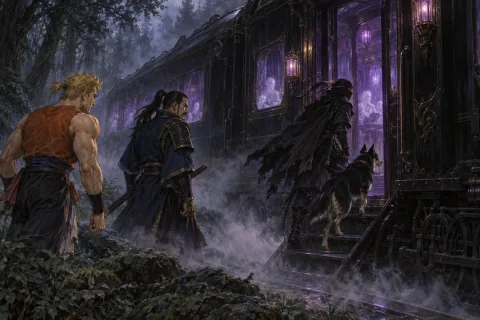
Sabin, Cyan, and the party, which may include Shadow depending on the player's choices, wander through the fog-filled forest and board a massive, stationary train. Only after the doors close and the train begins to move do they realize they have mistakenly boarded the train of the dead, a vessel the living should never enter. In this bizarre space with no known destination, the party is forced to move toward the front cars to survive.
While exploring the interior of the train, they reach the dining car and experience a strange moment of sitting down to eat and recovering their exhausted bodies. This scene of satisfying the hunger of the living in the middle of a space of death, where ghosts wander, awakens a sense that is both alien and mundane. To those who were just being chased by the Imperial army and hovering between life and death, this brief rest comes as a sensation that proves they are still alive.
This dining scene is not merely for creating a bizarre situation; it stands in stark contrast to the weight of the loss Cyan is experiencing. To him, who recently lost his homeland and family to poisoning, the very act of swallowing food and extending his life can be read as an act accompanied by heavy guilt. His inner self, where the fact of having survived becomes a source of pain, is silently shaken at this ordinary table.
The contradiction of having to maintain the warmth of the living in a space of the dead creates a subtle distance between the party members. Sabin tries to break through the situation with his characteristic energy, but Cyan's silence makes even that energy cautious. If Shadow is present, his thorough indifference seems to provide a space for Cyan to sink into his own sorrow. Each endures this strange journey in their own way.
The situation where ghosts buy and sell items, or sometimes a lost ghost helps the party in battle, blurs the line between enemy and ally. This irony, where they are chased by living enemies but receive favors from the dead, paradoxically reflects how cruelly broken the world of the living has become. Even while receiving help from ghosts, they must walk the train's corridors carrying the anxiety that the situation could turn at any moment.
The enclosed space of the train creates pressure that there is nowhere to run, but at the same time, it binds the party to rely on each other's presence. With the noise of the outside world blocked out and only the clattering of metal echoing, they focus on each other's breathing and footsteps. This becomes a quiet backdrop for those of different origins and purposes to slowly build bonds under the single goal of survival.
The passengers of the Phantom Train sit in silence, each harboring their own stories. Looking at their backs, Cyan might have been reminded of the people of Doma Castle whom he could not protect. The sight of those who have met their end peacefully heading toward their destination brings a deep sense of helplessness to him, who witnessed the final moments of those who lost their lives unjustly. The weight of the memories that the survivor must carry is deeply embedded in every car of the train.
The gazes of the ghosts encountered while passing through the narrow corridors of the train seem to constantly ask the party questions. Why are you still here? What are you trying to survive for? This unspoken question acts as a catalyst for Sabin to reaffirm his will to reunite with his brother, and for Cyan to reaffirm his desire for revenge against the Empire. As they brush past death, the purpose of the living becomes clearer.
The act of opening the door and moving forward after the brief rest in the dining car shows a silent resolve not to dwell in sorrow but to keep walking. The process of Cyan eating and then gripping his sword again is a painful choice not to give up on life despite the sense of loss from losing his family. The cold metal door they face after the mundane meal serves as a reminder of the harshness of the reality they must pass through.
This wrong boarding that began in the misty forest eventually becomes a mirror reflecting their inner selves. Their footsteps, trying to secure the time of the living while crossing the time of the dead, are precarious but firm. As they approach the train's engine, they prepare for a fierce struggle to escape not just the train, but the shadow of death that weighs them down. The sensation of being alive feels heavier than ever.
Chapter 2 · Defying the Path of Death While Alive
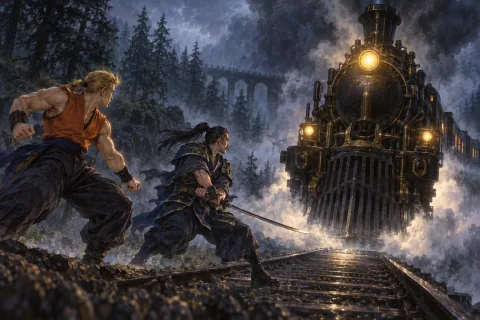
The party reaches the engine room, the front of the train, and operates the switch to stop it, but the train itself turns into a massive monster and attacks them. A fierce battle ensues between the Phantom Train, which intends to race to the afterlife with the living on board, and the party, which seeks to escape its tracks and return to life.
The battle with the Phantom Train unfolds in various ways depending on the player's choices. Some may use recovery items to instantly purify the undead train, while others may mobilize their respective skills and weapons for a long struggle. Regardless of the method chosen, this battle unfolds on the screen as a process of proving the will of a living, breathing human against a massive machine that carries death.
The direction of fighting face-to-face with the massive train visually conveys overwhelming fear and helplessness. The constantly billowing smoke and the sound of the whistle seem to warn that death is approaching without pause. The sight of the party standing against this massive lump of metal with their bare bodies symbolically shows the desperate resistance of humans who try to carve out their own path even in the face of an inescapable fate.
If Sabin fought by exceeding his physical limits to lift and slam the massive train, it provides a powerful visual pleasure where vitality overwhelms the weight of death. However, even without such dramatic techniques, the process of silently breaking the train's armor by swinging swords and throwing shuriken is sufficiently noble. What matters is the fact that they each put the brakes on the race of death in their own way.
For Cyan, this battle holds special significance. The act of directly striking the medium of death that might have taken his family can be read as a process of expressing his anger over the loss he suffered. In his appearance as he grips his sword and faces the train, there is a desperate will not to let his precious ones be taken away helplessly anymore. His blade is directed not just at an enemy, but at death itself.
The strange status-effect attacks emitted by the Phantom Train erode the party's mind and body, throwing the battle into chaos. This metaphorically shows how the world of death encroaches upon and collapses the living. The process of recovering and protecting each other to endure this chaos quietly proves that survival can never be achieved by individual strength alone and is completed through connection with others.
If Shadow is participating in this battle, his presence highlights the cool attitude of a mercenary standing on the boundary between life and death. His appearance, performing his mission without agitation even in front of the train of death, shows the dry survival method of one who has erased fear. This contrasts with the emotionally turbulent Cyan or Sabin, creating an effect that captures the various attitudes of humans toward death within a single screen.
The moment the train's engine slowly stops and the sound of metal fades, the silence lingering on the screen signals the end of the fierce struggle for survival. This space, where the massive machine has surrendered and only the breath of the living remains, brings deep fatigue along with the relief of having barely escaped the orbit of death. This victory is desperate rather than glorious, reminding them that the fact of having survived is the greatest reward.
It is the party's physical strength that stopped the Phantom Train, but behind it lie their own desperate reasons for needing to return to the world of the living. The mission to stand against the Empire and the purpose of finding a lost brother sustained their steps. Having returned from the threshold of death, they are ready to face the harsh reality awaiting them, based on a bond that has become firmer than before.
When the train came to a complete stop and the path to the outside opened, they finally gained the chance to escape the space of death. However, getting off the train means more than just escaping a crisis; it means saying goodbye forever to those left behind in the world of the dead. Behind the joy of survival awaits an irreversible severance, which is the prelude to the heartbreaking scene that follows.
Chapter 3 · Words Left for the Family Who Cannot Get Off
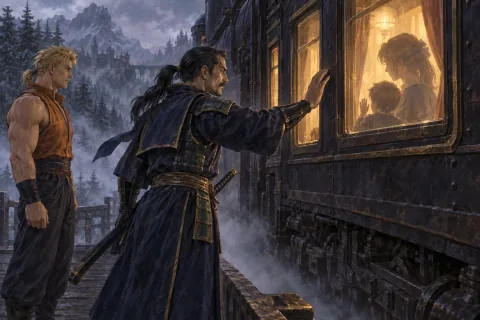
The party, having safely disembarked from the Phantom Train, watches as the train prepares to depart again. At that moment, Cyan sees his wife and son, who lost their lives at Doma Castle just moments ago, walking toward the train. Cyan rushes toward them, calling out, but there is no way to return his family, who have already boarded the orbit of the dead, to the world of the living. The train slowly pulls away, and he stops, confirming the distance he cannot bridge.
His wife and son bid their final farewell to Cyan from the departing train. Their lip movements and gestures fill the screen without sound, indirectly conveying the share that the survivor must carry and their unchanging affection for him. Listening to their final wishes, Cyan faces a cruel and sad moment where he must suppress the lingering attachment he wanted to hold onto and fully accept the death of his family.
This farewell scene visually nails down how irreversible the loss Cyan suffered is. Having lost his family to the sudden disaster of poisoning, he had to flee without even sharing a proper goodbye. The reunion on the Phantom Train gave him the chance to say his final farewell, but at the same time, it is a painful ritual that makes him confirm with his own eyes that his family has crossed a river from which they can never return.
Cyan's footsteps, running toward the direction the train is moving away and then stopping, make him realize the invisible wall between the living and the dead. No matter how excellent his swordsmanship, no matter how strong his will, he is helpless before the providence of death. The spot where he stops becomes the cold boundary line of reality that the survivor must no longer chase after the dead.
The final words left by his family send deep ripples through Cyan's inner self. To him, who was lost in sorrow and blaming himself, his family's peaceful greeting gives him a reason to keep living. It is the moment when a new direction sprouts in his heart, which had been sustained only by revenge: to live the rest of his life as the person his family wished him to be. This unspoken conversation does not alleviate his despair, but it gives him the strength to endure.
The direction where Sabin, and Shadow if he is still accompanying them, remain silent by Cyan's side at this moment leaves a deep lingering impression. The attitude of his companions, who do not offer hasty words of comfort or pity but simply watch over his sorrow, is a mature consideration that acknowledges they cannot fully understand another's pain. In this silence, Cyan has his own time of mourning, and his companions show solidarity by silently waiting until he stands up on his own.
The whistle of the departing Phantom Train sounds like a signal that announces the end of sorrow while simultaneously signaling a new beginning. The empty tracks and silence left behind after the train completely disappears from view represent the massive void opened in Cyan's heart. However, that void is no longer a vague despair, but has transformed into a solid space to carry the memories of his family. The process of confirming the loss paradoxically helps him stand up again.
Cyan's movement of lifting his head and turning toward his companions after letting his family go means that he, who had been tied to the past, has finally turned his gaze to the present. His heart may still ache as if it were tearing, but he no longer looks at the train of the dead. His footsteps as he returns to the side of the living are heavier and more serious than before, and his blade toward the Empire carries a resolve that goes beyond simple anger.
This tragic reunion and farewell also cause deep emotional agitation for the player. This is because it makes them vividly witness how the death of a character in the game is not just a tool for the narrative, but how it shakes and changes the life of the one left behind. The player, who has joined in Cyan's sorrow and watched the process of mourning he undergoes, sincerely understands the weight behind all his subsequent choices and actions.
The journey on the Phantom Train, which began in the misty forest, thus ends with the most painful farewell. The train of death they mistakenly boarded tested the party's will to survive and forced upon Cyan a time of unavoidable mourning. Now, they must leave the orbit of the dead behind and take steps again toward the cruel world where the living are entangled. The time that had stopped begins to flow again, and the journey of those left behind continues.
Scope of Materials and Interpretation
The main story flow of the Super Famicom original and the Pixel Remaster is used as the standard. Differences in survival, companion recruitment, and endings based on choices are distinguished in the relevant scenes, and the additional dungeons in the GBA version are explained as separate edition elements. Unstated inner thoughts of characters are interpretations based on the context of events, and the identities of unknown figures are not asserted as facts. Material verification date: October 15, 2026 (Bangkok time).
Square Enix · FINAL FANTASY VI Official Introduction and Characters
comments 0