
Recommended Game Story · FINAL FANTASY VI Part 15
Chapters in this story
The Face of the Emperor Leo Trusted
Spoiler Notice: This series covers the major events and the ending of FINAL FANTASY VI. If you are new to the game, you may wish to read only up to your desired chapter and experience the choices and music firsthand. This text includes both descriptions of events and interpretations of the characters' inner thoughts; it is not a translation of the original dialogue or an official novel. The illustrations are AI reconstructions based on public materials.
The fleeting peace that blossomed in the village of Thamasa is cruelly trampled by the Empire's greed. The hope that Espers and humans might understand one another is betrayed in the most brutal fashion, and the world enters a trajectory of irreversible ruin. This chapter demonstrates how helplessly goodwill and dialogue collapse in the face of violence, shaking the very foundations of the beliefs the characters have held dear. In the midst of this immense despair, those left behind are no longer heroes saving the world, but survivors forced to endure loss.
Chapter 1 · Weapons Descend upon the Square of Reconciliation
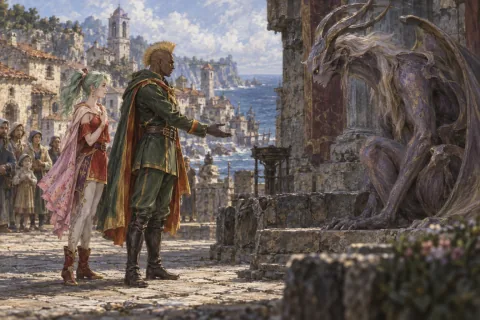
The Espers gathered in Thamasa and General Leo reach a precarious agreement to end their long-standing hostility and seek peaceful coexistence. Thanks to the dedicated mediation of Terra and her companions, both sides lay down their weapons and cautiously attempt to verify each other's sincerity. A hopeful atmosphere, suggesting that the conflict between the Empire and the Espers might finally be coming to an end, fills the square, and the characters look forward to a new era.
However, this brief peace is shattered when Kefka appears in a surprise attack, leading the Guardian weapon. He mercilessly slaughters the Espers who had come to talk while defenseless, forcibly crystallizing their lives into Magicite. The square of reconciliation, once a promise of peace, instantly transforms into a scene of horrific slaughter and plunder, and the party is left helpless, forced to watch the tragedy unfold before overwhelming violence.
The tragedy of Thamasa is all the more painful because it occurred at the very moment when the possibility of mutual understanding was beginning to bloom. This surprise attack, targeting the moment when Espers—who had long hidden away in distrust of humans—finally opened their hearts to come to the table, is the most malicious way to mock the very act of trusting someone. Violence inflicted when hope is at its peak leaves behind scars of profound despair.
The Espers lowering their defenses and emerging into the world was a response to the sincerity shown by the party. Their disarmament was an expression of a desperate yearning for peace, but the Empire exploited this as their most vulnerable weakness. This demonstrates how easily the defenselessness of those with good intentions can be violated by those with malice, revealing the fatal limitations of peaceful negotiation in this world.
The process by which Kefka converts Espers into Magicite vividly illustrates the Empire's inhumanity, treating living beings solely as tools of power. The will and emotions of living, breathing entities are thoroughly erased, leaving only their utility as magical energy. This can be read as a chilling depiction that accuses power, which cannot fully empathize with the suffering of others, of reducing the world to a mere warehouse of material resources.
From this event onward, the belief that conflicts can be resolved through dialogue and compromise within the game completely collapses. The optimism the party had harbored is scattered before Kefka's maniacal laughter, and all that remains is a primal struggle for survival where force clashes with force. The efforts of Terra and her companions, who acted as mediators for peace, prove futile, and they fall into an uncontrollable sense of helplessness.
The situation where the party is forced to remain incapacitated while the slaughter is carried out delivers a powerful sense of powerlessness to the player as well. The fact that the strength of the protagonists, who have led countless battles to victory, is of no use against such immense evil makes the atmosphere of the narrative drastically heavier. It forces a painful realization of the weight of massive violence that can never be stopped by individual heroic feats alone.
Originally, Magicite was a symbol of a noble legacy, where an Esper who met their end voluntarily passed on their power and will to the next generation. However, the Magicite forcibly extracted by Kefka is a result where its original meaning is horribly twisted. The process by which an object that once symbolized voluntary sacrifice and solidarity is transformed into a trophy of greed, obtained by exploiting the lives of others, suggests that the values of this world have been corrupted.
If one blames the act of trusting the other party as a failure, the responsibility of the one who broke the promise and attacked is obscured. The Espers' choice to come out to talk held the intent to find a possibility of living differently, and Kefka abused that possibility. Thus, this event asks us to consider who is responsible for the violence that breaks trust, rather than teaching that trust itself was foolish. Since the characters must continue to meet others, they cannot move past this betrayal by simply severing all relationships.
The blood-stained square of Thamasa remains a tragic monument, signaling the end of an era of pure hope and the beginning of an age of deep darkness. The scattered fragments of Magicite are like the debris of a peace that has become a vain dream. Carrying this horrific failure in their hearts, the party is placed in a position where they must take desperate steps not to save the world with grand goals, but to delay the ruin that is immediately before them.
Chapter 2 · Refusing Orders in the Name of Loyalty
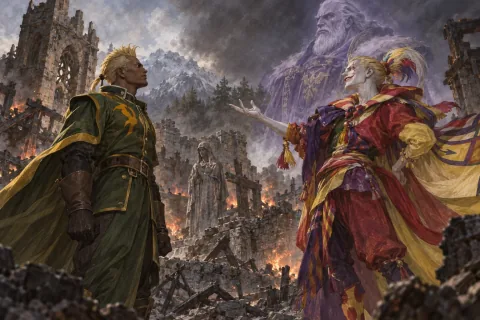
General Leo finally draws his sword to stop Kefka's brutal slaughter and clashes with him head-on. His sincere efforts to protect peace have come to naught, and he now engages in a desperate battle against runaway madness, acting as a rational human being beyond his status as an Imperial general. The player briefly takes his perspective to fiercely attack Kefka, but tragedy awaits at the end of this fight.
At the climax of the battle, Kefka cunningly creates an illusion of Emperor Gestahl to completely seal Leo's movements, and takes advantage of that opening to murder him mercilessly. Before the face of the master to whom he had devoted his entire life, Leo momentarily loses his will to resist and falls. With his tragic death, the last hope of the party, who had expected a rational self-cleansing process within the Empire, completely vanishes onto the cold floor.
Leo's rebellion can be seen not as a sudden change of heart, but as the result of a soldier's conscience, long suppressed, finally reaching its breaking point and erupting. He had obeyed orders while condoning the tragedies brought about by the Empire's expansion, but he could no longer close his eyes to the indiscriminate slaughter that took place in Thamasa. This shows the painful process of an individual who had conformed to a system witnessing moral bankruptcy and awakening.
It is difficult to read Leo solely as a hero without any responsibility. He served that system as a general of the Empire, and the fact that he personally cherished his subordinates does not erase the violence committed by the organization. However, one cannot declare his murder by Kefka as a deserved punishment or karmic retribution. What is important is to think together about what a person in a position of responsibility refused at a certain moment, and why that refusal was too late and too weak. Mourning and criticism do not erase each other.
Kefka's use of the Emperor's illusion is an act that most viciously mocks and tramples upon loyalty, the core value that defines Leo as a person. To Leo, the Emperor was likely an object of belief to whom he had dedicated his life, beyond being a mere superior. Kefka appeared wearing the shell of that belief and collapsed Leo's inner self; in effect, he destroyed him with a mental violence far deeper and more fatal than a physical blow.
Leo's hesitation before the Emperor's illusion embodies the tragic dilemma of a human being torn between the sense of belonging to which they have dedicated their life and their fundamental individual morality. He had to draw his sword even while knowing that disobeying orders meant denying the value of his own existence. That momentary hesitation proves how deep an internal conflict he was experiencing, showing that his choice did not stem from lighthearted heroism.
Even if the player controls Leo in battle to overwhelmingly corner Kefka, they cannot prevent his narratively scheduled death. This direction coldly declares that individual superior martial prowess or good intentions alone cannot overcome the betrayal of a system that has already become massively corrupt. No matter how strong a general may be, the fact that they are merely a helpless individual before the massive gears of power that has lost its morality hits home painfully.
Leo's death completely shatters any lingering illusion that the Empire could change in an honorable and rational way. If he had lived, he might have rallied the moderates within the Empire to seek a peaceful solution, but his absence means that the room for compromise in the relationship with the Empire has disappeared forever. This leaves the party with the heavy task that there is nowhere left to retreat, and that they must destroy the system itself.
Nevertheless, the moral courage Leo showed lies in his firm decision to finally say 'no' to an unjust order, knowing he would lose everything. The moment he realized the world he had believed in his whole life was a lie, he did not run away or compromise, but threw his life away to create a rupture in that lie. Even though his attempt ended in failure, his final appearance, having broken the chains of blind obedience himself, leaves a deep resonance.
The fact that his resistance did not save the Espers remains painful for the party left behind. What one can recall before his grave is not just the life of a perfect hero, but the contradiction of a person who tried to respect the other side while belonging to the Empire. There is no need to cover up the Empire's responsibility because we remember him, nor is there a need to treat his loss lightly because we demand that responsibility. There is power in Leo's brief appearance that allows us to endure these two emotions together. The gentle voice Terra encountered has vanished, but the memory that it existed does not.
Chapter 3 · Those Who Grasp the Magicite Lift the Heavens
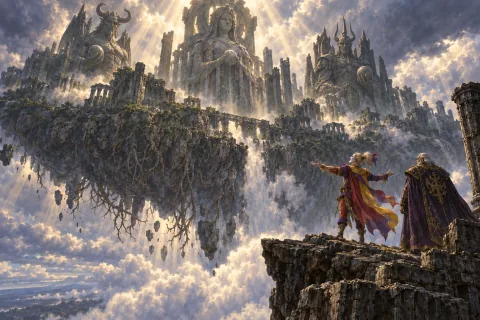
Additional Espers that appear are also defeated by Kefka, and Gestahl and Kefka approach the power of the Warring Triad beyond the Sealed Gate. Subsequently, a change occurs where the massive land rises into the sky. Here, it is not yet the stage to explain the aftermath of the World of Ruin. What the party faces is a greater threat that follows immediately from the failure of the peace negotiations, and a situation where they must rethink where to go next as the very shape of the land changes.
The wounded Interceptor returning to Thamasa makes one guess that something has happened to Shadow as well. However, the fact that the dog appeared alone does not confirm Shadow's death. Because of the blank spaces in information left by the screen, the companions and the reader are left to worry about where he is. Reading this as a finished farewell makes the meaning of the next meeting disappear. An attitude that does not rush to conclude an absence is necessary to understand the uncertainty that those left at this point must endure.
Just because someone is not in front of you does not mean the relationship with that person ends immediately. Interceptor cannot explain the situation through speech, and the party does not know all of Shadow's thoughts. Between those points, worry lingers longer than certainty. The fact that a mercenary who always kept his distance becomes the object of such worry allows us to read that he did not remain merely as one of the personnel who fought together. The way of remembering someone whose circumstances are not yet explained can also be a part of companionship.
The place where Leo was buried and the traces of the vanished Espers leave too many losses for the party in too short a time. The game does not stop the movement of the world until they have sufficiently mourned and sorted out their feelings. The scene of looking at the land rising into the sky is heavy not only because the scale of the threat is large. It is because different demands overlap: having to find a direction to act again while thinking of those just lost.
The Empire's move to get their hands on the power of the Warring Triad raises the question that obtaining magical power and being able to handle it are different things. The method of forcibly taking the power of Espers is repeated for even greater power. However, the fact that power has grown does not make judgment more accurate. Power that does not ask who uses it for what purpose, or whose life is endangered if it goes out of control, easily calculates what it has gained only as victory.
The massive land that has risen into the sky makes the danger of that calculation visible. On the familiar world map, land was generally the basis for movement, but now the land itself moves, making the next action difficult. While the reader is amazed by the spectacular miracle, it is difficult to accept it as mere wonder. This is because they know who was sacrificed to reach that scene. It is a moment where a beautiful screen and an anxious context act together.
Just because Gestahl and Kefka are moving toward the same power does not mean one can conclude that the two harbor the same purpose. The Emperor has coveted magical power as a means of domination, and Kefka has already trampled on promises and lives recklessly. If one remembers this difference, another anxiety arises from the sight of the two approaching great power. It is the possibility that there may be uncontrollable gaps even within power that appears to be cooperating.
For Terra, too, the failure in Thamasa makes the question of living between humans and Espers even more difficult. The attempt to make them understand each other was blocked by violence, but that does not leave only the conclusion that understanding itself was impossible. The fact that Leo and the Espers were actually together at the table of dialogue still remains. If one blames the cause of that possibility being broken on Terra's lack of ability or her birth, one fails to properly see the Empire's choice to betray the promise.
The reason the party must act in the future is read not because they have immediately overcome the loss, but because there is work to be done so that they do not lose more. There is no need to use someone's death as material for growth or to turn all sorrow into fighting spirit. It is possible to choose to notice danger and help others even without one's heart being settled. The weight of the steps toward the next path comes from the fact that those unprepared emotions have not disappeared.
This chapter stops before the rising land without prematurely concluding Shadow's end or Celes's subsequent life. What the reader must carry is the anxiety about great power, the sorrow of losing Leo and the Espers, and the question of whether they will be able to meet Shadow again. Now, the action of boarding the airship and approaching that threat becomes necessary. The tension of the next chapter becomes clearer when these blank spaces are left behind. The stories of people that have not yet ended wait above the sky.
Scope of Materials and Interpretation
The main narrative flow of the Super Famicom original and the Pixel Remaster was used as the standard. Differences in survival, joining of companions, and endings based on choices are distinguished in the relevant scenes, and the GBA version's additional dungeons are explained as separate edition elements. The unstated inner thoughts of characters are interpretations based on the context of the events, and the identity of the unknown 'Gogo' and similar elements are not asserted as facts. Material verification date: October 15, 2026 (Bangkok time).
Square Enix · FINAL FANTASY VI Official Introduction and Characters
Thonky · Reference for the Espers gathering place event progression
Thonky · Reference for the floating continent event progression
comments 0