
Recommended Game Story · FINAL FANTASY VI Part 11
Chapters in this story
Living Weapons Created by Vector
Spoiler Notice: This series covers the major events and the ending of Final Fantasy VI. Those who are new to the game may wish to read only up to a certain point and experience the choices and music for themselves. The text includes both descriptions of events and interpretations of the characters' inner thoughts; it is not a translation of original game dialogue or an official novel. Illustrations are AI reconstructions based on public materials.
The process of infiltrating the imperial capital, Vector, is more than a simple raid on enemy lines; it is a journey to confront the dark origins of the power that sustains this world. Here, where research facilities and Magitek factories are located, the party witnesses how magic is industrialized and how life is reduced to mere resources. At the same time, in the heart of these cold machine rooms, the fragile trust between the characters is put to the test. This episode poses a heavy question about how profound the ripples of individual doubt and choice can be within a system of massive violence.
Chapter 1 · Espers Beneath the Machine Room
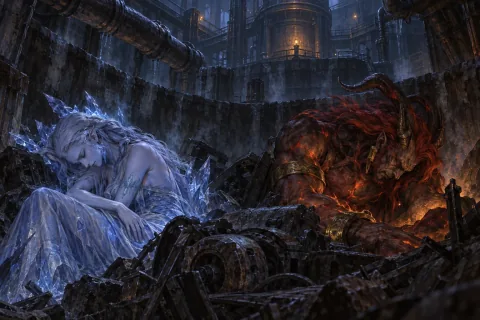
With the help of an imperial sympathizer, the party succeeds in infiltrating Vector, the heart of the enemy. Having breached the tight security and reached deep into the underground Magitek factory, they are confronted with a shocking sight. They witness Kefka forcibly extracting the power from the captured Espers, Ifrit and Shiva, and then, when no more energy can be drawn, discarding them onto a conveyor belt like broken machine parts.
This massive underground factory is the true heart of the overwhelming military power the Empire boasts. Here, the mysterious power of magic is forcibly extracted through a strictly engineering and mechanical process, converted into fuel that powers the Empire's Magitek Armor and various weapons. This scene, where the unknown energy of magic is reduced to a standardized industrial power source, clearly shows what the Empire's prosperity is built upon.
The Empire's flashy economy and formidable military power rely entirely on the ruthless exploitation occurring in this unseen underground. It is a cruel system that treats living, feeling, sentient beings as consumable resources concerned only with efficiency. By completely erasing the dignity of living creatures and wringing out their energy, the Empire maintains its mechanized superiority and gains the power to control the world.
The horrific suffering experienced by the Espers is conveyed even more chillingly through the cold, mechanical way they are processed, rather than through cruel torture devices or bloody, violent depictions. The sight of the Espers, drained of all energy, being indifferently tossed onto a cold steel conveyor belt, speaks volumes about how the Empire views the lives of others. This quiet process, where even screams are not permitted, proves how normalized violence has become.
Kefka's casual cruelty in this space serves to maximize the banality of evil. He does not torment the Espers out of grand malice or deep rage; he treats life with the annoyed attitude of a factory manager disposing of defective products. This complete lack of empathy for the suffering of others, combined with the dry, mechanical noise of the factory, makes the tragedy of the situation feel deeper and more chilling.
For the party, witnessing the industrialization of magic firsthand brings deep confusion and shock. Especially for those who have regarded magic only as a fearsome power or a mystical talent, the sight of that immense force being forcibly squeezed out between pipes and gears signifies the collapse of their existing worldview. The sight of mythical beings reduced to mere consumables warns of the endless depths of the Empire's greed and makes the party's hostility even more pronounced.
Meeting Ifrit and Shiva in what has become a dumping ground allows one to guess at the tragic time of endurance the Espers have suffered. Their profound exhaustion and extremely weakened state silently testify to how long the silent suffering has continued in order to build and maintain the Empire's glorious capital. This encounter becomes more than a simple boss battle; it is a heavy moment of facing the scars of the victims of a massive system of violence.
As they come to understand the miserable plight of the Espers, the party realizes the true cost demanded by this war. Their fight is no longer just a resistance struggle to defend territory or achieve political independence. A fundamental justification is granted—that the destructive system itself, which grinds up living souls to produce power, must be stopped—leading the party's steps with a more desperate and heavy sense of responsibility.
Depending on whom you have joined in this dangerous infiltration, excluding the mandatory Locke and Celes, the emotional texture of accepting this horrific scene may vary slightly. A responsible king or a martial artist might foresee the catastrophe that the Empire's unethical strategy will bring, while a boy raised in the wild might feel a more instinctive repulsion to the smell of the iron that suppresses life. This is the subtle influence of the player's choices on the narrative.
Ultimately, this underground factory acts as a space that ruthlessly shatters the illusions of greatness and civilizational progress that the Empire puts forward. The party clearly confirms that the enemy's overwhelming strength does not stem from superior innovation or wisdom, but is the result of parasitic exploitation that constantly gnaws at the world's ancient life force. Amidst the factory's smog and mechanical sounds, they have seen the Empire's ugliest face, and this leaves an indelible mark on their future journey.
Chapter 2 · Suspicion Returns to Celes
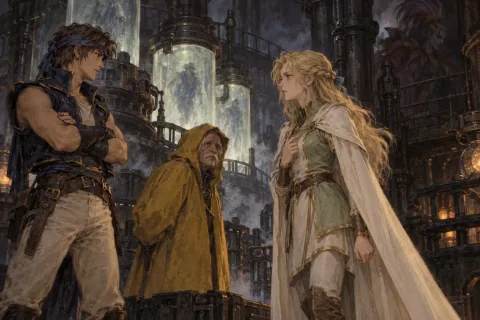
A tragic fact is revealed: when Espers die, they leave behind Magicite, a crystal in which their power is condensed. Cid, the Empire's chief researcher, realizes that this Magicite holds a far greater and purer power than the mechanical extraction method he devised. Paradoxically, this beautiful stone left at the end of life becomes the source of the most powerful weapon the Empire covets, revealing the cruel underside of the secrets of magic.
In the chaotic situation where this major discovery is made, Kefka appears and begins to cleverly exploit the rumors that Celes is a double agent for the Empire. As Locke momentarily wavers and cannot let go of his suspicion, Celes uses her magic to forcibly separate Kefka and the Imperial army from the party and disappears with them. Her sudden disappearance leaves the party in deep shock and serves as an occasion that clearly shows the vulnerability of their relationships.
The existence of Magicite heavily symbolizes the weight of the ultimate sacrifice the Espers had to pay. The moment Cid realizes the potential of Magicite is chilling, as it means the value of an Esper has shifted entirely from living vitality to a crystal left behind after death. The fact that even the last traces of life can be thoroughly instrumentalized and weaponized deepens the tragedy, weighing heavily on the cold air of the Magitek factory.
The psychological warfare Kefka employs is designed to be very precise and vicious. Instead of physically attacking the party's bodies, he strikes precisely at the bonds of solidarity that held them together. He saw accurately that in the extreme tension of the enemy's heart, firm belief in one another was their most fragile weakness. The distrust of suspicion spreads like poison, paralyzing the party's judgment in an instant.
The brief hesitation Locke shows at this moment becomes a decisive turning point that determines the direction of their relationship. It is difficult to view his failure to immediately defend Celes as mere malice or betrayal. It can be read that, with the complex overlap of unconscious defense mechanisms stemming from past wounds and the pressure exerted by the massive enemy that is the Empire, he failed to summon the inner courage to fully trust the other person at the most critical moment.
The weight of that short silence presses down on Celes's heart more heavily than any sharp words of condemnation. The distrust revealed by not actively defending her shatters the bond between the two. This profound sense of isolation, which she must experience when she returns to the space of her past as an Imperial general, is a moment that painfully proves how precarious the hope and sense of belonging she had placed in her new companions were.
Ultimately, the extreme choice Celes makes to disappear with Kefka is the most desperate way to prove her innocence. Realizing that words can no longer restore the broken trust, she can be seen as choosing to sacrifice herself to protect those who doubt her from immediate, lethal threats. It is a very sad and lonely way of proving her sincerity through action alone, rather than through pathetic excuses.
The empty space she left behind forces the remaining party members to face their own prejudices and weaknesses head-on. More painful than the fact that they lost a precious companion in the middle of enemy territory is the point that the loss stemmed not from an external attack, but from shallow internal suspicion. This event teaches them painfully that trust is not something given for granted, but a firm will that must be held onto until the end, even in darkness where one cannot see an inch ahead.
One should not conclude here that Celes's disappearance is clear evidence that she betrayed the party. Rather, it is a tragic result caused by a fractured relationship, and an escape and final shield she had no choice but to select in a desperate situation where truth could no longer exert power. It is a very bitter and realistic portrayal of how misunderstanding and distrust can drive a person to the edge of a cliff and lead them to isolate themselves.
Now, the party must move forward, carrying the heavy Magicite containing the souls of the Espers, along with the sediment of distrust they created themselves. The physical escape process from the factory overlaps with their psychological struggle to break free from the seeds of suspicion and division planted by the Empire. The price of lost trust is never light, and how to suture this wound remains the heaviest homework left for them throughout the arduous journey ahead.
Chapter 3 · The Path Out of the Collapsing Factory
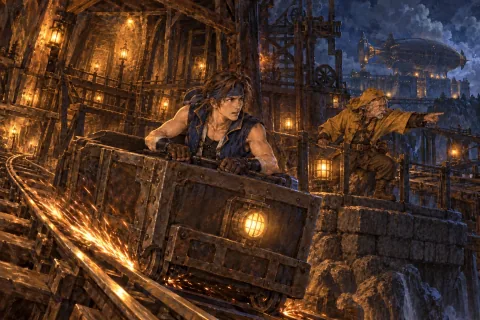
In the urgent situation where the interior of the Magitek factory becomes unstable and begins to collapse, Cid actively helps them escape by guiding the remaining party members to the mine carts. After racing through the perilous tracks and escaping, the party calls for Setzer's airship and waits for a dramatic rescue. During this escape, a fierce battle ensues against the Empire's massive mechanical cranes attempting to snatch the airship, and the tension of being chased reaches its peak.
Cid's act of risking danger to help the party escape suggests a major change in his affiliation and beliefs. Having learned the true origin of the Magicite and witnessing with his own eyes what horrific results the research he had dedicated his life to had produced, he finally turns against the Empire's blind expansionism. This can be seen as the belated reflection of an old scholar who realized what terrible monsters are born when the pursuit of knowledge loses its ethics.
Deep remorse and indelible guilt lie at the base of his sudden actions. The moment he faces the Magicite in which the souls of the Espers have solidified, Cid can no longer deny that his pure scientific curiosity has resulted in bloody fuel that runs a massive war machine. His urgent hand guiding the party to the carts is a very desperate and sad gesture to try to make up, even a little, for the terrible errors he has committed.
However, just because Cid helped the party escape does not mean the sins of the cruel experiments he committed in the past are immediately absolved. The game makes one look at his momentary realization and the long time of suffering that countless Espers had to endure because of it as clearly separate things. The narrative maintains very coldly that a belated reflection is only the beginning of a new choice and cannot be a complete atonement for the lives already destroyed.
The sequence of racing through the darkness in a mine cart that has fallen into an uncontrollable state symbolically shows the collapse of the perfect control the Empire boasted. The process of a massive factory that orderly exploited life transforming in an instant into a maze of death that threatens the party's lives is an excellent piece of direction that visually and with a sense of speed conveys how easily power built upon the sacrifice of others can crumble.
While frantically escaping through the dark tunnels, the absence of the vanished Celes sits as heavily as a stone in a corner of the party's hearts. This tense escape, which does not allow even the minimum leeway to look back or go out to find her, cruelly snatches away even the opportunity to mend the broken trust. As the speed of the cart increases, the sense of loss and helplessness the party feels paradoxically deepens, evoking regret.
The moment Setzer's airship arrives, breaking through the oppressive underground air, signifies liberation from suffocating claustrophobia. The open sky symbolizes the freedom the party craves, but the Empire's mechanical cranes reaching out toward the airship warn that that freedom is not yet complete. The Empire's reach extends persistently even above the sky, and their greed is like a massive shadow that cannot be easily shaken off.
The battle with the cranes taking place on the airship deck can be read as a clash between two different mechanical civilizations. The Empire's violent mechanical devices that ensnare and wring out life, and Setzer's airship that rides the wind toward adventure and romance, collide head-on. This fight is more than just physical resistance to survive; it is a symbolic struggle over what kind of technology and life the world should choose.
Escaping Vector alive may be a victory in tactical terms, but emotionally, it is close to a painful defeat. The party succeeded in unearthing the Empire's ugly secrets and obtaining valuable Magicite, but they succumbed to the spread of distrust and suspicion they had intended to fight against, losing a precious companion. Behind the relief of having escaped safely, a bitter and self-reproachful feeling that can never be washed away is bound to be deeply layered.
Now, the party flying away, leaving the continent behind, carries a weight completely different from before. In their arms, they hold the solidified souls of the Espers, and deep in their hearts, regret for the trust they failed to protect is deeply engraved. They head to the next journey with the heavy lesson that to bring down the Empire, more than just obtaining physically stronger power, they need the inner firmness to fully trust one another even in the darkness.
Scope of Materials and Interpretation
The main story flow of the Super Famicom original and the Pixel Remaster was used as the standard. Differences in survival, companion recruitment, and endings based on choices are distinguished in the relevant scenes, and the GBA version's additional dungeons are explained as separate edition elements. Unspecified inner thoughts of characters are interpretations based on the context of events, and the identity of unknown figures is not asserted as fact. Data verification date: October 15, 2026 (Bangkok time).
Square Enix · FINAL FANTASY VI Official Introduction and Characters
comments 0