
Recommended Game Story · FINAL FANTASY VI Part 4
Chapters in this story
Another Name Rescued from the Prison
Spoiler Notice: This series covers the major events and the ending of Final Fantasy VI. If you are a first-time player, you may wish to read only up to the desired chapter and experience the choices and music yourself. This text contains both descriptions of events and interpretations of the characters' inner thoughts; it is not a translation of original game dialogue or an official novel. The illustrations are AI reconstructions based on public materials.
Locke, a member of the Returners who was separated at the Lete River, infiltrates South Figaro, which is occupied by the Imperial army. This chapter depicts the exploration of the underside of a city under oppressive control and the process of discovering an unexpected ally in the heart of the enemy. It is a significant turning point that shows how the foundation of a new relationship is built not through grand ideologies or romantic salvation, but through practical choices for survival and mutual protection.
Chapter 1 · Borrowing the Clothes of an Occupied City
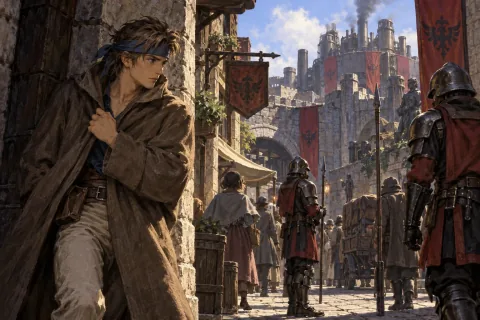
Locke carefully moves through the streets of South Figaro, now controlled by the Empire, after stealing the clothes of a merchant and a low-ranking soldier. The once-vibrant trading city is now wrapped in heavy silence and tension under the surveillance of Magitek Armor and armed soldiers. The player must constantly disguise their identity to deceive the enemy, directly feeling the oppressive atmosphere of the occupied territory. While it appears calm on the surface, fear lies beneath.
The residents of the city are complying with Imperial control in various ways. Their cooperation can be read not as stemming from inherent malice, but as the result of immense pressure applied to maintain their daily lives and survive. It is a bitter landscape showing how the lives of ordinary people are forced to compromise in the face of overwhelming violence. The game dryly reflects the process by which daily routines are damaged by fear, rather than simply criticizing those who have succumbed to power.
Locke's disguise technique goes beyond a simple infiltration puzzle, symbolizing a method of resistance that involves seeping into the oppressive system to disrupt it. The act of wearing the enemy's uniform and speaking their language temporarily blurs the boundary between the occupier and the occupied. In this process, the player is placed in a state of tension, constantly having to judge whom to trust and whom to avoid, and has the strange experience of viewing the city through the eyes of the enemy.
Unlike the controlled surface, another space exists beneath the city, connected by codes and secret passages. The hidden basement of a wealthy mansion visually embodies the secret potential for resistance that the city harbors, contrasting with the compliance shown on the surface. Even amidst oppression, people try to carve out their own spaces to breathe and keep secrets. Locke's exploration of these dark passages is akin to the process of approaching truths that are not visible on the surface.
To explore these hidden spaces, one must observe the minute cracks in the Imperial army's control network. No matter how thoroughly a city is monitored, blind spots created by human habits and carelessness are bound to exist. Locke digs into those gaps, moving his steps into the depths where the Empire's gaze cannot reach, uncovering the underside of the occupied territory. This acts as a device that implicitly reveals the fact that even immense power cannot be perfect.
The act of stealing merchant or soldier clothes to open paths forces the player to interact directly with the presence of the enemy. Beyond simply obtaining items, it mechanically allows the player to experience the desperate situation of avoiding crisis by borrowing another's identity. It reflects the reality of wartime where improvisation is prioritized over moral solemnity for the sake of survival. Every time Locke changes clothes, his role shifts, demanding flexibility according to the situation.
The place reached after passing through the deep basement of the mansion is a prison secretly operated by the Imperial army. The transition from the civilian zone, maintained by compromise and compliance, to a space where the Empire's violence and punishment are explicitly executed, sharply reverses the atmosphere. This is a space of cold reality that shows what price those who do not agree with the Empire's methods pay. The existence of the hidden prison confirms once again how deceptive the city's tranquility is.
The structure of the secret prison is designed strictly for isolation and surveillance. The passages hidden behind walls and the firmly closed iron bars maximize the helplessness of the imprisoned, reflecting the Empire's intention to block the hope of rescue. The process of Locke navigating this labyrinthine prison becomes the first small but meaningful step of resistance that cracks the oppressive system. The act of finding one's way in the dark itself comes across as a quiet struggle against the Empire's control.
The infiltration, moving to avoid the gaze of the Imperial army, shows Locke's abilities in a way different from the scale of brute force. It is not only those who can defeat every soldier in a head-on fight who participate in the resistance. The process of changing costumes, obtaining information, and finding passages requires a sense for reading the situation. The experience of the player learning the rules of a strange city becomes an opportunity to directly understand Locke's agility. This is read as the background that makes it difficult to judge a person solely by the clothes they wear when meeting strangers later.
In the deepest cell, Locke finally discovers a figure bound in chains. This encounter is not merely the completion of a mission to free a prisoner, but signifies the emergence of a new variable that will have a profound impact on the journey ahead. This connection, starting at the darkest bottom of the occupied city, implies that seeds of unpredictable change can sprout even within the Empire's solid control network. The encounter between the two is ready to completely alter their respective trajectories.
Chapter 2 · The Day the Emperor's General Refused Orders

The person trapped in the prison awaiting punishment is Celes, a former Imperial general and a Rune Knight who has been artificially infused with magic. She is branded a traitor and left in chains for rebelling against the Empire's cruel methods. Once functioning as a powerful weapon of the Empire, she is now in a position of being oppressed by that very power. Her fall shows how mercilessly the Empire discards tools that do not fit their purposes.
Celes's imprisonment, beyond simple punishment for disobedience, suggests that she harbored moral questions about the Empire's inhumane behavior. Despite being given artificial power and raised as a thorough soldier, uncontrolled judgment still remained within her. Because of this choice, she is left in a state of isolation, having lost all status and honor. The Empire only wanted her abilities; they never tolerated her independent thinking.
Locke attempts to free her without hesitation, but Celes's reaction is extremely defensive. She does not blindly believe the words of a stranger who says he came to save her, and instead views the situation with suspicious eyes. The setup of a savior appearing suddenly in the middle of enemy territory is merely an unrealistic and dangerous variable to a former general who has seen it all. Her wariness stems from the survival instincts she acquired through her long military life.
This distrust is perfectly rational given her background. As someone deeply involved in the Empire's military operations and deception tactics, it is a natural habit for Celes to first suspect the intentions hidden behind others' kindness. To her, Locke's actions have plenty of room to be interpreted as another trap or an approach with political motives rather than pure goodwill. Trust cannot be gained with a few words, especially in a hostile environment.
The game intentionally avoids the common development where a rescued prisoner feels immediate affection or blind gratitude toward their savior. Celes does not feel a romantic debt to Locke, and the initial interaction between the two is strictly practical and dry. This is an important directorial choice that clarifies that the character of Celes is not a passive being who relies on others. She coldly assesses her situation and intends to decide her next actions herself.
The identity of a Rune Knight casts a complex shadow over Celes. As a product of the Empire's experiments, she carries a heavy sense of responsibility for the acts committed in past operations along with her artificial magic. While Locke can take her out of prison, he cannot erase the traces of the Empire and the memories of the past etched into her body. Even after gaining freedom, she must prove to herself who she is and how she should live in the future.
Locke only provides the opportunity for escape; the final choice to leave the cell is left entirely to Celes. This can be read as the first independent act where she, who used to move according to the Empire's orders, decides her direction with her own will. The will to escape from being an oppressed tool and to control her own life again is cautiously manifested from this small choice. She has chosen to no longer be a pawn blindly following someone's instructions.
The act of taking a clockwork key from a sleeping guard to open a hidden door holds symbolic meaning. By making the stopped clock move again, it metaphorically shows that Celes's time, which had been frozen inside the prison, has begun to flow again. This mechanical manipulation becomes a turning point where she sheds her status as a prisoner and faces a new phase as a fugitive. The moment the firmly closed door opens, the Empire's physical restraints that bound her are also released.
The conversation between the two is short and concise, focused only on escaping the immediate crisis. Without grand causes or oaths of loyalty, there exists only a precarious agreement to survive and get out of this place. This urgency, which leaves no room to ask about each other's pasts or promise the future, actually makes their relationship more realistic and solid. By omitting unnecessary emotional exchange, the common goal of survival is highlighted more clearly.
This encounter marks the beginning of a relationship built strictly on mutual need. The two, who seem like they would never get along—a Returner organization member opposing the Empire and a former general abandoned by the Empire—must now entrust their backs to each other to escape the massive system that defined them. The companionship that began with distrust will have its true value tested in the trials to come. This precarious alliance formed in the heart of the enemy leads the flow of the story in a new direction.
Chapter 3 · Wounded Trust Finds a Path

The escape route of the two who have left the prison leads through the complex basement of the mansion and into the natural darkness of the Figaro Cave. The process of moving from an artificial structure into a rough cave visually indicates that they are gradually moving away from the Empire's control. The narrow, winding underground passage seems to represent the uncertain future they must navigate. As they enter deeper into places where light does not reach, the only thing the two can rely on is each other's presence.
The physical movement path follows the trajectory of the development of the two's relationship. Close cooperation is essential to pass through difficult terrain and hidden doors, and in this process, room for vague suspicion or wariness naturally disappears. The desperate steps toward survival act as a catalyst to break down the walls of distrust toward each other and form a practical alliance. The act of silently moving forward itself becomes a process of synchronizing their breathing and building trust.
The rescue from the prison and the subsequent escape process do not dwell on specific descriptions of the hardships Celes suffered, but focus on breaking through the current crisis. Rather than sensationally displaying the wounds of the past, the focus is on the dynamic movements of the characters trying to overcome the immediate situation. This allows the player to be fully immersed in their desperate escape without falling into sentimental pity. Leaving the traces of pain behind, the will to move forward fills the entire screen tightly.
Deep in the cave, they encounter Tunnel Armor, a mechanical monster dispatched by the Empire. This battle against the giant machine is the first full-scale test for their fragile alliance. With the Empire's pursuit closing in, they must maximize their respective abilities to overcome this overwhelming threat. The decisive battle in a dead end with nowhere to retreat becomes an important yardstick to gauge whether the two can be reborn as partners in the true sense.
In this battle, Celes's unique ability, Runic, plays a key role. This technique, which absorbs and neutralizes magic cast by the enemy with her sword, is a powerful defensive measure that protects the entire party from fatal attacks. In a crisis situation where magic attacks are pouring down, her sword becomes the only shield that guarantees survival and acts as a central axis controlling the flow of the battle. The player deeply feels the importance of defense by utilizing her abilities at the appropriate timing.
The battle system called Runic also holds deep narrative significance. The artificial magic forcibly injected by the Empire is paradoxically being used to destroy the Empire's weapons and protect the rebels. This process of repurposing the power that oppressed her to carve out her own path symbolizes the process by which Celes breaks free from the shackles of the past and establishes a new identity. The magic absorbed at the tip of her sword is like a thrilling counterattack that collapses the Empire's intentions.
While Celes defends against magic, Locke must deal physical attacks and use necessary items to support the battle. This structure, where one person is in charge of defense and the other is responsible for attack and recovery, creates perfect mutual dependence. A close cooperative system that is bound to collapse if either side fails to do their part is naturally built through the battle. This rhythm, where each fills the other's gaps with their own strengths, forms a bond stronger than words.
The two's trust is built not through sentimental conversations in the dark cave, but through practical protective acts of covering each other's vulnerabilities. Locke's physical strikes and Celes's magic defense are desperate responses to protect each other's lives. In this fierce offensive and defensive battle, the two characters with different origins and backgrounds are finally reborn as colleagues who can fully trust and rely on each other. It is a clear example showing that only protection proven by action can wash away deep distrust.
This battle also requires the player to understand and coordinate the different abilities of the two characters. It makes the player experience firsthand through the game's system how the heterogeneous combination of an Imperial general and a Returner thief must be fused for survival. The thematic consciousness that an alliance of those with different backgrounds is essential to survive in a hostile world is melted into the battle. It is a sophisticated design where the system and narrative align to further enhance the player's immersion.
The moment they finally defeat Tunnel Armor and exit the cave goes beyond a simple successful escape. It signifies the birth of a new partnership forged in the furnace of a fierce battle. The relationship between the two, which began with distrust and wariness, has now developed into a solid alliance that protects each other's backs, and this will become a sturdy foundation to navigate the greater battles and trials they will face in the future. Their steps as they emerge through the darkness extend much more firmly and powerfully than before.
Scope of Materials and Interpretation
The main story flow of the Super Famicom original and the Pixel Remaster was used as the standard. Differences in survival, ally recruitment, and endings based on choices are distinguished in the relevant scenes, and the GBA version's additional dungeons are explained as separate edition elements. Unstated inner thoughts of characters are interpretations based on the context of events, and the identities of unknown figures are not asserted as facts. Material verification date: October 15, 2026 (Bangkok time).
Square Enix · FINAL FANTASY VI Official Introduction and Characters
comments 0