
Recommended Game Story · FINAL FANTASY VI Part 21
Chapters in this story
The Abandoned Child and the Family in the Empty Mine
Spoiler Notice: This series covers the major events and the ending of FINAL FANTASY VI. If you are new to the game, you may wish to read only up to your desired chapter and experience the choices and music firsthand. This text includes both descriptions of events and interpretations of the characters' inner thoughts; it is not a translation of the original dialogue or an official novel. The illustrations are AI reconstructions based on public materials.
The shattered world scattered people far and wide, but the journey to find those left behind leads to unexpected reunions that confront the losses of the past. Some reflect on their own existence in the face of the rejection of a parent who abandoned them long ago, while others encounter a master they believed to be dead, rediscovering the true meaning of strength. Meanwhile, deep within an empty mine, a new bond blossoms that transcends species. This record follows the footsteps of those who, even amidst the ruins, embrace the past in their own ways and create spaces for new relationships.
Chapter 1 · The Son Whom Gau's Father Did Not Recognize
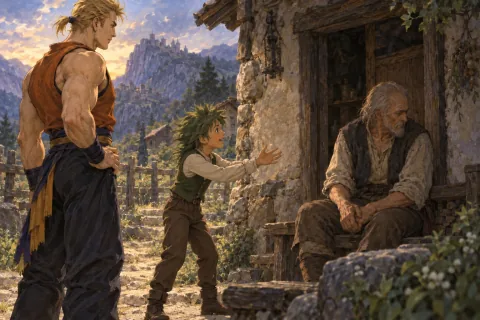
Rejoining the party in the wild, Gau travels with Sabin and the others to find the father who abandoned him long ago. The companions dress Gau in proper clothes and teach him manners, hoping for a heartwarming reunion between father and son. However, the father distorts the events of the day his wife died, fails to recognize the Gau before him as his own flesh and blood, and instead treats him like a monster, driving him away harshly.
Even immediately after being rejected, Gau does not show anger or resentment, but rather reacts with pure joy at the simple fact that his father is alive. Though the companions feel deep sorrow at this sight, they do not force the truth upon the father, respecting Gau's feelings as they quietly turn away. This brief and discordant encounter serves as a moment that heavily questions the weight of blood ties and the meaning of family to the player.
The process of the companions carefully dressing Gau up surely stemmed from warm intentions, but it simultaneously reveals the standards of normalcy demanded by civilized society. They likely believed that for a father to fully accept his son, he must first possess the appearance of a socialized human. This implies a naive hope that by changing one's outward appearance and adopting manners, a relationship severed long ago could be magically restored.
One cannot summarize the father's words with a specific diagnosis, nor can the act of abandoning a child be explained as inevitable due to past sorrow. The circumstances he recounts provide clues to understanding why Gau had to live in the wild, but the responsibility does not fall upon the child. The scene where the companions' expectations—based on dressing him up—are thwarted shows that the severance of a relationship cannot be mended by appearance and etiquette. What Gau needed was not a more perfect version of a son, but people to be with him just as he is.
Gau acting as if he were not hurt by his father's verbal abuse may not be because he fails to understand the gravity of the situation. To him, having survived in the harsh wilderness, what matters might not be the complex causalities of the past or social recognition, but the warmth of life itself. The sensory reality that his father is breathing and alive before his eyes likely came to him as the most certain and joyful truth.
Interpreting this scene as Gau sublimely forgiving the father who abandoned him is to somewhat flatten the complexity of the relationship. Gau did not view his father as a perpetrator who needed to be forgiven; he simply accepted the state of the father before him as it was. The game's direction, which retreats without forcing a reconciliation based on the standards of others, shows a mature perspective that does not rashly attempt to fill the void of a relationship.
The fact that Sabin accompanies him on this journey is also narratively interesting. Sabin is a character who has experienced deep conflict and reconciliation in his own relationship with his brother, but he realizes that Gau's family problem is on an entirely different trajectory from the brotherhood he experienced. Witnessing the bitter reality that blood ties alone cannot resolve all misunderstandings or restore love, he learns that one cannot recklessly intervene in the lives and wounds of others.
It is revealed that the proper clothes they put on Gau were merely a shell that could not fully contain his essence. Although he borrowed the outer layer of civilization to meet his father, the strength that truly sustains him is the raw vitality he learned while living among beasts in the wild. The act of changing clothes and mimicking manners visually depicts how he stands on the boundary between two worlds: human society and the wild.
Ultimately, one realizes that Gau's true family is not the father connected by blood, but the companions who accept his bizarre behavior and clumsy language as they are. When the father calls him a monster and pushes him away, the companions silently stand by his side and turn away with him. This shows the collapse of the traditional family bound by blood while simultaneously suggesting the possibility of an alternative family newly formed through mutual respect and choice.
Gau's footsteps as he leaves his father behind and returns to the journey are neither heavy nor tragic. Instead of being bound by the wounds of the past and consuming himself, he chose to affirm the present fact that his father is alive. To his companions, who live with their own losses in a broken world, Gau's attitude resonates much deeper than any grand words of comfort and serves as a quiet driving force that allows them to move forward.
Chapter 2 · The Hands Taught Anew by a Living Master
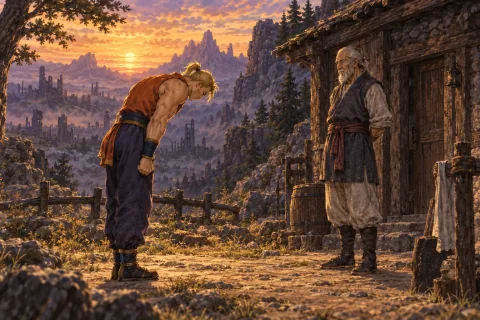
After the world collapsed, Sabin, wandering the barren lands, miraculously reunites with his master, Duncan, whom he had believed to be dead, in a remote cabin. Having firmly believed that his master had been murdered due to Vargas's false claims in the past, Sabin feels deep relief and overwhelming joy upon facing his master, who is alive and breathing. This unexpected encounter becomes a small light showing that hope has not completely vanished amidst the ruins.
Duncan helps his disciple grow by silently passing on the ultimate technique he has mastered. This is more than a functional process of increasing combat power within the game; it is a symbolic moment where the long-standing trust between master and disciple is manifested as physical strength. Through his master's strict yet warm teachings, Sabin deeply realizes once again the true meaning and responsibility held by the two hands he has honed in martial arts.
The process of uncovering Vargas's lies provides interesting narrative food for thought. The immense loss of the master's death was one of the initial driving forces for Sabin to set out into the world, but it is revealed late that it was a mere illusion. This implies that strength gained by relying on past anger and a desire for revenge is bound to have limits, and that true inner growth must stem from somewhere other than the heart that hates someone.
The relationship between Duncan and Sabin is firmly forged through thorough physical training and discipline. Rather than complex words or the exchange of emotions, the act of sweating and clashing fists is the most certain and reliable way of communication for them. When many in the collapsed world collapse under the weight of a desperate reality and words, this master-disciple relationship confirms and affirms each other's existence most transparently through the honest language of the body.
The ultimate technique Sabin receives from his master is far from blind violence meant to destroy the enemy before him. It is a power that must be used carefully to protect those weaker than oneself and to help rebuild the collapsed world. One can read that the master did not just teach the physical form of the technique, but also passed on the philosophy of a martial artist regarding in which direction that immense power should be used.
In contrast to the past where Vargas walked the path of self-destruction due to his blind obsession and jealousy regarding power, Sabin achieves the true completion of strength through devotion to others. If Vargas was obsessed with the compulsion to defeat and surpass his master, Sabin chooses the method of fully absorbing his master's teachings and sharing them with his companions. This is a passage that clearly shows how the inner direction of handling power determines a character's fate.
The fact that Duncan survived the world's massive collapse and was guarding a remote cabin gives the player a strange sense of stability. Amidst a catastrophe where the world's order has collapsed and the terrain is twisted, the sight of a master who silently keeps his place and does not neglect his training awakens the importance of values that do not easily change. He establishes himself as a solid rock upon which Sabin can lean at any time in a chaotic world.
Sabin's two hands have struck down countless enemies throughout his journey, but they have also been used to support a collapsing house. The reunion with Duncan is an important process that integrates the duality of destruction and salvation held by these two hands. Sabin's hands, newly forged through his master's rough hands, are now fully prepared to move not to blindly harm someone, but to save them.
The direction where Duncan passes everything on to Sabin and quietly steps back contains the meaning of a natural generational shift. Instead of fighting the world's evil himself, the old master firmly believes in his disciple's infinite potential and willingly entrusts the future to him. This can be called the heaviest praise, acknowledging that Sabin has stepped out of his master's massive shadow and has perfectly stood on his own as a complete martial artist and savior of the world.
Sabin's back as he leaves the old cabin is imbued with a much deeper and firmer sense of responsibility than before. The reunion with the master he thought he had lost forever is an experience that gently covers the losses of the past and gives him a clear reason to move forward. What he learned again from his living master was not merely the destructive trajectory of a fist, but the firm belief and warm kindness toward people that must be contained within that fist.
Chapter 3 · In the Mountains Where Mog and Umaro Remain
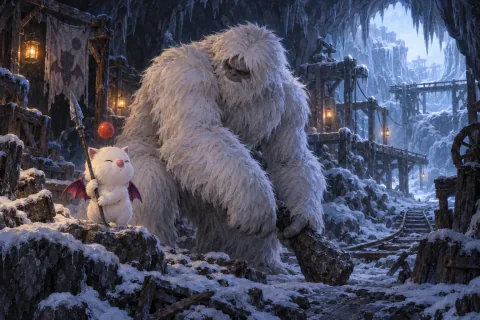
Narshe, a mining city that was once bustling with people, has turned into a desolate, empty ghost town after the world's collapse. The companions discover the Moogle Mog, who had survived alone and held his ground deep within the cold mine where human presence had completely ceased. Mog, remembering the companions who had scattered, joins the party again and silently guides them to the deep cave where the frozen Esper Valigarmanda is liberated.
Following Mog's guidance, the party descends deeper into the dark mine and encounters the giant yeti Umaro. Although Umaro appears very rough and does not understand human speech at all, he obediently nods at Mog's firm shout and joins the party as a new companion. The joining of these two non-human species, discovered by chance in the empty mountains, shows the unique and strong bond formed by the lives left behind in the collapsed world.
The empty landscape of Narshe is the space that makes one feel the world's massive downfall most visually and sensually. The mine, where humans have left in a hurry and the sound of machines has completely stopped, is even haunted by the aura of death, but paradoxically, in that cool silence, the non-humans Mog and Umaro were quietly securing their own survival territory. This is an excellent spatial background showing that the decline of civilization does not mean the end of all life.
The weight of the long, long time Mog spent waiting for the party alone in the empty cave is difficult to gauge easily. In a hopeless situation where even the survival of his kin was uncertain, he held firmly to the warm memories of the human companions he had fought with in the past and endured terrible isolation. The deep loneliness he must have carried in the darkness as the only Moogle who could communicate with language likely became the foundation for the blind and solid trust he felt toward the companions he met again.
The process of liberating the frozen Esper Valigarmanda can be read as a symbolic act of breaking the heavy shackles of the past. The Esper, which had become the seed of massive conflict due to the Empire's endless greed, is now freed from its long seal by the party's hands and willingly adds its new power to them. This is like an essential ritual to quietly settle the tragic history deeply intertwined with the space called Narshe and move forward.
Umaro is a unique companion in the game who is the only one the player cannot directly issue combat commands to. His uncontrollable, rough wildness seems to represent nature itself, which cannot be suppressed by the shallow rules or reason of humans. Accepting Umaro as a companion has the deep meaning of accepting his rough nature as it is, rather than forcibly civilizing him or taming him to one's own taste.
What is narratively interesting is the fact that this uncontrollable giant yeti obeys only the words of the small Moogle, Mog. If one looks only at the size of physical strength, Umaro is overwhelming, but their relationship is never determined by the superiority of force. This strange hierarchy, formed by leaping over the differences in species and the massive gap in physique, pleasantly shows that the logic of violence and power is not everything in the collapsed world.
Although Umaro does not use complex dialogue at all, his joining suggests the possibility of solidarity that transcends the language barrier. Just as Gau of the wild did, Umaro is a figure who exists outside the language of civilization, but he willingly joins the party's arduous journey. The fact that they can look in the same direction and walk together even without perfectly understanding each other's words is another small but precious hope discovered in a desperate world.
The empty Narshe mine was once a space of wounds, mercilessly dug up to mine resources, but now it functions as a quiet hideout where those left behind discover each other. What remains where human greed has receded like an ebb tide is the rugged friendship of abandoned beasts and forgotten species. The relationship between them, which blossomed in the ruined mountains, implies a strong will to survive, protecting what remains instead of just mourning what was lost.
As Mog and Umaro board the party's airship, a deep silence settles heavily over the empty mountains once again. However, this silence is different in texture from the cold, death-like stillness of before. It is a trace left behind by the lives the mountains held as they stepped away for a moment to head into a wider world, and it touches the player's heart like a silent promise that there might still be companions left to find somewhere in the collapsed world.
Scope of Materials and Interpretation
The main story flow of the Super Famicom original and the Pixel Remaster was used as the standard. Differences in survival, companion joining, and endings based on choices are distinguished in the relevant scenes, and the GBA version's additional dungeons are explained as separate edition elements. The unstated inner thoughts of characters are interpretations read based on the context of the events, and the identity of the unknown etc. are not asserted as facts. Material verification date: October 15, 2026 (Bangkok time).
Square Enix · FINAL FANTASY VI Official Introduction and Characters
Thonky · friend on veldt event progress reference
Thonky · return to narshe event progress reference
Thonky · another new friend in narshe event progress reference
comments 0