
Recommended Game Story · FINAL FANTASY VI Part 13
Chapters in this story
The Trap Masked by the Word Peace
Spoiler Notice: This series covers the major events and the conclusion of FINAL FANTASY VI. If you are new to the game, you may wish to read only up to your desired chapter and experience the choices and music firsthand. This text contains both descriptions of events and interpretations of the characters' inner thoughts; it is not a translation of the original dialogue or an official novel. The illustrations are AI reconstructions based on public materials.
This chapter, where destruction and deception intersect, highlights how easily the word 'peace' can be transformed into a weapon. The sealed gate opened by Terra does not lead to communion between two worlds, but instead unleashes uncontrollable rage, and upon the ashes of the capital, the Empire suddenly extends a hand of reconciliation. The polite conversations exchanged at the Emperor's banquet hide political calculations sharper than blades, and the treaty forged in the heart of enemy territory is as fragile as thin ice. Even the noble goodwill of General Leo appears infinitely precarious in the face of the Empire's grand conspiracy. The party, traveling in the same boat while still burdened by distrust and wounds, is tested to the core on the meaning of true solidarity as they face the underside of a false peace.
Chapter 1 · Representing Humanity Before the Sealed Gate
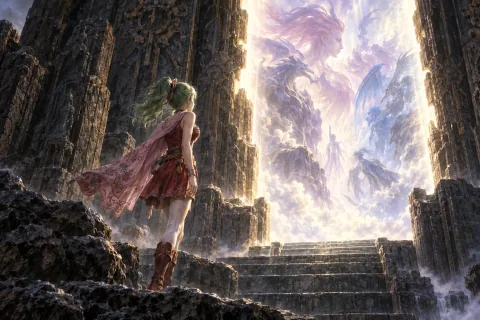
Terra carefully opens the sealed gate where the Espers reside in order to seek an alliance against the Empire. However, due to Kefka's surprise intrusion, the attempt at peaceful communion is shattered in an instant. The Espers, long suppressed under the Empire's violence, pour out beyond the gate, indiscriminately destroying the Imperial capital of Vector and bringing uncontrollable, massive chaos upon the world.
Immediately after the capital burns from the Espers' assault, Emperor Gestahl suddenly declares an end to the war and proposes peace negotiations to the party. He adopts an attitude that seems to acknowledge the Empire's helplessness in the face of the Espers' immense rage, and takes the decisive step of imprisoning Kefka, who is identified as the culprit behind all the events. Because this is such a sudden hand of reconciliation from yesterday's enemy, it invites deep suspicion.
In this scene, Terra's act of standing before the gate transcends a mere magical opening. As a being standing on the boundary between the worlds of humans and Espers, she carries the heavy burden of representing communication between heterogeneous groups that cannot understand one another. The massive responsibility of the survival of her race and the peace of the world rests upon her shoulders, acting as pressure that far exceeds the capacity of an individual.
The destructive rage shown by the Espers who escaped the gate proves the history of exploitation they have endured. The violence the Empire committed to build the Magitek Empire left scars deep enough to paralyze the Espers' reason. Their blind aggression instantly flips the dynamic of perpetrator and victim, chillingly demonstrating how terrifying a disaster can occur when an oppressed being gains power.
Kefka's intrusion reveals how easily the fragile hope for dialogue and understanding can crumble in the face of pure malice. He thoroughly tramples the only opportunity for the two worlds to commune, finding pleasure in inciting conflict. This sabotage serves as a painful reminder of the vulnerability of reality, where efforts to build peace can be rendered futile at any moment by the will of a single destructive individual.
The landscape of Vector turning to ash by the Espers brings a complex moral dilemma to the party. The sight of the Empire's heart being destroyed evokes heavy silence rather than exhilaration. Meeting violence with violence only leads to innocent sacrifices, and the party is forced to ask themselves if this horrific ruin was truly the result they desired. The justification of realizing justice blurs within the gray smoke.
Emperor Gestahl's sudden peace proposal is extremely unnatural given the context of the situation. It is difficult to accept that the embodiment of ambition, who sought to conquer the world with Magitek power, would repent for his sins overnight. His flexible change in attitude has plenty of room to be read as a high-level political calculation to escape an uncontrollable crisis and set up a new board, rather than true repentance.
The Emperor's measure of imprisoning Kefka is also far from the realization of justice. It is closer to 'cutting off the tail' to reduce all the Empire's evil deeds to the deviation of one individual and avoid the Emperor's own responsibility. Watching this deceptive punishment play out before their eyes, the party witnesses how easily a ruler at the pinnacle of a system can consume and discard others as pawns. The foundation of trust becomes even more precarious.
In this situation, being placed in a position where the party must accept the Empire's peace proposal is a harsh test. They are victims who have been persecuted by the Empire for a long time and have lost precious things. The reality of having to smile and accept the cup offered by yesterday's slaughterer approaches like another form of violence packaged in the name of peace. The bitterness of discussing the future while covering up the wounds of the past permeates the situation.
Terra's internal conflict falls into an even deeper labyrinth following this event. She intended to be a bridge connecting the two worlds, but ultimately became the trigger that threw open the gates of destruction. The painful realization that her goodwill could lead to the worst possible outcome shakes her identity. Amidst the contradiction where her steps toward peace instead threaten the world, she agonizes once again over the reason for her existence.
Chapter 2 · The Burning Capital and the Emperor's Banquet
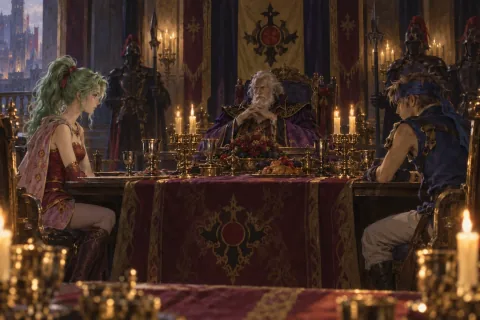
The party enters the ruined Imperial capital of Vector and attends a banquet hosted by Emperor Gestahl. Before the banquet begins, they must roam the palace for a limited time and converse with Imperial soldiers. While they engage in combat with some soldiers during this process, they also exchange brief words with many others, having a unique experience of facing strange tension in the heart of enemy territory.
The party seated at the banquet table determines the conditions the Empire will concede based on how they answer the Emperor's questions. Depending on the player's choices, major outcomes such as the liberation of Doma Castle or the withdrawal from South Figaro change. However, the words of apology offered by the Emperor still carry strategic ambiguity, and the process proceeds without certainty as to whether this is sincere reflection or an elaborate performance.
The time spent talking to soldiers before the banquet is a process of confirming the faces of the individuals who make up the massive machine called the Empire. While some show blind loyalty, the appearance of ordinary humans who complain of war fatigue or miss their hometowns is also discovered. As they realize that the enemy, once considered absolute evil, are also beings with their own lives, the black-and-white worldview held by the party begins to take on complex colors.
The banquet with the Emperor is a scene of psychological warfare more intense than any battle, even if swords and magic are not exchanged. The lives of countless people and the fate of territories hang on every toast the party makes and every question they pose. Amidst the strangeness of putting down weapons and sitting face-to-face at a dining table, they are forced into the role of diplomats who must suppress their anger and coolly secure practical benefits, bearing a heavy sense of responsibility.
The structure where the player's choices change the results in this scene excellently embodies the precariousness of diplomatic negotiations. While answering every question perfectly to obtain the best concessions might be considered the 'canon' path, in reality, an imperfect result mixed with mistakes and compromises shows a realistic slice of peace. Even if the best result is not obtained, carrying that responsibility forward is the cold essence of negotiation.
Emperor Gestahl's relaxed attitude across the table creates deep anxiety. He maintains an overly calm demeanor even while making the momentous decision to give up his territory. This attitude seems to stem from the conviction that he has more to gain than he is losing. The party struggles to grasp the real intentions hidden behind his smile, but piercing through a ruler's seasoned poker face is never easy.
The strategic ambiguity of the Emperor's apology plunges the party into deep helplessness. Peace in the form of benevolence offered by an obvious perpetrator does not truly soothe the victim's wounds. The party cannot shake the suspicion that this negotiation is merely a breather for the Empire, yet they must grasp that deceptive hand to prevent immediate bloodshed. It is a humiliating moment where they must swallow their pride for the sake of survival.
The direction that induces tension through dialogue and choices, moving away from the combat system, suggests how varied the forms of violence can be. War is not only about suppressing the opponent with force; exercising control and tightening the noose around the opponent's neck through language and negotiation is also an extension of the violence the Empire employs. The polite conversations exchanged under the banquet hall's ornate chandelier aim at the party's hearts like sharp daggers.
The process of accepting the Empire's proposal also causes subtle ripples in the party's internal cohesion. Because the depth of the grudge each holds against the Empire differs, invisible rifts of emotion can arise over how far to compromise. In a situation where a reasonable compromise for one might feel like an unforgivable betrayal to another, they must learn to suppress personal feelings for a common goal.
The political achievements the party gains after the banquet do not come across as a refreshing victory. They have obtained some visible concessions, but they intuit that the essence of the massive system called the Empire has not changed. The promises made over the ornate table are like thin ice that could break at any moment, and the party prepares for the next journey while carrying the lingering, uneasy feeling that they have walked into a trap named peace.
Chapter 3 · What Leo's Goodwill Cannot Guarantee
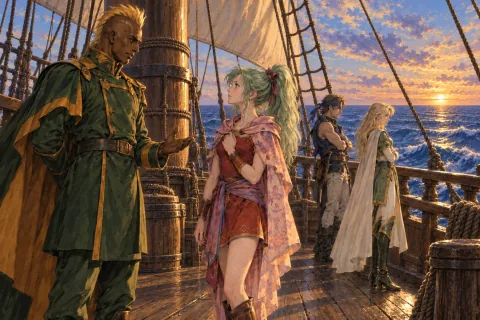
As part of the peace negotiations, a delegation led by General Leo is organized, and Terra, Locke, Celes, and Shadow embark on a journey with him to the village of Thamasa. Meanwhile, during this period in Narshe, an opportunity is given to welcome Mog as a new companion through choices related to the thief Lone Wolf. When choosing to save a life instead of material gain in a situation hanging on the edge of a cliff, the party gains an unexpected ally.
Locke and Celes, who joined the delegation, reunite for the first time since the Magitek Factory incident, but the air between them remains coldly frozen. Their relationship, tangled in misunderstanding and distrust, maintains an awkward distance without leading to a dramatic reconciliation. On the other hand, General Leo, who leads the Imperial troops, shows the party sincere goodwill and respect, leaving an impression entirely different from the cruel actions the Empire has shown thus far.
The process of welcoming Mog as a companion in Narshe highlights the value of small lives that are easy to forget in the vortex of a massive war. The choice to abandon a rare accessory in front of them and save a life in crisis subtly reveals the moral superiority that the party does not treat others as tools, unlike the Empire. This simple and human decision is a warm device showing that solidarity and kindness are still alive in a desolate world.
General Leo's existence makes visible the contradiction that a noble personality can exist even within an oppressive system like the Empire. He is the epitome of an ideal warrior who cherishes his subordinates and shows courtesy even to his enemies. However, his personal goodness cannot prevent the structural violence the Empire commits. The ethical dissonance that occurs when an individual with a fine character serves a corrupt system makes his goodwill appear somewhat precarious.
The confined space of the ship heading to Thamasa further highlights the psychological distance between the characters. The situation of having to share a boat with yesterday's enemy forces physical proximity, but the more they are together, the sharper their internal wariness becomes. The sight of them avoiding each other's gazes or cautiously probing on the narrow deck clearly shows that true trust between people cannot be built instantly through political treaties alone.
The awkward reunion of Locke and Celes realistically depicts how difficult it is to restore trust once it has been cracked. Locke could not fully trust Celes due to past wounds, and Celes felt a deep sense of loss at the fact that her sincerity was doubted. The sight of the two hovering without being able to approach each other bitterly proves that even feelings that bloomed in a crisis are bound to be infinitely fragile in the face of the seeds of distrust.
The direction that their relationship does not magically recover instantly adds depth to the narrative. By choosing awkward silence instead of a dramatic embrace of reconciliation, the game does not lightly consume the bitterness of their emotions. This attitude of silently acknowledging that time and proof are needed for a wounded heart to open again allows us to view the characters as living humans with complex inner lives, rather than mere accessories to the story.
The fact that Shadow is mixed into this uncomfortable company makes the atmosphere of the delegation even more unpredictable. The cynical attitude of a mercenary who moves according to money provides a strong contrast to General Leo's steadfast honor. Shadow's silence and indifference represent the instability of this group, which has gathered temporarily for their own purposes, and underscores the tension that this shallow peace could be broken at any time due to differences in ideology or interest.
Terra learns about the multifaceted nature of humans anew while observing General Leo. The fact that even among the Imperial soldiers who treated her like a weapon, there is someone who knows how to empathize with the pain of others, expands her worldview. This becomes an important milestone in the process of Terra understanding the human race as a whole, leading to a cautious attempt to look into the sincere hearts of individuals beyond the binary thinking of enemy and ally.
Ultimately, even General Leo's sincere goodwill cannot perfectly guarantee the party's safety. No matter how much he wants peace and tries to protect the party, the anxiety that he might be nothing more than a single pawn in the face of the Empire's grand conspiracy looms. The skepticism about whether individual honor and morality can overcome the malice of a system casts a long, ominous shadow over their journey to Thamasa.
Scope of Materials and Interpretation
The main story flow of the Super Famicom original and the Pixel Remaster was used as the standard. Differences in survival, companion recruitment, and endings based on choices are distinguished in the relevant scenes, and GBA-exclusive dungeons are explained as separate edition elements. Unstated inner thoughts of characters are interpretations read based on the context of events, and the identities of unknown figures are not asserted as facts. Data verification date: October 15, 2026 (Bangkok time).
Square Enix · FINAL FANTASY VI Official Introduction and Characters
Thonky · Cave to the Sealed Gate event progress reference
comments 0