
Recommended Game Story · FINAL FANTASY VI Part 20
Chapters in this story
The Letters Cyan Wrote on Another's Behalf
Spoiler Notice: This series covers the major events and the ending of Final Fantasy VI. If you are new to the game, you may wish to read only up to your desired chapter and experience the choices and music firsthand. These entries contain both descriptions of events and interpretations of the characters' inner thoughts; they are not translations of original game dialogue or official novels. Illustrations are AI reconstructions based on public materials.
The letters Cyan sent provide comfort to Lola, but they also leave behind the difficult problem of borrowing the name of a deceased lover. While one can interpret this action as being linked to his own sense of loss, his true inner feelings cannot be reduced to a single conclusion. This chapter examines the traces leading from Maranda to Mt. Zozo and the optional Dream of Doma, exploring the burden one carries when the desire to comfort another meets the truth. It also reflects on how memories of family remain during the process of returning to living relationships.
Chapter 1 · Comfort Offered in the Name of a Dead Soldier

Lola in the town of Maranda endures each day in a collapsed world, anxiously waiting for letters from her lover who left for Mobliz. However, the soldier has long since lost his life. It is revealed to the party that Cyan has been secretly sending replies along with flowers, borrowing the name of the deceased via carrier pigeon. This act of extending hope without revealing the death appears, on the surface, to be an act of altruistic consideration. Lola's desperate waiting and Cyan's secret ghostwriting intersect, creating a strange tension.
These false letters cannot be read merely as a good-willed attempt to reassure Lola. They may be the result of Cyan's own projection of his desperate heart, unable to bear watching another precious relationship severed amidst the immense sense of loss from having lost his own family and homeland. By blocking the despair of another, it acts as an unconscious attempt to receive some small compensation for the painful helplessness of having been unable to protect anything in his past. He likely sought to support his own broken heart by protecting the hope of another.
However, this kind deception is ultimately nothing more than an act of deferring the truth. Lola remains bound to the illusions of the past, waiting for someone who will never come, and Cyan experiences the contradiction of hiding in another's life while wearing the mask of the dead. Comfort built on lies only anesthetizes the immediate pain; it carries the fatal risk of depriving the bereaved of the opportunity to properly mourn their loss and begin a new life. Comfort that obscures the truth is, in the end, like a ticking time bomb.
The act of writing the letters itself shows Cyan's intense desire to connect with others. Seeing him, a warrior who spent his life wielding a sword, now holding a pen to create delicate flowers can be interpreted as a struggle to move toward the realm of creation and care rather than destruction. This suggests that he attempted to indirectly restore the warmth of daily life he had lost, even if through the relationships of others, and evokes a sense of pity for his struggle within deep solitude. The flowers blooming from his clumsy fingertips are the crystallization of a longing that can never be reached.
However, acting as a proxy for the voice of the dead inevitably entails a heavy sense of guilt. Every time Cyan wrote a letter, he had to dwell on the soldier's death while simultaneously bearing the psychological burden of deceiving Lola. While this attitude of trying to shoulder another's sorrow seems noble, there is plenty of room to read it as a self-defensive escape—avoiding the mourning process he himself must face and hiding behind another's narrative. By performing the tragedy of another, he was turning a blind eye to his own.
The fact that Lola finds comfort without knowing the truth of the letters poses a sharp question about the harmlessness of deception. It makes us ask whether the truth is always the best, or if sometimes a kind lie provides the strength to live. However, the game does not package this lie merely as a beautiful anecdote. Faced with a truth that is bound to be revealed someday, it subtly warns that this deferred sorrow could approach Lola as a greater collapse, questioning the weight of the relationship. Peace built on lies is always precarious.
The setting where Cyan sends flowers along with the letters is highly symbolic. The fake flowers that do not wither seem to promise eternal love, but they are also a metaphor for death, lacking vitality. This serves as a device that visually demonstrates that Cyan's attempt to conceal the soldier's absence is, in the end, not a vibrant, living relationship, but merely an illusion stuffed into a stopped moment, adding depth to the narrative. A flower without scent can never replace living warmth.
The fact that his companions learn of the situation with the letters creates an opportunity to view Cyan's choices from a different perspective. However, it cannot be said that intervening to reveal someone's secret is always right or necessarily a salvation. The point to observe in this encounter is not to publicly judge his heart, but the change that a problem he tried to solve alone enters into the realm of relationships. While acknowledging his intent to comfort someone, we can think together about what results that method left behind.
Communication through letters is a method of one-sided and safe distancing. By not facing Lola directly, Cyan fundamentally blocked the risk of being hurt. This shows that he was not yet ready to fully face others and form relationships. His psychology of wanting to remain in a controllable, fake relationship rather than forming a real one due to the fear of loss offers a glimpse into the universal defense mechanism of a deeply wounded human. He chose the path of hiding behind a ghost to avoid being hurt.
Ultimately, this false letter incident depicts a landscape of the heart where good intentions and deception, comfort and escape are complexly intertwined. This ambiguity, which makes it impossible to either condemn Cyan's actions as mere trickery or praise them as perfect consideration, makes the character more three-dimensional. In his clumsy comfort, we discover the desperate and sad struggle of a human who tried to find meaning in life by connecting with others somehow, and we feel deep compassion and empathy. A lie containing sincerity is bound to feel more painful than any truth.
Chapter 2 · The Truth Descending from Mt. Zozo
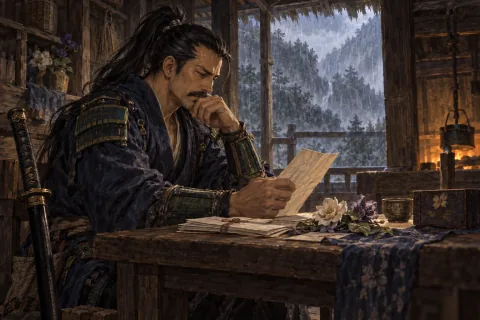
The party finally finds Cyan, who had been living in seclusion near the summit of the rain-drenched Mt. Zozo. He honestly confesses to his companions the story behind the letters sent to Lola and expresses his intention to rejoin the party and join the journey to save the world. The traces of him trying to learn about machines by reading books in the mountains, despite being unskilled with them, bring no small amount of surprise to his companions. His hideout is a space where the past and present are strangely mixed.
The space of Mt. Zozo acts as a place of isolation cut off from the world, and at the same time, a space of punishment where he exiled himself. The gloomy landscape where the rain never stops visually represents the unceasing sorrow residing within Cyan. Living here as an agent of the dead, he was pushing himself to the periphery of the world, as if his real life had stopped along with the world below the mountain. In that place filled only with the sound of rain, he must have conversed only with the echoes of the past.
The fact that he learned how to handle machines and tried to write letters cannot be consumed merely as humor or a change in personality. It shows that he held a desperate will to connect with others, enough to embrace even the objects he loathed. The process of a warrior, once trapped in the old beliefs of the past, learning the tools of a new era is an important passage that implies his stopped time has begun to flow again. A longing for communication has bloomed in the place beyond hatred.
The moment Cyan confesses the truth to his companions is an act of sharing the heavy responsibility he had been carrying. By speaking out the sorrow of another and his own guilt that he had tried to bear alone, he finally takes a step out of the prison of secrets. The attitude of his companions, who listen silently without rashly condemning or praising his actions, allows us to guess what true support for the wounded is, leaving a heavy resonance. Sometimes, listening with judgment reserved is the greatest comfort.
The choice to rejoin the party is like a declaration that he will descend from the mountain, which was his place of escape, and bear the weight of reality again. It is a firm will to take off the safe mask of being an agent of the dead and stand in the world as Cyan himself, living with his loss. This comes as a moment of growth that cautiously shows he has realized that facing the difficult reality together with his companions is more valuable than the relief provided by false comfort. He abandoned the peace of illusion and chose the reality full of wounds.
His room left behind in the mountains is a space that proves how fiercely he tried to imitate the lives of others. The scattered papers and machine parts reveal without filter the clumsiness and fragility hidden behind the facade of the perfect warrior. By having his companions witness this space, the game effectively conveys to the player how much agony and secret effort were hidden behind the steadfastness of the character Cyan. That cluttered room is like a mirror reflecting his complex inner self.
The process of replacing Lola's letters can be read as a symbolic ritual of him breaking away from the ways of the past. It is a change in attitude, helping her face reality as it is, rather than extending another's life with lies anymore. This is interpreted as Cyan himself vowing to escape the ghosts of the past and live in the present, and as an expression of mature responsibility to face the pain of others with truth rather than deception, clearly showing his internal change. The hand that delivers the truth must have required much heavier courage than before.
While his clumsy appearance in handling machines is sometimes directed in a comical way, a desperate survival instinct to adapt to an unfamiliar world lies behind it. He must have felt painfully that he could not insist on only the methods he knew to survive in a world where everything was destroyed. This evokes a bitter empathy, representing the universal task of survivors who must seek new ways of life in the place where old values have collapsed. Behind the comical gestures lies a desperation to survive.
The path down from Mt. Zozo is the beginning of a difficult journey where he relates to the world again. If he walked toward isolation alone when climbing the mountain, he walks in step with his companions when descending. The physical movement of location means the narrowing of psychological distance, and it is a heavy direction showing that he has chosen to breathe with the living by his side instead of talking to the ghosts of the past anymore. The footsteps from the isolated peak toward the plains signify reconciliation with the world itself.
Descending from Mt. Zozo does not mean all of Cyan's sorrow ends. He carries the memories of his family, and the issues surrounding the letters sent to Lola are not light. However, the change of moving with his companions again is different from the time when he thought about that burden only by himself. The reader reads the next possibility through the fact that he now has people to be with, rather than a declaration that he has abandoned the past. Forming new relationships while carrying loss is not something that can only begin after perfect healing is finished.
Chapter 3 · Meeting Family Again in the Dream of Doma
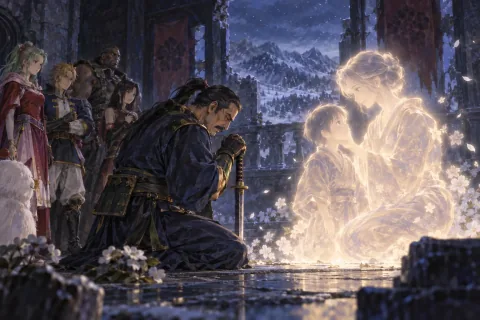
When the party rests in the ruins of Doma Castle, Cyan's soul is sucked into the nightmares of the past. In this optional journey, the companions enter his dream to rescue him from the suffering caused by the Dream Stooges and the monster Wrexsoul. Deep in the dream, Cyan meets the souls of his dead wife and son, and through their encouragement, he looks at the memories of his family again and gains new sword techniques. A night in the forgotten castle leads him to the deepest abyss of his unconscious.
The space of Doma Castle is a memory of glory and a scene of horrific slaughter for Cyan. Sleeping there is an act of facing head-on the unconscious fear he had long suppressed. The monsters appearing in the dream come across as the embodiment of the self-reproach and despair that had been eating away at him, rather than external enemies. This is an excellent direction that visualizes that the most intense battle is ultimately taking place within himself. He had been executed every night in the prison of guilt he created himself.
The setting where his companions enter his dream directly maximizes the meaning of solidarity. The process of willingly walking into another's deep trauma and experiencing that pain together is a deep emotional intervention that goes beyond simple physical assistance. The fact that Cyan finds his way with the help of his companions instead of overcoming the nightmare alone suggests that the wounds of loss are difficult to heal with the will of an isolated individual, emphasizing the power of relationships. The courage to jump into another's hell is the proof of true camaraderie.
The bizarre landscapes like trains and mines encountered in the dream project Cyan's confused psychological state. The endlessly repeating paths and closed doors show his internal deadlock, unable to move forward while trapped in the past. The process of the companions solving this maze and approaching him can be read as a cautious and persistent process of affection that opens the bolts of his heart that had been tightly closed, giving deep emotion. The tangled tracks resemble the trajectory of his lost heart wandering.
The scene where the souls of his wife and son appear is a key turning point in this narrative. Instead of resenting Cyan for why he couldn't protect them, they wish for him to put down the burdens of the past and live his own life. This is the decisive moment that makes him realize that the illusion he had long feared was actually a projection of the guilt he created himself, and that true love does not demand the pain of those left behind. The dead never want the living to die, crushed by the weight of guilt.
The encouragement of his family does not erase the memories of loss, but changes the way he handles those memories. Cyan does not become free by forgetting his family, but gains the strength to live in the present by using the love they left behind as fuel. The resolution to leave the dead fully in the space of mourning and return to the world of the living is a sublime scene showing that he has performed the true farewell ritual he had long postponed. Memory is no longer a thorn pricking him, but the root supporting him.
The battle with Wrexsoul has a unique condition where one must reveal the enemy hiding in a companion. This is a game battle rule, and it should not be read broadly as advice that one must inflict harm on oneself or those close to them to heal emotional wounds. On the stage of a dream, the difficulty of revealing an invisible threat in front of one's eyes is expressed as a battle. Through that device, what the reader can understand is that Cyan's pain is not a problem that can be easily judged by looking only at the surface.
The fact that he masters new sword techniques after waking from the dream is proof of internal growth that goes beyond a simple increase in combat power. As the shackles of his suppressed soul are released, the potential he originally possessed is fully manifested. This shows that the energy tied to the wounds of the past has finally been converted into a positive force to protect his current life and companions, and it is a narrative fruition that makes us ask where true strength comes from. A sword that can only be held by one who has forgiven oneself is sharper and harder than any other weapon.
This dream journey is all the more special in that it is not an essential event, but an optional story that can be experienced depending on the player's choice. This deep inner landscape opens only when the player decides to visit the ruined Doma Castle and rest. This is a game-based allowance that subtly informs us that the process of understanding and facing the hidden wounds of others is not given automatically, but requires a voluntary will and effort to approach. The choice to face the pain that could have been ignored becomes the key to salvation.
Through this process, Cyan escapes the ghosts of the past and returns completely to the bonds with his living companions. The pain of loss may not disappear completely, but now he does not let himself be crushed by that pain and holds his sword for those by his side. The isolated man who wrote letters as an agent of the dead finally returns to a place of a whole life where he pioneers tomorrow together with his companions in his own name, exiting the long tunnel of mourning. The tip of his sword is no longer aimed at the ghosts of the past, but at the hope of the future to come.
Scope of Materials and Interpretation
The main story flow of the Super Famicom original and the Pixel Remaster was used as the standard. Differences in survival, companion joining, and endings based on choices are distinguished in the relevant scenes, and the GBA version's additional dungeons are explained as separate edition elements. The unstated inner thoughts of the characters are interpretations read based on the context of the events, and the identity of the unknown 'Gogo' and similar matters are not asserted as facts. Material verification date: October 15, 2026 (Bangkok time).
Square Enix · FINAL FANTASY VI Official Introduction and Characters
Thonky · Reference for the 'Friend in Maranda' event progression
comments 0