
Recommended Game Story · FINAL FANTASY VI Part 26
Chapters in this story
People Answering Before the God of Destruction
Spoiler Notice: This series covers the major events and the ending of Final Fantasy VI. If you are new to the game, you may wish to read only up to your desired chapter and experience the choices and music yourself. These sentences describe events and interpret the characters' inner thoughts; they are not translations of original dialogue or official novels. Illustrations are AI reconstructions based on public materials.
The tower rising above the ruins of the destroyed world is both a scar left by the former Empire and the terminus of the madness that seeks to return everything to nothingness. The scattered companions, having overcome their respective losses, gather once more to head toward the final battlefield via three separate paths. This journey goes beyond a simple heroic tale of defeating evil, posing a heavy question about what humans hold onto while living in a finite life. Through the process of these individuals—brought together by the player's choices—finding their own answers, we discover the meaning of relationships that do not lose their light even in the face of ruin.
Chapter 1 · The Tower Rising in Three Paths
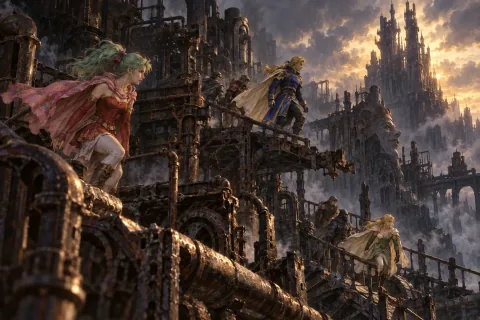
The ruins of Vector, once the capital of the Empire, have now become a grotesque tower piercing the sky. To enter this space, where the source of the destruction that tore the world apart resides, the party must divide into three groups, opening paths for one another as they advance. The process of these scattered individuals reuniting to breach a massive labyrinth is, in itself, a stage demonstrating the power of solidarity. This tower is like a tomb where past glory and corruption are intertwined.
The personnel and composition for climbing the tower are entirely up to the player's choice. You can find all companions to form a complete formation, or choose a difficult path with only a few members. These steps toward the summit, where the three Goddess Statues await, can be read as a process of sharing the weight of the past that each carries. Deciding whom to bring is, ultimately, an act of asking what memories and relationships you will carry into the final battle.
The three-way path does not signify isolation. The structure where one team steps on a switch to open a door for another team visually embodies the fact that they are connected even when out of sight. This seems to metaphorically represent the process of those who experienced disconnection from others in the ruined world regaining trust. Toward the summit, which one could never reach alone, they become stepping stones for each other.
The interior of the tower is hideously entangled with machinery, Magicite, and collapsed architecture. This reveals the deformed results born from the Empire's greed, which blindly worshipped magic and technology. Walking through these ruins, the player visually experiences the catastrophe that resulted from a blind craving for power. The anxiety seeping through the collapsed steel frames hints at the enormity of the enemy the party faces.
The Goddess Statues blocking each path were once beings that maintained the balance of the world, but now they have become mere shells, avatars of destruction. The act of defeating them one by one holds the meaning of putting an end to the old order, beyond simply removing obstacles. In a world where even divine beings have fallen, these battles are imbued with the heavy responsibility that humans must forge a new tomorrow themselves.
The countless choices and losses the player experienced while gathering companions act as the driving force for climbing the tower. Memories of failing to save someone or moments where hope was barely regained are deeply layered in the background of this final journey. In particular, the process of saving Cid or Celes escaping the swamp of despair to stand again becomes an important context explaining why they walk toward tomorrow so desperately.
Moments where you must trust and wait for companions in places you cannot see create a strange tension. You cannot move forward without the belief that the team you are not controlling will successfully fulfill its role. This functions as a directorial choice where the game's system combines with the narrative to instill the value of solidarity back into a world rife with distrust. The act of entrusting one's path to others requires great courage in itself.
The participation of a character like Shadow in this journey holds special significance. The sight of him, who had locked himself in shadows and tried to push relationships away, keeping pace with others suggests that the door to his closed heart is opening little by little. Even if his end meets a sad conclusion where he disappears somewhere, the fact that he chose to walk with someone for this moment leaves a deep lingering impression.
The tower's structure is designed to constantly ascend, but the path is by no means straight. Wandering through the tangled maze, you sometimes find that you must descend to discover the path to climb again. This resembles the life trajectories of the characters who have walked detours while experiencing loss and frustration. The process of converging toward a single goal despite the wandering represents their unbreakable will.
When the three teams finally gather in one place and stand at the final threshold, the player realizes the weight of all the time accumulated so far. The optional recruitment of companions and their narratives weave together, leading to an emotional climax beyond simple combat. The enemy they face mocks everything as meaningless, but the footprints they have walked together until now are already a powerful rebuttal against that nihilism.
Chapter 2 · The Question of Why Protect a Vanishing Life
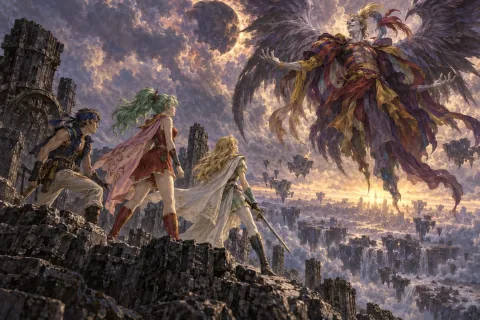
What awaits the party upon reaching the top floor is a mocking question: why do you constantly try to create and live when everything will eventually be destroyed and disappear? The one who has become the God of Destruction points out the finiteness of life and effort, asserting that only emptiness remains at the end. Faced with this declaration of massive despair, the party must offer their own answers based on the trajectories of the lives they have led.
This question goes beyond a villain's sophistry, touching upon a fundamental skepticism that anyone who has experienced loss might have harbored at least once. Confronting the gaze that denies current value because it is not eternal, the characters do not claim immortality or miracles. Instead, they speak of the meaning found in extremely ordinary and daily relationships. The preciousness of the fleeting moments that shine within finiteness becomes their weapon.
The answer Terra found stems from the sense of love born from the desire to protect someone. The process of her, who was raised as a soldier and did not even know her own emotions, realizing the warmth of life through interaction with others is fully melted into that answer. This resonates deeply in that it starts not from grand world salvation, but from a very personal and tender will to care for the small life beside her.
Locke affirms the new relationship that saved him, who had been bound by past loss. The declaration to let go of the obsession to restore what was lost and instead hold the hand of the person beside him now to move toward tomorrow shows that he can head toward new relationships after accepting the farewell of the past. This can be read as asserting the value that the act of sharing one's heart with someone while alive possesses, even if there is an end called death.
Brothers Edgar and Sabin speak of their trust in each other and the responsibilities they have kept in their respective positions. When the one who shouldered a kingdom and the one who chose freedom meet again, affirming the world in their own ways, their bond becomes a solid shield that deflects nihilism. The silent support shared by the brothers proves what a great pillar of strength the unbreakable bond of blood and companionship is, even if the world collapses.
Through Cyan's story, the sorrow of losing family and the relationships that are still alive are placed together. This past becomes a perspective to counter Kefka's logic that nothing matters because the world will eventually end. This does not mean Cyan directly stated every meaning interpreted by the reader in a long speech on the top floor. Here, we are reading by connecting the short responses of the final conversation with the preceding journey. The weight of the character becomes clearer when distinguishing between what was actually said in the scene and the interpretation trying to understand those words more broadly.
Celes carries the memory of having passed the moment when she tried to give up everything in despair, and having stood up again simply because someone was waiting for her. Her answer shows how another person's continuous care and belief make a person live. The very existence of the companions who came to find her in the endless darkness is the most certain and vivid evidence for her to refute nihilism.
Setzer accepts the dream of his lost friend as his own, declaring that he will not give up the freedom and romance of flying in the sky. His attitude as a gambler, betting everything on an uncertain future, is a cheerful rebellion that he will enjoy the thrill of the process even if the outcome is predetermined. This can be interpreted as an expression of the will to proactively choose every moment of life, countering the deterministic nihilism put forward by the God of Destruction.
The answers they offer are not grand philosophical discourses, but specific fragments of the lives each has experienced. Ordinary acts of loving someone, overcoming wounds, and dreaming new dreams gather to form a massive breakwater against destruction. Listening to their voices, the player realizes that the time accumulated while playing the game was never in vain, and that those trivial moments gather to form life.
The God of Destruction is enraged without understanding their answers, but perhaps the outcome was already somewhat decided within this conversation. The flexibility of humans who find meaning within finiteness while acknowledging it is far stronger than the hardened madness that only engages in blind destruction. The figures of the characters holding weapons with their own reasons silently show that living itself is the greatest resistance.
Chapter 3 · Different Reasons to Overcome Nihilism
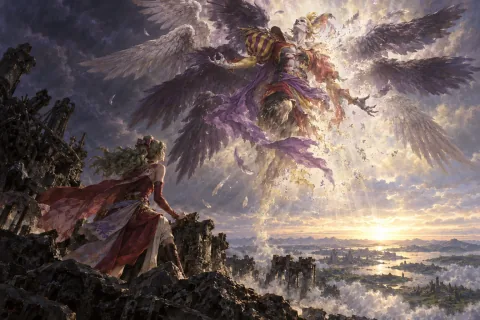
The final battle unfolds with a majestic direction, stepping up layer by layer on grotesquely intertwined statues, finally facing the God of Destruction in the form of an angel. Amidst the grand, multi-movement music, the party ascends, steadily toppling the illusory divinities from the bottom up. At the end of this battle, an irreversible result awaits: the supernatural power known as magic will completely disappear from the world.
The enemy's form, divided into several stages, takes on a grotesque appearance that seems to embody pain, corruption, and deformed salvation. The player alternates between the many companions they have organized to face this enemy, which is like a massive tower. This is a system implementation of the message of solidarity that it is not just one hero or a fixed party that saves the world, but that everyone must join forces to chip away at massive despair.
The mad melody flowing in the background reverses the atmosphere at each stage of the battle, conveying the chaos and sorrow possessed by the God of Destruction simultaneously. The grand organ sound and irregular beats seem to auditorily depict the inner self of one who, despite obtaining absolute power, could not fill the emptiness in the end. This music becomes a catalyst that makes the player feel the desperate beauty of a crumbling world, beyond the simple tension of battle.
The process of stepping on the statues and ascending can be read as an expression of the will to stand on one's own two feet, without relying on blind faith or transcendental power. As the layers get higher, the enemy's attacks become more intense, but the process of companions taking turns to fill the empty spots is deeply moving. The sight of someone taking over the will to fight when another falls shows how finite lives acquire permanence.
The final form they finally face is paradoxically in the shape of the most holy and beautiful angel. However, behind that shining exterior lies only empty malice that seeks to return everything to nothingness. This visually accuses the fact that absolute power or immortality, which look perfect on the outside, are in fact just cold shells lacking the warmth of life. True beauty lies with the wounded and finite humans.
The result that magic power also disappears when Kefka falls leaves a special anxiety for Terra. It cannot be read as a simple conclusion that magic itself was evil or deformed and therefore had to be eliminated. This is because the Espers, including Maduin and Ramuh, were also beings with will and relationships. The question the reader will face lies in how opposing those who monopolize power changes the lives of people connected to that power. The fact that safety is not immediately guaranteed even after victory creates tension for the subsequent escape.
The system where companions fall and are replaced during battle brings the player both the fear of loss and the reassurance that someone is backing them up. Rather than forcing one perfect strategy, the process of the remaining members flexibly dealing with the situation aligns with the way of life this game intends to speak of. It is a moment where the power of relationships, trusting and relying on each other even in unpredictable crises, shines.
The desperate attacks poured out by the God of Destruction shake the entire screen and present an overwhelming sense of helplessness, but the party persistently endures this with their own unique skills and magic. This symbolically shows the human crowd resisting without losing their individuality and way of life even in the face of overwhelming nihilism. The most powerful weapon against standardized destruction might be the colorful solidarity of those with different colors.
If Shadow joined this final battle, his presence evokes more complex emotions. His end, disappearing quietly somewhere without ever fully revealing his past, leaves a deep sense of regret. Despite the efforts of his companions to save him and the short solidarity he showed, the sight of his back as he chooses isolation reminds us bitterly that the restoration of relationships does not always result in a perfect happy ending.
When the God of Destruction collapses after a long, desperate struggle, the grand music fades, signaling that the age of magic is coming to an end. In the place where transcendental power has disappeared, only wounded humans and a ruined world remain. However, this ending is not the end, but the beginning of a new hope that they can rebuild tomorrow by relying on each other's body temperature without miracles. Before the eyes of those who have overcome nihilism, a world entirely their own is now unfolding.
Scope of Materials and Interpretation
The main story flow of the Super Famicom original and the Pixel Remaster was used as the standard. Differences in survival, companion recruitment, and endings based on choices are distinguished in the relevant scenes, and the GBA version's additional dungeons are explained as separate edition elements. Unstated inner thoughts of characters are interpretations based on the context of events, and the identity of the unknown "Gogo" is not asserted as fact. Material verification date: October 15, 2026 (Bangkok time).
Square Enix · FINAL FANTASY VI Official Introduction and Characters
comments 0