
Recommended Game Story · FINAL FANTASY VI Part 19
Chapters in this story
What Terra Protected When She Could Not Fight
Spoiler Notice: This series covers the major events and the ending of FINAL FANTASY VI. If you are new to the game, you may wish to read only up to your desired chapter and experience the choices and music firsthand. This text contains both descriptions of events and interpretations of character emotions; it is not a translation of original game dialogue or an official novel. Illustrations are AI reconstructions based on public materials.
In the World of Ruin of FINAL FANTASY VI, we are first confronted with loss, yet in the village of Mobliz, we discover that life continues in an unexpected form. Terra, who lived as a weapon of the Empire, is now building a new daily life, caring for children who lost their parents and the lives that remain. This commentary examines deeply why Terra lost the strength to fight and how, through the process of caregiving, she comes to face her own true strength.
Chapter 1 · The One Who Calls the Children by Name First
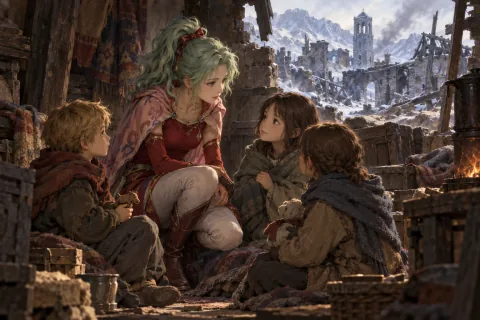
In Mobliz, where all the adults lost their lives to the Light of Judgment, only the children and the young lovers, Duane and Katarin, remain. When her companions first find this place in the ruined world, Terra is silently guarding the side of the pregnant Katarin while caring for the orphans. She has lost the power to transform into an Esper or engage in battle as she once did, and despite her companions' earnest requests for her to join them, she chooses not to leave the village immediately and remains in her place.
Terra's loss of combat power is not merely a depletion of magic, but a meaningful phenomenon showing that her way of relating to the world has fundamentally changed. Having been used as a destructive weapon of the Empire her entire life and forced to live by the will of others, this can be cautiously read as an intense process of adaptation where she undergoes a self-imposed disarmament to stand fully as a being who protects and nurtures fragile, delicate lives.
The moment the children of Mobliz call Terra 'mother,' that word anchors her firmly to an entirely new reality. For someone who grew up without ever experiencing the warmth of a normal family, being placed in a position where she must care for others entirely was likely a heavy and unfamiliar experience that forced her to question the meaning of belonging and affection from the ground up. This unfamiliar title shakes her identity.
Deep within her heart, as she hesitates to leave the village, lies a profound fear that if she leaves, she might abandon these young lives that rely entirely on her. In the ruined world, Mobliz has become a small, precarious ecosystem sustained only by Terra's presence, and she is enduring the heavy responsibility at the center of that fragile world with her entire being. Her steps cannot easily turn away.
The companions who visit this place face the reality that Terra is no longer the soldier who once traversed the battlefield with them. When she decides not to join them immediately and stay in the village, the way the companions silently accept this serves as an excellent piece of direction, showing that they deeply respect the weight of the new responsibility she carries and her complex psychological state. Their attitude of not forcing her to come is another form of trust.
The sight of Terra focusing on the daily care of feeding the children and soothing their anxieties suggests that she is finally rooting herself in the present. This repetitive daily care stands in stark contrast to the battles for the fate of the world—vast and abstract—that she was swept up in the past, highlighting the value of the most basic acts that sustain life. The warmth right in front of her has become a more urgent task than any grand cause.
The presence of the pregnant Katarin adds a more complex layer to Terra's inner self. Watching the process of a new life being conceived and growing up close, even in a desperate situation where the world has collapsed, Terra must have approached the meaning of the word 'hope' and the way life continues from a perspective entirely different from before. The vitality that sprouts even on destroyed land becomes an important catalyst that quietly but surely expands her worldview.
By engraving the names and faces of the children into her heart before any grand mission to save the world, Terra is learning the heavy meaning that individual relationships hold. She is slowly realizing, while mingling with the children in the dust of Mobliz, that if one cannot fully protect the person right in front of them, even saving the world can become hollow. This is a step away from abstract heroism toward concrete love.
The pause and caregiving during this period are by no means wasted time for Terra, but an essential period of rest that she must go through to move forward. This process of establishing a foundation for her life and personal meaning—which she could never have had under the Empire's control—will serve as a solid inner foundation when she eventually returns to the battlefield. Confirming the specific objects she must protect is more important than anything else.
Ultimately, the direction of Terra not joining during the first visit provides the player with an opportunity to rethink the conditions of a hero. The game quietly argues that strength is not just about holding a weapon and defeating enemies, but that staying by the side of the wounded and protecting their daily lives also requires immense courage and patience. Terra's choice is a precious scene that reminds us that the value of care is as heavy as the value of battle.
Chapter 2 · Between the Power of Battle and the Power of Care
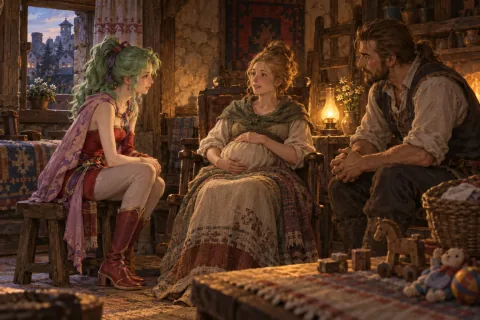
The village is exposed to the constant threat of the terrifying monster Humbaba. Amidst this crisis, Duane feels deep fear regarding his impending responsibility as a parent and wanders, while Katarin also struggles, engulfed in realistic anxiety about having to give birth to and raise a child in a ruined world. Welcoming a new life in an environment where even survival is difficult comes as a cruel trial to these young lovers.
The children rely entirely on Terra for their safety, but when Humbaba attacks, Terra, whose combat ability has weakened, cannot block the threat alone and collapses. This incident starkly reveals the painful gap between the role of caregiver she wishes to assume and the physical strength required to fully protect it. It is a moment where the fact that the desire to protect alone cannot stop the violence of cruel reality hits home.
The fear Duane feels is a perfectly natural reaction stemming from the overwhelming responsibility of bringing a child into a broken world. His hesitation and avoidance serve as a mirror reflecting the uncertainty within Terra, who constantly doubts whether she can truly protect and raise the fragile beings who depend on her until the end. The wavering of a human in the face of fear is a universal emotion that anyone in this barren world must experience.
Katarin's pregnancy holds the meaning of a quiet but powerful resistance against a ruined world shrouded in despair. Her existence forces those around her, especially Terra, to face the unfamiliar concept of the future head-on, and it asks heavily what we must endure and sacrifice in the present to welcome that future safely. The game shows that the act of carrying life itself is the most fundamental struggle against destruction.
The desperate struggle against Humbaba shows the limits Terra is currently facing with cruel clarity. Her desire to protect the children is greater than ever, but she painfully realizes that without the overwhelming power she once possessed, she cannot protect the village from physical destruction with that pure will to care alone. This reminds us of the cold law of reality that good intentions alone cannot suppress malicious violence.
This conflict well illustrates how difficult it is to find a balance between the power of battle and the power of care. Terra is painfully learning that while the gentleness of warmly caring for someone is essential to life, at the same time, the determination to actively fight back is sometimes necessary to secure a space where that life can grow safely. The two powers are not mutually exclusive but are like two wheels that must go together for survival.
The narrative never treats the fear experienced by Duane or Katarin as an object of criticism, but looks at the trauma experienced by survivors in this harsh environment with a gaze of deep compassion. Their vulnerability and wavering make the need for someone to firmly protect them even more desperate, and it grants strong justification to the role of guardian Terra has shouldered. The attitude of not carelessly judging the pain of the survivors stands out.
The affection Terra pours into the children should not be reduced to a maternal destiny forced upon women, but should be read as an intentional love she chose herself. She actively decided to pour her emotions and energy entirely into these specific lives, and this is the most meaningful act of breaking away from her past of living as a tool for others. It is her first choice to love someone as her heart leads, not by anyone's command.
The inner tension she feels is not limited to the physical problem of fighting monsters. Underlying it is a deep contemplation of how to reconcile her identity as someone who once ravaged the world with destructive power and her current identity as a guardian who saves and cares for others; this is an inner homework she must solve. The process of integrating two conflicting selves is bound to be a journey more arduous than any battle.
The scene where companions intervene to help in battle before the threat of Humbaba silently suggests the importance of solidarity. Terra does not need to shoulder the burden of protection perfectly all by herself, and she will slowly realize through this joint battle that willingly accepting the help of others in moments of crisis and facing it together is also an important wisdom for sustaining care. In a relationship that fills each other's deficiencies, she gains the courage to stand up again.
Chapter 3 · The Answer Left After Driving Away Humbaba
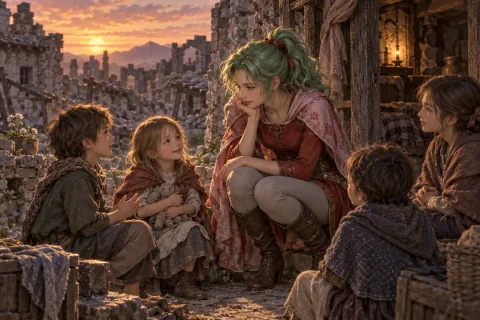
When her companions visit the village again later, Terra finally succeeds in fully drawing out the power of the Esper within her to drive Humbaba away permanently. The children do not fear her unfamiliar appearance as an Esper in the slightest and accept her as she is, and this dramatic event becomes a decisive catalyst for Terra to affirm her true strength and identity. She has finally reached the moment where her long-suppressed essence is freely liberated.
After securing the immediate safety of the village, Terra decides to leave the side of the children and rejoin the arduous journey of her companions. This is not a choice to abandon the children, but a choice born from the deep realization that to fundamentally protect the future they will live in, she must go beyond hiding and step out to heal the wounds of the world. She has learned that true protection is going beyond avoiding the threat in front of her to reclaiming the safe world itself.
The driving force that allowed Terra to transform again is not someone's coercive command or a blind destructive impulse, but an earnest desire to protect those who are precious. Her power is now manifested using the attachment relationships she has formed as fuel, which means its fundamental nature has changed completely from the power she used as a weapon of the Empire in the past. It has been reborn not as magic for destruction, but as a warm and solid shield to protect life.
The scene where the children accept the Esper form of Terra without resistance has a very important narrative meaning. For her, who lived her whole life fearing she would be seen as a monster, the children's unconditional acceptance gives her an important experience that affirms her entire existence and allows her to overcome the self-doubt that had long remained in her heart. This pure gaze that sees the heart, not the appearance, becomes the most powerful magic that saves her.
Through this acceptance, Terra comes to view her dual nature not as a curse, but as a unique ability that can connect different worlds. She has realized that she can be a warrior who fiercely faces enemies and at the same time a kind guardian who comforts the wounded, and that these two aspects never negate each other. It is a beautiful process of growth where she overcomes inner division and integrates into a complete, single self.
Her decision to leave the village is no longer avoidance or bystander behavior, but an active act of expanding the realm of care to the entire world. The painful realization that the children of Mobliz cannot enjoy true peace as long as the fundamental threat to the ruined world does not disappear becomes the most powerful motive that leads her back to the arduous battlefield. It comes across as a noble resolution to willingly walk the thorny path herself to protect the children's laughter.
By choosing to fight again, Terra fully regains control over her power. Now, she takes up arms voluntarily, not because she is being manipulated by someone, or because there is no other alternative, but because she has discovered for herself a precious value she wants to protect even at the cost of her life. This is like the process of clearing away the past of being swayed by others' wills and acquiring true freedom, and her steps are filled with more conviction than ever.
The resolution gained in Mobliz is not rooted in grand ideology, but firmly in extremely personal and concrete experiences. The quiet times of sharing food together, soothing anxious nights, and enduring day after day in a barren environment have piled up, transforming the abstract goal of having to save the world into a vivid and desperate reason that feels within reach. Small memories of daily life have transformed into the greatest power that sustains the world.
Her return to the battlefield, as depicted by the game, heavily conveys the fact that true strength stems from connection with others. Her arduous journey, which began as a cold weapon of the Empire, is completed as the image of a warm guardian protecting the future through deep relationship-building with the most fragile and vulnerable, leaving a deep lingering impression on the player. It is an excellent narrative showing how love for others makes a person the strongest.
The path Terra shows in the World of Ruin quietly implies that finding a reason to fight is directly connected to finding a reason to live. Her back as she leaves Mobliz feels less like simple tragedy and more like a hopeful promise that she wants to meet the children again in a peaceful world where all threats have disappeared someday. Please check for yourself in the journey that follows how this promise will bear fruit.
Scope of Materials and Interpretation
The main story flow of the Super Famicom original and the Pixel Remaster was used as the standard. Differences in survival, companion recruitment, and endings based on choices are distinguished in the relevant scenes, and the GBA version's additional dungeons are explained as separate edition elements. Unstated inner thoughts of characters are interpretations read based on the context of events, and the identity of the unknown 'Gogo' is not concluded as fact. Material verification date: October 15, 2026 (Bangkok time).
Square Enix · FINAL FANTASY VI Official Introduction and Characters
comments 0