
Recommended Game Story · FINAL FANTASY VI Part 27
Chapters in this story
What the Escaping Hand Told Us
Spoiler Notice: This series covers major events and the ending of Final Fantasy VI. If you are new to the game, you may want to read only up to the desired chapter and experience the choices and music yourself. This text contains both descriptions of events and interpretations of the characters' inner thoughts; it is not a translation of the original dialogue or an official novel. The illustrations are AI reconstructions based on public materials.
In the final moments as the world crumbles, the characters attempt their escape in their own ways, showing the fruits of the relationships they have built. This desperate situation at Kefka's Tower is not merely a disaster, but a final test asking how they will save each other and continue their lives. Some grasp a hand in the present instead of a relic of the past, some break through their fears to operate machinery, and others affirm their own paths under the name of brotherhood. This escape is a quiet yet heavy answer that lets us guess what they will mean to each other in the harsh world they will live in from now on.
Chapter 1 · The Person Grasped Before the Bandana
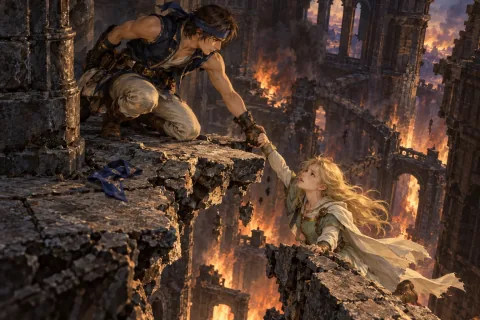
During the escape, Celes drops Locke's bandana and finds herself in danger on the crumbling floor while trying to retrieve it. If you have recruited Locke back as a companion, he catches and saves her. In branches where he is absent, scenes involving other companions take his place. One should not read this as a story where the bandana is gone forever and Celes grows by discarding it. The act of trying to retrieve a precious object, and the relationship of protecting each other even during that act, are the center of the scene.
The bandana is not just an old piece of cloth to Celes. In the path where Cid dies, it reminded her of the possibility that a companion might be alive, and in any path, it holds memories connected to Locke. Therefore, the act of turning back in a dangerous situation is difficult to understand solely by the price or function of the object. The reader already knows what it makes her remember. Because the small size of the object and the magnitude of the time contained within it differ, even a short movement carries the weight of emotion.
There is no need to conclude that retrieving it is an unhealthy obsession with the past. The heart that cherishes memories and the heart that forms present relationships can coexist. The fact that Celes treasures the bandana does not mean she fails to see Locke as a person. Rather, one can read her attachment through the fact that she has long remembered a small trace handed to her by someone. This scene leaves behind a more complex heart than the lesson that one must put down all objects of the past to start a new life.
The scene where Locke reaches out can feel special to readers who know his memories with Rachel. He once blamed himself for failing to protect someone, and after a long search, he accepted that person's farewell. Now, the movement of catching Celes before his eyes is read as an act of responding to a present relationship. However, this does not prove that all guilt has ended, nor does it mean Celes has become a reward replacing Rachel. The change of meeting different people in different relationships is important.
Even in the moment Celes is saved from crisis, she cannot be reduced to a helpless person. She crossed a ruined world to find her companions again and participated in this final battle of her own will. The fact that such a character receives help shows that strength and dependence can coexist. No one needs to endure every moment alone. A person who helped others before can now reach out a hand, and within that exchange, the shape of the relationship expands.
The branch without Locke is also important. Just because there is an attachment to the bandana, it does not mean that only one specific person must support Celes's life. The variation where other companions save her reflects the various relationships formed through the search in the ending. Even if the faces change depending on the journey the player experienced, the direction of trying to survive together continues. When one lover's rescue is not set as the only correct answer, one can also examine the emotions of the other paths the game has prepared.
The crumbling floor does not allow for a long conversation explaining their hearts. That is why the act of holding hands becomes important. It is a concrete action to help someone who is falling right now, and the reader connects that action to the memories accumulated beforehand. Even without creating and attaching unspoken promises or marriages, the scene is sufficiently heavy. What is needed to interpret the relationship is not to confirm the answer to all of life afterward, but to look closely at what actions they took toward each other in this moment.
The heart that cherishes the bandana and the act of holding a living hand do not compete with each other. If the trace of memory made her move, the current companion shares the danger within that movement. Reading this connection, the past and present do not look like two separated rooms. The time that has passed remains within the current heart, and the current action makes one reinterpret that memory. In that a single small object in the game connects such relationships, the escape scene creates a lingering feeling in a different way from the victory of battle.
There is no basis to say that Celes, after being rescued, will no longer rely on any object. What she will cherish and live for in the future remains open. What the reader can clearly see is the opportunity to survive and the fact that there are people who protect that opportunity together. There is no need to erase the point that a memento is still meaningful to someone who has experienced loss. A reading that does not make forgetting and living the same choice brings the tenderness of this scene closer.
What remains at the end of this scene is not an empty hand that discarded the bandana, but the possibility of living while embracing both memories and relationships. The attachment revealed in danger is not evaluated only as a flawed weakness, but meets the reaching hand and enables the next action. The reader is made to think about the tension between the heart that cherishes precious things and the safety of a person. There is warmth in the ending of Celes and Locke in not summarizing that tension into a simple lesson. The final escape continues with the hands of many more companions.
Chapter 2 · The Position Two Brothers Chose Again
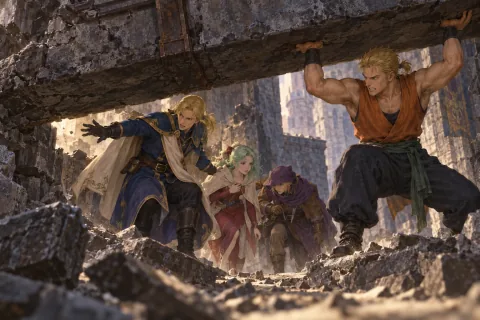
In the escape route of the brothers Edgar and Sabin, a crisis occurs where a massive steel frame collapses. At this moment, Sabin uses his superhuman strength to hold up the heavy steel frame, opening a path for Edgar to pass through. In this desperate moment, the two look after each other's safety and face once again the lives they had each decided upon with a coin toss in the past.
This scene goes beyond a physical escape from crisis where a strong younger brother saves his older brother; it visually shows the balance of the relationship the two have maintained for a long time. It is a moment where the different weights of their lives—the older brother who shouldered a kingdom and the younger brother who chose freedom—are substituted into the strength that supports each other under the collapsing steel frame.
The short conversation exchanged while Sabin holds up the steel frame excludes value judgments such as one side's life being more superior or correct. The responsibility of the throne is not heavier than the life of a free martial artist, nor is freedom without ties lighter than a king's duty. They acknowledge to each other that they have lived their best in the positions they each chose.
Edgar's choice to leave his brother behind and pass first is impossible without deep trust. The act of fully trusting his brother's strength and turning his back amidst the collapsing debris forms a strange symmetry with the heart of the older brother who watched the back of his younger brother leaving the kingdom in the past. Now, it is the older brother who trusts his younger brother's sturdy back and moves forward.
The two's choices do not lead to a lazy ending where they return to the kingdom together to rule. Without damaging the value of each other's lives, they confirm their solidarity as brothers who can share each other's weight at any time in a decisive moment. This is a mature companion relationship that respects each other's way of life beyond blood ties.
The immense weight of the steel frame seems to metaphorically represent the weight of the destiny they had to shoulder. The heavy sense of responsibility they had to divide relying on a single coin in their childhood has now transformed into a realistic obstacle that two adults can handle with their respective physical strength and wisdom. They are no longer swayed by fate and carve out their own paths with their own power.
The sight of Sabin holding up the pillar proves that the physical training he has pursued was not merely to become strong, but a means to protect those precious to him. His journey, which started by seeking freedom, eventually reduces to the power to save his brother at the most decisive moment, silently testifying that his choice was never an escape.
Edgar also momentarily puts down his aspect as a strategist who handles machines and tools, and entrusts his body solely to his brother's physical limits. The sight of a king, who always moved under thorough calculation and planning, relying solely on the power of blood in a scene of uncontrollable collapse, lets us guess the depth of the human bond he possesses.
Their escape is not a process of washing away past wounds or lingering attachments, but closer to a ritual of affirming each other as they are in the present. The trajectories of the two, which were divided like the two sides of a coin, briefly intersect in the extreme space of a collapsing tower, quietly reminding them that they are important puzzle pieces that complete each other's lives.
The footsteps of the two brothers moving through the collapse are a powerful leap to return to their respective places. They will not invade each other's lives or try to merge them into one, but will maintain a distance where they can reach out their hands at any time while running on parallel lines. This appropriate sense of distance is the form of the most solid trust the two have cultivated for a long time.
Chapter 3 · Salvation Handed Through Machines and Airships
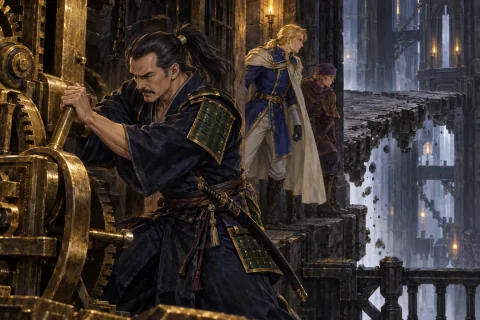
In the escape process, Cyan, who had an extreme distrust of machines, unhesitatingly operates mechanical devices to help Edgar. Meanwhile, Setzer finds the escape route with the highest probability of survival by flipping his coin amidst the collapsing debris.
One cannot read the sight of Cyan handling machines as evidence that a specific ailment caused by the Empire was cured at once. One can pay attention to the change where a character who previously appeared unskilled with machines now puts his hands on a device for the sake of a companion. It is an act of taking on unfamiliar work instead of just waiting for someone's help. The fact that traces of learning lead to a concrete role in a crisis broadens the perspective that explained him only with swordsmanship and sorrow.
The sight of Setzer finding a path by flipping a coin means that his gambler's temperament has converted into a practical sense for survival. This coin flip is not a miracle that changes cosmic destiny, but it represents his will to bet on hope and move forward even amidst uncertainty. His attitude of taking risks becomes the driving force that leads everyone's survival.
These actions show how each overcomes the sorrow and loss they possess through solidarity with their companions. Not only Cyan's swordsmanship or Setzer's airship piloting skills, but their inner changes and decisiveness shine in crisis situations. The sight of them moving forward while compensating for each other's weaknesses is evidence of hope left in a barren world.
It is difficult to read the sight of Setzer using a coin only as leaving it to unconditional luck. The coin reminds one of his personality, but the core of the scene lies in the fact that he judges and moves even in front of a blocked path. The evaluation that he acts without thought because he holds an object of chance is different. The reader can remember together the experience that he has flown the airship and overcome various dangers until now. A single familiar prop leaves the same character's sense even in the final moment.
The escape where one person's skill and another's judgment connect shows that not all companions need to be brave in the same way. The machine that is unfamiliar to Cyan is familiar to Edgar, and in front of uncertainty, Setzer moves in the way he knows. This difference is not just an obstacle to solidarity but a resource that opens the path. Heading toward the same goal does not mean turning into the same person. One can read the power of the scene of surviving together in the point that each person's method remains even when reaching the end.
The act of handling machines makes one think that tools of fighting can change into tools of saving people. The Empire tried to dominate others by combining technology and magic, but here, the device creates a path for companions to pass. The same kind of object is not necessarily used for the same purpose. The short action of Cyan moving the device, without solving all the problems of the world, clearly reveals within what kind of relationship power should be used.
Setzer's pathfinding can be read as an appearance of not stopping current judgment even if the future cannot be known for sure. There is no need to make this a romance that ignores the danger of death. This is because the survival of others also hangs on the decision he must make. In that a person who keeps the individuality of a gambler participates in a joint escape, one can see how individual habits meet responsibility within a relationship. The familiar coin does not mean that the responsibility has become light.
If one reads these scenes as a sign that all sorrow has ended, one closes the time the characters have passed through too easily. Cyan's family did not return, and the Daryl that Setzer lost did not come back to life. Nevertheless, each action creates a role for the current companion. The possibility that one can do other things even while harboring memories and loss is here. The appearance of participating in a new relationship without erasing the past becomes a more concrete comfort than a declaration of perfect healing.
The escape in this chapter was a place to read together the strength of brothers, the hand extended to Celes, Cyan's device operation, and Setzer's judgment. Depending on who the companions are, some scenes may change, but the direction of finding the path together continues. In the next chapter, we will examine the final movements of Shadow, Relm, Strago, and other optional companions. The reason for reading the simultaneously occurring endings separately is to prevent each relationship from being hidden under the single word of victory.
Scope of Materials and Interpretation
The main story flow of the Super Famicom original and the Pixel Remaster was used as the standard. Differences in survival, companion joining, and endings according to choices are distinguished in the corresponding scenes, and the GBA version's additional dungeons are explained as separate edition elements. The unstated inner thoughts of characters are interpretations read based on the context of events, and the identity of the unknown 'Gogo' is not concluded as a fact. Data verification date: October 15, 2026 (Bangkok time).
Square Enix · FINAL FANTASY VI Official Introduction and Characters
comments 0