
Recommended Game Story · FINAL FANTASY VI Part 7
Chapters in this story
A Family Learned on the Veldt
Spoiler Notice: This series covers the major events and the conclusion of FINAL FANTASY VI. If you are new to the game, you may wish to read only up to your current progress to experience the choices and music firsthand. This narrative includes both descriptions of events and interpretations of the characters' inner thoughts, and it is not a translation of the original game dialogue or an official novel. Illustrations are AI reconstructions based on public materials.
After escaping the Phantom Train, Sabin and Cyan arrive at the Veldt, a land of wild, untamed nature. Here, they meet Gau, a boy who survives by mimicking the behavior of monsters, and begin an unexpected journey together. This installment deeply illuminates how those abandoned by the world recognize each other's voids and form a new type of family in the most primal way, without the need for fluent language. The solidarity that blooms in this space, disconnected from civilization, binds their footsteps more firmly than any grand cause.
Chapter 1 · Food Offered to a Hungry Child
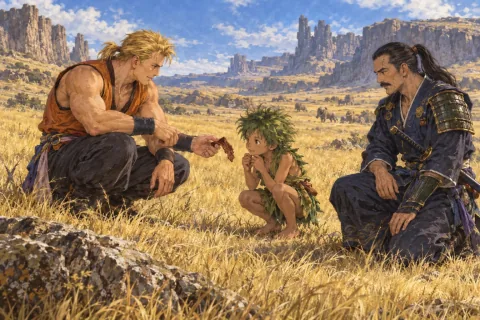
Sabin and Cyan encounter Gau, a boy surviving on the monster-infested Veldt. They offer him dried meat obtained from the nearby town of Mobliz, breaking down the boy's wariness; after eating, Gau naturally joins their journey. The sight of a boy who has mimicked monster behavior to survive in the wild may seem bizarre at first, but it soon reveals the profound isolation he must have endured.
Meanwhile, in Mobliz, a soldier injured by an Imperial attack exchanges letters with his lover, Lola, who is far away. If the player chooses to deliver the letter on behalf of the soldier, who has limited mobility, they witness the poignant hearts of ordinary people trying to sustain their daily lives amidst the horrors of war. This civilian narrative intersects with the encounter with Gau in the wild, showing the desperate desire of those disconnected from the world to connect with others.
Gau's animalistic gestures and cries should not be read as a lack of intelligence, but as a language of survival chosen to live while excluded from human society. In a harsh environment without an adult to protect him, he must have internalized the laws of predator and prey with his entire being. This conveys the heavy weight of the harsh reality that a child without the protection of civilization had to bear.
In this context, the act of offering dried meat is not a shallow means of taming a wild animal, but an expression of deep understanding that touches the most primal vulnerability. Hunger is the most honest and painful state shared by all living things, and relieving it acts as a powerful message of peace, signaling that one will not threaten the other's survival. Food becomes a medium that proves the absence of hostility more surely than any flowery rhetoric.
Sabin, who left his kingdom, and Cyan, who lost his home and family, know the pain of loss and deprivation better than anyone, albeit in different ways. Without demanding etiquette or forcing the ways of civilized people upon Gau, they offer the most basic kindness of giving food to a hungry child. This scene, where wounded adults accept another wounded child as they are, creates a quiet but heavy emotional resonance.
The sight of the injured soldier in Mobliz asking strangers to deliver a letter to his lover also shows a desperate reliance on others. That one must entrust their most precious feelings to the hands of nameless people in an isolated situation paradoxically suggests that humans are beings who cannot live without trusting one another. Even amidst the massive disconnection created by war, the faint will to reach someone is not easily broken, leaving a deep impression on the party.
The soldier's letter and the dried meat given to Gau share the same meaning in that they are lifelines connecting a disconnected world, despite their different forms. Both actions are attempts to build relationships with others across physical and social barriers, and these small connections gather to create the warmth needed to endure a bleak world. The game places these two events side by side to explore the various layers of communication.
Gau's decision to find a path to follow after eating shows that trust can begin from concrete needs rather than grand oaths. There is no need to fabricate details here about who he met in the past or how he was treated. What is revealed on the screen is an encounter where food is exchanged and they begin to learn each other's words and gestures. If one reads this small exchange as important, Gau appears not just as a child to be protected, but as a companion with the potential to help the party in other ways.
In particular, the process of Cyan, a knight of Doma who values strict discipline and etiquette, communicating with Gau is very interesting. The situation where he must set aside refined language and formality to collide with raw sincerity serves as an opportunity for Cyan to slowly peel away the heavy armor of his heart. The way two people from completely different worlds adjust to each other's unfamiliar methods reveals the flexibility and inclusiveness of relationships very delicately.
This journey on the Veldt proves that grand ideologies or goals are not necessary to rebuild a broken sense of belonging. The act of noticing someone's hunger and willingly sharing the small things one possesses is enough for those who were complete strangers to become reliable companions who make room for each other. The barren Veldt, paradoxically, settles in the party's memory as a warm space where they learn and practice what the most human kindness truly is.
Chapter 2 · A Heart That Arrived Before Words
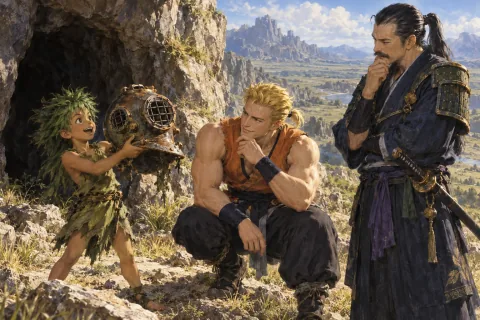
To repay Sabin and Cyan for their kindness, Gau leads them deep into Crescent Mountain. There, the boy pulls out an old diving helmet that allows one to breathe underwater, claiming it is his most precious treasure, and hands it to the party. This crude object becomes an essential tool for continuing their journey and serves as an important medium that binds the three together.
The core of this scene lies in the attitude of the adults, who do not make Gau's clumsy speech a subject of ridicule but try to read the sincerity contained within it. Sabin and Cyan listen carefully to the boy's fragmented words, which are not composed of perfect sentences, and respect the deep attachment that exists beyond the practical value of the object he offered. Their communication, which transcends language barriers, is filled with quiet consideration and understanding for each other.
The fact that Gau's treasure is a tool for survival rather than a sparkling jewel or a powerful weapon clearly shows his worldview. In a barren environment, the standard for determining value must have depended solely on whether it could protect him in the harsh nature. This crude helmet, far from being flashy, approaches the player as an object that silently testifies to the lonely and intense times the boy has endured alone.
Willingly giving this precious object, which is like his own lifeline, to others means that Gau has entrusted his safety entirely to his new companions. This massive trust, shown for the first time by a boy who had to survive solely by his own strength, feels heavier and more truthful than any grand oath. He has willingly shared his most vulnerable part and thrown open the doors of his heart.
The adults also create a qualitative change in their relationship by not taking this gift lightly. Instead of evaluating the rusty and unsightly appearance of the helmet, they fully accept the excitement and courage the boy must have felt in handing it over. This process of warm acceptance can be assumed to be a precious opportunity that first awakened in Gau the fact that he is a valuable being who can be of help to someone.
Their conversation shows that grammatical accuracy or logical completeness are not essential conditions for communication. Gau's halting words contain a much higher purity of affection than any fluent and deceptive rhetoric used by the Imperial army. This scene eloquently argues that the heart often arrives before refined sentences, and that the raw substance itself exerts greater power in conveying sincerity than flashy wrapping paper.
Sabin's boisterous and unpretentious personality plays a decisive role in building a bond with Gau. He is not bound by complex social customs or saving face, and reacts immediately to the pure energy and intent the boy radiates. This attitude of Sabin greatly alleviates the fear Gau might feel in the process of adapting to the unfamiliar human world, and serves as an excellent lubricant that quickly narrows the psychological distance between the two.
The sight of them caring for each other reminds one of a new form of alternative family not bound by blood. The three, who were pushed out of the worlds they originally belonged to for their own reasons, fill each other's voids and become a warm sanctuary for a while. This solidarity, created by those who share the common wound of loss, becomes a solid foundation that cultivates the inner strength to face the massive threats to come.
The game's direction depicts the process of them adapting to each other plainly and without exaggeration. The adults learn how to read the boy's unfamiliar gestures, and the boy slowly realizes that contact with others is no longer pain or a threat. This interaction approaches the player as an exemplary case of equal and horizontal relationship-building, where they positively change each other, rather than one-sided teaching or salvation.
Consequently, the diving helmet Gau offered symbolizes a silent promise to dive into the unknown world together. In the journey ahead, where they must endure the suffocating pressure of the water, they must rely entirely on each other for their lives through this one piece of old equipment. This goes beyond simply sharing physical breath, coming across as a confirmation of deep solidarity to keep each other breathing in a harsh world.
Chapter 3 · When the Underwater Path Leads to Narshe
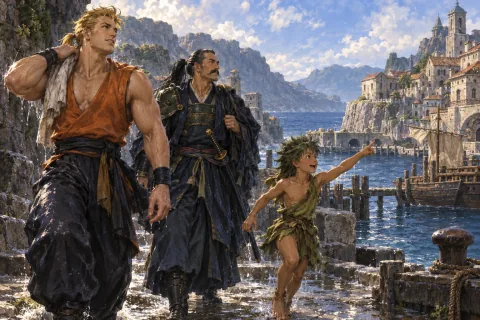
Wearing the diving helmets, the three commit themselves to the Serpent Trench, a violently swirling undersea current. Having safely completed this perilous underwater movement, where one cannot predict even an inch ahead, they are finally washed up on the beach of the vibrant port city of Nikeah. Their journey, having escaped the embrace of rough nature and returned to a place where human warmth reaches, prepares to enter a new phase.
In Nikeah, they board a regular ship bound for Narshe, ending the long and arduous detour. Boarding this ship means that the independent scenario of Sabin's party is concluding, and the time is approaching to rejoin the other two groups led by Terra and Locke. The process of the scattered companions slowly converging toward a single destination evokes both a strange tension and relief in the player.
The rough current of the Serpent Trench seems to physically embody the trajectory of those swept away by uncontrollable fate. There is not much an individual can do in the massive water flow, and there is no choice but to endure the rapids by relying on firm trust in each other and the equipment provided by Gau. This can also be read as a metaphor for resistance, where one tries to survive by finally uniting even while feeling helpless in the face of the massive Empire's tyranny.
The underwater environment inevitably blocks all conversation and forces deep silence. In this quiet yet fierce world where voices cannot reach, their survival is achieved only by relying on eye contact, gestures, and the presence of the companion by their side. For those who already learned how to communicate without language on the Veldt, it can be assumed that this time of silence acted as a silent ritual that solidified their bond.
The landscape of civilization encountered upon arriving in Nikeah forms a stark contrast to the Veldt. The bustling market and the lively voices of merchants make them painfully realize how far they have traveled, not just geographically but psychologically. The wonder and unfamiliarity that Gau, who had become accustomed to the laws of the wild, must have felt at the threshold of this complex human society now becomes a new task for the party to embrace together.
Preparing to board the ship to Narshe, they quietly gauge the weight of the coming reunion. They are not returning simply as survivors who lived, but as new beings who have formed unexpected bonds and undergone inner changes during their time in isolation. This short but intense journey has left an indelible mark on each of their hearts, which will become an important psychological driving force for the battles ahead.
Sabin's scenario holds special meaning in that it illuminates the lives on the periphery, away from the center of the world. While Terra and Locke pass through the center of military conflicts and political conspiracies, Sabin's party has traced the forgotten wild and the traces of people abandoned there. This dispersion of perspective expands the game's worldview three-dimensionally and shows how many diverse layers the world they must protect is composed of.
This narrative branching argues that the fight against the Empire does not stop at the grand act of overthrowing a massive evil. True struggle is in contact with the process of protecting the small, ordinary kindnesses, such as delivering a letter for an injured soldier and sharing food with an abandoned child. These fragments of simple life witnessed on the frontier become the most certain and concrete answer to why the party must not give up on this world.
The strange tension lingering before the reunion with the other party stems from the concern of how to integrate Gau, who has become a new family member, into a larger group. It is still unknown how the existing companions will accept this wild boy, and whether Gau can find his place among strangers without being hurt. This will be a new stage to test how flexibly the boundaries of the trust they have formed can be expanded.
This long, winding waterway leading from the Veldt to Narshe teaches that one can sometimes meet the most precious connections when taking the longest way around. They did not just find a shortcut to reach their destination, but learned how to live together and redrew their inner maps. The reason their footsteps toward the cold blizzard of Narshe are never lonely is because of that silent, solid solidarity they shared in the rough water.
Scope of Materials and Interpretation
The main story flow of the Super Famicom original and the Pixel Remaster was used as the standard. Differences in survival, companion recruitment, and endings based on choices are distinguished in the relevant scenes, and the additional dungeons of the GBA version are explained as separate edition elements. The unstated inner thoughts of the characters are interpretations based on the context of the events, and the identity of the unknown, etc., are not asserted as facts. Material verification date: October 15, 2026 (Bangkok time).
Square Enix · FINAL FANTASY VI Official Introduction and Characters
comments 0