
Recommended Game Story · FINAL FANTASY VI Part 23
Chapters in this story
The Name Shadow Could Not Erase
Spoiler Warning: This series covers the major events and ending of FINAL FANTASY VI. If you are new to the game, you may wish to read only up to your desired chapter and experience the choices and music firsthand. This text contains both descriptions of events and interpretations of character motivations; it is not a translation of original game dialogue or an official novel. Illustrations are AI reconstructions based on public materials.
Even after the Floating Continent collapses and the world is torn asunder, the past of an individual does not vanish but stubbornly remains. Behind the cold mask of an assassin lies the heavy silence of a man who abandoned his true name and fled. This journey is a careful tracing of the trajectory of the life he barely maintains in a ruined world, and the fragments of memory he buried deep because he could not bear to face them. The way a man who isolated himself reconnects with others is never loud, and through the footprints he leaves behind, we realize that one person's silence cannot be explained by a single reason.
Chapter 1 · Returning Alive from the Veldt Cave
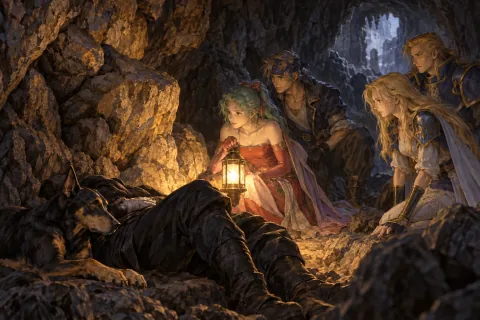
If you chose to wait for Shadow until the very end on the Floating Continent, the party will find him severely wounded and collapsed deep within the Veldt cave in the World of Ruin. In this barren, dark cave where wild monsters roam, he is barely breathing and is taken to the village of Thamasa to quietly recover. Only the player's decision not to abandon him at the edge of the world becomes the sole thread that pulls this lonely assassin back into the realm of the living.
If you left the Floating Continent without waiting for him, it is Relm who is found in this cave, not Shadow. The game applies the consequences of the player's choices very strictly, ensuring that once Shadow is lost, no magic or miracle can bring him back. This coldly demonstrates how precarious the survival of one who has rejected bonds with others truly is.
The condition that whether you waited on the Floating Continent changes subsequent encounters is not proof that Shadow desired his own death. One must distinguish between the progression branches the player must know and the heart the character harbors. In the path where he can be met again, the time spent waiting once leaves behind the possibility of a new relationship. Reading the meaning of waiting begins with viewing the fact that he could be a living companion again as important, rather than making his death a predetermined fate.
The cave on the Veldt where he lay is a rough, primal space governed only by survival instincts. This overlaps strangely with his inner landscape, where he had to kill his emotions and survive like a beast as an assassin. Even after the world perished, he could not find a comfortable refuge, hiding instead in a dark, cold cave that most resembled his own circumstances, struggling to protect the last embers of his life.
Even after being moved to Thamasa, his recovery process is depicted as thoroughly solitary. The party simply waits silently for him to wake, never forcing him to stay by their side or asserting rights as his savior. This is a way of respecting the distance he maintains in his relationships with others, suggesting that deeper understanding is required to break down his wariness, which cannot be approached carelessly.
To welcome him back as a companion after he recovers, you must wager the Ichigeki (Assassin's Dagger) at the Colosseum and face him in battle. This rough method—not of words or emotional persuasion, but of crossing weapons and risking lives—is the most familiar and natural way of communicating for a man who has lived his whole life as a mercenary and assassin. The party willingly steps into the sandstorm of the Colosseum to meet him on his own terms.
The battle at the Colosseum is not a mere test of strength, but a silent ritual of confirming each other's resolve. Through the trajectory of their blades, the party proves they are ready to stand back-to-back with him once more in this desperate world. Shadow, too, parries the party's attacks, taking the time to quietly gauge whether these people are capable of bearing the darkness he carries.
The Ichigeki that must be wagered is an object that symbolizes his professional identity and the weight of his murderous intent. The party offering this weapon can be read as a silent declaration that they will not force him to repent for his past or change his way of life. Their attitude of acknowledging and accepting Shadow the assassin as he is becomes the decisive turning point for him to open his heart once again.
There are no grand oaths or moving speeches in the process of him joining the party after the battle. The footsteps of those who were walking their own paths simply overlap quietly in one direction. This dry and understated direction is more effective in conveying with sincerity and weight the fact that a wanderer who had chosen isolation his whole life has begun to learn how to walk with others again.
His presence, which would have vanished forever had the choice on the Floating Continent been different, makes this moment of reunion all the more poignant and heavy. His survival was never a given; it is closer to a miracle created by someone's desperate waiting. Thus, his shadow, following the party in silence, holds a meaning beyond that of a mere companion, constantly reminding us of the preciousness of a relationship forged after overcoming the crisis of loss.
Chapter 2 · The Nightmare Left by Clyde and Billy
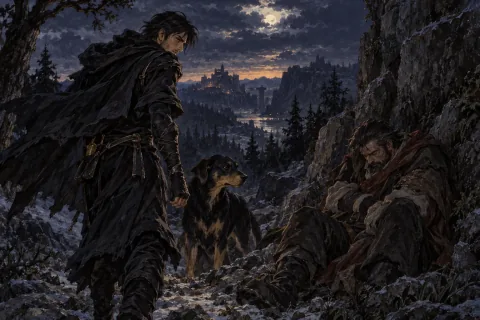
If you include Shadow in your party and rest at an inn, his past nightmares are occasionally replayed in fragments. In these dreams, he is called by his real name, Clyde, instead of Shadow, revealing his days as an outlaw who committed train robberies with a partner named Baram or Billy. Unlike his current self, who strictly controls his emotions, the man in his dreams is an ordinary human shaken by desire and fear.
In one of the many dreams, a situation is revealed where an old partner, having escaped and been severely injured, asks for death in his fear of being captured by the enemy. Clyde cannot carry out that request and leaves. There is no need to extend this short memory into a specific scene of violence. The fact that an intimate relationship was severed at a desperate moment is heavy enough. The clue to understanding the current Shadow lies not just in the conclusion of what he did, but in the fact that he still encounters that event in his dreams.
The game does not resolve this past at once through long explanations or confessions, but shows it in short dreams seen at inns. The structure, where the player might not see every dream, makes the experience of learning about Shadow's circumstances incomplete. Therefore, it is more important how each clue leads to a different reading of his current silence than which scene was seen first. Rather than turning the fact that dreams are presented into evidence for a clinical diagnosis, one can view them as a narrative device that tells of a past he cannot easily speak of.
The fact that he turned away from a companion's final request at the most desperate moment brought him terrible moral agony. His current profession as a cold-blooded assassin can be read as a harsh punishment he inflicted upon himself to thoroughly erase the weak self of that day. His struggle to become numb to taking the lives of others paradoxically shows that he is crushed by the weight of life.
At that moment of flight, he abandoned not only his companion's life but his own name and identity, Clyde, right there. Denying his past and living under a pseudonym that means 'shadow' is a desperate defense mechanism to avoid forming deep relationships with anyone ever again. Having no name is akin to a self-destructive declaration that he will wander like a ghost, belonging nowhere in the world.
While there is a basis to read that he harbors guilt, one cannot conclude that he judged himself as someone who could never be forgiven. The game does not fully explain his inner thoughts in words, leaving only actions and short memories. If one fills all these blanks with punishment and self-loathing, the meaning of the relationship of actually being together again diminishes. The fact that the past cannot be undone and who one can be with in the present are different questions. The reader can place both questions together within one character.
The heavy silence he maintains throughout the journey stems not simply from a taciturn personality, but from a deep fear that he might lose or betray someone again. His attitude of keeping distance from his companions is not a rejection of others, but an expression of the pessimistic belief that anyone near him will become unhappy. He isolates himself not to avoid being hurt, but to avoid hurting others.
The nightmares that come at random expose that no matter how perfect a mask of an assassin he wears, he can never be free from the ghosts of his past. Even during bloody battles or quiet moments of rest, the blood-red memories of that day suddenly return to choke him. This reminds us that no human has succeeded in escaping their past, and that repressed memories always return at the most vulnerable moments.
Hiding these fragments of dreams as optional elements rather than essential events is the game's thoughtful attitude toward his secrets. The player only catches a glimpse of his wounds by chance and cannot force him to confess the truth. The deepest pain of another is not fully conveyed when it is picked apart, but when it is watched silently through a crack that has accidentally opened.
The memory of his old companion makes us think about the loss and responsibility Shadow left behind. However, one cannot generalize that the life of someone who ran away must be one of endless self-loathing. What is important is that this character is still alive and forming other relationships now. It is necessary to leave room to see his current choices without erasing his past actions. The reason it is hard to say you know Shadow completely even after seeing all the dreams is that the game does not give the reader the final answer that explains a person.
Chapter 3 · The Home Interceptor Remembers
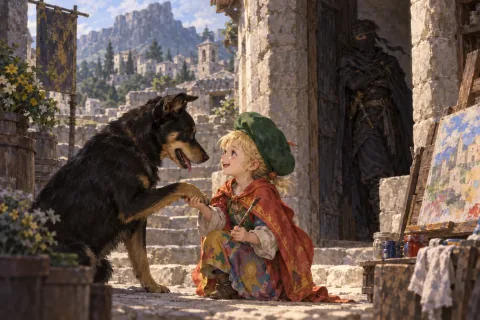
In another dream, memories of the time he stayed in Thamasa and briefly built an ordinary family faintly emerge. Along with this, his hunting dog, Interceptor—who usually bares his fangs fiercely at strangers—shows the strange behavior of letting his guard down and staying by Relm's side. These two clues subtly hint that there is a deep connection between the two, who seemed to have no point of contact.
The Memento Ring can be equipped by both Relm and Shadow, which also makes one think of their connection. Reading the dream of Thamasa and Interceptor's intimacy together serves as a strong hint pointing to a father-daughter relationship. However, it should not be described as if there is a long confession or a complete reunion scene on screen. The reader understands the relationship by connecting the scattered clues, but does not receive all the answers as to why he left and what he cannot say now. A reading that protects both what is known and what is left behind is necessary.
The direction where the most primal bond of blood is conveyed indirectly through the instinctive attachment of a dog, rather than through the person's own mouth, is deeply sorrowful. Interceptor's wagging tail is like a mirror that shows the suppressed affection and longing that Shadow himself cannot express. In place of the man who has closed his own mouth, only a speechless beast remembers the warmth he lost.
The favor Interceptor shows Relm is not a mere coincidence, but signifies an invisible thread that has continued for a very long time. That a hunting dog living in assimilation with its master's dark emotions becomes a gentle lamb only in front of a specific girl means that the girl occupies the deepest and most fragile place in the master's heart. This proves the unbreakable relationship between the two more convincingly than any long confession.
Nevertheless, the fact that Shadow never reveals his identity to the end can be read as stemming from a deep resignation that he is not qualified to be someone's father or family. Living with blood on his hands due to the sins of the past, he must have believed that his very existence would be an indelible stain on the child's pure life. Burying the truth is the cruelest form of consideration he chose.
The Memento Ring that protects Relm is an element that symbolizes the protection of her dead mother while simultaneously maximizing the helplessness of a father who cannot step forward despite being by her side. The restriction of this ring, which exists only systemically, strongly touches the player's heart without narrative explanation. Protecting the child is only the memento of the dead; he, who is alive and breathing, merely watches the child's back from a distance and hides into the darkness.
Not consuming this tragic family history with a dramatic reunion or a tearful reconciliation, but leaving it as a mere hint, makes the lingering impression of the story deeper. Revealing the truth and asking for forgiveness might be a selfish act to ease one's own guilt. To avoid shaking the child's peaceful daily life, he chooses to bear the weight of the solitude and stigma he carries entirely alone, opting to remain a stranger forever.
One cannot justify his attitude of keeping distance as the only way to protect the child. While there is a possibility that love or guilt is connected to silence, the game does not fully explain what that silence meant to Relm. Therefore, what the reader can examine is not only the pain of leaving, but the life of the one left behind. Relm is not a child who is only completed when Shadow's circumstances are revealed, but a character who meets Strago and her companions and unfolds her own talents. The void of a family does not replace her entire being.
The contrast between the warm times in Thamasa and his current desolate life allows us to guess the magnitude of the happiness he had to give up himself. His life, in which he had to throw away even the short opportunity to return to an ordinary daily life, chased by the ghosts of the past, shows the sorrow of one who has not been saved. The home he left behind has now become a mirage-like space that he can only wander in his dreams and can never reach again.
His story does not head toward a hasty reconciliation and ends in a distance that is never closed. The quiet patience of a man who erased his real name and became a shadow, but could never erase the faces engraved in his heart. That is the heaviest question and sorrow that the character Shadow leaves with us. By saying nothing, he paradoxically proves the value of everything he has lost.
Scope of Materials and Interpretation
The main story flow of the Super Famicom original and the Pixel Remaster was used as the standard. Differences in survival, joining the party, and endings based on choices are distinguished in the relevant scenes, and the additional GBA dungeons are explained as separate version elements. Unstated inner thoughts of characters are interpretations read based on the context of events, and the identity of the unknown 'Gogo' is not asserted as fact. Material verification date: October 15, 2026 (Bangkok time).
Square Enix · FINAL FANTASY VI Official Introduction and Characters
comments 0