
Recommended Game Story · FINAL FANTASY VI Part 16
Chapters in this story
The Six Parts Where the World Splits
Spoiler Notice: This series covers the major events and the ending of FINAL FANTASY VI. If you are new to the game, you may wish to read only up to your desired chapter and experience the choices and music firsthand. These entries contain both descriptions of events and interpretations of the characters' inner thoughts; they are not translations of original dialogue or official novels. Illustrations are AI reconstructions based on public materials.
On the Floating Continent, where the Empire's ambition meets the source of magic, the world reaches an irreversible turning point. The massive continent rising into the sky carries a warning about realms that humanity should not touch. Here, the characters struggle to break free from the shackles of the past, but the desire for destruction, now beyond control, eventually tears the earth and rips the sky apart. Even amidst the despair of everything collapsing, we examine how a small choice to wait for someone until the very end changes the relationships of those left behind.
Chapter 1 · The Choice Left on the Floating Continent
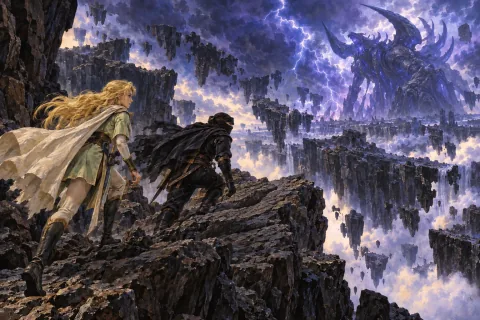
The party overcomes the Empire's fierce aerial forces and persistent obstacles, finally landing on the Floating Continent that has risen into the sky. Rejoining Shadow, who had been moving alone on the barren land, they push through a treacherous path to face the ancient, forgotten magical beasts and head toward the center where the Warring Triad sleeps. During this process, the player is given the option to return to the airship at any time, which is utilized based on the player's decision.
The terrain of the Floating Continent is grotesquely twisted, bearing the scars left by the ancient War of the Magi. As the party battles the powerful monsters roaming this land, they experience firsthand how dangerous and alien the power the Empire seeks truly is. The life-or-death struggle against the ancient beasts is not merely about clearing obstacles; it is a process of confronting the remnants of a massive violence that threatens the very foundation of the world.
The enemies encountered on the path to the sky seem to test the weight of the journey the party carries. The mechanical weapons that constantly block their way symbolize the Empire's arrogance in attempting to control magic through technology, and the act of pushing through them signifies a firm resistance against an oppressive order. Entering the unknown realm of the sky is read as a resolution to step into a massive, irreversible vortex of fate.
The scene where the party meets Shadow again in the middle of the Floating Continent shows his isolated inner self intersecting with the party's trajectory once more. That he, who moved only for money, appears on the most dangerous battlefield where the fate of the world hangs in the balance, suggests complex motives hidden behind his superficial reasons. His act of fighting as part of a group again, after trying to keep everyone at a distance, offers a glimpse into a faint will to connect with others despite his thorough detachment.
The battle against the ancient magical beasts brings the destructive history held by this continent into the present. The sight of weapons from a forgotten era still radiating murderous intent serves as a heavy warning of how terrible the consequences of the thirst for power can be across ages. This implies that the power of the Warring Triad, coveted by the Empire, is also a seed of catastrophe that humanity can never handle or tame, allowing the party to gauge the scale of the tragedy they must stop.
The option to return to the airship during the progression acts as a psychological reprieve beyond the game's structural allowance. The opportunity to catch one's breath or retreat to a safe place in the face of an impending catastrophe paradoxically reveals the pressure of the situation they face even more clearly. In the characters' decision to turn back to the barren continent despite being able to flee at any time, one can discover a firm sense of responsibility to protect the world.
The difference in progression where Shadow remains on the continent if one returns to the airship briefly can make one feel that his companionship is not yet fully stable. However, this action alone cannot be diagnosed as a desire for death or self-destruction. One must also reflect on the reader's impatience to interpret the choice without knowing the character's inner circumstances. The moment that asks whether to wait for him is heavy because one may not want to lose a person even if understanding is not complete.
The grotesque landscape of the Floating Continent resonates deeply with the anxiety residing within the characters. The sensation that the ground beneath their feet is floating in the void reminds them of how fragile the foundation of the world they have relied upon is, making the precursor to the coming collapse physically palpable. The struggle taking place in the strange sky, rather than on familiar ground, heightens the tension by reflecting a chaotic era where existing values and order are shaken to their core.
The enemies encountered here are beings distorted by the power of magic. These deformed creatures imply that the future of the Magitek Empire pursued by the Empire will eventually flow in a direction that damages and exploits the natural form of life. The party's act of defeating them can be interpreted as a desperate struggle to prevent the tragedy where life is instrumentalized by the logic of power.
Ultimately, the journey on the Floating Continent is like a prelude to the massive loss to come. The party heads to the center carrying their own fears and hesitations, unconsciously sensing that the truth waiting at the end will change their lives forever. The bond built while walking this difficult path becomes the only support that prevents them from giving up on each other in the face of the harsh trials that follow.
Chapter 2 · The Desire for Destruction That Went Further Than the Emperor
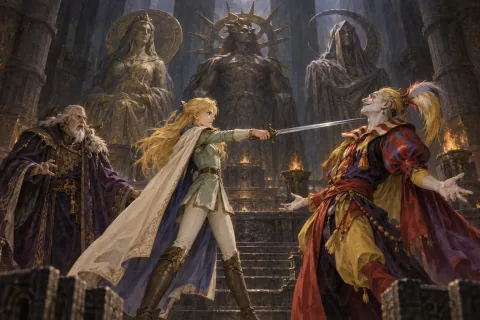
Upon reaching the center, the party encounters Emperor Gestahl and Kefka, who seek to control the power of the Warring Triad. The Emperor attempts to persuade Celes to betray her companions and return to the Empire in exchange for her former status and power, but she instead attacks Kefka and firmly rejects the offer. From this point on, the situation completely defies the Emperor's expectations and falls into an uncontrollable vortex of catastrophe.
An enraged Kefka rejects the Emperor's control and commits an act of insubordination, ultimately murdering him in cold blood. Following this, he commits an irreversible atrocity by moving the statues of the Warring Triad, which maintained the balance of the world, as he pleases. As a result, the fundamental balance of magic collapses completely, and all living things on the ground, beyond the Floating Continent, are forced to face an era of horrific destruction and division.
The offer the Emperor makes to Celes shows the height of imperial arrogance, believing that human hearts can be controlled through power and authority. He fails to understand the weight of the new relationships Celes has formed while with the party, treating her merely as a piece of imperial equipment that can be reclaimed at any time. This clearly reveals how violent and deceptive the Emperor's method of trampling on others' wills and reigning over them truly is.
Celes's act of stabbing Kefka is a heavy choice that goes beyond attacking the enemy before her; it is a declaration of a complete break from the past that oppressed her. She sheds the flashy shell of an imperial general and willingly bears the stigma of a traitor to protect her current life with her companions. In this moment, her blade is read as a desperate resistance against the Empire's violent system itself.
The scene where Kefka murders the Emperor shows that blind greed for power eventually creates an uncontrollable monster that destroys itself. The Emperor believed he could control the madness of the Magitek weapons he created forever, but that arrogance returns to him in the most miserable and futile form of death. The process of the violence born from an oppressive regime eventually consuming the pinnacle of that regime evokes a chilling horror.
The Emperor's death comes too quickly and futilely compared to the countless evils he committed and the wounds he left on the world. He is not given a chance to reflect on his faults or seek forgiveness from others; he is merely discarded worthlessly by the greater evil he nurtured. This shows how pathetic the end of one who stood at the pinnacle of power can be, bitterly emphasizing the futility of violence.
Kefka's act of moving the statues of the Warring Triad is an expression of pure malice that seeks to destroy all existing order and meaning. Beyond the goal of ruling and reigning over the world like the Emperor, he cannot bear the fact that the world exists in its entirety and seeks to return everything to nothingness. The sight of incomprehensible madness shaking the foundations of the world visualizes the horror of a catastrophe that cannot be stopped by logic and reason.
The massive energy generated as the alignment of the statues shifts instantly renders all the efforts the characters have made to protect the world powerless. The direction where magic loses control and runs wild, tearing the earth to pieces, cruelly shows how easily the small will and solidarity of humans can crumble in the face of cosmic-scale violence. This signals that the collapse of the world is the beginning of despair that transcends physical destruction.
At this moment of collapse, the characters reach out desperately to save each other, but they are scattered by an uncontrollable force. The sight of companions who have overcome countless adversities together being helplessly separated in the face of a massive disaster poses a heavy question about how the strong bonds they have built will be harshly tested in the midst of physical separation. Their bonds are as deeply wounded as the torn-apart world.
This massive catastrophe where the world splits is the climax of a tragedy that shows how thoroughly someone's selfish desire and uncontrolled madness can ruin the peaceful lives of others. On the horrific ruins where everything that needed to be protected has collapsed, only a bleak and heavy task remains: how the survivors will find meaning in life again and walk toward each other. Despair now becomes their daily life.
Chapter 3 · The Time Spent Waiting for One Person Changes the World
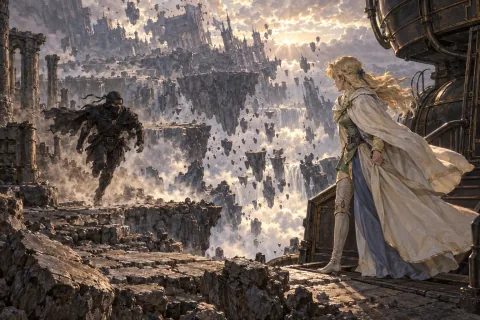
To stop Kefka's rampage, Shadow throws himself into the fray to hold him back, and the party finds themselves in a situation where they must urgently escape the crumbling Floating Continent. Within a limited time, upon reaching the end of the escape route, the player makes a critical choice: to jump onto the airship and ensure safety, or to risk danger and wait for Shadow. Depending on this decision, Shadow's survival is completely determined.
If one chooses to wait until the end, Shadow joins just before time runs out and they escape together, but if one leaves first without waiting, he disappears forever with the crumbling continent and can never be met again. However, no matter which one chooses, the massive flow of the world's collapse cannot be stopped, and even the airship the party barely boards is shattered and crashes, scattering the party across the world.
Shadow's act of holding onto Kefka to buy time for the party to escape is a moment where he, who always tried to keep distance from others, throws himself entirely for someone else. That he, who lived a thoroughly isolated life and tried not to owe anyone anything, willingly becomes a shield for his companions' survival allows one to guess at the faint attachment to others he had hidden deep in his heart.
The time limit given during the escape process exerts extreme psychological pressure on the player, conveying the fear the characters feel to the outside of the screen. While rushing through the crumbling ground and pouring enemies, the instinctive fear of survival and the sense of responsibility to save a companion clash violently. This short and intense time makes one painfully feel how much courage altruistic action requires.
The choice to wait for Shadow at the edge of the cliff is closer to blind faith than logical judgment. In a desperate situation where one does not know when the ground beneath their feet will collapse, the act of letting precious time slip away while risking one's own life for a person who has no guarantee of returning is a desperate way to prove the weight of a relationship. It approaches a noble will to not give up on others, transcending the logic of efficiency and survival.
If one escaped first without waiting, Shadow becomes a character who cannot be met again. However, that result should not be concluded as a moral flaw of the player or a guilt shared by all companions afterward. It is necessary to distinguish between the experience of understanding the game's conditions for the first time amidst the urgency of the escape and the hearts of the characters in the story. Comparing the branches makes it clear that this scene provides an opportunity to wait for one person, but there is no need to fill in emotions not shown on screen as facts.
Shadow's disappearance can never be glorified as a dignified or valuable sacrifice. That he is left alone on the crumbling continent means that his clumsy attempt to connect with someone ended in a tragic severance. His absence remains not as a noble heroic tale, but as a painful memory of a failure to save a lonely soul, leaving an indelible regret for those left behind.
The sense of relief at the moment Shadow appears after waiting provides a small sense of victory that one life was saved even while the world was perishing. Although this anxious wait does not stop the massive disaster of the world's collapse, the fact that they did not forsake each other and trusted until the end remains the only warm comfort the characters can hold onto in a world falling to pieces.
The direction where the airship is split in two and crashes visually declares that the physical and psychological foundations the characters relied on have been completely destroyed. The sight of the symbol of hope that freely roamed the sky and bound the companions together being shattered coldly informs them that they must now face the harsh reality with their bare bodies, without any protection. Along with the crashing hull, their solidarity is also scattered.
Ultimately, the escape from the Floating Continent is a horrific turning point that signals the beginning of new despair while witnessing the end of the world. In an ash-colored world where everything is split and broken, the memory of having waited for someone until the end at the edge of a cliff, or the heavy burden of having left them behind, acts as a complex and desperate driving force that makes the scattered characters face their barren lives again and set out to find each other, preparing for the next journey.
Scope of Materials and Interpretation
The main story flow of the Super Famicom original and the Pixel Remaster was used as the standard. Differences in survival, companion recruitment, and endings based on choices are distinguished in the relevant scenes, and the GBA version's additional dungeons are explained as separate edition elements. The characters' unstated inner thoughts are interpretations read based on the context of the events, and the identity of the unknown 'Gogo' is not concluded as fact. Material verification date: October 15, 2026 (Bangkok time).
Square Enix · FINAL FANTASY VI Official Introduction and Characters
Thonky · Reference for the Floating Continent event progression
comments 0