
Recommended Game Story · FINAL FANTASY VI Part 2
Chapters in this story
A Kingdom That Takes the Hand of a Fugitive
Spoiler Notice: This series covers the major events and the ending of FINAL FANTASY VI. If you are new to the game, you may wish to read only up to the chapter of your choice and experience the choices and music yourself. This text contains both descriptions of events and interpretations of the characters' inner thoughts; it is not a translation of the original dialogue or an official novel. The illustrations are AI reconstructions based on public materials.
The journey from the cold snowfields of Narshe to the sand-swept desert kingdom captures the conflicting gazes of a fugitive who has lost her memory and those who reach out to her. Under the massive shadow of the Empire, trusting someone is a gamble with one's life. The relationships formed in this process take the form of an intense exploration where individual deficiencies and political survival are intricately intertwined, even before any grand cause.
Chapter 1 · What the Treasure Hunter Seeks to Protect
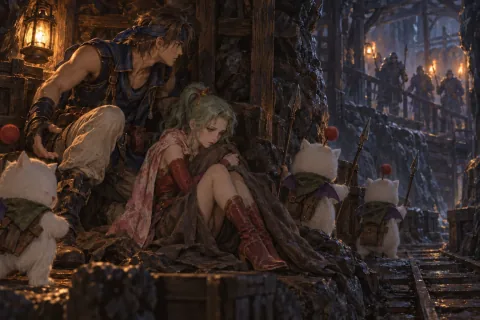
Tina, now a fugitive, flees deep into the dark mines of Narshe, but she is eventually surrounded by pursuers and collapses, losing consciousness. At this desperate moment, Locke, who calls himself a treasure hunter, appears and joins forces with a group of Moogles inhabiting the mines to rescue her from the Imperial soldiers.
Upon regaining consciousness, Tina learns from Locke that he is a member of the Returners, a secret organization resisting the Empire, and he firmly declares that he will help her. Leading her, as she struggles with confusion and memory loss so severe she can barely recall her own name, the two escape the snowfields of Narshe toward their new hideout, Figaro Castle.
The unconditional protection and kindness offered by a stranger cannot help but evoke a sense of strange suspicion rather than complete relief in someone who has lost their memory. The helping hand that Locke willingly extends creates tension, leaving room for it to be perceived as another form of restraint or dependency by Tina, who has just escaped the oppressive control of the Empire.
Locke's attitude, vehemently denying the public label of 'thief' and insisting on the identity of a 'treasure hunter,' reads as a very interesting defense mechanism. It is closer to a compulsive attempt to define himself not as someone who merely takes others' possessions, but as someone who finds and fully protects the valuable things hidden in the world.
The depiction of the Moogles, a non-human race that does not speak human language, willingly jumping into dangerous combat to protect Tina, hints at the nature of solidarity in this world. Even in the absence of grand causes or verbal promises, it silently shows how instinctive protection for a poor life in crisis leads to firm solidarity.
Throughout this rescue process, Tina remains in the position of a passive object, thoroughly protected by others. Despite physically escaping the shackles of control that were placed upon her, the fact that she must still be guided by someone to survive suggests the arduous process she must undergo before achieving true independence.
The fundamental motive for Locke willingly risking his life for a stranger he has just met is not clearly explained at this point. However, the fact that he is fiercely obsessed with the act of protecting someone suggests that some deficiency or painful loss he may have experienced in the past is strongly driving his current devoted behavior.
Locke's firm declaration that he will protect her is a unilateral promise imposed from the outside, regardless of Tina's own will. This heavy statement, which deeply intervenes in another's life in the name of protection, casts a quiet question into the player's mind about whether he will be able to take responsibility for the weight of this promise until the end.
Having no memory means that the basis for proving one's past has disappeared, which acts as a factor that extremely inhibits the formation of current relationships. Tina's hesitation and inability to fully accept Locke's kindness stem from the fundamental fear of having to entrust her empty self, which even she does not know, to another.
The footsteps of the two, leaving behind the cold snowfields of Narshe and heading toward the sand-swept desert, are a process of seeking a very precarious refuge. The reason their journey seems perilous despite having a destination is that they are precariously leaning only on the immediate task of survival, lacking a complete understanding of each other.
Chapter 2 · The King's Calculation Hidden Behind a Smile
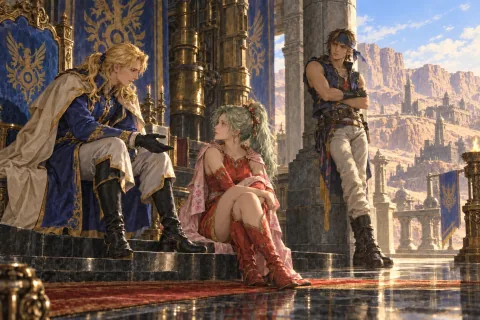
Upon arriving at Figaro Castle, located in the middle of the desert, Tina and Locke meet Edgar, the king of the country. While this nation, with its highly developed mechanical civilization, appears on the surface to maintain peace by forming a solid alliance with the Empire, Edgar is secretly supporting the Returners, an organization resisting the Empire, in both material and spiritual ways.
Edgar welcomes Tina with lighthearted jokes, but he cannot hide his deep surprise upon learning that she can use magic. Shortly after, when Kefka, an envoy of the Empire, visits the castle in pursuit of the escaped Tina, the precarious tightrope walk of neutrality that Figaro has maintained is put to a massive test.
The light and cheerful attitude Edgar shows in front of strangers is like an elaborate mask to hide the heavy responsibilities he bears as a monarch. To him, who must protect his country and people under the sharp surveillance of the Empire, his nonchalance, which makes his true intentions difficult to read, acts as a more powerful and efficient diplomatic tool than any weapon.
Figaro's position, outwardly forming an alliance with the powerful Empire while simultaneously helping the rebels who oppose them, shows a facet of extreme pragmatism. This reveals Edgar's governing philosophy, which prioritizes the safety of his people over moral clarity or justification, and is the result of intense and cold calculations to survive in the cracks of power.
The bewildered reaction Edgar shows when Tina's magical ability is revealed reaffirms the alien and fearful status that magic holds in this world. The existence of magic, which makes even a king at the pinnacle of mechanical civilization astonished, is a device that painfully imprints that Tina is a border-dweller who can never easily blend into ordinary human society.
The process by which Edgar decides to hide Tina, who is being relentlessly pursued by the Empire, entails immense political risk. Although he had the firm guarantee of Locke, a member of the rebels, the choice to protect a mysterious girl while staking the survival of the nation clearly shows how heavy and harsh the responsibilities accompanying a monarch's decision are.
Kefka's sudden appearance creates tension, standing in stark contrast to Edgar's refined and calculated attitude. In front of the Imperial envoy, who engages in clever threats disguised as courtesy and insane speech and behavior, Edgar's appearance of maintaining composure until the end allows one to guess at his inner firmness and political sophistication.
While many people within the castle trust and follow Edgar deeply, he himself is in an isolated position where it is difficult to confide his true feelings or fears to anyone. His deep loneliness, as he holds the throne firmly while bearing the void left by his twin brother's long absence, lies like a dark shadow behind the scenery of the splendid and lively castle.
Tina observes the tense battle of nerves between Edgar and the Empire from the sidelines, encountering the complex dynamics of human society for the first time. She begins to broaden her perspective, slowly recognizing the world of clever lies, hidden intentions, and political compromises made to protect something—things she never knew during the days she was being controlled.
The peaceful and relaxed air that permeates Figaro Castle is, in fact, like a thin sheet of ice that could break at any moment. The moment Edgar firmly rejects Kefka's unreasonable demands and decides to protect Tina to the end, the precarious balance they have spent a long time building is bound to collapse, which foretells a massive collision to come.
Chapter 3 · The Castle That Disappears Beneath the Desert
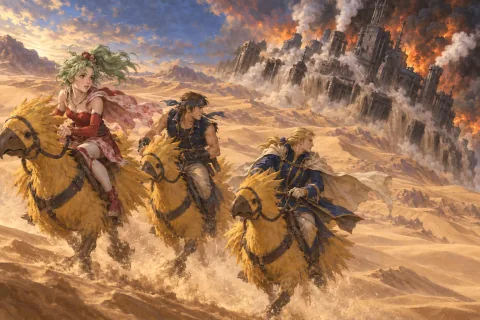
Kefka makes a horrific threat that he will burn the castle if they do not hand over the escaped Tina, and he actually sets fire to parts of Figaro Castle without mercy. In response, Edgar activates mechanical devices he had thoroughly prepared in advance, dramatically avoiding the Empire's destructive attack by submerging the entire massive castle deep beneath the desert sands.
Taking advantage of the massive chaos as the castle sinks into the sand, Tina, Locke, and Edgar mount Chocobos and attempt an escape into the endless desert. The Empire's elite Magitek Armor units pursue them closely, and the three join forces for the first time to defeat the mechanical weapons, taking arduous steps toward the rebels' hidden hideout.
The image of the fiercely burning castle visually and clearly proves the blindness and cruelty of the violence possessed by the Empire. Kefka's behavior, which lightly tramples even minimal diplomatic procedures or the justification of an alliance on a whim, serves as a painful reminder to the party that peaceful coexistence with the Empire was a delusional fantasy from the start.
The magnificent spectacle of the massive castle walls sinking into the sand without a trace is not a magical miracle, but a marvelous product of thorough mechanical engineering. It shows the infinite possibilities of human intellect that can counter the Empire's overwhelming Magitek, while simultaneously revealing Edgar's meticulous foresight in fortifying the entire nation in preparation for the worst-case scenario.
Edgar's choice to evacuate his people to a safe underground floor while he heads outside, where danger lurks, presents a new interpretation of a king's duty. Instead of reigning from within safe castle walls, his action of personally luring out lethal external threats to protect the nation quietly asks what the true weight a leader must bear is.
The escape act of leaving behind the castle made of massive machinery and relying on Chocobos, living creatures, to run across the desert offers a strange sense of liberation. The sight of them freely racing across the endlessly unfolding sand plains, momentarily setting down the shackles of the oppressive Empire and the weight of a heavy crown, seems to represent a deep, suppressed longing.
The fierce battle with the Magitek Armor units, which kick up dust as they pursue, is a moment where the shackles of the past and the will of the present collide head-on. To Tina, the Magitek Armor is a fragment of the terrible memories that bound her, and the act of destroying them with her own power can be read as an inner will to fight back rather than succumb to past trauma.
The astonished reaction of her companions when Tina uses magic amidst the urgency of battle brings deep contemplation regarding her identity. The fact that the power she desperately brought out to escape a crisis brings strange fear to others becomes a factor that makes it difficult for her to fully affirm and accept her own unique abilities.
The three disparate people—a fleeing fugitive, a treasure hunter trying to prove himself, and a king carrying a nation—form a strange sense of camaraderie as they fight for a single goal. Although the journey began with each harboring their own secrets and purposes, they slowly transform into reliable companions who are willing to entrust their backs to each other amidst life-or-death crises.
The path across the hot desert to find the rebels is an arduous and lonely march for those who have completely lost the place they could return to. The scenery of the burning castle's smoke fading into the distance beyond the rough sandstorm silently implies how much sacrifice and painful decision-making the path of resistance they have chosen will require in the future, adding to the weight of the journey.
Scope of Materials and Interpretation
The main story flow of the Super Famicom original and the Pixel Remaster was used as the standard. Differences in survival, joining of companions, and endings based on choices are distinguished in the relevant scenes, and the additional dungeons of the GBA version are explained as separate edition elements. The unstated inner thoughts of the characters are interpretations based on the context of the events, and the identity of unknown figures is not asserted as fact. Material verification date: October 15, 2026 (Bangkok time).
Square Enix · FINAL FANTASY VI official introduction and characters
comments 0