
Recommended Game Story · FINAL FANTASY VI Part 22
Chapters in this story
The Grandfather Found by the Painting
Spoiler Warning: This series covers major events and the ending of Final Fantasy VI. If you are new to the game, you may want to read only up to the desired chapter and experience the choices and music yourself. This text includes both descriptions of events and interpretations of the characters' inner thoughts; it is not a translation of the original game dialogue or an official novel. The illustrations are AI reconstructions based on public materials.
After the world crumbles, the scattered people endure their losses in their own ways. Some escape into the fantasy of art, some throw themselves into blind faith, and others cling to unfinished tasks from the past. The journey of Relm and Strago is a process that shows how the bonds of family, having lived together in the ruined world, support one another. Their story is not merely a reunion of family, but a delicate illumination of how an individual in despair finds their footing in reality again through connection with others.
Chapter 1 · Moving Paintings in Owzer's Mansion
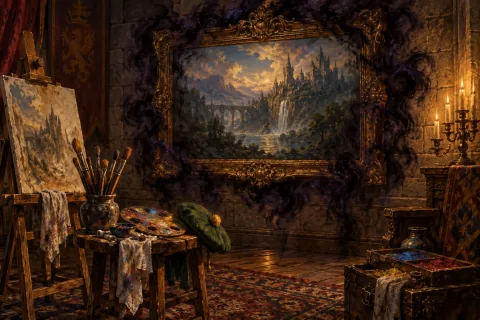
After passing the branch where she is rescued from the cave in the Veldt, Relm is found in the mansion of Owzer, a wealthy man in Jidoor. She was painting there, but a monster named Chadarnook had possessed her work, transforming the mansion into a bizarre space. The party rescues Relm, who was suppressed by the monster, and helps her step back out into the world. In this process, the relationship between art and ownership is revealed.
Owzer valued Relm's talent and tried to protect her, but ultimately provided the pretext for the monster to take control. The monster parasitized Relm's paintings, reducing her creative act to a tool for satisfying its own desires. This suggests that the pretext of adult protection can sometimes undermine an artist's autonomy and act as a form of violent oppression. Relm was thoroughly isolated in that space.
The paintings Relm creates are not merely magical omnipotence. They are an attempt to observe and understand the subject deeply, and her own unique language for communicating with the world. The fact that the monster seized those paintings means that the way Relm relates to the world was thoroughly blocked. A young artist whose language was stolen would inevitably become helpless in the mansion, a space that was magnificent yet closed off.
Adults often try to own or control a child's talent. Owzer's patronage may have stemmed from good intentions, but it resulted in locking Relm away in a safe mansion. This can be read as a projection of an adult's anxiety to protect a child in a collapsed world. However, true protection should not be about locking a child in a greenhouse, but about supporting them so they can hold the brush themselves and paint the world.
The monster Chadarnook threatens the party by shifting between the forms of a goddess and a demon. This can be interpreted as a staging that simultaneously shows the fascinating beauty of art and the destructive obsession hidden behind it. Defeating this monster, which symbolizes the duality of Relm's talent, is connected to the process of providing an opportunity for Relm to fully control her abilities and express them in a positive direction.
The process of the party rescuing Relm goes beyond the physical act of retrieving a lost companion. It is a process of returning artistic agency, distorted by the desires of others, to its rightful owner. Only after being rescued can Relm pick up the brush again for others and for herself. It is presumed that her brushstrokes, freed from oppression, will possess a much freer and firmer power than before.
One cannot conclude that the reason Relm paints is solely a desire to escape reality. She already possessed the talent as a painter and was using that ability in the mansion. Since Chadarnook, who dwells in the paintings, is a monster that actually appears, this should not be re-explained as anxiety created by Relm's inner self. However, through the contrast where the space of creation turns into a space of threat, the reader can perceive the issue that one needs help and safety even in the place where one unfolds their abilities.
The appearance of her companions gives Relm the courage to open the closed door and leave. She could not have escaped the monster's control alone, but the presence of those who came to find her becomes the reason she faces the world again. Art cannot be completed in an isolated state; it only gains meaning when there is an object to view it and commune with it. The companions function as the new world itself toward which Relm's paintings should be directed.
Relm rejoining the party does not need to be seen as a declaration of independence that no longer requires adult help. Being recognized for one's talent and being cared for are not mutually exclusive. The young painter's appearance of helping her companions with what she can do was already revealed in previous battles, but that does not mean she must bear all risks alone. The change the reader can observe in this reunion lies in the relationship of welcoming her as someone to be with, rather than just seeing her as an object to be protected.
The scene where Relm rejoins the party raises the question of what role art can play in a collapsed world. In a reality where even survival is difficult, the act of painting might seem useless. However, Relm's paintings have the power to observe the essence of the subject and reveal the hidden underside. The colors blooming from the tip of her brush are like a small attempt to breathe vitality back into a world that has turned ash-gray.
Chapter 2 · The Old Man Who Found His Name in the Cultists' Tower
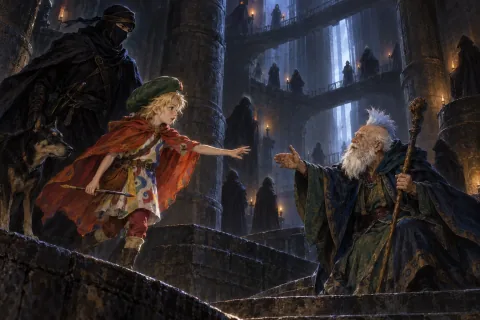
In the Cultists' Tower, built after the world collapsed, a group worshipping Kefka offers blind prayers. Strago, thinking his granddaughter Relm had died, has fallen into deep despair and lost his sense of self while entrusting his body to this religious group. In this bizarre tower where only magic is allowed, the party uses Relm to knock on Strago's closed heart, leading him back to the real world and welcoming him as a companion.
Strago becoming a cultist is not because he agrees with Kefka's destructive ideology. It is the result of giving up on thinking and judging for himself, unable to endure the immense sense of loss from losing his granddaughter, who was the only reason for his life. The religious group cleverly dug into his empty heart and forced blind faith upon him. The moment he confirmed Relm's survival with his own eyes, he escaped from the false salvation and reclaimed his lost name.
In the collapsed world, people try to find a place to lean on somehow. This is why those gathered in the Cultists' Tower cannot simply be dismissed as an evil group. Many of them are likely ordinary people who, like Strago, lost something precious and fell into a swamp of despair. The mental pain and emptiness people were experiencing at the time were so deep and thick that even Kefka, the incarnation of destruction, had to be made an object of worship.
Strago's appearance vividly shows the deep crisis experienced by an elderly person. The magical knowledge he had dedicated his life to protecting, and the heavy responsibility of being an elder of Thamasa, held no meaning in the face of his granddaughter's death. The incomprehensible prayers he must have muttered incessantly while climbing the tower might have been a desperate and sad struggle to cover up his self-reproach and guilt for failing to protect Relm.
The way Relm awakens Strago is not through grand persuasion or powerful magic. It is simply showing her living existence before his eyes and calling him in her usual blunt but affectionate voice. The fact that this simple act instantly breaks the solid brainwashing highlights that the clue for a person to escape despair may not be in transcendental faith or miracles, but in the relationship with the person by their side.
The very structure of the Cultists' Tower symbolizes the violence of blind faith. This bizarre space, which forces only magic and neutralizes all other physical resistance, spatially embodies the closed worldview of the cultists who try to eradicate diversity and inject only one absolute truth. By locking himself in this suffocating space, Strago tried to turn his eyes completely away from the painful reality of the outside world.
The emotion Strago feels after coming to his senses must be a mix of relief and bitter shame. As an adult who should have firmly protected the child, he instead relied on the child's call to escape to reality. However, Relm never blames her grandfather's weakness. Rather, that weakness becomes paradoxical evidence of how deeply the two were relying on each other.
This event gives Strago a new motivation to fight. If his journey until now stemmed from a sense of duty to prevent the world's destruction, his steps after coming down from the tower are filled with a personal and desperate desire to protect the future where Relm will live. The old man who experienced the bottom of despair now seems ready to move forward, stepping on the barren land with his own two feet, no longer relying on illusions.
The way the religious group exploits the vulnerability of individuals reflects the dark side of reality. Kefka's followers grew by feeding on people's fear and sadness. Strago's rescue goes beyond simply retrieving one companion; it explores the answer to how to protect humanity in a world consumed by fear. It starts from the power of solidarity, calling each other's names and sharing memories.
The scenery Strago would have looked back on while leaving the tower must have felt completely different from before. The space filled with blind prayers is now collapsing into illusions, and by his side stand his warm-hearted granddaughter and companions. Having found the link to the world he had lost, he finally sheds his old shell and gets the chance to find the meaning of his remaining life as a whole human being.
Chapter 3 · An Old Promise Continued at Ebot's Rock
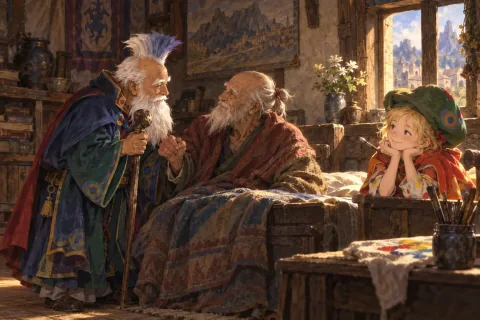
The legendary monster Hidon is hiding at Ebot's Rock, north of Thamasa. Gungho, an old friend of Strago, pretends to be seriously injured to keep a promise from his youth to defeat Hidon. Strago, learning of this, sets out to subdue Hidon on behalf of his friend, and Relm, while noticing Gungho's ruse, silently supports her grandfather's final challenge while pretending not to know.
Gungho's lie is not a malicious deception, but a clumsy consideration to ignite a hot flame once again in an old friend who is losing his will to live. Strago willingly falls for the lie and faces head-on the homework he had put off in a corner of his heart for a long time. In this process, the heavy depth of friendship in old age and the weight of memories passed down through generations are depicted in a calm yet moving way.
The monster Hidon is not just an enemy to be defeated, but a symbol of the past shared by Strago and Gungho. It is an existence condensed with the spirit and passion of their youth, and the regret of what they ultimately could not achieve. The reason this private revenge drama holds significant meaning even in a situation where the world is on the brink of destruction is that it acts as the final puzzle piece that completes the personal history of the character Strago.
The scene where Relm sees through Gungho's acting but does not expose the truth shows her inner maturity. Usually, she would have laughed at the old men's bluff with biting sarcasm, but this time, she respects her grandfather's pride and his sense of debt toward his friend. This means that Relm is no longer a protected child, but has acquired a deep gaze capable of understanding the complex emotions and the weight of others' lives.
There is a risk of battle in going to find Hidon, but there is no basis to read Gungho's fake injury as a test set up by Relm to drive the old man to his death. This optional story brings back the personal wish that remained for Strago. Even within the big goal of saving the world, one person's old promise can have a place. However, one does not need to justify all methods of the deception just because one affirms the friend's good intentions. The texture of the scene comes alive when read as a relationship where friendship, mischief, and pride are mixed.
The process of exploring the dark cave of Ebot's Rock overlaps with the journey of Strago tracing his own past. The act of finding the way while collecting coral pieces resembles the work of picking up scattered fragments of memory and weaving them into one complete narrative. When he finally faced Hidon in the darkness, he might have felt a strange sense of familiarity, as if meeting an old friend again, rather than fear.
The fact that Gungho did not step forward himself but urged Strago on means that he acknowledges his own limits while at the same time fully trusting his friend's abilities. Friendship in old age is expressed not by poking at each other's weaknesses, but by quietly preparing a stage where the other person can shine the brightest. Even if it is a stage that started with a lie, the magic Strago unfolds on it comes across as more truthful and powerful than ever.
The conversation Strago shares with Gungho after returning from defeating Hidon is closer to a modest memoir than an exaggerated heroic tale. Instead of grand pride in having saved the world, they share the relief of having resolved a long-standing wish. This small sense of accomplishment plays a role in helping people living in a collapsed world regain a sense of daily life. This is because the small history of the individual must continue to be written even amidst great despair.
This episode can also be read as a process of Relm understanding her grandfather's generation and inheriting their legacy. Watching Strago learn Hidon's technique, Relm witnesses how the knowledge of magic is passed down through generations. The old promises of the elderly gain new vitality by being imprinted in the memory of the younger generation, Relm. It is a meaningful moment where the past and the future intersect.
Ultimately, the event at Ebot's Rock is a process of asking for new meaning in the life of old age heading toward death. Aging is not just a process of decaying and disappearing, but can be a quiet conclusion that puts a period to an unfinished story and opens the way for the next generation. By keeping his promise to his friend, Strago would have tied up his past and gained the momentum to continue the remaining journey with Relm.
Scope of Materials and Interpretation
The flow is based on the main story of the original Super Famicom version and the Pixel Remaster. Differences in survival, companion recruitment, and endings based on choices are distinguished in the relevant scenes, and the additional dungeons of the GBA version are explained as separate edition elements. Unstated inner thoughts of characters are interpretations based on the context of events, and the identity of the unknown 'Gogo' is not asserted as fact. Date of material verification: October 15, 2026 (Bangkok time).
Square Enix · FINAL FANTASY VI Official Introduction and Characters
Thonky · Friend in Jidoor event walkthrough
comments 0