
Recommended Game Story · Final Fantasy VI Part 24
Chapters in this story
Time Intended for Rachel
Spoiler Warning: This series covers major events and the ending of Final Fantasy VI. If you are new to the game, you may want to read only up to your desired chapter and experience the choices and music yourself. This text contains both descriptions of events and interpretations of the characters' inner thoughts; it is not a translation of original game dialogue or an official novel. Illustrations are AI reconstructions based on public materials.
In the process of finding companions scattered after the world's collapse, Locke's whereabouts lead to the end of the deepest and hottest cave. The Phoenix Cave, which can be visited depending on the player's choices, is a space where he faces the reality of the guilt he has harbored for so long. The blind steps of someone hoping for a miracle and the moment of short farewell that finally arrives shed heavy light on how a person bound to the past walks back into the present. We follow the traces left by his attempt to restore what was lost.
Chapter 1 · The Phoenix Cave Crossed in Two Paths
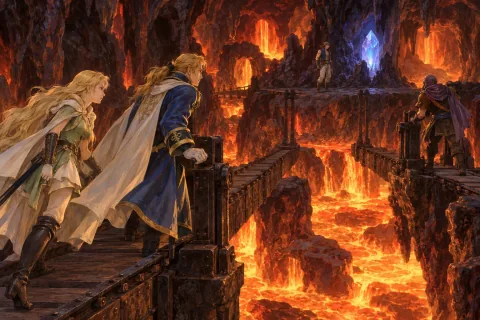
While companions gather again in the ruined world, Locke is exploring the depths of the Phoenix Cave alone. With the sole purpose of using the power of the legendary Esper to revive his lost lover, Rachel, he is making his way through treacherous, lava-boiling terrain in search of the cracked Magicite. The player must operate two parties alternately, stepping on switches to open paths and reach where he is.
This cave is not a mandatory path; it is designed in such a way that, depending on the player's choices, Locke might never be found. It is a physical background that shows that rather than ignoring his companions, he was drawn to this isolated place by a long-standing debt he had to settle personally, even in the face of the world's destruction. The lava and thorny paths visually represent the weight of the heart he carries.
The puzzle elements that require two groups to cooperate to advance paradoxically act as a device to emphasize Locke's thorough isolation. Because he broke through the difficult path—which requires multiple people to join forces to pass—all alone, driven only by the obsession to turn back the past. This allows us to guess at his closed-off inner state, which did not allow for the intervention of others.
The motif of the cracked Magicite symbolizes the precariousness of humans clinging to incomplete hope. The attitude of denying an irreversible death, even while holding a tool of imperfect miracles, is underpinned by a terrible self-reproach that his lover became unhappy because of him. For him, this exploration can be read as a desperate struggle to save his own time before saving the world.
It is unlikely that Locke left his side because he did not value new companions like Celes. Rather, it is highly likely that as new relationships deepened, his fear grew that he could not truly protect anyone in the present without fully facing and taking responsibility for his past failures. The obsession that he must erase the shadows of the past to engage in present relationships as a whole person drove him into the cave.
The red color of the underground, filled with lava, simultaneously reveals his frozen passion, anger, and the harsh environment that seems to punish him. This extreme space, where it is difficult for living things to survive, touches upon the desolate psychological landscape he has inhabited since losing Rachel. The player walks through that hot space of disconnection, feeling the depth of the isolation Locke has endured.
The process of companions finding him can be interpreted as a process of solidarity that pulls a disconnected individual back into the flow of the world. The act of stepping on switches to open closed doors is like a silent expression of will to knock on Locke's tightly closed heart and share the burden he carries. It is a cautious approach that shines an external light on him, trapped in a maze he cannot escape alone.
The broken Magicite that Locke holds creates tension by implying the possibility of failure itself. The sight of him unable to stop walking despite the anxiety that a perfect resurrection might be impossible shows a desperate attempt to seek atonement through the act itself, regardless of the result. This is a realm beyond rational judgment, a blind way of atonement that only the person involved can understand.
The player exploring this optional path stands in a position to empathize with Locke's wounds rather than blaming his selfishness. This is because one can glimpse how heavily the microscopic tragedy that collapsed one person's world weighs on an individual, even amidst the macroscopic tragedy of the world's destruction. It is a point where the game's perspective, which does not neglect personal suffering within a grand narrative, stands out.
When Locke is finally found at the end of the cave, he has already poured everything he could into it. The fragment of the incomplete miracle he obtained now becomes the reason for his steps toward Kohlingen, forcing a moment of truth that had been postponed for a long time. This cave remains not as an end, but as a heavy rite of passage preparing for the most important confrontation where the past and present collide.
Chapter 2 · A Short Farewell Left by a Returned Voice
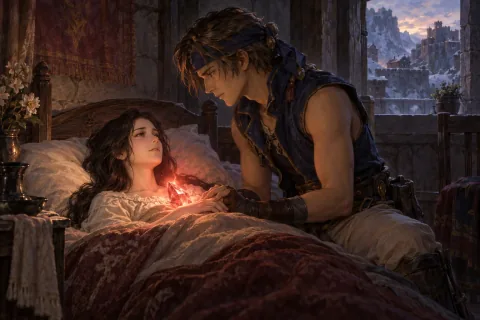
The light emitted by the Phoenix Magicite in the basement of Kohlingen wakes Rachel for only a very short time. Opening her eyes, she remembers the love Locke gave her and leaves a request for him to let go of his guilt toward her and live his life in the present. The miracle does not lead to a permanent resurrection, and only the Phoenix Magicite, having regained its complete form, remains where she left.
This short reunion signifies the failure of the complete resuscitation Locke so desired, but at the same time, it is the moment when the conversation between the two, which had been stopped for a long time, finally finds its conclusion. Rachel's voice is filled not with resentment or regret, but with quiet support for the future of the one left behind. Her final words act as a decisive trigger to break the old chains that were binding Locke.
The direction of choosing a momentary awakening instead of eternal resurrection shows a mature attitude of the narrative toward loss. If death could be easily reversed with magic, the weight of the agony Locke had experienced would have been lightened. By maintaining the stern rule that life that has crossed an irreversible line cannot return to its place, the game does not damage the reality of the loss that the survivor must bear.
The core of the message Rachel conveyed lies in erasing herself as a victim, stuffed into Locke's memory. Instead of asking for responsibility for the accident, she affirms the warmth of the time they spent together, awakening him to the fact that the punishment he inflicted upon himself is meaningless. This comes as a forgiveness and a declaration of liberation from another, which was most needed in the inner self of a human who was endlessly self-flagellating, blaming himself for the sacrifices of others.
In this scene, the restoration of trust paradoxically blooms in the process of accepting an eternal farewell. Locke believed that his sincerity toward her would only be proven if he could revive Rachel, but she answers that the heart already given was enough. It shows that deep comfort can be established just by confirming that the sincerity of their hearts toward each other was not damaged, even without material miracles or the reversal of results.
The fact that the broken Magicite remains in the complete form of Phoenix seems to symbolize that Locke's inner self, which had been left broken, has finally been sutured into a single conclusion. This Magicite is not an object replacing Rachel, but a condensed result of the last request she left and the long time of mourning Locke endured. It is as if the power to open a new future has finally been grasped in the hand that was scraping together the debris of the past.
The conversation exchanged in the moment of the short reunion creates a heavy resonance without flashy rhetoric. The scene of the reunion that Locke must have imagined countless times would probably have been filled with his apologies and tears, but the actual meeting is instead filled with Rachel's calm comfort. This breaks the image of the passive lover trapped in Locke's gaze and reveals the will of a person who independently decides her own end.
The part where Rachel tells Locke to live in the present contains the bitter truth that a life tied to the past ultimately makes both the dead and the living unhappy. She does not want Locke to suffer because he cannot forget her, and she hopes he can smile again in new relationships. This request confirms that the act of Locke opening his heart to others is by no means a betrayal.
The silence that comes after the miracle ends forms a complex space where the pain of loss and the relief of liberation intersect. In this stillness, the player guesses the turbulence of emotions Locke must be experiencing. It is a quiet turning point that pushes him into the flow of a new time, mixed with the emptiness left in the place where the goal he had clung to for so long has disappeared, and the lightness of finally putting down a heavy burden.
This farewell does not stop at showing the tragic ending of a lover, but asks for the true meaning of living with memories. It is a process of learning how to place the past in a safe place so that it does not eat away at the present, rather than forgetting it. Rachel's short return can be read as the cruelest yet kindest consideration the narrative has prepared to make Locke's time flow again.
Chapter 3 · Grasping the Present with Hands That Protect the Past
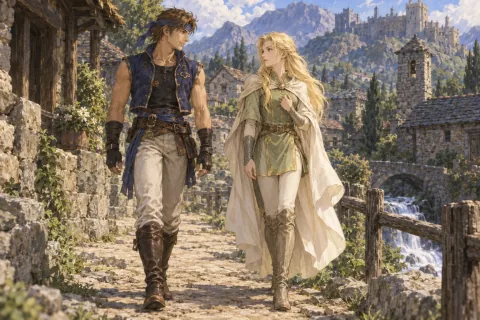
Locke, who buried Rachel's final greeting in his heart, returns to his companions after accepting Rachel's farewell. He rejoins those who waited for him and is ready to jump fully into the fight to save the ruined world. The player who has gone through this optional journey witnesses how the long burden of heart Locke carried was resolved, and how he returns to the present.
The reunion with his companions is more than just a reinforcement of strength; it is the moment when the character Locke overcomes his inner division and establishes himself as a complete companion. He is no longer chased by the obsession that he failed to protect someone, but changes to a state where he can focus on the relationship itself with the people by his side now. This is also a process in which his suppressed original self is fully restored.
The way Locke remembers the past changes its nature from an escape that denies reality to a driving force for living in the present. If the memory until now was a shackle that dragged him into the treacherous depths of the underground cave, the memory after the farewell becomes a foundation that makes his goodwill to protect others even firmer. By accepting the loss, he has learned how not to be crushed by the memory of the loss.
In this process, the perspective on the relationship with Celes also needs to be redefined. Just because Locke has organized the past does not mean that Celes is reduced to a reward or a substitute filling Rachel's empty space. Celes is an independent person who has navigated the difficult world with her own will and choices, and the relationship between the two should be read as a new solidarity of equal people living with their own wounds.
The heart or actions Locke extends to Celes come not as a compensatory psychology to make up for past failures, but as full respect directed toward the person in the present. Having lightened the debt of guilt toward Rachel, he finally secures the vision to see Celes as she is, not as a projection of someone else. This suggests that the center of gravity of the relationship has moved from the phantom of the past to the reality in front of his eyes.
Not all players experience this optional path. If you do not meet Locke again in the Phoenix Cave, you cannot take him as a companion, and the final escape scene reflects that vacancy with other characters' scenes. Therefore, it should not be said that Locke, who has not seen this story, participates in the final battle in the same way. Here, we are reading the path of finding and joining him. The experience of exploring and reuniting on one's own makes one remember the circumstances of the person who has returned with a weight beyond combat power.
His desperate gesture to protect the past now changes into a firm handshake that holds onto his current companions. It is a transition from a defensive attitude of being anxious about losing something to an active attitude of wanting to form and protect new relationships even at the risk of losing them. This can be interpreted as a process of realizing that the courage not to be afraid of being hurt is the true meaning of protection.
Locke's narrative delicately points out how the arrogance of wanting to save someone eats away at oneself, and how one can escape that shackle when accepting the sincerity of others as it is. He was finally able to save himself by admitting the fact that he could not save Rachel. It shows that only those who have learned how to embrace failure can generously embrace the incompleteness of others.
The direction in which his companions silently wait for him and welcome him back proves how trust is maintained even in a ruined world. They do not criticize Locke's private wandering and give him space until his time flows again. This loose but firm solidarity is a point that well shows the unique relationship-building of this game, which respects each other's wounds but supports each other at critical moments.
In the end, the short miracle in the Phoenix Cave and Kohlingen was a ritual for a human to finish a long mourning. Locke is no longer a pursuer chasing the shadows of the dead, but a companion walking toward tomorrow with the living. His earnestness to restore the lost time ended in failure, but on the ashes left by that failure, he salvaged the treasure of the most precious present time.
Scope of Materials and Interpretation
The main story flow of the Super Famicom original and the Pixel Remaster was used as a standard. Differences in survival, companion joining, and endings according to choices are distinguished in the relevant scenes, and GBA-added dungeons are explained as separate edition elements. The unstated inner thoughts of the characters are interpretations read based on the context of the events, and the identity of the unknown, etc., are not concluded as facts. Date of material verification: October 15, 2026 (Bangkok time).
Square Enix · FINAL FANTASY VI Official Introduction and Characters
comments 0