
Recommended Game Story · Shin Megami Tensei V: Vengeance Part 24
Chapters in this story
Afterword · The Questions Remaining After Passing Through Six Futures
Spoiler Notice: This series covers the Canon of Creation and Canon of Vengeance in Shin Megami Tensei V: Vengeance, including the six major endings. The two paths and each ending are distinct alternatives. This is not a transcription of the original game's dialogue or a novel, but an original commentary and critique that reads the choices and emotions of the characters based on major events. Unstated inner thoughts are distinguished as interpretations, and illustrations are AI reconstructions referencing public materials.
Concluding the long journey of Shin Megami Tensei V: Vengeance, we have witnessed six diverging futures woven by countless gods, demons, and humans upon the desolate stage of Da'at. In this 24th and final chapter of the series, we intend to go beyond simply summarizing the game's endings to reflect on what we sought to give up and what we sought to gain at each moment of choice. The four endings of the Canon of Creation and the two endings of the Canon of Vengeance are parallel possibilities born from the collision of different values, and what runs through all these paths is the fundamental question: 'What is a human?' Now, amidst the echoes left by all those choices, we begin our final story, calmly gazing at the ethical dilemmas we faced as players and the landscape beyond them.
Chapter 1 · Optional Battles and Shadows of Other Worlds
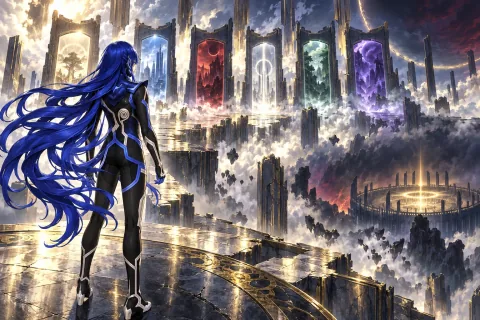
The optional battles against powerful entities such as Shiva, Masakado, Demi-fiend, and Satan encountered in Shin Megami Tensei V: Vengeance are narrative devices that go beyond simple difficulty challenges. These are transcendental beings that exist independently of the six major endings of the main story; the trials of Satan and the 'Godborn' difficulty broaden our perspective on challenges and cycles, but they are not counted as an arbitrary seventh official ending. The access conditions for such additional content vary depending on the path, clear status, and edition, paradoxically showing how vast and multi-layered the world we have traversed is.
Additional content like Satan's trials or the Godborn difficulty serves to broaden the player's view of the cyclical world. This does not increase the number of endings, but rather acts as advanced learning that makes us delve deeper into the meaning of the endings we have already reached. These challenges only prove their worth when the player fully understands the game's systems and has reached the pinnacle of demon fusion and cultivation. In other words, these battles are not so much an extension of the narrative as they are a reward for the player's proficiency and another window into exploring the depth of the world-building.
We must be careful not to conflate these optional battles into an inevitable, singular canon that occurred on every path. If we were to bind all battles into a single linear history, the unique tragedy and hope of each ending would be diluted. Dialogue or events added through specific updates are also not essential narratives that every playthrough must experience, but special fragments given to those who enjoy multiple playthroughs. Through this, we maintain a unique color for each playthrough, allowing players to build up different layers of experience.
These bosses each test the protagonist with their own unique philosophy. They are not merely strong enemies, but judges who question the legitimacy of the path the protagonist has chosen. For example, the battle against the Demi-fiend seems to ask about the weight of being a successor to a legacy of the past, while the confrontation with Satan asks what attitude humans should take on the boundary between order and chaos. These encounters force the player to look back on the path they have walked and ask themselves if the choices they made were worth the price.
Ultimately, optional battles are fragments of a narrative completed through the player's active participation. Beyond the fixed endings presented by the game, the player's own will to overcome obstacles and reach a higher plane becomes a narrative in itself. In this process, the player feels more strongly their awareness as an agent who determines the fate of Da'at, rather than a mere observer. This is the core of an active narrative experience where the player and the game interact, going beyond the passive storytelling method provided by the game.
Through these shadow-like beings, we realize once again that the end of the world is never just one. Optional battles hint at the possibilities of other worlds we have not seen, reminding us that even after the game ends, gods and demons still exist somewhere in Da'at in their own ways. This does not give the player a sense of futility, but rather serves to more clearly imprint the weight of the ending they chose. Through all these challenges, we finally complete our journey as a 'Nahobino' in the true sense.
Chapter 2 · The World Chosen by Those Who Met Demons and Friends
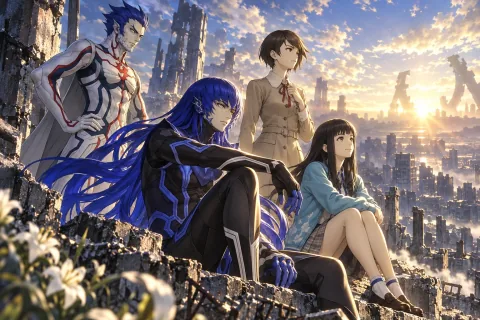
From the protagonist, Aogami, Tsukuyomi, Tao Isonokami, Yoko Hiromine, Yuzuru Atsuta, Miyazu Atsuta, Ichiro Dazai, Sahori Itsukishima, Shohei Yakumo, Nuwa, and even the Qadistu, the countless characters appearing in this game pose questions to the protagonist based on their own beliefs. The four endings of the Canon of Creation and the two endings of the Canon of Vengeance are by no means continuous events that can all be reached in a single playthrough; each choice is a parallel alternative born from the collision of different values. Players struggle between them, moving toward an ending that projects the image of the world they aspire to.
Beyond the repetitive summaries for each character, we must contrast the core issues they raise: the protection of the weak, the right to self-determination, the desire for recognition, the maintenance of the community, and the coexistence of humans and demons. For example, if an ending that values order prioritizes the stability of the community, an ending that aims for chaos emphasizes individual freedom and power. The human-centric endings shown in the Vengeance path resist the existing mythological order and strongly reveal the will of humans to pioneer their own destiny. The collision of these values gives the player constant ethical dilemmas.
If we simplify the confrontation between Tao Isonokami and Yoko Hiromine into a structure of human versus demon, we miss the questions posed by both. Tao does not want to give up on the wishes of those already living, while Yoko hopes to break the structure that breeds oppression so that both humans and demons can have a free start. Neither side is concluded simply by the intimacy of having joined hands. It is a choice that asks who has the right to decide what to save, what to eliminate, and what the price will be.
The process of change in companions like Yuzuru Atsuta or Ichiro Dazai is also a point we must pay attention to. They grow or collapse in the harsh environment of Da'at, carrying their own wounds and desires. Whether their choices lead to tragedy or salvation, the process constantly asks the player, 'What kind of being is a human?' In a world where one must contract with demons and borrow their power to survive, deep reflection is needed on what it truly means to maintain one's humanity.
Ultimately, at the end of this entire journey, the player must take responsibility for the consequences of the ending they chose. The game does not say that any one ending is absolutely correct. Rather, it coldly shows the pros and cons of each ending, inducing the player to judge for themselves. Will you find rest within the mythological order of the Canon of Creation, or will you pioneer a new future within the human-centric struggle of the Canon of Vengeance? This question will remain in the reader's heart long after turning off the game, influencing the perspective on life in reality.
Now, I would like to ask you, the readers. What kind of world did you want to see in the wasteland of Da'at? Is it a world that meets a peaceful end under the order of the gods, or a world that constantly struggles and moves forward in the chaos where demons and humans are mixed? Now that you have passed through six futures, what question remains in your hands? I hope that all the moments we pondered together through this long series will become a small milestone at the very moment you decide the fate of Da'at yourself. The world of Shin Megami Tensei V: Vengeance is now complete with your choices.
Scope of Data and Interpretation
As of October 16, 2026 (Bangkok), official work/character introductions were cross-referenced with the ending/character/quest data below. Official introductions were only checked for the scope of disclosure, and fan wikis and walkthroughs are treated as separate materials. This is a text for an overview of major events and original critique, not a reenactment of all dialogue/play scenes or an official novel. Optional quests and developments by edition/path are not merged into facts common to all playthroughs.
PowerPyx — Distinction between optional bosses and main story endings
PowerPyx — Six endings and additional branching conditions for the Canon of Creation
comments 0