
Recommended Game Story · Shin Megami Tensei V: Vengeance Part 5
Chapters in this story
Canon of Creation · Words That Could Not Reach Sahori
Spoiler Notice: This series covers the Canon of Creation and the Canon of Vengeance in Shin Megami Tensei V: Vengeance, along with the six major endings. The two paths and their respective endings are distinct alternatives. This is not a transcription of the original game's dialogue or a novelization, but an original commentary and critique that interprets the characters' choices and emotions based on key events. Unstated inner thoughts are distinguished as interpretations, and illustrations are AI reconstructions based on public materials.
In the Canon of Creation of Shin Megami Tensei V, the tragedy experienced by Sahori deals with a structural ruin caused by the intersection of the social issue of school bullying and demonic intervention. The devastation in Shinagawa, witnessed by the protagonist and Tao, reveals the process by which everyday safety nets collapse and the limitations of intervening in the suffering of others. By examining the background of why Sahori had no choice but to accept Lahmu's temptation and the consequences brought about by Tao's devotion, this analysis explores the paradox of salvation and the tragic narrative depicted in the Canon of Creation.
Chapter 1 · The Shadow of the Promise to Save
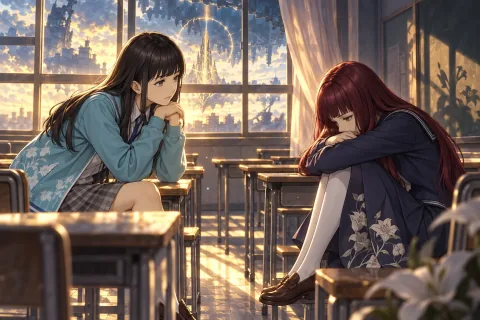
The violence inflicted upon Sahori by her tormentors and the neglect of those around her were wounds that existed beforehand. Lahmu does not become innocent simply because he did not create those wounds. He approaches her promising revenge, but in reality, he seeks to reclaim his own Knowledge dwelling within Sahori to become a Nahobino. The fact that Sahori had nowhere left to turn for help makes this transaction even more cruel. A desperate wish is being exploited for someone else's restoration of power.
The school attack and the kidnapping of students demonstrate the process by which conflicts in the real world are transferred to the battlefield of the otherworld, Da'at. Sahori is swept into a massive vortex of fate regardless of her own will, and the revenge she craved ultimately becomes a trap that leads to her ruin. This event clearly reveals how demons instrumentalize human emotions and how human agency is obliterated in the process.
Tao's concern is sincere, but it cannot immediately end Sahori's suffering. However, it is insufficient to explain that the tragedy occurred simply because Sahori could not accept her friend's goodwill. In a situation where there seems to be no means to stop the repeated bullying, a voice promising revenge can sound like a concrete exit. This scene forces us to look back at why other safe options disappeared before judging the victim's judgment.
Sahori's anger cannot be simply dismissed as evil. The pain she experienced is real, and the responsibility of the surrounding environment that stood by and watched is also heavy. However, the method of revenge presented by Lahmu does not save Sahori. It is a path that leads only to destruction, and Sahori falls into a vicious cycle where she uses the suffering of others as collateral to resolve her own pain. In this process, the victim transforms into a perpetrator, and justice drifts further away.
The helplessness Tao feels aligns with the frustration players face as they progress through the game. Tao's will to save Sahori is thwarted in the face of the immense evil power of Lahmu. This narrative device allows the player to feel pity for Sahori's choices while contemplating why she had no other choice and how fatal the tragedy caused by the breakdown of communication can be.
Chapter 2 · The Life Tao Paid and the Remaining Loss
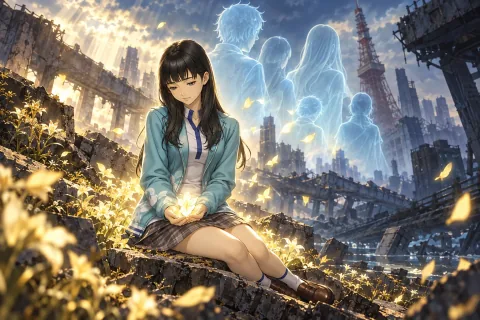
In the Canon of Creation, Tao and the protagonist are hit by a fatal attack from Lahmu. Tao uses her latent power to revive the protagonist and Aogami, but she loses her life as a human. Even after successfully defeating Lahmu, they cannot return Sahori as a living friend. The fact that achieving the goal of the battle and saving the person did not ultimately align is the core of this passage.
Tao's choice is read as a decision to save the person in front of her. However, gauging what she hoped for and saying that her death was absolutely necessary are different things. For the player who can continue the battle, the restoration of ability is a reward, but within the story, the empty spaces of two friends who did not return together remain. It is a moment where the game's victory indicator does not emotionally signify victory.
Defeating Lahmu can prevent him from harming others further. However, reversing the life of Sahori, who was already caught up in the fusion, is a different matter. To explain this tragedy, it is not necessary to conclude that Sahori's soul was essentially corrupted. The loss after the battle is heavy enough simply with the result that she could not be saved and the fact that Tao's intention to avoid that result went awry.
Tao's reappearance as a goddess is a matter for the distant future. What the player faces right now is the loss of Tao and the tragedy of Sahori. The fates of these two characters are intertwined, and Tao's sacrifice makes Sahori's tragedy stand out even more. The Canon of Creation resonates deeply with us through the portrayal of human frailty, demonic temptation, and the humans agonizing between them. Tao's death is not a rite of passage for a new beginning, but loss itself.
Sahori was a victim of bullying, but after merging with Lahmu, she stands in the position of a perpetrator. However, condemning her is not the only answer. While the game shows Sahori's evil deeds, it does not let go of compassion for why she had to become that way. Sahori wanted revenge, but what she got was ruin. This tragic ending clearly shows the futility that revenge brings and makes us rethink the dangers inherent in the emotion of revenge.
Scope of Materials and Interpretation
As of October 16, 2026 (Bangkok), official works and character introductions have been cross-referenced with the ending, character, and quest materials below. Official introductions were only checked for the scope of disclosure, and fan wikis and strategy guides are distinguished as separate materials. This is a text for an overview of major events and original critique, not a reenactment of all dialogue/play scenes or an official novel. Optional quests and developments by version/path are not consolidated as facts common to all playthroughs.
Megami Tensei Wiki — Comparison of events by Tao's two paths
comments 0