
Recommended Game Story · Shin Megami Tensei V: Vengeance Part 20
Chapters in this story
Vengeance Route · Humans Before the Final Gate
Spoiler Notice: This series covers the Canon of Creation and the Canon of Vengeance, along with the six major endings of Shin Megami Tensei V: Vengeance. The two paths and their respective endings are distinct alternatives. This is not a transcript of the original game's dialogue or a novelization, but an original commentary and critique that interprets the characters' choices and emotions based on key events. Unstated inner thoughts are distinguished as interpretations, and illustrations are AI reconstructions based on public materials.
We have reached the terminus of the Canon of Vengeance. Tragedies and resolutions entirely different from the Canon of Creation await. The relationship between Yakumo and Nuwa, and the crossroads of the world presented by Tao and Yoko, are not merely a confrontation between good and evil. They are fundamental questions about how humanity will accept the order of God. At this point, the player faces the final choice as a Nahobino and as a human being. Will you protect the order of God, or will you reject that order itself? Before the final gate of the Canon of Vengeance, we look back on the journey through Da'at that we have walked thus far.
Chapter 1 · Yakumo Who Lost Nuwa
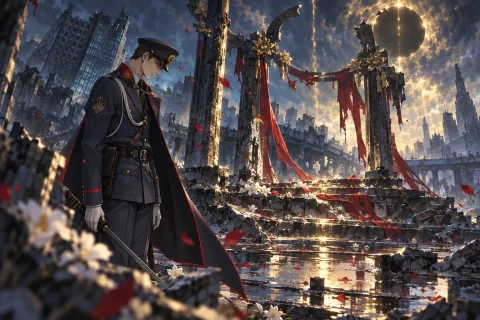
Yakumo has consistently defined Nuwa as a tool for his own purposes. In the Canon of Vengeance, his past and his hatred for demons are revealed more deeply, and his obsession with destroying demons to create a world for humans alone is cloaked in cold logic. However, the moment Nuwa vanishes to protect him from Tiamat's attack, the logic he has built collapses. Unlike the Canon of Creation, where Yakumo and Nuwa go to the throne together, the loss of a companion he called a tool carries more meaning for him than a simple loss of combat power, forcing him to reflect on the words he once uttered.
It is highly likely that Yakumo calling Nuwa a tool was a self-defense mechanism to refuse coexistence with demons. Because demons were the object of his hatred and enemies to be exterminated, he sought to protect his convictions by defining Nuwa, who accompanied him, as a means to an end. However, Nuwa's death shows that the existence of demons, which he loathed, is actually intertwined with human will. The sense of loss he must have felt is closer to an intellectual shock that fundamentally shakes his worldview, going beyond the simple sadness of losing a comrade.
In the Canon of Vengeance, Yakumo's narrative takes on a much more personal and tragic tone than in the Canon of Creation. If he was a companion moving toward the throne with Nuwa in the Canon of Creation, in the Canon of Vengeance, he strongly reveals the aspect of an avenger left alone. The absence of Nuwa heightens the purity of his hatred while simultaneously casting doubt on whether the place that hatred is directed is truly correct. He must now walk toward the final gate with his own will alone, having lost the only witness to prove his convictions.
Through the character of Yakumo, the player indirectly experiences the isolation and the weight of choices that a Nahobino faces. Like the protagonist, Yakumo is a human who resists the order of God, but his method is extreme and closed-off. His journey shows the ethical cost of humans using the power of God to deny God. The silence Yakumo shows after losing Nuwa implies that the conclusion he has reached is not a victory at all, but one that touches upon deep nihilism. This leaves a profound lingering impression on the player as well.
Shinjuku after Nuwa disappears feels like a space that projects Yakumo's inner self. The landscape of the devastated city visually reproduces the weight of the burden he carries. Yakumo no longer compromises. All that remains for him is the will to carry out his convictions. This aspect of him makes the player rethink their identity as a Nahobino once again. The question of what we fight for and what we use the power of God to protect is posed through him.
For Yakumo, Nuwa's death is not something to be dismissed as a punishment he deserved. While one can criticize the harsh view of survival he put forward, the pain of actual loss can be viewed separately. The fact that a man who claimed to protect humanity survived under the protection of a demon remains a powerful question that shakes his certainty. Rather than explaining what kind of heart he reached afterward, it is necessary to note that the words he used before can no longer sufficiently explain the relationship.
Chapter 2 · The Path to the Throne and the Crossroads of Two Goddesses
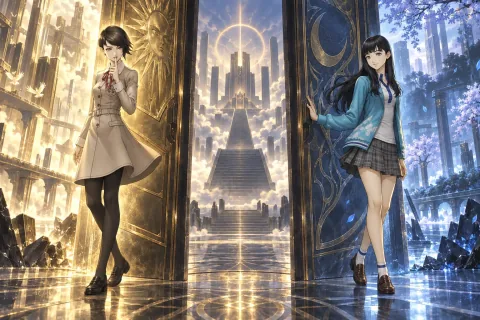
In the Canon of Vengeance, the path to the throne also leads through the Key of Daito and the Temple of Eternity to the confrontation with Metatron. This process follows a structure similar to the Canon of Creation, but its meaning is entirely different. On this path, the player faces a final confrontation with Abdiel and Ichiro Dazai, figures who blindly believe in the order of God. Afterward, the path branches into the two futures presented by Tao and Yoko; the four choices of the Canon of Creation do not open as they did before. This journey is not merely a competition to seize the throne, but a philosophical struggle over how to reorganize the order of God.
Abdiel and Ichiro Dazai represent the archetype of humans and angels who seek to protect the order of God. Their convictions are firm, but the results they bring flow in a direction that castrates human will. Through the confrontation with them, the player witnesses the comfort that the order of God gives to humans and the loss of freedom that must be paid as the price. This confrontation goes beyond a simple structure of good and evil, raising fundamental doubts about whether humans can live autonomously under the rule of God.
Tao and Yoko present different futures before the throne. Tao aims for a new order that does not abandon the wishes of those living now, while Yoko seeks to sever the foundation that has birthed rulers and the ruled and start anew. If one explains Yoko's will as an era for humans alone without demons, the points of contention between the two paths disappear. The goal of opening freedom to both humans and demons, and the price of erasing the existing world, must be discussed together.
The choice between Tao and Yoko is the heaviest decision in the game. Tao's path is a conservative approach that seeks gradual change while maintaining the existing order, whereas Yoko's path is a revolutionary approach that seeks to destroy everything and plan for a new beginning. By deciding who to side with, the player confirms the vision of the world they aspire to. This choice is not merely a branch that determines the ending, but the player's answer to how they will conclude the journey thus far.
The ending of the Canon of Vengeance requires a level of contemplation different from the four options of the Canon of Creation. If the Canon of Creation focused on how to modify the order of God, the Canon of Vengeance asks a more fundamental question: whether to sustain the order of God itself or to abolish it completely. At this crossroads, the player feels the weight of the convictions held by the two goddesses, Tao and Yoko. This is a process that asks the player for ethical responsibility as a Nahobino carrying the fate of the world, going beyond a simple game-like choice.
The conflict before the final gate is the core of the Canon of Vengeance. Through the journey so far, the player has gained the power of God and has grown while agonizing between demons and humans. Now, based on all that experience, the player must choose one of either Tao or Yoko and ascend to the throne. This choice is by no means light, and all the events and emotions the player has experienced in Da'at so far are melted into this decision. The moment the final gate is opened, the player becomes the master and witness of the world they have chosen.
Data and Scope of Interpretation
As of October 16, 2026 (Bangkok), official work and character introductions have been cross-referenced with the ending, character, and quest data below. Official introductions were only checked for the scope of public information, and fan wikis and walkthroughs are distinguished as separate materials. This is a text for an overview of major events and original critique, not a reenactment of all dialogue or gameplay scenes, nor an official novel. Choice quests and developments by version/path are not consolidated into facts common to all playthroughs.
Megami Tensei Wiki — Yakumo and Nuwa's path-specific actions
Megami Tensei Wiki — Events at the Sanctuary of Shakan
PowerPyx — Six endings and additional branch conditions for the Canon of Creation
comments 0