
Recommended Game Story · Shin Megami Tensei V: Vengeance Part 22
Chapters in this story
Vengeance Ending 1 · A World for All Wishes
Spoiler Notice: This series covers the Canon of Creation and Canon of Vengeance of Shin Megami Tensei V: Vengeance, including the six major endings. The two paths and their respective endings are distinct alternatives. This is not a transcription of the original game's dialogue or a novelization, but an original commentary and critique that reads the characters' choices and emotions based on major events. Unstated inner thoughts are distinguished as interpretations, and illustrations are AI reconstructions based on public materials.
The Vengeance route of Shin Megami Tensei V: Vengeance presents a different texture from the grand, mythical narrative of the Canon of Creation. In particular, the path of Order taken with Tao Isonokami does not merely defend the existing order of the gods, but embodies a longing for a new world centered on human wishes. In this installment, we will critically examine what it means to face the abyss known as Tehom beyond Tiamat, and how the daily life we sought to protect is reconstructed. Let us explore whose wish this peace is, and what the price of it might be, once all choices have been made.
Chapter 1 · The People Tao Does Not Give Up On
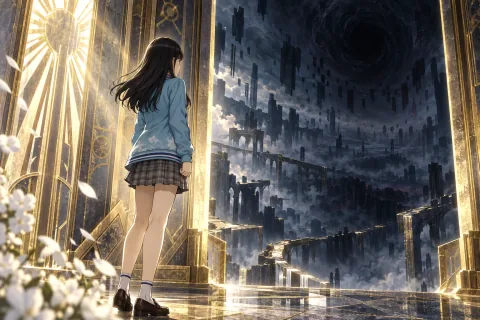
The path taken with Tao aims for a world that redeems the wishes of those who currently exist. Even after surpassing Tiamat, the confrontation does not end. Yoko Hiromine sacrifices herself to summon the primordial abyss known as Tehom, and the protagonist and Tao must pass through it. This battle is distinct from the event where one faces Mastema in other paths. It is not merely that the names of the enemies are swapped; the entity one faces changes depending on which future was rejected.
However, Tao's ideal of redeeming everyone's wishes inevitably clashes with a massive ethical dilemma. Designing a world where people with conflicting wishes coexist implies the possibility that one person's wish might need to be adjusted or suppressed for the sake of another's. At this point, Tao's path transcends the dichotomy of good and evil, raising questions about how the value of order must compromise and coordinate with human desire. This is not simply about maintaining peace, but a process of rewriting the definition of peace itself.
The scene where Yoko sacrifices herself to summon the primordial abyss of Tehom after defeating Tiamat is the most dramatic turning point in this narrative. Tehom is not merely an evil or an antagonist, but the source of chaos that order has suppressed, symbolizing the fundamental lack inherent in humanity. The way Yoko confronts this abyss clashes directly with Tao's order, clearly revealing the differences in the worldviews the two characters aim for. The fact that Tehom and Mastema play different roles in this path suggests that establishing order is not just about eliminating evil, but about how to govern the abyss.
While the Order path with Tao aims for a new world that redeems the wishes of existing people, the sacrifices and conflicts that arise in the process are by no means light. The devotion Tao shows is for others, but questions are constantly raised about who those others are, and whether their wishes truly align with the order Tao envisions. This requires the player not just to follow a set path, but to engage in ethical reflection on who the world they are creating is for, and to what extent human free will can be guaranteed within that world.
As the player traverses the desolate landscape of Da'at with Tao, they witness how her compassion for humanity and her convictions become the driving force for reshaping the world. In this process, Tao grows beyond a mere assistant into a companion who becomes a co-architect of the world alongside the protagonist. The unwavering attitude she displays gives the player deep trust, but at the same time, makes them feel the weight of that conviction. The journey with Tao is not just a process of defeating enemies, but a process of constantly asking oneself what values we wish to protect.
Ultimately, Tao's path does not lead to an unconditional repetition of order, but toward the creation of a new order centered on human wishes. The process of facing and overcoming the vast abyss of Tehom is like a rite of passage toward a new world where human will, rather than the mythical order of the past, is reflected. The choices made by Tao and the protagonist on this path are the first steps toward a world where human wishes, not the will of God, take center stage, which can be considered the core narrative achievement of the Vengeance route presented by Shin Megami Tensei V: Vengeance.
Chapter 2 · The Revived Daily Life and Yoko's Place
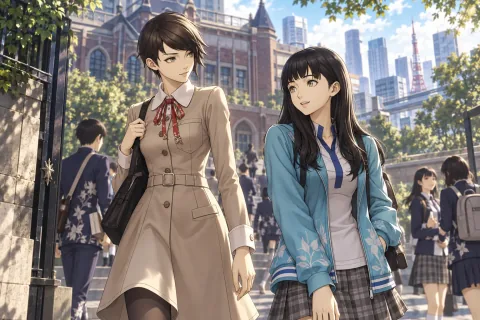
After overcoming Tehom, facing Lucifer, and going through the decisive battle to gain his Knowledge, the world the protagonist faces looks completely different from the previous Da'at. The sight of Tokyo, where dead friends have returned to life and daily life has been restored, seems peaceful, but at the same time, it creates a subtle tension regarding what price and design maintain that peace. This ending shows a world as the result of the order chosen by the protagonist, rather than a utopia where everything is perfectly resolved. In this tranquility, the player confirms the results of their choices and feels complex emotions.
A point of particular note is that even Yoko lives within this new world. This shows that the order Tao aims for is not just for those who follow her, but has the will to embrace even those who were hostile or touched by the abyss. Yoko's presence symbolizes the scope of inclusivity in the new world, and the sight of her blending into daily life is read not as oppression forced by order, but as a result reflecting Tao's will for reconciliation and coexistence. This holds meaning beyond a simple victory.
However, it cannot be concluded that this ending is the same result as the Creation Order ending. The ending of the Vengeance route is a unique result created by the hardships the protagonist has endured and the complex intertwining of relationships with Tao and Yoko. The peace of the new world is not merely a restoration of the past daily life, but a new design reflecting the experiences the protagonist had in Da'at and the wisdom gained in the process. The question of who designed this peace leads to the fundamental question of who the master of this world is, and the player looks back on their choices as the subject of that design.
The sight of Tao and Yoko living like ordinary students in the restored daily life has a completely different texture from the daily life at the beginning of the game. They no longer appear as tools of a mythical war, but as beings living their lives by their own will. However, the question of whether this tranquility will last forever, or if it is being controlled by another form of order, does not disappear. This ambiguity is the charm of the Shin Megami Tensei series, a point that does not force an answer on the player but makes them think for themselves.
This ending asks whether human desire can truly be satisfied under the banner of a world for all wishes. The world created by Tao and the protagonist is certainly peaceful, but that peace would have been impossible without someone's sacrifice or compromise. This ending, which attempted to embrace even the dark side of humanity that Yoko showed through the abyss, tries to present an answer to how order integrates darkness rather than just remaining in the realm of light. This is an attempt to explore new possibilities beyond the dichotomy of order and chaos.
Ultimately, this ending does not show the player a completed story, but leaves them with homework on how to accept the world they have created. The daily life shared by Tao and Yoko is beautiful, but one must not forget the weight of the choices hidden behind it. In this way, Shin Megami Tensei V: Vengeance makes the player deeply reflect on how their choices affect the world and what the meaning of those results is. Now, I hope you find the answer yourself as to what kind of tomorrow you will dream of with them in that world you have created.
Scope of Materials and Interpretation
As of October 16, 2026 (Bangkok), official work and character introductions have been cross-referenced with the ending, character, and quest data below. Official introductions were checked only for the scope of disclosure, and fan wikis and walkthroughs are distinguished as separate materials. This is a text for an overview of major events and original critique, not a reenactment of all dialogue or gameplay scenes, nor an official novel. Choice quests and developments by version/path are not consolidated as facts common to all playthroughs.
Megami Tensei Wiki — Comparison of Yoko's background and path-specific choices
Megami Tensei Wiki — Background of Tiamat and the Creation system
PowerPyx — Six endings and additional branching conditions for the Canon of Creation
comments 0