
Recommended Game Story · Shin Megami Tensei V: Vengeance Part 21
Chapters in this story
Vengeance Path · The Returning Blue Voice
Spoiler Notice: This series covers the Canon of Creation and the Canon of Vengeance of Shin Megami Tensei V: Vengeance, including all six major endings. The two paths and their respective endings are distinct alternatives. This is not a transcript of the original game's dialogue or a novelization, but an original commentary and critique that interprets the choices and emotions of the characters based on major events. Unstated inner thoughts are distinguished as interpretations, and illustrations are AI reconstructions based on public materials.
The Vengeance path of Shin Megami Tensei V: Vengeance forces us to confront the weight of primordial chaos before the order of creation was established. At its center stands Tiamat, the great mother who is both the source of all life and the entity that devours everything. This overwhelming presence the protagonist faces is read not merely as an enemy to be defeated, but as a symbol of the primal desires and regression that were suppressed in the name of order. In this installment, we illuminate the complex interests surrounding Tiamat and the final choices characters make in the face of her destructive power. The return of Aogami and the sacrifice of Koshimizu remind us once again of the meaning of loss and salvation in the game, asking the player what the true value of a companion is. What destination is the blue voice echoing through the desolate landscape of Da'at heading toward?
Chapter 1 · The Mother Who Devours All
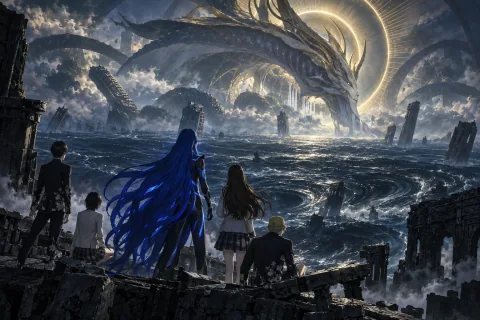
Tiamat resides in the abyss of Da'at as the primordial mother figure who was chaos itself before the throne of creation was established. It is revealed through the Vengeance path that her power was sealed after she was defeated by Marduk, the embodiment of order, and that the world we experience is merely a system built upon the wreckage of that defeat. Depending on the path, Yoko stands in the protagonist's way by manipulating Tiamat on the Tao route, or Mastema does so on the Yoko route. Tiamat's appearance is an event that raises fundamental questions about the legitimacy of the current worldview, going beyond a simple encounter with a powerful boss.
The conflict between Yoko's intention to use Tiamat as a member of the Qadistu and Mastema's attempt to keep her in check to achieve his own goals demonstrates the political dynamics surrounding this great mother. Yoko seeks to overthrow the existing mythological order by borrowing Tiamat's power, while Mastema intends to keep even that chaos under his control. In this process, Tiamat suffers the tragedy of being reduced to a tool for others, regardless of her own will. As players watch this massive entity being swayed by the desires of others, they witness how an absolute being in mythology is consumed by human political calculations.
The overwhelming destructive power Tiamat displays is proportional to the magnitude of the loss she harbors. She carries the sorrow of a mother who lost her children and had her world taken away. Her act of trying to devour the world can paradoxically be interpreted as a twisted manifestation of maternal love, attempting to return everything to her embrace. Players come to perceive her not just as a monster to be defeated, but as a tragic entity representing the voices of a suppressed past. This is a crucial point showing how the game handles the fundamental suffering of existence beyond the dichotomy of good and evil.
The battle against Tiamat offers players psychological tension, going beyond simple level differences, as they face an entity that denies the very foundation of this world. The energy she emits alters the terrain of Da'at and exerts pressure as if trying to return everything around her to nothingness. This battle is a stage that tests whether the power the player has accumulated as a Nahobino is truly effective against the primordial power that existed before creation. Players endure Tiamat's attacks and personally experience the immense sorrow and rage she holds.
The debate between order and chaos does not end simply by choosing to defeat Tiamat. This battle is passed regardless of whether one accompanies Tao or Yoko. Therefore, this victory cannot be concluded as an event where the possibility of primordial freedom disappears forever. The judgment on what to create after defeating the same enemy differs. This is why the common result of the battle and the different meanings of the two endings must be read separately.
The background of being a primordial mother defeated by Marduk adds historical weight to Tiamat's appearance. However, knowing that background does not mean we know what Tiamat wanted in her heart or how she accepted her defeat. What can be confirmed here is who moved her and whom that power hurt. It is more accurate to read the problems that arise when a plan claiming liberation uses the people currently existing as sacrifices through the results.
Chapter 2 · The Return of Aogami and Koshimizu's Final Protection
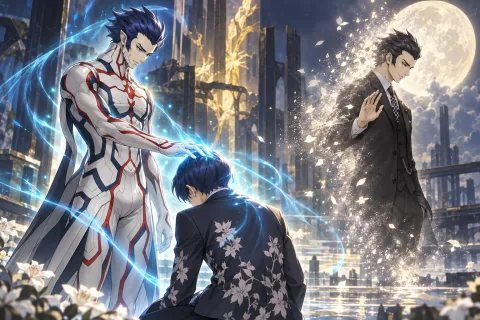
After regenerating, Tiamat deals a fatal blow to Koshimizu and the chosen goddess, bringing the crisis to a climax. At this moment, the sky of Da'at is filled with a sense of despair as if it were collapsing, and the player feels a sense of helplessness in the face of the sacrifice of their companions. However, at the end of that despair, Aogami, who had been absorbed for so long and whose presence had faded, is released and fuses with the protagonist once again. Aogami's return is read not merely as a replenishment of combat power, but as a symbolic event to end Tiamat with power connected to the Susano-o dragon-slaying myth.
The scene where Aogami fuses with the protagonist again is a moment where the Susano-o dragon-slaying myth is reinterpreted in a modern way. If the myth of the past was a hero's tale, the fusion here shows a deep bond where two beings share each other's pain and hope to become one. Aogami's blue light pierces through Tiamat's darkness, granting the protagonist new power. This power is not just a means to defeat an enemy, but a crystallization of the will to throw everything away to protect what is precious.
On the other hand, Koshimizu's end shows a tragedy of a different resolution than Aogami's return. He chooses the path of sacrificing his own existence to save the goddess he chose. Koshimizu's death offsets the joy caused by Aogami's return, painfully imprinting on the player the fact that victory always comes with a price. Just because Aogami has returned does not mean everything is perfectly restored. Koshimizu's sacrifice makes the weight of the loss experienced by the player even heavier, and grants a sense of responsibility regarding how to carry on the will he left behind.
The return of Aogami and the death of Koshimizu leave different emotions within a single victory. The joy felt because of the person who returned does not erase the sadness for the person who left. A player who has gone through both companions can reflect on how the same promise to protect came from different relationships and choices. The fact that it is difficult to calculate that the loss was compensated because someone else was gained distinguishes this scene from a simple change in combat power.
The final blow that ends Tiamat is the crystallization of the rage and sorrow poured out by Aogami and the protagonist as they become one. This attack goes beyond the act of simply defeating an enemy; it is like a declaration of liberation that breaks the chains of fate and mythology that suppressed them. Players feel a catharsis as all the emotions accumulated so far are released, watching the blue light spread across the screen and feeling the vibration transmitted through the controller. This victory is by no means light, and one realizes it is a valuable result built upon numerous sacrifices.
Koshimizu gives himself up to save the chosen goddess. One can read the intention to protect in that action, but there is no need to add a monologue about what he was thinking in his final moments. The fact that remains is that Koshimizu can no longer be with the protagonist, who has joined hands with Aogami again. The next creation is remembered not as an achievement of one victorious person, but as a path that remembers the different companions who helped reach it.
Scope of Data and Interpretation
As of October 16, 2026 (Bangkok), official work and character introductions were cross-referenced with the ending, character, and quest data below. Official introductions were only checked for the scope of disclosure, and fan wikis and walkthroughs are classified as separate materials. This is a text for an overview of major events and original critique, not a reenactment of all dialogue/play scenes or an official novel. Choice quests and developments by version/path are not combined into facts common to all playthroughs.
Megami Tensei Wiki — Background of Tiamat and the Creation System
Megami Tensei Wiki — Tsukuyomi and the Two Nahobino Paths
Megami Tensei Wiki — Yoko's Background and Comparison of Choices by Path
comments 0