
Recommended Game Story: Shin Megami Tensei V: Vengeance Part 4
Chapters in this story
Common: The Throne Without a God
Spoiler Notice: This series covers the Canon of Creation and Canon of Vengeance in Shin Megami Tensei V: Vengeance, including all six major endings. Both paths and their respective endings are distinct alternatives. This is not a transcription of the original game's dialogue or a novelization, but an original commentary and critique that interprets character choices and emotions based on major events. Unstated inner thoughts are distinguished as interpretations, and illustrations are AI reconstructions based on public materials.
The world of Shin Megami Tensei V: Vengeance is a theater of fierce struggle where gods and demons vie for the throne after the collapse of the Creator's order. This narrative goes beyond a simple confrontation between good and evil, posing the fundamental question of who shall define the laws of the world. This series analyzes the essence of the Nahobino and the tragic significance of the space known as Da'at. The process of human Knowledge combining with divine power is not merely an acquisition of strength, but a philosophical turning point that dismantles existing mythological orders and explores new possibilities. In these ruins, the player faces the void left by the absence of God and bears the heavy responsibility of choosing what future to forge as a human.
Chapter 1: The Gods Deprived of Knowledge and Humanity
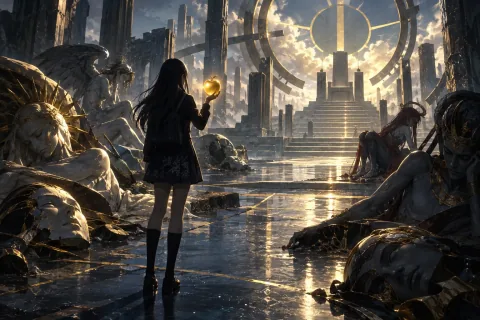
The being who ascends the Throne of Creation can alter the laws of the world. The gods who once vied for that seat were turned into demons after being stripped of their Knowledge by the Creator, and that Knowledge came to reside within humans. Here, 'Knowledge' does not refer to test scores or intelligence. It is established as a part of the demons' own existence that they lost. Thus, the life of an ordinary student appears to the gods as the key to reclaiming their lost power.
The union of Aogami and the protagonist demonstrates this setting physically. One can become a Nahobino when the life of a demon and the corresponding human Knowledge meet again. It is not the case that just any demon merging with any human produces the same result. Understanding this difference allows one to grasp why certain gods are obsessed with specific humans. That obsession can be a partnership that respects the human heart, or a unilateral desire to reclaim a part of oneself.
The gods treat humans as tools to reclaim their Knowledge, thoroughly disregarding their dignity. This arrogant perspective triggers the fundamental conflict between gods and humans. Humans emerge not as beings exploited as mere vessels or repositories of Knowledge, but as subjects who can contain divine power and shake the mythological order. This directly refutes the logic of the gods, who seek to place human value beneath divine power.
In this worldview, angels are also included within the classification system of demons. This dismantles the binary structure of good and evil, showing that all beings are either agents of the Creator's power or competitors seeking to usurp it. The order claimed by the angels is merely another form of domination that suppresses human freedom. Within this structure, humans are depicted as the most vulnerable yet essential beings who must survive on the battlefield of gods and demons.
This setting ties the power of combat and the right of creation into the same question. Does the mere fact that one can defeat an opponent grant the right to redesign that opponent's life? Players choose and fuse demon allies to become stronger, but in the end, they must also judge to what order that power will be applied. It raises the question of whether the familiar attitude of seeking advantageous choices in battle can serve as a sufficient standard when determining the future of the world.
Ultimately, the relationship between the gods deprived of Knowledge and humans is a struggle that transcends the relationship between power and the ruled. The gods attempt to recreate their glory through humans, but humans harbor the potential to use that Knowledge to reject the divine order. Depending on the player's choices, this world will either return to the divine order or walk an entirely new path. The decision made by a human, bearing the heavy burden called Knowledge, before the throne is the core of this narrative.
Chapter 2: The Collapse Eighteen Years Ago and the Leftover Tokyo
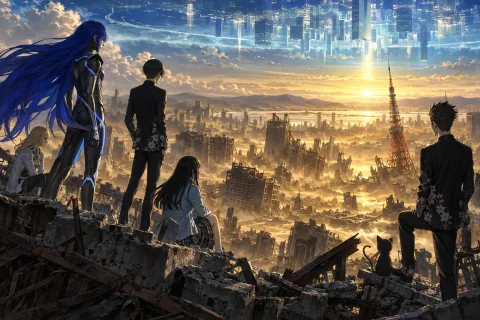
The ruins of Tokyo spread across Da'at are the horrific result of the Great War that occurred 18 years ago. The daily life we knew has already collapsed, and the current Tokyo is a reconstructed space barely maintained by the Shekinah Glory, the power of the Creator. This city is a ghost-like place holding onto memories of the past, and the demons and humans living within it are all fragments of a collapsed world. The landscape of Tokyo that the player encounters is beautiful yet chilling, and the shadow of destruction hidden behind it reveals the precariousness of the world.
The fact that the Creator was defeated by Lucifer and died means that the absolute order that sustained this world has vanished. As the power of the Shekinah Glory weakens, the reconstruction of the city becomes increasingly unstable, suggesting that the collapse of the world is accelerating. In this situation, the remaining Tokyo is no longer a safe haven, but a battleground for demons seeking to occupy the space where divine power has vanished. The player must navigate this precarious city and contemplate what to save at the end of the world's destruction.
One cannot simply dismiss the human lives in the reconstructed city as fake. For those living within it, this daily life is the only reality, and their joys and sorrows are more truthful than any other reality. Even if the city is maintained by the power of the Creator, the human relationships formed within it and the fear and hope they feel are undeniable proof of life. Through this fake city, the game asks how fragile the reality we believe in truly is.
The fact that the power to maintain the city has vanished makes each claim to creation more desperate. The gods assert their logic to restore their order, demons to realize their desires, and humans to survive. This desperation permeates every corner of Da'at, and the player must listen to their arguments and ponder whose side to take. The power vacuum causes chaos, but at the same time, it opens up new possibilities.
The experience of exploring the Tokyo of Da'at resembles the process of excavating the heritage of a destroyed world. Traces of the past visible between collapsed buildings make one imagine the lives of the people who once existed here. Through this environmental storytelling, the game effectively conveys the tragedy of the world without direct dialogue. While walking through the ruins, the player is constantly forced to ponder how much of a scar the war of the gods has left on humanity, and how to move forward after overcoming those scars.
Ultimately, the collapse 18 years ago is not just a past event, but an ongoing tragedy. Tokyo, left behind after the death of the Creator, is a massive test bed for how humans will carve out their own path in a world where the divine order has vanished. The player must establish their identity as the Nahobino amidst these ruins and make the decision to end the war of the gods. The Tokyo of Da'at is not merely a background, but a living narrative itself, waiting for the player's choice.
Scope of Materials and Interpretation
As of October 16, 2026 (Bangkok), official work and character introductions have been cross-referenced with the ending, character, and quest materials below. Official introductions were only checked for the scope of disclosure, and fan wikis and walkthroughs are distinguished as separate materials. This is a text for an overview of major events and original critique, not a reenactment of all dialogue or gameplay scenes, nor an official novel. Optional quests and developments by version/path are not consolidated into facts common to all playthroughs.
SEGA/ATLUS Official Story and Character Introduction
Megami Tensei Wiki — Comparison of the World and Events of Shin Megami Tensei V
Megami Tensei Wiki — The Structure of Knowledge and Creation
comments 0