
Recommended Game Story: Shin Megami Tensei V: Vengeance Part 1
Chapters in this story
Common: Closing the Book and Stepping into the Desert
Spoiler Notice: This series covers the Canon of Creation and the Canon of Vengeance in Shin Megami Tensei V: Vengeance, including all six major endings. The two paths and their respective endings are distinct alternatives. This is not a transcription of the original game's dialogue or a novelization, but an original commentary and critique that interprets the characters' choices and emotions based on key events. Unstated inner thoughts are distinguished as interpretations, and illustrations are AI reconstructions based on public materials.
The world of Shin Megami Tensei V begins as the facade of a peaceful daily life is torn away. The collapse of the Takanawa Tunnel is more than a mere accident; it signifies the total annihilation of the coordinate system of reality upon which the protagonist stood. Da'at, the desolate desert, is not a space in another dimension, but the ruins of Tokyo destroyed by the war of the gods. This series analyzes the choices made by human will amidst the conflict between gods and demons, and the ripples those choices cause in the fate of the world. Facing the dust-filled winds of a ruined Tokyo, we track the reality of the destruction the protagonist encounters.
Chapter 1: The Student Who Lost the Way Home
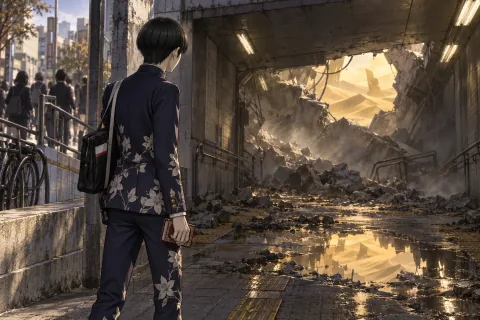
The story begins with a quintessential, everyday scene in Tokyo. The protagonist is an ordinary student who repeats the routine of commuting to and from school. This daily life provides the reader with a familiar sense of reality through specific geographical coordinates like the Takanawa Tunnel. However, the collapse of the tunnel is more than a disaster; it is a signal flare announcing that the coordinate system of the daily life we took for granted has completely collapsed. Through this sudden severance experienced by the protagonist, the reader confronts the terror and bewilderment of a safe world transforming into an unfamiliar space in an instant.
Da'at, which unfolds beyond the collapsed tunnel, is both the ruins of the Tokyo we knew and a wasteland where mythological imagination is projected. This is not another planet or a fantasy world, but a space of destruction that exists as an extension of the reality we stood upon. The desertified terrain and the bizarre forms of the demons make it clear that the protagonist is no longer a protected student, but an isolated being who must struggle for survival. This spatial contrast concretizes the sense of loss experienced by the protagonist and conveys the tragic sentiment of the worldview presented by the game.
The Da'at the protagonist encounters is not merely a physical ruin, but the traces left behind by the war of the gods. Here, the protagonist is swept into a massive vortex of fate, regardless of their own will. The fact that they have lost their way home provides a powerful motivation for the protagonist, while paradoxically showing how limited their choices are. In this process, the reader maintains an objective perspective on the isolation felt by the protagonist and the inevitable fate that compels them to move forward nonetheless.
By not assigning a fixed personality or narrative to the protagonist, the game leaves space for the player to fill in the protagonist's inner world themselves. This is a device that allows the reader to view Da'at through the protagonist's eyes and accept the unfamiliarity and fear they feel as their own. Because the protagonist is not a special hero, but merely an ordinary student, they can demonstrate a human will that stands out even more in this harsh environment. This character setting acts as a key element that makes the reader immerse themselves more deeply in the game's world.
The process of exploring Da'at is also a struggle to reclaim the lost daily life. The protagonist discovers traces of the past within the ruins of Tokyo and gradually realizes what fate the world they lived in has met. In this process, the reader uncovers the secrets of the world alongside the protagonist, facing philosophical questions that go beyond a simple adventure. Why did the world perish, and what values must humans uphold while living within it? These are the important thematic consciousnesses that permeate this game.
This journey experienced by the protagonist lies at the intersection of nostalgia for an unreachable past and anxiety about the approaching future. Following the protagonist's footsteps, the reader can discern that the trials and hardships they face are not merely game mechanics, but symbols of the essential solitude of human existence. Da'at is a cold and dry desert, but the protagonist's steps as they walk through it do not lose their vitality. Crossing the desert with the protagonist, we are led to rethink what survival truly means.
Chapter 2: The Responsibility Gained with the Extended Hand
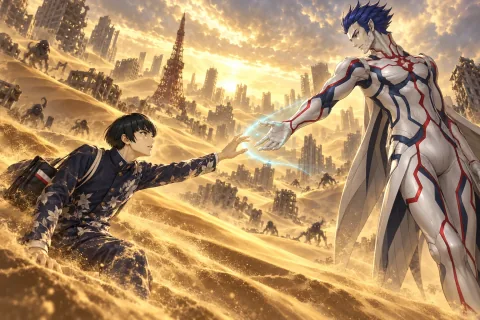
In the midst of a desperate crisis, a being named Aogami appears before the protagonist. He extends his hand to the protagonist, proposing the fusion of the two beings. The act of taking this hand signifies more than just cooperation for survival; it marks the birth of a new being called the Nahobino, where the boundary between human and god dissolves. Aogami exists as a voice that protects and guides the protagonist, but the power of decision remains entirely with the protagonist. This relationship setting gives the reader food for thought regarding the balance of power and the weight of responsibility.
The fusion of Aogami and the protagonist forms a mutually complementary relationship. Aogami provides the knowledge and power to survive in the harsh environment of Da'at, while the protagonist provides the will and human judgment to wield that power. This is closer to a partnership that fills each other's deficiencies, rather than unilateral domination or subordination. Observing their relationship, the reader can discover the sublimity of the process of overcoming massive trials by uniting with others. The sight of two beings becoming one and moving forward forms the core aesthetic of the game.
In the early part of the story, the choice of whether or not to extend a hand to the girl the protagonist encounters becomes a major turning point that determines the main thread of the narrative. This choice is the fork in the road that divides into two canons: the Canon of Creation and the Canon of Vengeance; it is not a simple branch, but a momentous decision that changes the fate of the world. Through the conflict and agony the protagonist experiences at this moment of choice, the reader realizes the weight of human decision. Whatever choice is made, the result is entirely the protagonist's, and this is the greatest responsibility and right the game grants to the player.
These two canons are like parallel lines that can never be merged into a single story. The path of Creation contains the will to reorganize the order of the gods, while the path of Vengeance contains the anger and resistance of the oppressed. The Canon of Vengeance is not a sequel to the "human-only world" ending of the Canon of Creation, but a completely independent and separate narrative. By choosing one of these two paths, the reader projects their own values and worldview. The game does not present a correct answer as to which side is right or wrong. It merely silently shows the changes in the world that appear as a result of the choice.
The Nahobino at the beginning of the story is powerful, but it is not yet decided what that power will be used for in the future. Whether to respond to negotiations even if Aogami warns of danger, whether to accept the requests of others, and what to give up in the face of conflicting demands remain the protagonist's choices. Therefore, the union of the two beings should not be read merely as a scene of passing responsibility to a god. It is closer to a starting point that asks back what kind of help one will give to others now that they have received help.
The hand extended by the protagonist is not just a handshake, but a promise of solidarity toward a new world. The protagonist, who has become the Nahobino through the fusion with Aogami, must now prove the possibilities of humanity in Da'at, which is ruled by gods and demons. The reader grows alongside the protagonist and breathes with them through every moment of choice they face. The protagonist's journey, having closed the book and stepped into the desert, has just begun. We will watch together to see what awaits at the end and find its meaning.
Data and Scope of Interpretation
As of October 16, 2026 (Bangkok), official work and character introductions have been cross-referenced with the ending, character, and quest data below. Official introductions were only checked for the scope of disclosure, and fan wikis and walkthroughs are distinguished as separate materials. This is a text for an overview of major events and original critique, not a reenactment of all dialogue or gameplay scenes, nor an official novel. Choice quests and developments by version/path are not combined into facts common to all playthroughs.
SEGA/ATLUS Official Story & Character Introduction
ATLUS Official Work Introduction — Composition of the Two Stories
comments 0