
Recommended Game Story · Shin Megami Tensei V: Vengeance Part 8
Chapters in this story
Canon of Creation · Life Encountered Outside the Throne
Spoiler Notice: This series covers the Canon of Creation and the Canon of Vengeance of Shin Megami Tensei V: Vengeance, including all six major endings. The two paths and their respective endings are distinct alternatives. This is not a transcription of the original game's dialogue or a novelization, but an original commentary and critique that reads into the choices and emotions of the characters based on major events. Unstated inner thoughts are distinguished as interpretations, and illustrations are AI reconstructions based on public materials.
The Canon of Creation in Shin Megami Tensei V is a grand stage where order and chaos collide, but beneath it lies the stories of individual lives blooming within the desolate landscape of Da'at. Amidst the grand narrative toward the throne, the player witnesses the strange bonds formed between humans and gods within the ruins of a destroyed Tokyo. This is more than just a process of making choices that determine the fate of the world; it is a process of feeling the weight of the lives left on the path the Nahobino walks. The narrative of Khonsu and Miyazu, along with the various beings encountered in Da'at, serves as an important turning point that asks how divine power intervenes in human life and what kind of agency humans can exercise in that process.
Chapter 1 · The Different Possibilities of Khonsu and Miyazu
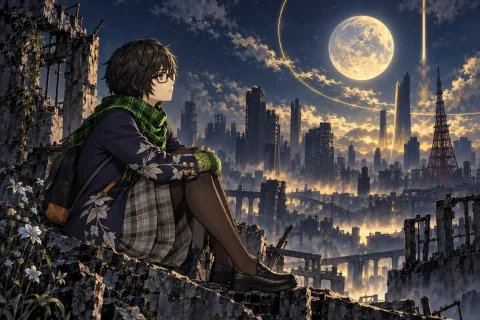
The narrative of Khonsu and Miyazu occupies an exceptional space within the grand conflict structure of the Canon of Creation. While Yuzuru seeks to protect his younger sister Miyazu, the relationship between Miyazu and Khonsu is not a passive state under her brother's protection. The relationship of 'Knowledge' between Khonsu and Miyazu revealed in side quests and Khonsu's choices show the strange bonds formed between gods and humans amidst the devastation of Da'at. This leaves room to be read as an attempt to understand each other's deficiencies, going beyond a relationship where gods view humans as tools or subjects of domination.
Miyazu's frailty is a tragedy to be overcome and a justification for protection for Yuzuru, but for Miyazu herself, it is a unique condition that defines her life. Her encounter with Khonsu can be interpreted not as a means to seek a divine miracle, but as an expression of her will to face her own destiny. If Yuzuru's logic of protection seeks to exclude Miyazu from the center of events, her relationship with Khonsu pulls her directly into them. This questions the price humans must pay and the agency they must exercise when borrowing the power of gods.
The choice to spare or oppose Khonsu is a mirror reflecting the worldview the player aims for. The conflict in the Egyptian-themed quests is not merely an act of subduing demons, but a point where the will to build a world solely for humans clashes with the will to maintain the order of the gods. The attitude Khonsu shows toward Miyazu could be the arrogance of a god or a strange attachment to humanity. Within this ambiguous relationship, the player must decide the ethical weight they choose to bear.
Exploring the ruins of Da'at, one witnesses both the isolation Miyazu experiences and the detachment Khonsu possesses as a god. Yuzuru's blind pursuit of order to protect his sister shows the limitations of humanity, but the relationship Miyazu forms with Khonsu can be read as an attempt to transcend those limitations. This narrative device reminds us that the game's world is not simply an object to be conquered, but a complex ecosystem where countless individual lives are intertwined.
The narrative of Khonsu and Miyazu is closely linked to the ending conditions for building a world solely for humanity. The will to exclude divine intervention and pioneer the future with human power alone secures its legitimacy depending on how one resolves the relationship with a divine being like Khonsu. If the player chooses to embrace or surpass Khonsu, it can be interpreted as a process of humanity stepping out of the shadow of the gods and being reborn as truly independent beings.
Chapter 2 · Fionn, Amanozako, and the Reason for Meeting Shiva
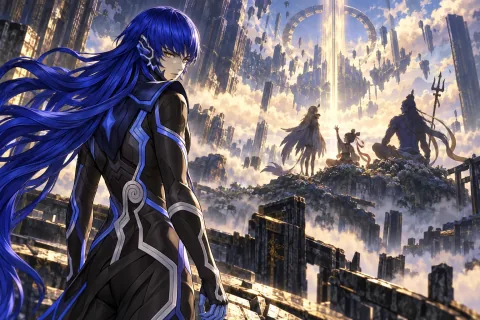
The appearances of Fionn mac Cumhaill and Amanozako are elements that bring vitality to the desolate journey through Da'at. They provide the player with a window into the hidden side of the world, beyond merely being a means to acquire powerful allies. Amanozako's story is another optional companion narrative, and it cannot be concluded that her quest is a prerequisite for a secret ending. Furthermore, Sophia's fusion and Gustave's transactions also add depth to the worldview, highlighting the weight of the destiny the Nahobino carries as part of life in Da'at.
The process of defeating Shiva is one of the greatest challenges a player can face in the Canon of Creation. Shiva is more than just a powerful enemy; he tests the limits of humanity as a being standing at the pinnacle of mythological order. The act of defeating him is a symbolic event that proves how humans can overcome divine power, going beyond the combat achievement of simply leveling up and using powerful skills. This is an important litmus test for human agency.
In the process of acquiring allies and defeating powerful enemies, the player constantly pays an ethical cost. The act of fusing demons and borrowing their power may seem to contradict the goal of building a world solely for humanity. However, this contradiction is the core question posed by Shin Megami Tensei V. The contemplation of whether borrowing the power of gods to drive out gods is truly independence, or just another form of domination, continues throughout the playthrough.
The journey as the Nahobino inevitably entails isolation. Although one interacts with countless demons and makes them allies, it is ultimately the Nahobino and Aogami who advance toward the throne. Beings like Fionn or Amanozako are fleeting connections in this lonely journey, and meeting them further highlights the weight of the destiny the Nahobino bears. Through conversations with them, the player catches a glimpse of the anguish and desires possessed by mythological beings.
The fact of having defeated Shiva and the judgment of having saved everyone must be clearly distinguished. Defeating Shiva is a victory of the player's skill and strategy, but it does not necessarily lead to an ending where everyone is saved. The ending of the Canon of Creation is the sum of the choices the player has made so far, and defeating Shiva is merely one achievement that can be obtained in that process. The player must reflect on how every choice they have made affects the fate of the world.
Data and Scope of Interpretation
As of October 16, 2026 (Bangkok), official work and character introductions have been cross-referenced with the ending, character, and quest data below. Official introductions were only checked for the scope of disclosure, and fan wikis and walkthroughs are distinguished as separate materials. This is a text for an overview of major events and original critique, not a reenactment of all dialogue or play scenes, nor an official novel. Choice quests and developments by version/path are not consolidated as facts common to all playthroughs.
PowerPyx — Six Endings and Additional Branching Conditions for the Canon of Creation
comments 0