
Recommended Game Story · Shin Megami Tensei V: Vengeance Part 7
Chapters in this story
Canon of Creation · The Three Keys and the Returned Goddess
Spoiler Notice: This series covers the Canon of Creation and Canon of Vengeance of Shin Megami Tensei V: Vengeance, including all six major endings. The two paths and their respective endings are distinct alternatives. This is not a transcript of game dialogue or a novelization, but an original commentary and critique that reads into character choices and emotions based on major events. Unstated inner thoughts are distinguished as interpretations, and illustrations are AI reconstructions based on public materials.
In the Canon of Creation of Shin Megami Tensei V, the Nahobino entering the Daito ward faces the inevitable gateway to claiming the Throne of God. To prove one's worthiness to inherit the throne in a world where the Creator has vanished, one must break the will of powerful gods who seek to either defend or usurp the existing order. This process is not merely a battle of strength, but a massive ideological battlefield where beings with different mythological backgrounds clash, each asserting their own definition of justice. The journey to collect the three keys poses a fundamental question beyond the protagonist simply growing stronger: who shall design the new order of a ruined world? Through the gods who appear in the ruins of Daito bearing their own convictions, and the presence of Tao, who is reborn as a goddess to illuminate the protagonist's path, we contemplate the meaning of creation.
Chapter 1 · Asking the Way from Opposing Gods
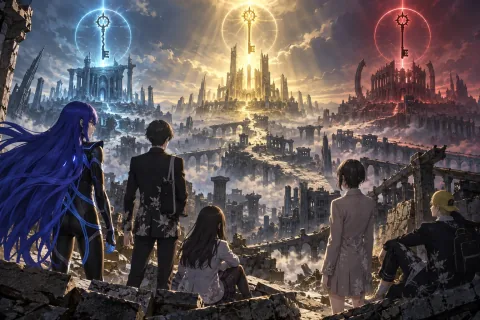
On the path to the throne in the Daito ward, three powerful gods exist: Vasuki, Zeus, and Odin. They stand in the protagonist's way, asserting their own convictions and powers to claim the throne in a world without a Creator. Battles with them are not just acts of proving strength, but essential gateways of creation that determine who will design the order of the new world. It is not about determining the superiority of each mythology, but a power struggle to confirm who possesses the qualities of a new creator within the ruins of Da'at.
Vasuki, Zeus, and Odin are competitors, each with their own forces and intentions for the throne. In the process of obtaining the three keys, the legitimacy asserted by existing power holders becomes a barrier blocking the protagonist's path. The threat felt by the player varies depending on the order in which they face them. Exploring Daito feels less like a predetermined hero's march and more like a test of choosing the next opponent once one has sufficient strength and judgment.
These gods assert their legitimacy in different ways. Zeus seeks to maintain order through overwhelming power, while Odin attempts to use creation as a means to prevent the coming apocalypse. Such attitudes from the gods may appear arrogant from a human perspective, but from the perspective of a god, they are inevitable choices to maintain the world. The player faces their logic and must judge which conviction is for the new world. This is the point where the game functions as a narrative medium that poses philosophical questions.
The order in which the three bosses are faced depends on the player's choice, and this is the process of deciding which mythological values the protagonist will first reject and absorb. The experience of breaking through Vasuki's cold, Zeus's lightning, and Odin's magic attacks gives the player a sense of achievement that they are approaching the pinnacle of the gods. What is felt in this process is not merely the pleasure of victory, but the responsibility of personally concluding the grand narrative of mythology. Each boss's battle pattern is the result of implementing their mythological identity into the system.
The path to the throne does not open simply because one possesses the power of the Nahobino. The trials connected to the three keys demand continuous proof of one's qualifications. This structure gives the impression that those who wish to become creators rely more on victory and defeat than on common rules that they would acknowledge each other by. It is a point where the sense of achievement the player feels from winning battles and the discomfort with the way only the winner designs the world are placed together.
If one cannot surpass the gods, the new world will not open, and the protagonist will remain a remnant of the past. Through these fierce battles, the player feels that the age of mythology is ending and a new era led by the Nahobino is arriving. The moment they overcome the massive walls of Vasuki, Zeus, and Odin, the player confirms that they have become more than just a protagonist; they have become the creator of a new mythology. This process is a rite of passage that must be gone through on the way to the goal of creation.
Chapter 2 · Creation Guided by Tao and Dazai
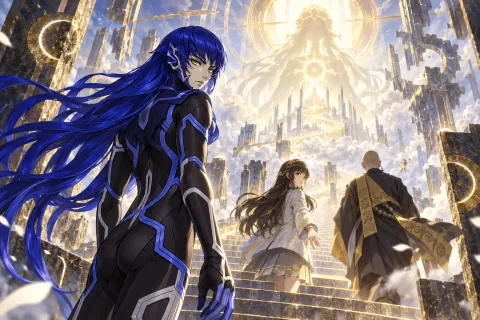
Tao, who died as a human, reappears as a goddess guiding creation. The scope of who can join depends on the path the protagonist chooses. Amidst the joy of meeting the same face and voice, the role toward creation now intervenes in the relationship between the two. What distance has formed between Tao as a friend and Tao as a goddess is a matter to be read through her roles and actions; one cannot conclude that all loss was reversed just by her return.
Dazai, as a monk silently watching the process of creation, assists the protagonist on a different level than Tao. The fact that his identity is revealed in the latter half and connected to Amitabha shows that this game encompasses not just mythological confrontation, but also the narrative of Buddhist reincarnation and salvation. Dazai's guidance differs in tone from Tao's divine leading, providing a more contemplative and philosophical perspective. Through the two guides, Tao and Dazai, the player views the grand event of creation from multiple angles.
The reason one feels strangeness seeing Tao returned as a goddess is that this reunion is not a return to daily life in the same way as before. She now guides the protagonist to the throne. The help one hoped for from a friend who was human and the help received from a guide of creation overlap but are different. Rather than simplifying that difference by saying a noble being has discarded human emotions, one can focus on how the role Tao has taken changes the relationship.
Dazai's presence makes the atmosphere of the Canon of Creation even more mysterious. He does not directly block or help the protagonist's path, but always appears at the right time to offer meaningful words. His words make the player rethink the meaning of creation and provide hints about the path the protagonist must choose. The moment Dazai's identity is revealed, the player realizes that the actions he showed until then were not mere coincidences, which shows how meticulously the game's narrative is designed.
The guidance of Tao and Dazai is an essential element for the protagonist to grow as a Nahobino. Tao soothes the protagonist's inner self through divine power, and Dazai broadens the protagonist's perspective through philosophical insight. With the help of these two beings, the protagonist collects the keys of creation and takes one step at a time toward the throne. Through their presence, the player feels that they are not alone and finds comfort even in the lonely journey of creation. Their guidance is a compass that helps the protagonist choose the right path.
Tao and Dazai are the two pillars supporting the narrative of the Canon of Creation. If Tao is an emotional link, Dazai is a symbol of rational insight. Because these two beings exist, the protagonist's journey can be not just a process of destruction, but a process of creation that gives birth to a new world. Guided by them, the player runs toward the ending of the Canon of Creation, and at the end, decides what kind of world they will create. The presence of Tao and Dazai is a key element that makes the Canon of Creation a narrative with depth beyond a simple game.
Scope of Materials and Interpretation
As of October 16, 2026 (Bangkok), official works and character introductions were cross-referenced with the ending, character, and quest materials below. Official introductions were checked only for the scope of disclosure, and fan wikis and walkthroughs are distinguished as separate materials. This is a text for an overview of major events and original critique, not a reenactment of all dialogue or play scenes, nor an official novel. Optional quests and developments by version/path are not combined as facts common to all playthroughs.
Megami Tensei Wiki — Comparison of the world and events of Shin Megami Tensei V
Megami Tensei Wiki — Comparison of events by Tao's two paths
comments 0