
NieR Chronicles 1 — The Plan to Preserve Humanity
Chapters in this story
- The Beginning of NieR: The Plan to Preserve Humanity
- 1. What Happened Before Automata's War
- 2. The Boy Protecting His Sister in the Ruins
- 3. A Long Time Later, Yonah Is Still Ill
- 4. The Village Where Devola and Popola Live
- 5. Gestalt and Replicant Do Not Mean the Same Thing
- 6. How the Siblings' Wishes Lead to the Lost Shrine
- Sources and Version Notes
The Beginning of NieR: The Plan to Preserve Humanity
Spoiler notice: This series discusses the major events, character identities and endings of NieR Replicant and NieR:Automata. Parts 1–6 follow the brother and sister of Replicant through the world that precedes Automata. Later parts follow Automata's events in their narrative order and from their different perspectives, explaining separately the outcomes that depend on a choice. This is a detailed account of the events and relationships in original wording, rather than a reproduction of game dialogue or an official novel.
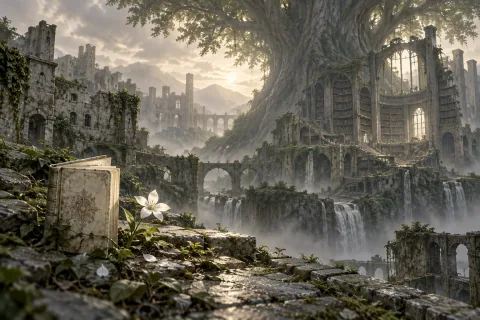
1. What Happened Before Automata's War

No living humans appear on NieR:Automata's opening battlefield. Androids said to have been created by humans fight machines said to have been created by aliens, and the soldiers are taught that they wage their war for humanity. To understand why humans are absent, however, we must travel much further back than this war. In that earlier world, Replicant shows how the wish to protect one family comes into conflict with a plan to preserve the human species.
The starting point is Drakengard's E branch. A red dragon and an enormous being, fighting in another world, appear in modern Tokyo. Their clash lies outside the wars and disasters the city's inhabitants have known. Even after these strangers appear and die, their influence remains. Contact with their remains and particles brings a catastrophe that transforms human bodies, and an extraordinary incident in one city grows into a threat to the survival of all humanity.
Humanity faces the catastrophe called White Chlorination Syndrome. Infected bodies either turn to salt and die or become Legion, beings that attack humanity. People must fight these transformed creatures as well as contain the disease. Protecting their cities and land, treating the sick and preserving another living generation all become precarious at once. This disaster, which predates the Black Scrawl afflicting Yonah in the later village, forces humanity to seek a new plan for survival.
The solution people devise is to separate souls from their present bodies. They intend to preserve human consciousness outside the body, remove the catastrophe and then reunite those souls with safe new bodies. Gestalt technology preserves the souls; Replicants provide the bodies that will eventually receive them; androids administer the system. Together they form Project Gestalt, entrusting humanity's future to something beyond its present flesh. This is not a finished solution chosen in peaceful circumstances, but a plan made by people who can find few other exits from a collapsing world.
2. The Boy Protecting His Sister in the Ruins
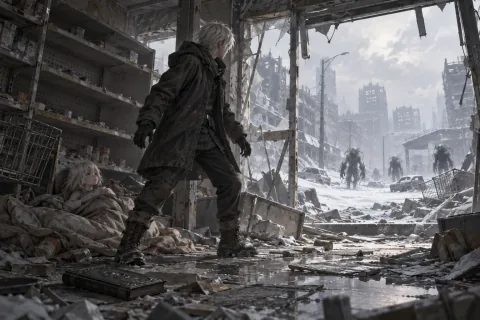
Replicant's prologue begins among ruins in the summer of 2053. Amid a white landscape at odds with the season, a boy and his younger sister Yonah hide in a ruined shop. Yonah is ill and coughing, and the boy tries to protect her from the cold and danger. Outside are dark beings that attack people. Before any explanation about bearing humanity's fate, the story begins with one person's efforts not to lose the small family lying before him.
The boy fights the dark beings approaching them. This is not the opening of a hero who already possesses the power to save the world and sets out with a secure plan. He acts because he cannot abandon Yonah and flee, nor can he simply wait for their enemies to retreat. Fighting off their attackers buys the siblings a little time. Defeating the enemies in front of them, however, does not also solve the problem of his sister's illness.
A black book is present. The boy is wary of it, but as the fighting continues he eventually accepts its power. The ability he gains manifests as magic that extends beyond the fighting he could do with his previous weapon. He now has another means to drive threats away from his sister. But gaining a power and concluding that it will save the siblings completely are different things. The prologue does not turn the acquisition of a new ability directly into safety for the family.
The boy does not want Yonah to touch the book. But while he holds off the enemies, she reaches for it, wanting to help her brother. Black markings cover her body and her condition worsens. He returns and calls to her, but gaining the power to sweep away his enemies has not provided the answer to saving his sister. The means he accepted for her sake and the choice she made to help him meet in tragedy inside the same small refuge.
What follows places the boy at the center of the plan. While souls subjected to the same technology lose their sense of self, he becomes a special Gestalt capable of retaining his identity. The promise that Yonah will be saved, and his role in stabilizing other souls, bind his life to the project. The boy who wanted to live with his sister is given an extraordinarily long wait. Rather than showing every day of that wait, the scene shifts to another brother and sister 1,412 years later.
3. A Long Time Later, Yonah Is Still Ill
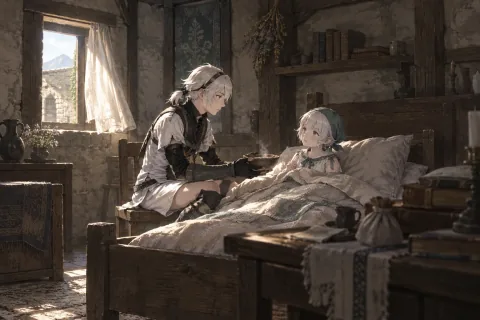
When the scene changes, the reader encounters a very different setting for everyday life. After the shattered modern architecture of the prologue, there are people farming, trading goods and running errands beyond their village. They make use of surviving facilities without fully understanding the world's past or its technology. An old library, ruins and industrial facilities coexist in one world. A great gap separates the residents' present lives from the past that produced those places.
In a village in 3465 live another boy with a familiar face and another Yonah. This protagonist, named by the player, is also an older brother protecting his younger sister. The two live without their parents; while he goes out to work, she waits at home. When he opens the door and returns, she first welcomes him back safely. A brother and sister with the same wish as the pair in the modern shop live out their days in a world that has taken an entirely different form.
Yonah has the Black Scrawl. Her presence, waiting for him at home, is one reason the protagonist takes on the village's work and travels into dangerous places. Their livelihood is not separate from the journey to find a cure. Helping others to earn a living, obtaining necessities and completing the villagers' requests form his starting point. He will eventually make choices that change the world's fate, but he is not initially someone in a position to make decisions on that scale.
Yonah is not merely a nameless objective waiting for her brother's protection. She worries about him, wants to help him and recognizes that his efforts on her behalf are difficult. The siblings' care for one another does not always lead in the same direction. As her brother tries to keep her away from danger, she also tries to do something for him. Because of this relationship, Yonah's own actions can set new events in motion while the protagonist is away earning money and obtaining medicine.
The protagonist finds medicine and food for his sister. He must complete the work entrusted to him and earn payment to keep their household going. A small report that Yonah feels better can make him happy, but each return home does not find her illness completely gone. There is always a reason to go out again. A cure is not an academic problem he can address after someday understanding the world; it is a daily concern he cannot put aside even after finishing his next job.
4. The Village Where Devola and Popola Live
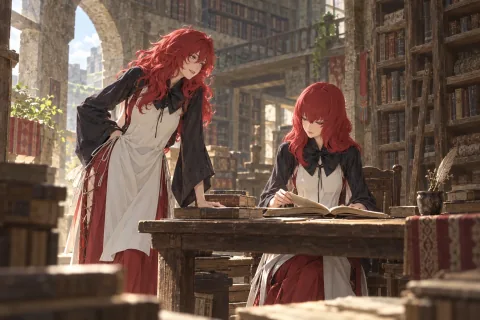
Devola and Popola help sustain the protagonist's everyday life. We meet Devola as someone who plays music in the village, and Popola as someone in the library who connects the villagers' work and assists the protagonist. To him, early in the game, they are not suspicious administrators explaining the world's secrets. They are familiar people in his life whom he can turn to for help. Knowing the later revelations in advance cannot erase the relationship that exists earlier.
Receiving work from Popola, leaving the village and returning form a basic route through which the protagonist connects with the outside world. The plains link the safety of the village with other regions, and animals and Shades inhabit those paths. He must face Shades to return to his sister, yet must leave the village again to support their livelihood. Their circumstances do not allow them to live while avoiding danger entirely. Within this repeated pattern, the longer journey to find a cure also begins.
The villagers call the dark beings Shades. They threaten travel and livelihoods beyond the village. The protagonist cannot converse with them to learn where they come from or what they want; he faces them as enemies attacking him and his community. Clearing a path with his blade lets him finish his work and return home. As he grows accustomed to fighting, killing Shades becomes an ordinary part of what he does for his family.
The sisters' longstanding work extends further. Devola and Popola are androids who administer the plan to preserve humanity and oversee the Replicants. While helping the protagonist and watching Yonah's condition, they also monitor the system they are charged with maintaining. Familiar neighbors and responsible observers occupy the same two people. To the boy receiving their help, those positions still appear as a single familiar face.
5. Gestalt and Replicant Do Not Mean the Same Thing
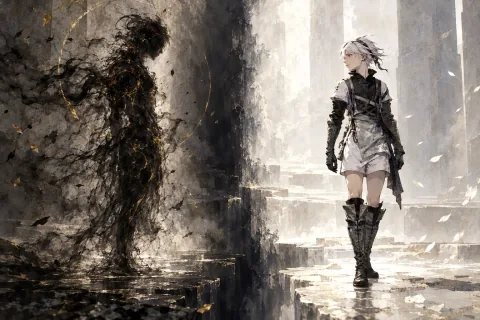
To follow the later revelations, we need to distinguish the kinds of beings involved. A Gestalt is the soul separated from a human. A Replicant is a being prepared on the bodily side, intended to receive that soul again later. Androids are different from both. If we group Devola and Popola, who work to administer and maintain the project, together with the Replicant villagers as the same kind of being, we miss why the twins act under different responsibilities.
According to the plan, after the danger had passed, Gestalts were to reunite with their corresponding bodies and humanity was to return. While the project is being maintained, however, Replicants develop self-awareness. The lives of the siblings and villagers cannot be explained as empty bodies repeating prescribed functions. They love others, build memories, suffer wounds and want their own lives to continue. The intended function of a body for an original human and the needs of a being presently living its own life diverge.
The original humans who have waited all this time have reasons to reunite with their families and live in their own bodies again. The Replicants, too, have built lives with their families since awakening. The home one side must return to is already the home the other has lived in. The administrators try to complete reunification, but the bodies subject to that procedure face the danger of losing their own place. The conflict the two Yonahs will eventually encounter within one body begins here.
Relapse, in which a separated soul loses its identity and deteriorates, also affects its corresponding Replicant. The Black Scrawl appearing on that body connects to the crisis in a project hidden beyond village life. But the brother beside Yonah's bed knows nothing of that correspondence. He acts because his sister is ill before him and he must find a way to treat her. The nearer his search for her cure comes to the disease's source, the more it touches the foundations of the world in which he lives.
6. How the Siblings' Wishes Lead to the Lost Shrine

The story of the Lunar Tear that reaches Yonah connects to the siblings' wishes. She wants to do something for her brother, and that desire does not lead only to the safe choice of remaining at home. While the protagonist goes outside for his sister, Yonah also acts on her wish to help someone. To her brother, she is his sick younger sister who needs protection; the fact that she has a will of her own to act for him is what moves this incident forward.
When Yonah heads for the Lost Shrine, the protagonist must enter a place more dangerous than the area of his ordinary errands and livelihood. Finding his sister inside the shrine is more urgent than an expedition to discover the world's secrets. He is not in a position to investigate thoroughly, prepare and decide to return at his leisure. Knowing that she is inside drives him forward. His coming relationship with Grimoire Weiss begins from this specific situation as well.
At this point, the protagonist does not know many things: the connection between the prologue's siblings and himself, the identity of the Shades, Devola and Popola's responsibilities, or the system behind the Black Scrawl. What he wants, however, is clear. He wants to find Yonah, bring her home, cure her illness and continue their life together. Later events demonstrate the strength of this wish while repeatedly asking whether that wish alone can determine how to judge every other being's circumstances.
The boy in the prologue and the village protagonist act from different positions to protect a younger sister. The story places these similar wishes in times far removed from one another, then reveals what their choices mean when the two beings eventually meet. The siblings' life before Grimoire Weiss appears at the Lost Shrine is not decoration for that revelation. It is the starting point that lets the reader first understand the relationship the protagonist will not relinquish.
Sources and Version Notes
This account follows the brother protagonist of the game NieR Replicant ver.1.22474487139.... It does not mix his family relationship with the father version of the 2010 game. Later parts identify separately the events and ending added to the 2021 version. Explanations of established information are distinguished from interpretations of the characters' actions. A TroubleMaker editorial story account prepared with AI-assisted editing. Checked on October 18, 2026, Bangkok time.
comments 0