
Recommended Game Story · Shin Megami Tensei V: Vengeance Part 6
Chapters in this story
Canon of Creation · In the Name of War
Spoiler Notice: This series covers the Canon of Creation and Canon of Vengeance of Shin Megami Tensei V: Vengeance, including the six major endings. Both paths and their respective endings are distinct alternatives. This is not a transcription of the original game's dialogue or a novel, but an original commentary and critique that reads the characters' choices and emotions based on major events. Unstated inner thoughts are distinguished as interpretations, and illustrations are AI reconstructions based on public materials.
In the Canon of Creation of Shin Megami Tensei V, Chiyoda is a vortex of war itself. Amidst these ruins where Bethel and the Demon King's army clash, the protagonist and Aogami face questions that go beyond mere survival to the very foundations of the world. The flames of Chiyoda are not just a geographical backdrop, but a symbol of the collapse of the gods' order and the ignition of the potential for a new creation. In this installment, we will delve into the changes in identity that occur when Aogami's true nature is revealed, and the inner workings of a fracturing Bethel that has lost its common enemy. At this point where divine authority and human will collide, what kind of future should we choose?
Chapter 1 · The Flames of Chiyoda and Aogami's Identity
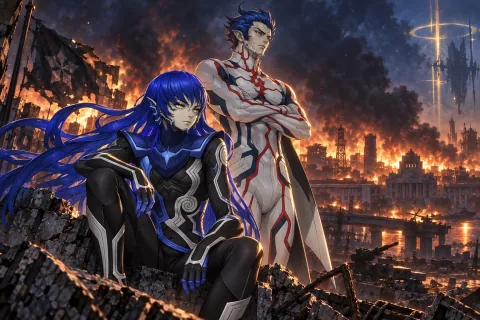
The Chiyoda region is the stage for the all-out war between Bethel and the Demon King's army in the Canon of Creation. This place is more than just a combat zone; it is a symbolic space that shows how the war of the gods destroys and reconstructs human civilization. Amidst the ruins of a burning Tokyo, the player must prove their power as a Nahobino by facing Surt, Ishtar, and eventually Arioch at the Demon King's Castle. The tension felt during this process goes beyond the simple desire to level up; it comes as a sense of responsibility to become the sole hope in a dying world. The tension flowing through the forest of ruined buildings makes one painfully aware that this world is no longer just for humans.
Aogami is an artificial god-slayer created by Bethel to protect Japan. It is revealed that he is not merely a helper, but an entity deeply connected to Susano-o, the hero of Japanese mythology. This fact comes as a great shock to the player, as the companion who has fought alongside the protagonist until now is revealed to be a weapon forged with advanced technology. However, the revelation of his identity does not make the bond built between him and the protagonist fake. Rather, he transcends his destiny as a tool and is reborn as a person who dreams of a new world with the protagonist. This sends a message that one's current relationships are more important than one's origins.
Aogami's identity as a god-slayer provides the answer to why he chose the protagonist. He is the crystallization of the will to protect Japan, and that will met the vessel of the protagonist to be completed as a new entity called the Nahobino. This penetrates the core theme of Shin Megami Tensei V, where the boundary between god and human becomes blurred. Looking at Aogami, the player is forced to ask themselves whether the value of existence lies in its origin, or in the role one is currently performing and the relationships one has formed. While accepting his origins, he demonstrates a free will that is not bound by them.
The flames covering Chiyoda imply that the order of the old era is burning away. While Aogami faces his past and his identity, the surrounding landscape reveals the misery of war. In these flames, Aogami chooses the path to walk with the protagonist, transcending the mission given by his creator. This is not just a process of recovering past memories, but a process of active change, attempting to pioneer the future with his own will. The player feels Aogami's anguish amidst these flames and builds deeper trust with him. The flames act as both a symbol of destruction and a symbol of purification.
The moment Aogami's identity is revealed is the point where the game's narrative expands from personal survival to a grand discourse on determining the fate of the world. He is no longer a tool executing Bethel's orders, but begins to make independent judgments as the protagonist's partner. This change gives the player a great sense of liberation. Systemically, it allows for the use of powerful skills, but narratively, it signifies that the relationship with the companion has evolved from a vertical to a horizontal one. Now, they rely on each other as equal subjects moving toward the end of the world together.
Ultimately, the battle in Chiyoda is the process of completing the entity known as Aogami. He establishes himself as a complex character who possesses both the heroic aspects of Japanese mythology and the cold rationality of an artificial god-slayer. The emotion the player feels while breaking through Chiyoda with him is not just the joy of victory. It is a process of defining one's own identity and solidifying the resolve to change the world based on that definition. The union of Aogami and the protagonist is now more than just a fusion; it becomes the first step toward a new creation. Their journey can be seen as having just entered its full-scale trajectory.
Chapter 2 · Bethel Fractures After Victory
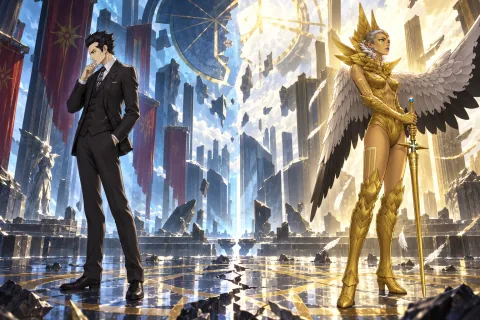
Once the common enemy, the Demon King's army, disappears, the massive coalition known as Bethel rapidly begins to crack. Each branch begins to clash, putting forward different beliefs regarding the future of Tokyo and the world. This process nakedly shows how political interests destroy sacred order. Watching the sharp conversations in Bethel's conference room, the player feels a deep skepticism about what true justice is. The coalition shouts for peace on the surface, but hides their own desires underneath. It is bitter to realize that even the world of gods is no different from human politics.
Koshimizu reveals that he is Tsukuyomi, and expresses his firm will to save Tokyo and the gods of Japan through creation. His appearance is an act of directly challenging the existing order of Bethel. He intends to protect the specific nation of Japan and its gods through creation, which conflicts with the absolute authority of the Creator represented by Abdiel. Koshimizu's choice has a concrete goal of prioritizing Japan's survival, and this cannot be broadly interpreted as universal liberation for all humans. He is prepared to boldly abandon the existing coalition for his own purpose.
Abdiel believes in the Creator's authority as the absolute truth and is dedicated to defending that order. To her, the reality of the Nahobino is nothing more than blasphemy and a disturbing element that disrupts order. Her stubbornness does not stem from mere blindness, but from a heavy sense of responsibility to protect the only law that has sustained the world. She tries to protect God's will by sacrificing everything she has, and the very existence of the Nahobino carries a contradiction that directly clashes with that faith. The player witnesses the intense tension created as her firm beliefs collide with the reality of the Nahobino.
The division of Bethel is not just a factional fight. It is a collision of grand values: order and chaos, preservation and creation. If the path proposed by Koshimizu is to seek a new order where humans and gods can coexist, the path adhered to by Abdiel is a conservative regression to regain the glory of the past. Between these two paths, the player struggles with what choice to make as a Nahobino. The game does not say that one side is absolutely right, but waits for the player's judgment. The weight of this choice will become even heavier as the game progresses toward the latter half.
Watching the division of Bethel demands an ethical cost from the player. This is because the future of Tokyo changes completely depending on whose hand you take. Koshimizu's method seems rational, but he cannot completely exclude the arrogance of being a god. On the other hand, Abdiel's method seems noble, but it demands countless sacrifices in return. This conflict is like a test that asks the player what values they pursue and what they can give up for those values. In this process, the player's own beliefs are tested.
This crack that came after victory shows the narrative depth of Shin Megami Tensei V. What is harder than defeating an enemy is deciding how to design the world after victory. The division of Bethel is merely the prelude to the creation that has just begun. In this chaos, the player must solidify their beliefs and establish their identity as a Nahobino. Where the flames of Chiyoda have died out, an even greater crossroads of fate now awaits us. We must find the answer to what kind of world we will create for ourselves.
Scope of Materials and Interpretation
As of October 16, 2026 (Bangkok), official work and character introductions were cross-referenced with the ending, character, and quest materials below. Official introductions were checked only for public scope, and fan wikis and walkthroughs are distinguished as separate materials. This is a text for an overview of major events and original critique, not a reenactment of all dialogue or gameplay scenes, nor an official novel. Optional quests and developments by version/path are not combined into facts common to all playthroughs.
Megami Tensei Wiki — World and Event Comparison of Shin Megami Tensei V
comments 0