
Recommended Game Story · Shin Megami Tensei V: Vengeance Part 2
Chapters in this story
Common · The City That Speaks with Demons
Spoiler Notice: This series covers the Canon of Creation and Canon of Vengeance of Shin Megami Tensei V: Vengeance, including all six major endings. Both paths and their respective endings are distinct alternatives. This is not a transcript of the original game's dialogue or a novelization, but an original commentary and critique that interprets the characters' choices and emotions based on major events. Unstated inner thoughts are distinguished as interpretations, and illustrations are AI reconstructions based on public materials.
The world of Shin Megami Tensei V is not simply a game about exploring a ruined city. Da'at, which the protagonist faces, is a vast ecosystem where demons live by their own logic of survival in the place where God's order has collapsed. We examine how the protagonist forms relationships with demons on the sands of the destroyed Tokyo, and what political dilemmas they face in the real Tokyo they return to. The player is not merely a hero defeating enemies, but an outsider who must constantly negotiate and make contracts with others to survive in this strange world. Conversation with demons is the core narrative device of this game and a gateway that shakes the standards of what one believed to be moral good and evil. We analyze the weight of the relationships the protagonist builds while traversing between the desolate desert and the precarious Tokyo.
Chapter 1 · The First Relationship Formed on the Sand
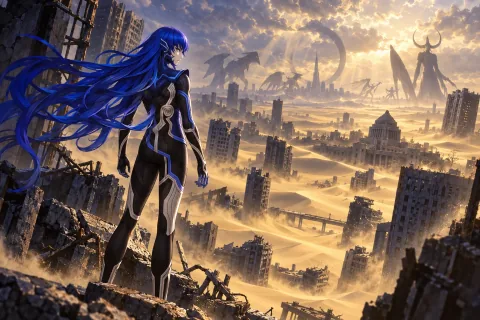
Amidst the desolate sandstorms of Da'at, the protagonist fuses with Aogami to become the Nahobino. This is a space where demons live by their own logic of survival after the collapse of God's order. The player does not simply annihilate enemies, but goes through the process of talking to and negotiating with demons to make them allies. This method of survival becomes the first step for the protagonist, as an outsider, to learn the rules of the world and establish their position in a land ruled by the logic of power.
Negotiation with demons is not just an extension of battle. Amanozako acts as a guide to the terrain of Da'at, Gustave collects remains to provide resources, and Sophia presides over the world of the Compendium to facilitate demon fusion. These are essential helpers for the protagonist to grow their power as the Nahobino and explore the world. The act of making demons allies is a practical choice to increase survival probability by borrowing their power, as well as a means to build relationships with hostile entities.
Nuwa and Yakumo, encountered at the Diet Building, present a unique path of survival for humans alone. They are not bound by God's order or the chaos of demons, aiming solely for the preservation of humanity. Their appearance causes conflict for the protagonist between their identity as the Nahobino and their will to protect humans. Their determination to exclude demons and build a world only for humans clashes directly with the bonds the protagonist has formed with demons, triggering a collision of worldviews.
Categorizing demons by the yardstick of moral good and evil does not fit the reality of Da'at. The desires and values of demons revealed during the negotiation process are not significantly different from those of humans, and are sometimes expressed more honestly. Through conversation during battle, the player grasps their personalities and concerns, sometimes handing over items to form contracts. These interactions make the player perceive demons not as mere objects for gaining experience points, but as subjects that constitute the world.
Growth as the Nahobino is not simply a process of leveling up. The power gained through fusion with Aogami becomes the foundation for absorbing and reconstructing the abilities of demons. Players create more powerful beings by fusing demons in the World of Shadows, a process where sacrifice and creation coexist. Deciding which demons to make allies and which powers to take amidst the imbalance of power is the price and responsibility the protagonist must pay to survive in Da'at.
Chapter 2 · The Disaster That Does Not End Even After Returning to Tokyo
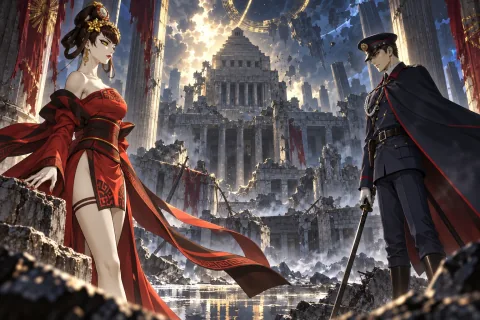
What awaits the protagonist upon returning from Da'at to the real Tokyo is not a peaceful daily life. The Bethel Japan branch keeps students under control under the pretext of protection, but this is an act of dragging them into a massive political vortex rather than guaranteeing safety. The organization led by Koshimizu puts forward the justification of protecting God's order and places the protagonist's group under systematic management. Tokyo may seem to maintain daily life on the surface, but underneath lies an uneasy reality that has become a battlefield for gods and demons.
Yuzuru and Tao are already deeply involved with Bethel, and Ichiro Dazai also joins as a collaborator. Their relationships gradually create cracks between the organization's goals and personal beliefs. While Bethel claims to be a shield protecting humans, there are individuals within it who view humans as tools or prioritize their own interests. The player witnesses the process of friends changing as they get caught up in the organization's logic, and is constantly tested on whom to trust and what values to protect.
Abdiel considers God's order an absolute value and views the protagonist, who has become a Nahobino, as a taboo and a threat. Her strictness stems from a sense of divine duty, but her methods are exclusionary and violent. Human lives and emotions are treated as spare parts for God's plan, which directly conflicts with the bonds the protagonist has formed with demons in Da'at. The confrontation with Abdiel goes beyond simple conflict, showing the point where the fundamental order of the world and human will collide.
One must distinguish between the fact that Bethel is necessary to protect people and the claim that all of the organization's judgments are correct. The Demon Summoning Program given to the students is a means of survival, but at the same time, it makes them participants in a war they do not fully understand. Considering how much risk a person who has received help must bear in return, and whether they lose the right to question the protecting agency, a small tension remains even in the relief of the return scene.
The space of Tokyo has now become a battlefield for gods and demons, not a place of daily life. Tokyo under Bethel's control harbors anxiety and fear, and the students are swept up in the wheels of fate without fully understanding what they have experienced. In this precarious situation, the player must protect their friends while simultaneously fulfilling the mission given to them as the Nahobino. The returned daily life is no longer the peaceful scene it once was, serving as a reminder that it is a sandcastle that can collapse at any moment.
Scope of Materials and Interpretation
As of October 16, 2026 (Bangkok), official work and character introductions have been cross-referenced with the ending, character, and quest materials below. Official introductions were checked only for the scope of disclosure, and fan wikis and walkthroughs are distinguished as separate materials. This is a text for an overview of major events and original critique, not a reenactment of all dialogue or play scenes, nor an official novel. Optional quests and developments by version/path are not consolidated as facts common to all playthroughs.
SEGA·ATLUS Official Story & Character Introduction
Megami Tensei Wiki — World and Event Cross-Reference for Shin Megami Tensei V
comments 0